
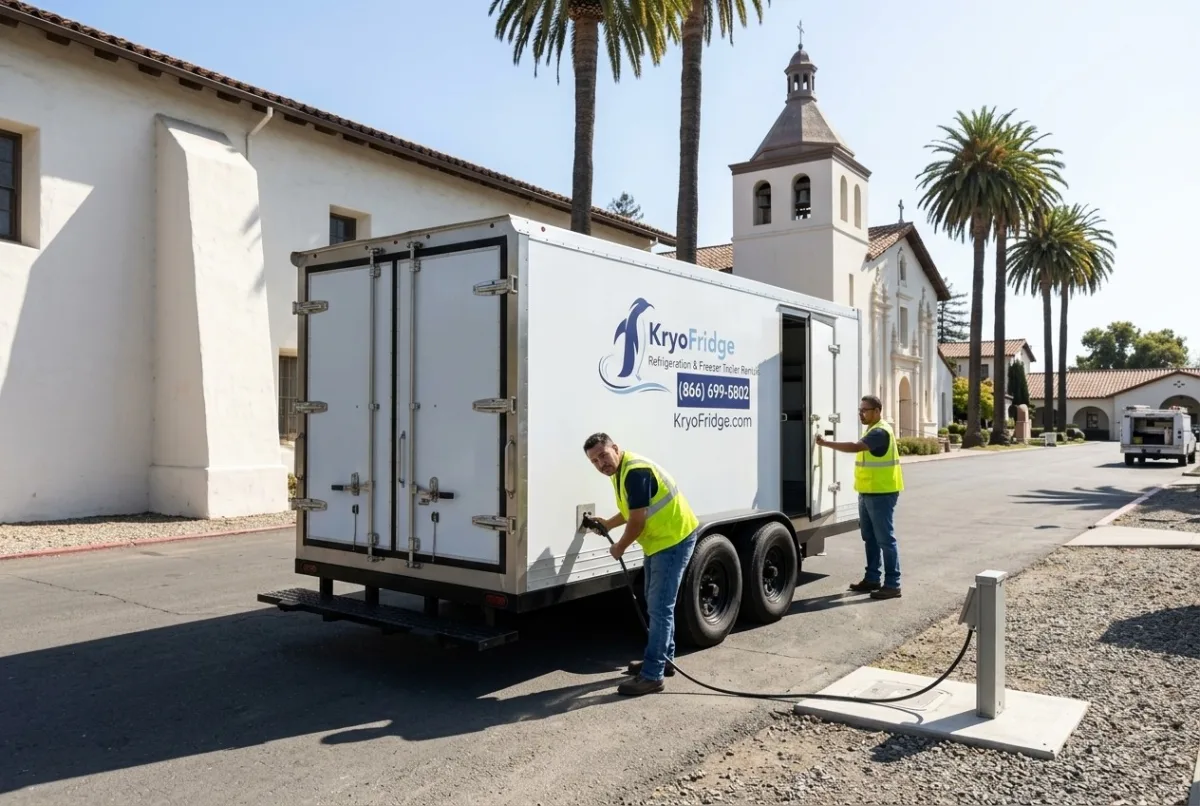
KryoFridge is the go to freezer trailer team in Santa Clara, and we have been holding product cold for Silicon Valley kitchens and event crews for more than 30 years. We deliver a walk in freezer trailer to a restaurant lot on El Camino Real, a commissary yard off Walsh Avenue, a Levi's Stadium load in or a Central Park festival footprint, then level it, power it and hand it over already pulled down to temperature the day it lands. Call us or start a reefer trailer rental quote and we will confirm your dates before your site plan goes to the county.
We are a family run rental company with more than three decades behind us, and freezer trailers are equipment we own, service and dispatch ourselves. There is no broker in the middle, because the trailer that rolls onto Scott Boulevard or Great America Parkway comes off our own yard. We run one of the largest freezer trailer fleets in the region, every unit is NSF ready, licensed and fully insured, and somebody picks up the phone at two in the morning. Santa Clara sits in the middle of our California portable refrigeration rentals coverage, so a call from the Old Quad or the Golden Triangle gets a truck from the same yard that serves San Jose, Sunnyvale, Cupertino and Milpitas. Give us a call and we will tell you what is on the yard today.
Our trailers sit staged around Santa Clara, fueled, pre-cooled, and maintained in-house, parked and waiting for the call rather than being sourced after it. That is why an emergency call usually puts a unit on your lot and pulling temperature in about 45 minutes.
The voice on the phone belongs to the same outfit that owns the trailer and sends the driver. No reseller in the middle quietly marking up somebody else's equipment while your inventory creeps past 40°F on the shelf.
Every unit is ours to own, service, and deliver, and each one swings between deep-freeze and fresh-cold on a precise digital set-point. So we can size the answer to your Santa Clara job and turn it around the same day rather than putting you on next week's list.
National chains do not gamble on refrigeration. A drifting set-point during dinner rush can cost a brand a day of sales and a health-code headache, so the chains that scale fast vet a cold-storage partner the same careful way they vet a protein supplier. KryoFridge has held temperature for names like McDonald's, Chick-fil-A, and Dutch Bros, and earned the repeat call.
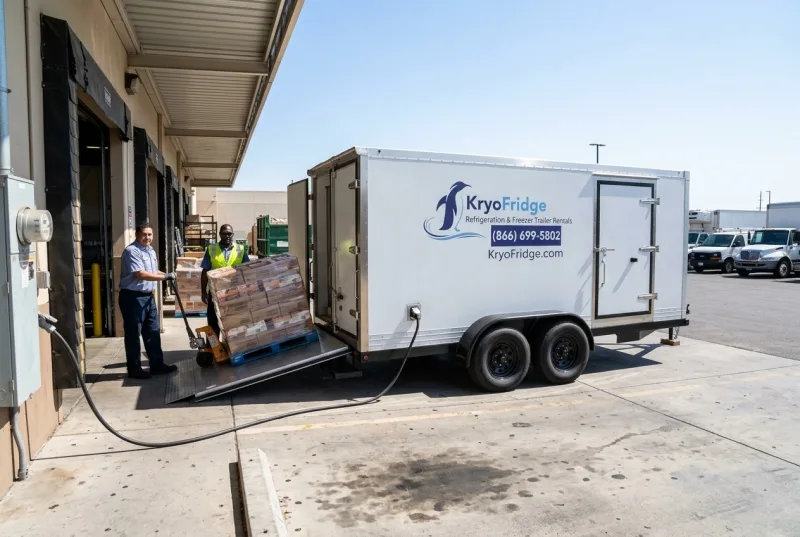
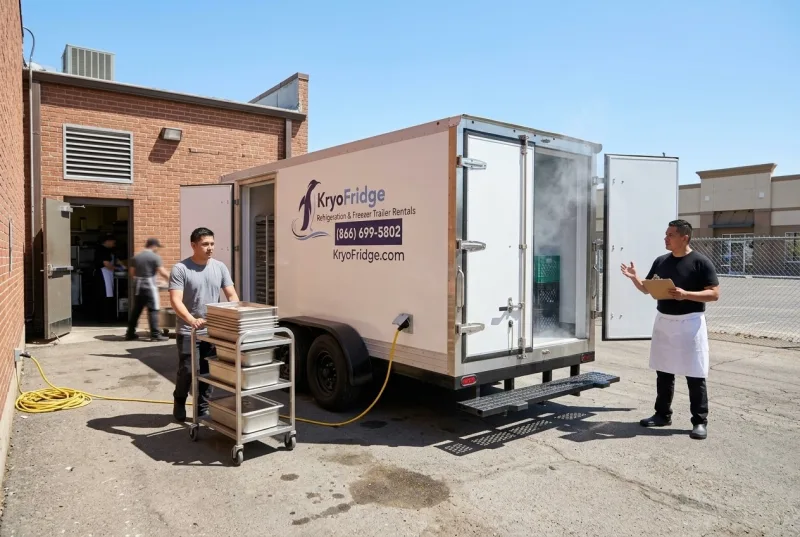
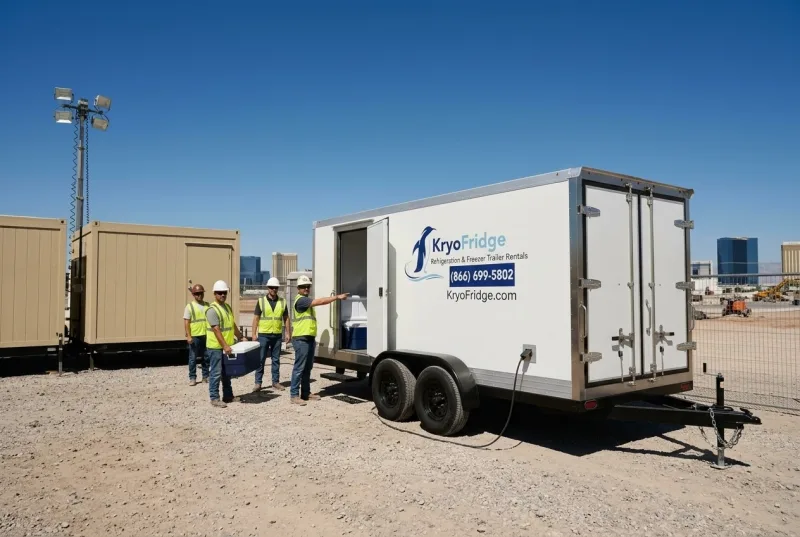
The stories behind that trust are the kind every restaurant owner recognizes. One Friday at 6:30 in the evening, a Chick-fil-A called in with a dead walk-in and a drive-through line already wrapped around the building. We prepped a trailer, dispatched it, and had it on their pad pulling temperature 34 minutes after the phone rang. The manager's first words when the driver pulled in were, "I cannot believe you are already here." That is the bar we hold ourselves to. Another year, an overnight outage shorted a cooler on the morning of a holiday rush, and our team staged three freezer trailers to hold every pie, every protein, and every prep tray so the kitchen served the rush without missing a ticket. The reason we hear some version of that line so often is the same every time: the equipment was already nearby, already cold, and owned by the people who answered the phone. That same standard travels to every Santa Clara job, from a one-cook taqueria to a distribution floor.
"Our experience with KryoFridge was amazing. Our walk in went down on a Friday, they were incredibly responsive, and nothing in our kitchen was lost. I would absolutely use them again."
 Andrew C. · Restaurant owner, El Camino Real
"These guys are great. We rent a trailer for every large campus event and the units are the cleanest cold storage I have ever loaded. It plugs into a standard circuit at the dock and holds temperature all week."
 Maria P. · Catering director, Golden Triangle
"The trailer was set exactly where we asked in the lot and the driver walked our crew through it before he left. Using a generator meant we never had to fight for venue power during load in. Would recommend to anyone."
 Kellie A. · Event producer, Levi's Stadium lots
Our signature walk in freezer trailer dials from about 50 degrees down to minus 10, so one unit covers a chilled produce hold for a campus lunch on Mission College Boulevard and a hard frozen protein hold for a kitchen on El Camino Real. We stock more than one footprint, and you can compare walk in freezer trailer sizes against your lot before you pick one.
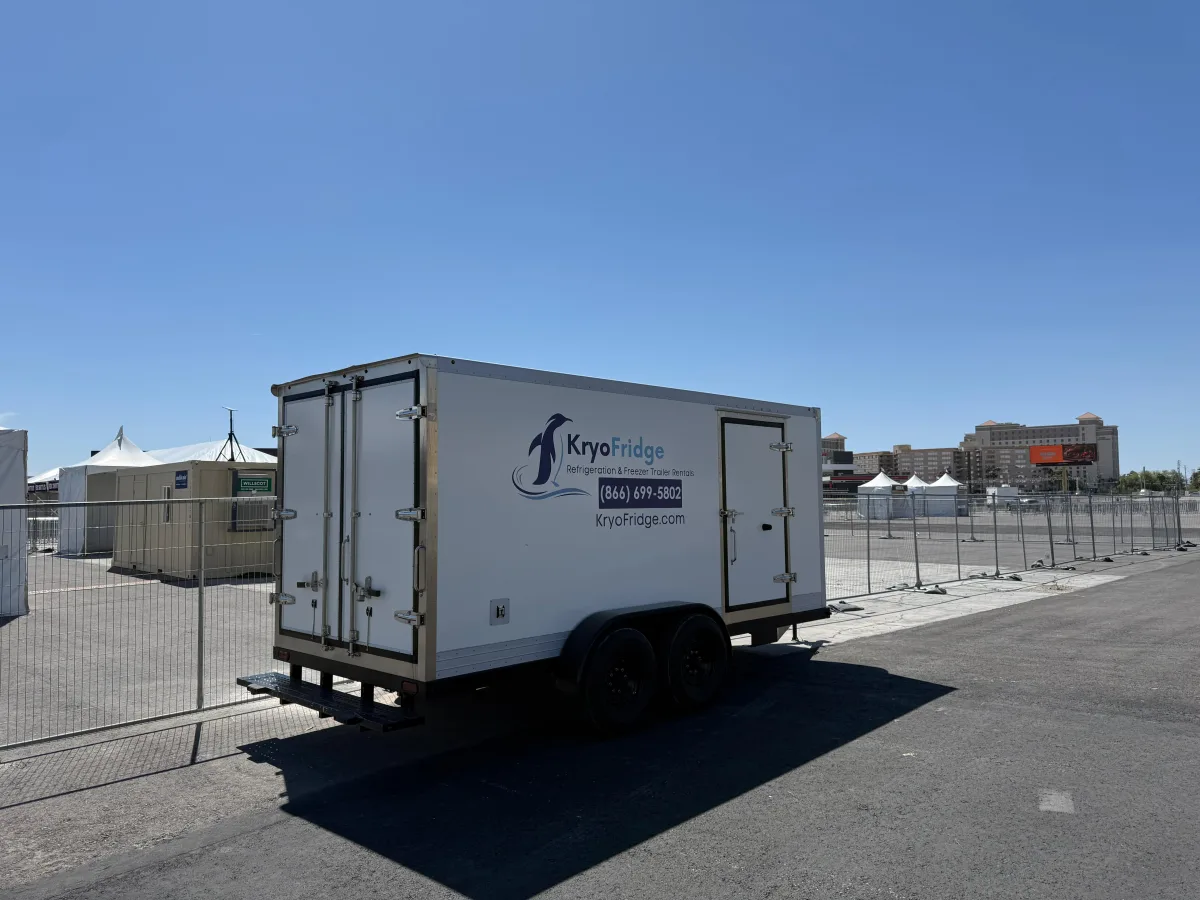
The 16' Utility is the trailer our crews reach for when the job is serious. A 16-foot insulated box on a tandem axle holds anything from -10°F deep-freeze to 50°F fresh-cold on one precise digital set-point, with NSF-approved surfaces throughout. Rear double doors take pallet loads straight off a dock, and the side utility door lets a cook grab one tray without opening the whole box to the heat.
We own every one of these units, so the trailer that shows up is fueled, pre-cooled, and maintained in-house. It runs on a dedicated 120V, 20-amp circuit or a generator we supply, and it holds its number through triple-digit afternoons. When a walk-in dies or a harvest runs long, this is the box that carries the load.
| Spec | What you get |
|---|---|
| Temperature range | Roughly -10°F deep-freeze up to about 50°F fresh-cold |
| Mode | Dual-purpose: freezer or refrigerator on one precise digital set-point |
| Power | A dedicated 120V, 20-amp circuit within about 100 feet, or a generator we supply |
| Food safety | NSF-approved for direct food contact, food-safe surfaces, proper drainage |
| Footprints | 6x8, 6x12, and 6x16, from a tight retail lot to distribution scale |
| Backing | Owned in-house, fully licensed and insured, with 24/7 emergency dispatch |
Each unit holds a precise digital set-point and runs on a dedicated 120V/20A circuit or a generator. The trailers are not wired for 208 to 240V building service, so we confirm your hookup before the truck rolls.
We deliver, set and service walk in freezer trailers throughout Santa Clara and the surrounding Silicon Valley cities. If you are inside this map you are on our regular route, and if you are outside it we still deliver, because we serve customers in all fifty states. Tell us the address, the gate width and how you plan to power it, and we will handle the rest. Nearby, we handle ice box and freezer trailer rentals in San Mateo, portable refrigeration in Berkeley and Antioch reefer trailer rentals.
Neighborhoods and towns we cover include Old Quad, Rivermark, Santa Clara Square, University Square, Killarney Farms, Bowers Crest, Forest Park, Laurelwood, Pomeroy, Northside, Sutter, Central Park, Franklin Square, Mission College, Golden Triangle, Lawrence Station, Agnew, Alviso, North San Jose, Sunnyvale, Cupertino, Milpitas, Campbell, Mountain View.
From the busiest commercial corridors to the quietest side streets, these are the Santa Clara area communities we serve every week.
One call sizes the trailer, sets the delivery window, and locks your quote for Santa Clara. Call now, or send the quick quote request and we will call you.
Santa Clara gives us three very different cold storage calls in the same week. A restaurant on El Camino Real loses a walk in mid service. A production crew needs holding capacity on asphalt in the Levi's Stadium lots for a five day load in. A caterer feeding eight hundred people at a Golden Triangle campus runs out of commissary space four days out. Same trailers, three different setups, and we plan each one before the truck leaves.
Santa Clara carries a deep bench of Korean, Indian, Chinese and Mexican markets alongside the grocery anchors at Santa Clara Square Marketplace and Rivermark Village. When a frozen case fails there is rarely a second box to move product into, so a trailer in the receiving lot holds the department while the contractor works.
Most Santa Clara kitchen projects run two to six weeks and land in winter or early spring. The trailer becomes the temporary walk in for the duration, parked in the rear lot on a standard dedicated circuit, so the contractor gets full access and the business keeps its inventory.
Restaurant groups opening in Santa Clara Square or Rivermark Village need cold storage on site before the permanent refrigeration is commissioned. Staff training, menu testing, the soft opening and the first inventory buy all happen in that gap, and a trailer bridges it without pushing the opening date.
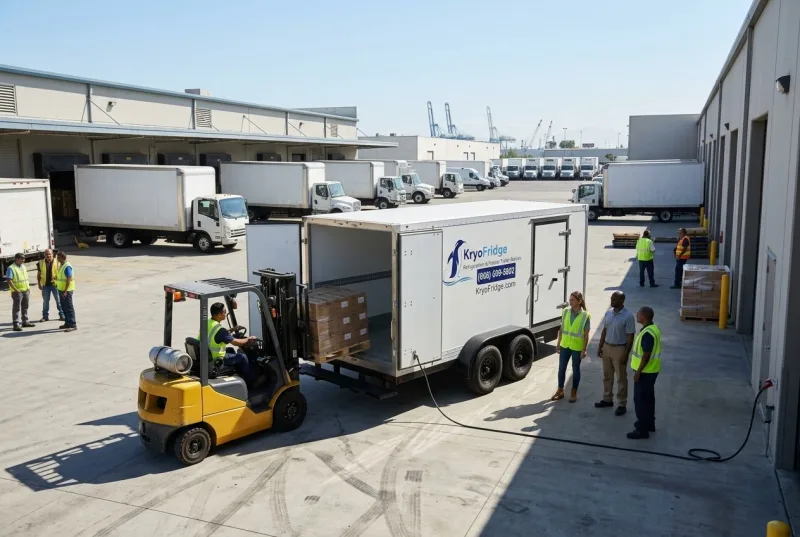
Contract manufacturers and co packers in the Walsh Avenue and Scott Boulevard belt hit runs that exceed finished goods freezer space, especially on seasonal contracts. Long holds are simple here because these buildings have yard room and dock height doors, and we can swap the unit if the load changes.
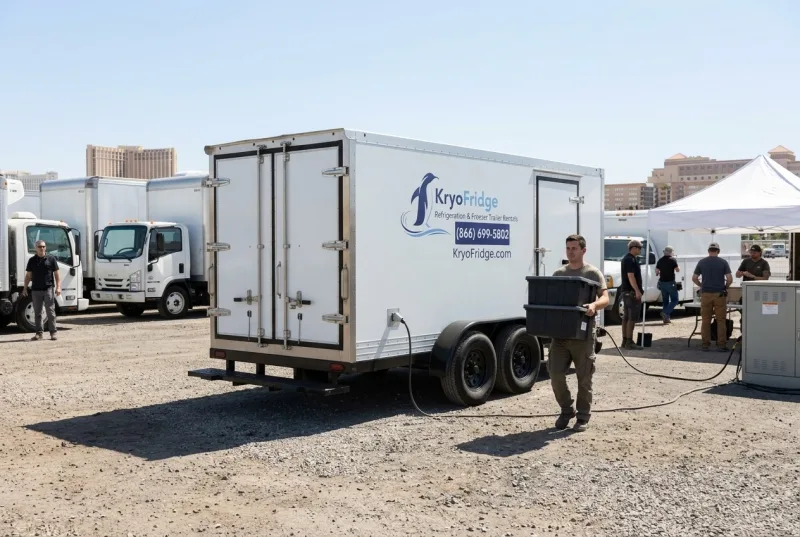
Santa Clara requires film permit applications at least 14 business days out, and 30 days when police escorts or traffic control are involved. Craft services on a multi day shoot needs holding capacity a location rarely has, and our generator option keeps a production self sufficient on any lot in the city.
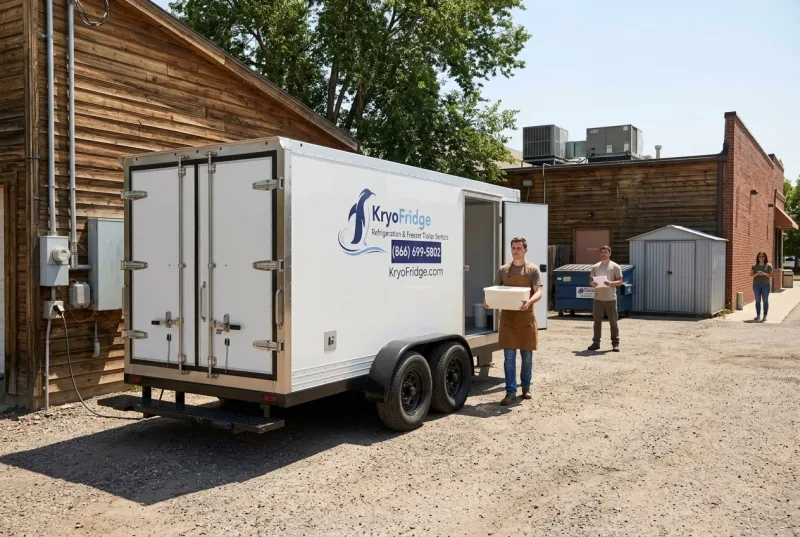
We keep units staged for emergency work and we deliver to all fifty states, so a Santa Clara customer supporting a response effort elsewhere is not calling a different company. The same dispatch team that handles refrigerated trailer rentals in Fresno coordinates the whole thing. One number, any distance.
What ties these together is the clock. Nobody budgets a freezer trailer into next quarter. They reach for one the hour a compressor quits, or the evening before a party when the stack of rented ice chests suddenly looks laughably undersized. Since our units sit staged around Santa Clara instead of a couple counties down the freeway, "can I get it today" is an ordinary ask here, not a stretch.
Add it up the way an owner in Santa Clara has to. One restaurant walk-in routinely sits on a small fortune in proteins, dairy, and prepped product. Scale that to a grocery rack or a warehouse freezer bay and the exposure balloons. Now knock the power or the compressor out on a triple-digit afternoon, and that whole inventory is in jeopardy inside a few hours. Then stack on the sales you lose while the line sits dark and the wages you burn paying staff to triage what can still be saved.
Hold a pre-staged trailer up against that risk and it reads like cheap insurance, a fixed, predictable expense parked in front of a loss with no ceiling. That is exactly why the businesses that got stung once tape our number by the phone. There is never a second scramble, because the next time they dial before the product has a chance to warm. Owning every trailer ourselves means we can scale the answer to fit. A single compact box suits a corner cafe. A clustered setup covers a warehouse floor. Either turns around the same day.
Santa Clara has an easy climate on paper. July averages about 82 degrees for a high and 53 for a low, January runs roughly 58 and 38, and most of the rain falls in winter. For eight months of the year a properly sized walk in cooler here has nothing to complain about, which is exactly why so many kitchens in this city are working with no backup at all.
The risk is concentrated rather than constant. Bay Area heat arrives in short violent spikes in late summer and early fall, and September 2022 is still the reference everyone uses. San Jose recorded 109 degrees, the hottest reading in a record reaching back to 1893, and Santa Clara County posted its warmest September ever measured, with an average September low of 58.7 degrees against a twentieth century average low of 52.8. Warm nights are the part that breaks equipment, because a cooler that struggles all afternoon never gets a cool night to recover.
That spike lands on top of the busiest weeks of the local calendar. Mid September is the Art and Wine Festival weekend at Central Park, football season starts at Levi's Stadium, the convention calendar picks back up and campus catering returns to full volume. When a heat event hits that week we get calls from restaurants, caterers and event coordinators inside the same afternoon. Customers who book ahead of that window are the ones not spending the weekend calling around.
El Camino Real is the restaurant spine of Santa Clara, and it carries a lot of building stock older than the businesses inside it. The Korean barbecue houses, the Indian drive thrus serving filter coffee and dosa, the taquerias and the sushi counters are often working out of shells where the walk in cooler was installed by a tenant two leases ago. The condenser sits on a flat roof that gets punishing sun, and there is no second cooler to fall back on.
When that walk in goes down, the kitchen stops. It holds the proteins, the produce, the dairy, the dressings and every prepped item the line depends on, so a failure at 6:30 on a Friday is the whole night. The California Retail Food Code puts the cold holding limit at 41 degrees, and a cooler drifting toward 45 gives an owner hours to act, not days.
Our answer is a trailer that arrives fast and works off what the site already has. Two ways to power it: a generator we bring, or one dedicated 120 volt, 20 amp circuit within 100 feet of where the trailer parks. That is an ordinary kitchen circuit, not an electrical project, which matters in a city where new capacity takes real lead time. Set the temperature on arrival, load the product, keep serving.
Chains have the same fix for a different problem. A quick service brand on Homestead Road cannot simply close the drive thru, because there is a franchise agreement and a regional facilities manager who needs a documented fix before the morning report. We have handled exactly that for national restaurant accounts for years. Call the dispatch line and we will give you the delivery window before you hang up.
Levi's Stadium seats 68,500 and expands to roughly 75,000 for the biggest events, with 174 executive suites and more than 109,000 square feet of club and meeting space behind the bowl. The city secured about 31,600 parking spaces for stadium events. All of that turns into food, and permanent stadium refrigeration is sized for a normal game day rather than a Super Bowl LX weekend or a stadium concert with a full field build.
The 2026 calendar showed how that stacks up. Six World Cup matches landed at Levi's Stadium between June 13 and July 1, Super Bowl LX was played there on February 8, and the summer run brought Ed Sheeran on July 25, AC/DC on August 5 and KAROL G across August 21 and 22. Load in starts days early, and the lots fill with sponsor activations and media compounds that each feed their own crews.
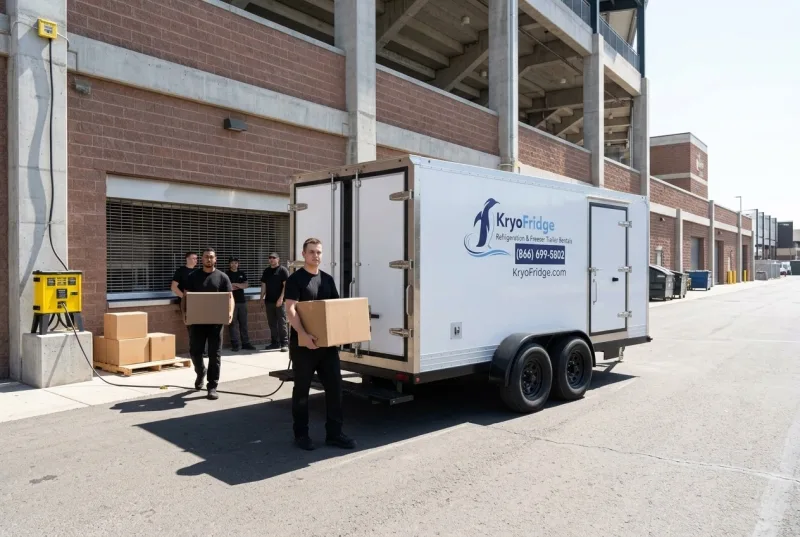
The Santa Clara Convention Center at 5001 Great America Parkway is the other half. Ninety thousand square feet of exhibit space, a 22,400 square foot ballroom, 31 breakout rooms and more than 350,000 visitors a year means house catering plus dozens of exhibitor sampling programs, and exhibitor product usually arrives before there is anywhere cold to put it.
Outdoor events work the same way with tighter rules. The Santa Clara Art and Wine Festival brings more than 170 artists and vendors to Central Park on September 19 and 20, and every food booth on that grass is subject to county holding requirements. One shared trailer covers multiple vendors and gives the coordinator a single clean line on the site plan. Send us your event dates early and we will reserve a unit while the permit package is still being built.
The Golden Triangle is unlike any other catering market in California. Intel at 2200 Mission College Boulevard, Nvidia at 2788 San Tomas Expressway, Applied Materials at 3050 Bowers Avenue with roughly 8,500 employees, AMD at 2485 Augustine Drive, ServiceNow at 2225 Lawson Lane and Palo Alto Networks at 3000 Tannery Way all sit inside city limits, and all of them run constant catered programs.
Those campuses have excellent conference space and almost no spare commercial refrigeration. A caterer asked to feed several hundred people on a Thursday has to hold that product somewhere from Monday, and commissary square footage in the Walsh Avenue and Reed Street belt is expensive enough that nobody carries idle cold storage waiting for a peak.
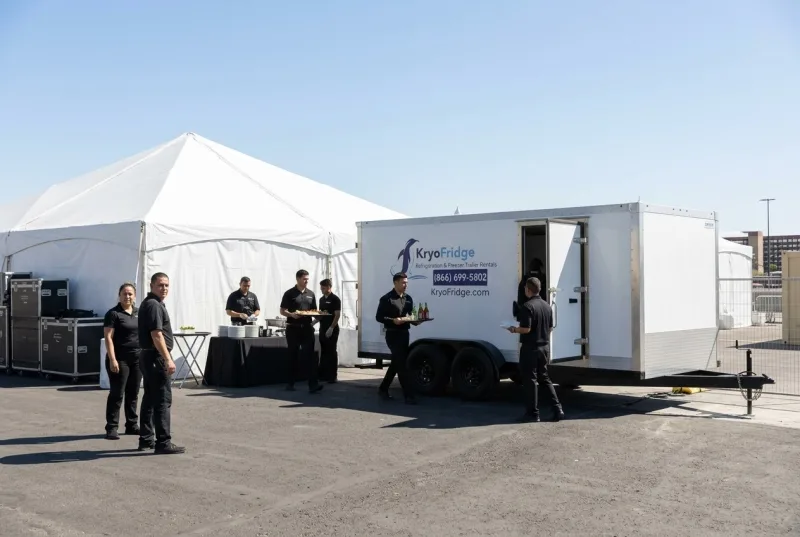
That work is usually planned rather than urgent. The trailer goes on the caterer's yard or straight onto the campus loading area, takes power from a standard dedicated circuit or a generator we supply, holds chilled on one job and hard frozen on the next, and goes back when the event is over. Because our units work as either a cooler or a freezer, nobody has to order different equipment week to week.
The convention hotels on Great America Parkway have the same math. A banquet kitchen sized for a normal week gets hit with a citywide convention or a nine day match window, and banquet freezer capacity is the first thing to run out. Renting for the length of the peak costs a hotel nothing in permanent space. Reach out with your dates and we will pencil in a delivery slot.
"Cold" is not one number. Different product stays safe inside different temperature windows, which is the entire reason a precise digital set-point matters, and in the middle of a heat wave in Santa Clara, a load that slips out of its window is a load you write off. Use the chart below as the reference our customers lean on when they size a rental.
| Product | Target holding band | Trailer mode |
|---|---|---|
| Ice cream and frozen desserts | -10°F to 0°F | Deep freeze |
| Frozen proteins, seafood, prepared meals | 0°F or below | Freezer |
| Fresh meat and poultry (short hold) | 28°F to 32°F | Refrigerated |
| Dairy, deli, packaged produce | 34°F to 38°F | Refrigerated |
| Beverages, florals, catering trays | 38°F to 45°F | Refrigerated |
One figure outranks everything in that chart, and it is not listed there: 40°F. Food-safety guidance treats the band between 40°F and 140°F as the zone where bacteria thrive, and the clock on perishable product starts ticking the moment it crosses 40 on the way up. Roughly four cumulative hours above that line and most refrigerated inventory is no longer safe to serve. Picture that countdown running on a 100-degree afternoon in Santa Clara with the walk-in dark, and the urgency of a quick trailer drop stops being abstract.
Tell us the single coldest item you are holding when you call, and we dial the trailer to that. One unit carries a straight freezer load with no fuss. But when your list mixes deep-freeze desserts with fresh-cold produce for the same remodel or event, we will usually point you toward a split setup or a second box so neither side of the load has to settle for the wrong temperature.
Powering one of our trailers is refreshingly simple, and there are precisely two ways to do it. Either you have a dedicated 120-volt, 20-amp circuit reachable within roughly 100 feet of the parking spot, or we bring a generator. What the units will not accept is standard 208 to 240V building service, so a quick question about your outlet before dispatch heads off any surprise on delivery day.
On placement, all the unit really asks for is a fairly flat patch with enough room for the delivery truck to maneuver it in and set it straight, plus either a power source in reach or space for a generator. We lock down the exact drop point before dispatch, and our drivers know the Santa Clara layout cold, so the delivery is one clean trip instead of a guessing game on the property.
The call came in on a Friday evening at 6:30, right in the middle of the rush, with the walk in cooler dead and the drive thru backed up. Our dispatcher took the details, the yard prepped a trailer while she was still on the phone, and the driver rolled. The unit was on site 34 minutes after the call, plugged into a dedicated circuit behind the building, and the crew moved product straight across. That restaurant finished service and never posted a closed sign.
An overnight power outage shorted the fuse on a walk in cooler the morning of one of the busiest days of the year. Losing cold storage on a holiday with a full reservation book is about as bad as it gets. Our dispatch team put three freezer trailers on site that morning to hold the pies, the meats and the rest of the inventory. The kitchen worked the entire day at full volume and nothing was thrown away.
A coordinator running a multi vendor outdoor food program came to us three weeks out, after realizing the site plan going to the county had no cold storage on it. We placed one trailer on the footprint as shared holding for the vendor row, set it as a cooler for the first day and dropped it to frozen overnight, and used a generator so nothing depended on venue power. She submitted one line on the site plan instead of chasing every vendor separately.
We settle the Santa Clara power question before the truck leaves. Santa Clara is one of the few California cities with its own electric utility, and Silicon Valley Power is working through real capacity limits while more than 55 data centers in the seven square mile cluster north of El Camino Real draw about 60 percent of the city's electricity. Adding electrical capacity here is a project with a timeline. That is why our power spec is a selling point rather than a caveat: a KryoFridge trailer needs either a generator we bring or one dedicated 120 volt, 20 amp circuit within 100 feet, which almost every kitchen, campus dock and event site already has.
On a bad day, booking should be the part that does not add stress. Four steps, an upfront number, and a single person who owns the whole thing.
Tell us whether it is freezer or fridge product, a ballpark volume, and your rough window. That is enough for us to call the right size.
We pair you with a unit, confirm whether you have a dedicated circuit or need a generator, and pin the exact drop point so the truck makes one trip.
We arrive on your schedule, about 45 minutes for a true emergency, set the trailer, energize it, and let it drive down to your number.
It holds the set-point for your entire term while our line stays live the whole way through. Wrap up, and we swing back for the pickup.
The number that governs everything is 41 degrees. California Health and Safety Code section 113996 requires potentially hazardous food to be held at or above 135 degrees or at or below 41 degrees, with narrow exceptions for preparation, cooking, cooling and transport under 30 minutes. Serving lines and salad bars get a limited allowance up to 45 degrees for no more than 12 hours in any 24 hour period, and unused portions have to be discarded at the end of that window. That is a useful rule to have, because it turns a vague worry about a struggling cooler into a clear line an owner can act on.
For events, the County of Santa Clara Department of Environmental Health runs the Temporary Food Facility program. A temporary event is a short term gathering such as a fair or festival occurring no more than 25 days within a 90 day period, and every booth giving away or selling food needs a TFF permit unless the vendor already holds a county mobile food facility permit. The coordinator submits everything at least two weeks ahead, including vendor applications, supporting documents, the site plan and payment, and each booth needs its own application and fee. The department takes temporary event questions at 408-918-3400.
The City of Santa Clara adds its own layer. Special event permit fee applications go to the Parks and Recreation administration office at least 60 days before the event date, and the application requires an event diagram showing setup dimensions, tents, staging and power locations. That power line is the one that matters here, and the answer is short: a generator we deliver, or a dedicated 120 volt 20 amp circuit within 100 feet. Filming follows its own track, with applications due at least 14 business days out and 30 days when police escorts or traffic control are involved, plus separate permissions for anything at Levi's Stadium or the Convention Center.
One caveat we always state plainly: we supply the food-safe, temperature-holding hardware itself, but we are not a temperature-logging or alarm-monitoring service. If your program requires continuous written records, line that vendor up on your own.
Our signature 16 foot Utility series leads the fleet. It is the trailer we send on most jobs, and crews like it for the side utility access door. We build three footprints in all, so a single kitchen holding overflow stock has a fit and so does a distribution floor in a disaster. Every unit is dual purpose by design: one adjustable system swings between freezer and refrigerator on a digital set point. Each trailer runs on a dedicated circuit or on a generator.
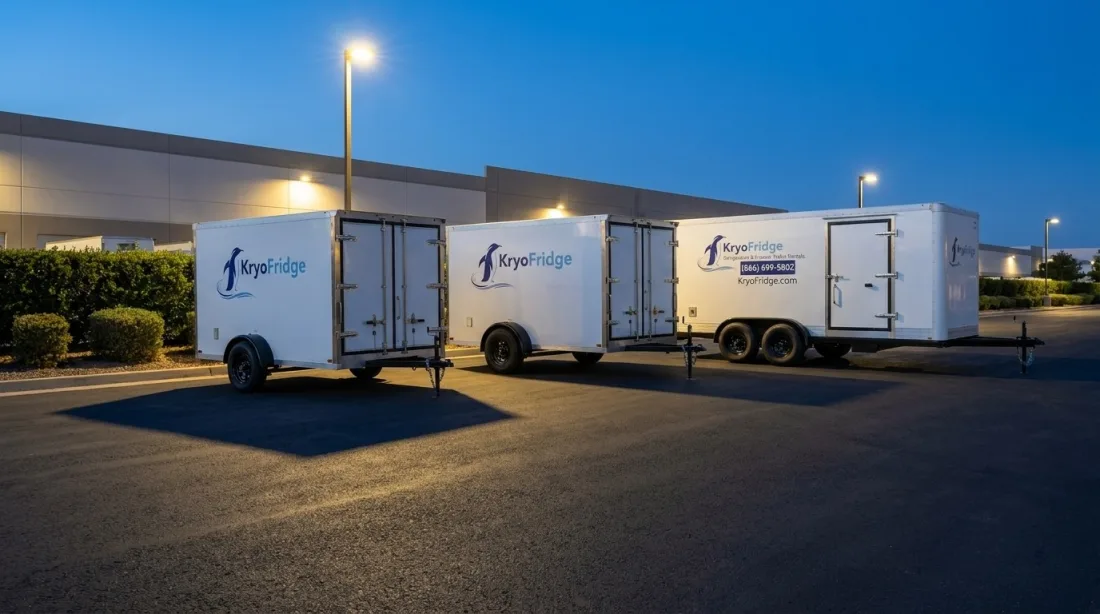
| Trailer | Best for | Temp range |
|---|---|---|
| 6x16 Utility ⭐ | Our signature series: distribution, large events, disaster response, side utility door | Heavy-duty reefer |
| 6x12 | Grocers, caterers, mid-size events | Deep-freeze capable |
| 6x8 | Tight lots, small kitchens, short overflow | -10°F to 50°F |
Each unit holds a precise digital set-point and runs on a dedicated 120V/20A circuit or a generator.
Think eight or so pallet spots, and the unit to grab when square footage is the whole problem. It slips into the pinched service yards and cramped back-of-house corners that a larger box cannot even swing into. One cafe or small-market walk-in goes down, and this is almost always enough cold to cover it, plus the simplest unit to set in a small space.
Call it fourteen pallet spots, deep-freeze rated, and far and away the size people ask for most. It lands right in the middle: roomy enough for a multi-day catering job or a restaurant that needs true walk-in-equivalent room while the kitchen is torn up. Roomy enough that nobody is playing Tetris with shelves, yet still small enough to set in most commercial back lots without a site survey.
Roughly twenty pallet spots paired with a heavy-duty reefer plant engineered to keep deep-freeze locked in even when the ambient air is merciless. Reach for it when a warehouse bay drops, when a large festival needs an anchor, or when a relief operation is carrying its own cold chain.
Not sure which size fits? Most customers land on the 16 foot Utility, and we will tell you honestly if a smaller footprint covers your job. Tell us roughly what you are storing and for how long, and we will spec it for you.
The questions that surface once the basics are settled. Tap any topic to open it.
The pop-up walk-in cooler. Cheap to rent and easy to set up, but it chills, it does not freeze, and it draws every watt it needs from your building while depending on a calm ambient temperature around it. The second your building loses power, your cooler loses it too.
The refrigerated box truck. Designed to haul product on the interstate, not to sit in a lot and babysit it. Parked, it idles fuel all day, broadcasts compressor noise across a storefront or an event lawn, and pins down a tractor plus a driver you probably do not need.
The freezer trailer we deliver. Built from the ground up to be dropped on a pad and to defend a temperature for as long as the job runs. It freezes deep, carries NSF approval, locks, stays quiet near guests, and lives on nothing more than one dedicated circuit or a generator.
Even a rented box has to satisfy the county environmental health office that licenses and inspects every food facility. Show an inspector a unit that cannot document its temperature or was not built for food contact, and they have the authority to halt service immediately.
That is a bar each of our trailers clears: NSF-approved throughout, food-safe interior surfaces, proper drainage, and a digital controller that puts the set-point in plain view. We supply the food-safe, temperature-holding hardware itself, but we are not a temperature-logging or alarm-monitoring service.
For a typical kitchen or market, one box does the job. Distribution floors, big fairs, and full-scale disaster response routinely need more, and because the fleet is ours, we can cluster several units and bring them online in waves as the work expands. Match the cold capacity to the operation rather than make the operation squeeze itself into one box.
The clock is yours to set. Some jobs are a handful of days for an emergency or a single event. Others stretch across weeks or months for a remodel or a seasonal swell, and a few become standing contracts for businesses that want capacity parked on standby. Name your window and you will get a clean quote, no penalty for an honest "not sure yet."
Building permanent cold storage is a capital project in every sense: you hire a refrigeration contractor, schedule the electrical, pull a building permit, and wait weeks before a single pallet goes inside. A rental turns that equation on its head. You bring in precisely the cold you need, for precisely the stretch you need it, and the trailer is holding temperature that same week, frequently that same day, with the commitment ending the moment your need is over.
Three engineered elements carry the load. Thick insulated panels and tightly gasketed doors lock the sun outside and the cold inside. A self-contained reefer condensing system specified with surplus capacity keeps stripping heat out of the box even when the air outside is brutal. And a digital thermostat locks onto your chosen number and cycles the compressor to hold the line. Run those three together and a trailer baking on open asphalt behaves like one tucked in a cool warehouse. That is also why power is the first thing we ask about: the design delivers its safety margin only on steady, uninterrupted power.
"Absolutely great for an outdoor event. We used one trailer as shared cold storage for our whole vendor row and it made the site plan so much simpler. The temperature never moved on a hot September weekend."
 Zaire M. · Festival coordinator, Central Park
"The KryoFridge team goes out of their way to take care of our locations. The trailers are always in good working condition, and when we need a swap they handle it without me chasing anyone."
 Francisco i. · Facilities manager, Santa Clara Square
"Great and excellent service. Our frozen case failed on a Saturday and they had us covered the same day. Very pleased and I will recommend them to other shop owners nearby."
 richard k. · Market owner, Homestead Road
"Love this company. Great customer service from the first call to the pickup. We kept the trailer for six weeks during our kitchen remodel and it did exactly what they said it would."
 Danielle R. · Kitchen manager, Rivermark Village
"Super great service. I would recommend anyone book KryoFridge for their next big event. Really clean unit and it held everything our caterer needed for a two day setup."
 John H. · Wedding and event planner, Old Quad
"Highly recommended. Dispatch actually answered at night, which is the whole reason I called them instead of the last company we used. The trailer was on site quickly and the crew was professional."
 Steven L. · Restaurant group operations, Sunnyvale border
"Excellent service and the driver was very careful placing the trailer in our yard. We keep it through our busy season every year and it holds hard frozen without any trouble."
 Bruce N. · Commissary supervisor, Walsh Avenue
"Great company to work with. We rented cold storage for a convention week and it took all the pressure off our banquet kitchen. The unit was spotless and delivery was easy start to finish."
 Michael H. · Banquet manager, Great America Parkway
"This is our second year renting from KryoFridge and it was well needed and well received. We run a seasonal production spike, and the extra frozen capacity in the yard means we never turn down a contract."
 Jason S. · Food manufacturer, Scott Boulevard
Sample reviews written to mirror genuine Santa Clara situations, to be replaced with verified Google reviews ahead of launch.
Every unit we rent adjusts across a working range from about 50 degrees down to minus 10. The same trailer holds chilled produce and dairy for one job and hard frozen proteins for the next, and you set it with a digital control on the unit. You do not have to choose between a cooler and a freezer when you book. Tell us what you are holding and we will suggest a starting set point.
There are exactly two ways to power one. Either you plug into a dedicated 120 volt, 20 amp circuit within 100 feet of where the trailer parks, or we bring a generator and the trailer works independent of your building. That first option is an ordinary kitchen or dock circuit, which matters in Santa Clara where adding new capacity through the city utility takes real lead time. We confirm which one you are using on the booking call.
Our dispatch line is staffed 24 hours a day and emergency swaps are routine work for us, not a special favor. We have put units on site well under an hour after the call when the yard and the traffic cooperated, and Santa Clara sits on our regular routes through San Jose, Sunnyvale, Cupertino and Milpitas. Call us and we will give you an honest delivery window before you hang up rather than after.
Yes. California Health and Safety Code section 113996 requires potentially hazardous food to be held at or below 41 degrees, and our units hold well below that with room to spare. Most kitchens set a chilled hold in the mid 30s and a frozen hold at zero or lower. The unit carries a digital set point control your team can read and adjust at any time.
The trailer is equipment, so the permitting question is really about your event and your food program. The County of Santa Clara Department of Environmental Health requires a Temporary Food Facility permit for booths giving away or selling food, and the coordinator submits the full package including the site plan at least two weeks ahead. The City of Santa Clara wants special event applications at least 60 days out with an event diagram showing power locations, and our power requirement is simple enough to fill that box in correctly the first time.
Yes, and it happens constantly around Levi's Stadium and the Santa Clara Convention Center. Lot placement is normal for us and a generator keeps the unit independent of venue power during load in. What we need from you is the placement location and the access route. We also need the load in window the venue gave you. Venue and city permissions come from them, and we supply whatever equipment details your event manager asks for.
It depends on the footprint you rent and how you load it. We stock more than one trailer size specifically because a restaurant holding a single walk in worth of inventory and a food manufacturer staging a production run need different capacity. Pallet loading, speed racks and hand stacking all give different numbers, so the useful conversation is about what you are holding. Call us with your product list and we will tell you which size fits.
Rentals run from a single weekend to a full season and longer. Emergency rentals often last a few days while a refrigeration contractor finishes a repair, kitchen remodels usually run two to six weeks, and manufacturers in the Walsh Avenue belt sometimes keep a unit through an entire seasonal contract. Extensions are normal, and we would much rather you call early than scramble at the end.
Often yes, but it takes planning. Older streets around Santa Clara University are narrower, with mature trees and tighter driveway approaches than the corporate corridor. We ask about gate width, overhead clearance, the turning approach and where the unit will sit before we schedule, and our drivers scout a difficult address ahead of delivery day. Send us a photo of the space and we can usually answer quickly.
Yes. Santa Clara sits on our regular Silicon Valley routes alongside San Jose, Sunnyvale, Cupertino, Milpitas, Campbell and Mountain View, and we cover the rest of the state from the same dispatch team. We also deliver to customers in all fifty states, which matters most for emergency response, disaster recovery and long term rentals. One phone number handles all of it.
Deeper reading for local businesses, from the failure-hour playbook to compliance and seasonal planning. Tap any guide to open it.
A walk in cooler is the center of a restaurant. It holds the proteins, the produce, the dairy, the dressings and every prepped item the line depends on, so a failure is not a maintenance issue, it is an operating emergency. In Santa Clara the pattern is familiar: a building on El Camino Real or Homestead Road that has been through several tenants, a condenser on a flat roof taking punishing afternoon sun, and no second cooler on the property.
Start by confirming what you actually have. Put a calibrated thermometer in the box rather than trusting the wall display, and check the product temperature of something dense in the middle of the box, not the air near the door. California Health and Safety Code section 113996 requires potentially hazardous food to be held at or below 41 degrees, so the question is what number your product is sitting at and how long it has been there. Write down the time and the reading.
California Health and Safety Code section 113996, food holding temperatures
Santa Clara runs an outsized event calendar for a city of 127,647 people. Levi's Stadium seats 68,500 and expands to roughly 75,000, the Santa Clara Convention Center carries 90,000 square feet of exhibit space and draws more than 350,000 visitors a year, and Central Park hosts the Art and Wine Festival with more than 170 artists and vendors across a September weekend. Every one of those events has a food program, and almost none have enough permanent cold storage to support it.
The first thing to understand is the timeline, because permits drive equipment decisions and not the other way around. The City of Santa Clara asks for special event permit fee applications at the Parks and Recreation administration office at least 60 days before the event date. The County of Santa Clara Department of Environmental Health needs the Temporary Food Facility package, including vendor applications and the site plan, at least two weeks before the event, submitted by the coordinator rather than by individual vendors.
Santa Clara is one of a small number of California cities that owns and operates its own electric utility. Silicon Valley Power serves the whole city, and that single fact shapes how anybody here should think about adding equipment that draws power. It is the difference between a plan that works on the day of delivery and one that turns into a months long electrical project.
The load story here is dominated by data centers. More than 55 of them sit in a roughly seven square mile cluster north of El Camino Real, and those facilities consume about 60 percent of the city's electricity. Reporting through 2026 has described the utility's grid capacity as constrained, with new data center connections delayed and sequenced. The city and Silicon Valley Power announced a pilot with Emerald AI in 2026 to demonstrate flexible data center load as a way to support reliability and free up capacity.
The most common mistake in renting temporary cold storage is starting the conversation with cubic feet. Almost nobody knows how many cubic feet of product they hold, and the number would not help much anyway, because how a trailer gets loaded matters as much as how big it is. Start instead with what you are holding, how often you touch it and how long you need it.
Begin with the product mix. Chilled and frozen behave differently, and so do the people retrieving them. A restaurant holding produce, dairy and prepped items opens the door many times a shift, which makes door traffic, warm air infiltration and recovery time all matter. A food manufacturer in the Walsh Avenue belt staging finished goods might open the door twice a day, which is a completely different picture.
Grab a quick, no-runaround quote, or ring our round-the-clock line for emergency cold storage anywhere across Santa Clara and the surrounding area.