
KryoFridge is the first call for refrigerated trailer rentals in Arlington, and the fleet behind that claim is ours. We deliver a walk-in cold box sized to your pallet count and set it level. We hand it off holding temperature the same day it lands. Kitchens in the Entertainment District, docks out in the Great Southwest Industrial District, and taprooms off Division Street all keep our number close. Call now or request a free quote, and we will lock your dates before the product is at risk.
KryoFridge builds every rental in Arlington around one line: cold product sits at 41 degrees or below, and it has to still be sitting there when the person with the daily list walks up. Hot holding has its own line at 135 degrees, and the two numbers are what a health visit turns on. Our trailers hold a set point and show it on a display you can copy straight into your log. Mechanical cooling does that. Ice and hope does not. We have rented cold storage for more than 30 years. We are fully insured and SAM.gov registered. Dispatch picks up around the clock. Call us now or ask for a free quote, and we will tell you which unit holds your product in range before you commit to anything.
You get a person connected to the trucks and the fleet. No go-between desk in the middle, no ticket number, no waiting on a callback from the company that actually owns the trailer.
Every unit dials from about 50 degrees down to negative 10. A produce hold in spring and a hard freeze in July come out of the same trailer, with no swap and no second delivery.
World Cup week and race weekend pull cold storage requests from all over the metro at once. Running one of the largest fleets in our markets is what keeps us saying yes after everyone else is booked.
Compressors pick their own hours. Our dispatch line is staffed the whole way around the clock, and an emergency at 2 a.m. moves the same way it would at 2 p.m.
Hospital systems, city departments and venue teams all want insurance and licensing paperwork eventually. We are SAM.gov registered and fully insured, and the file goes out up front.
KryoFridge comes out of a rental family with more than 30 years in the equipment business and a 99.9 percent incident free record. The people on the delivery have set a lot of these boxes.
National brands do not take chances with refrigeration. They put our trailers behind their busiest locations because the equipment holds temperature and the company behind it answers the phone.
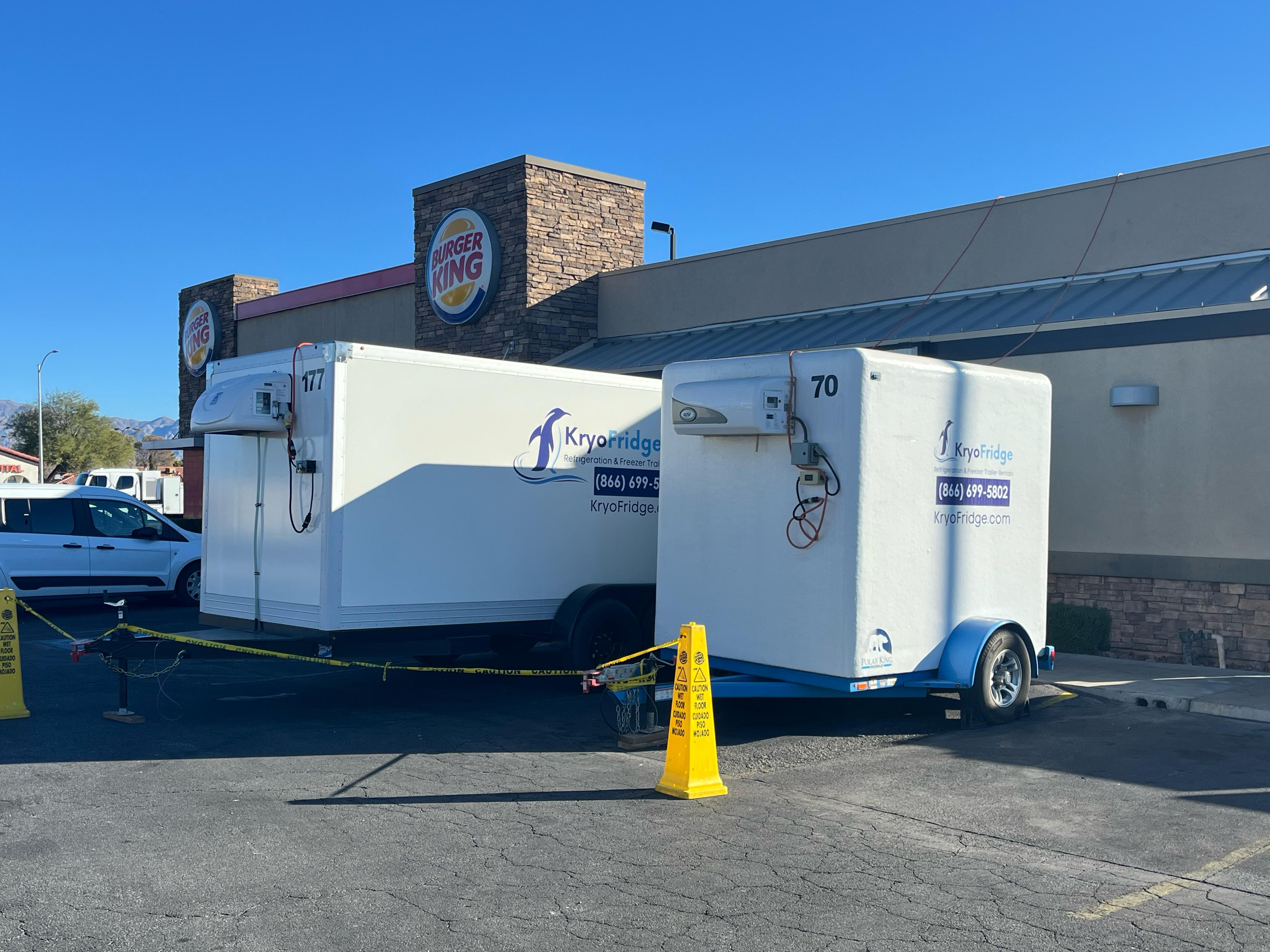 Burger King
Backup freezer capacity during walk-in repairs, holding frozen inventory on site instead of trucking it away.
same-day swap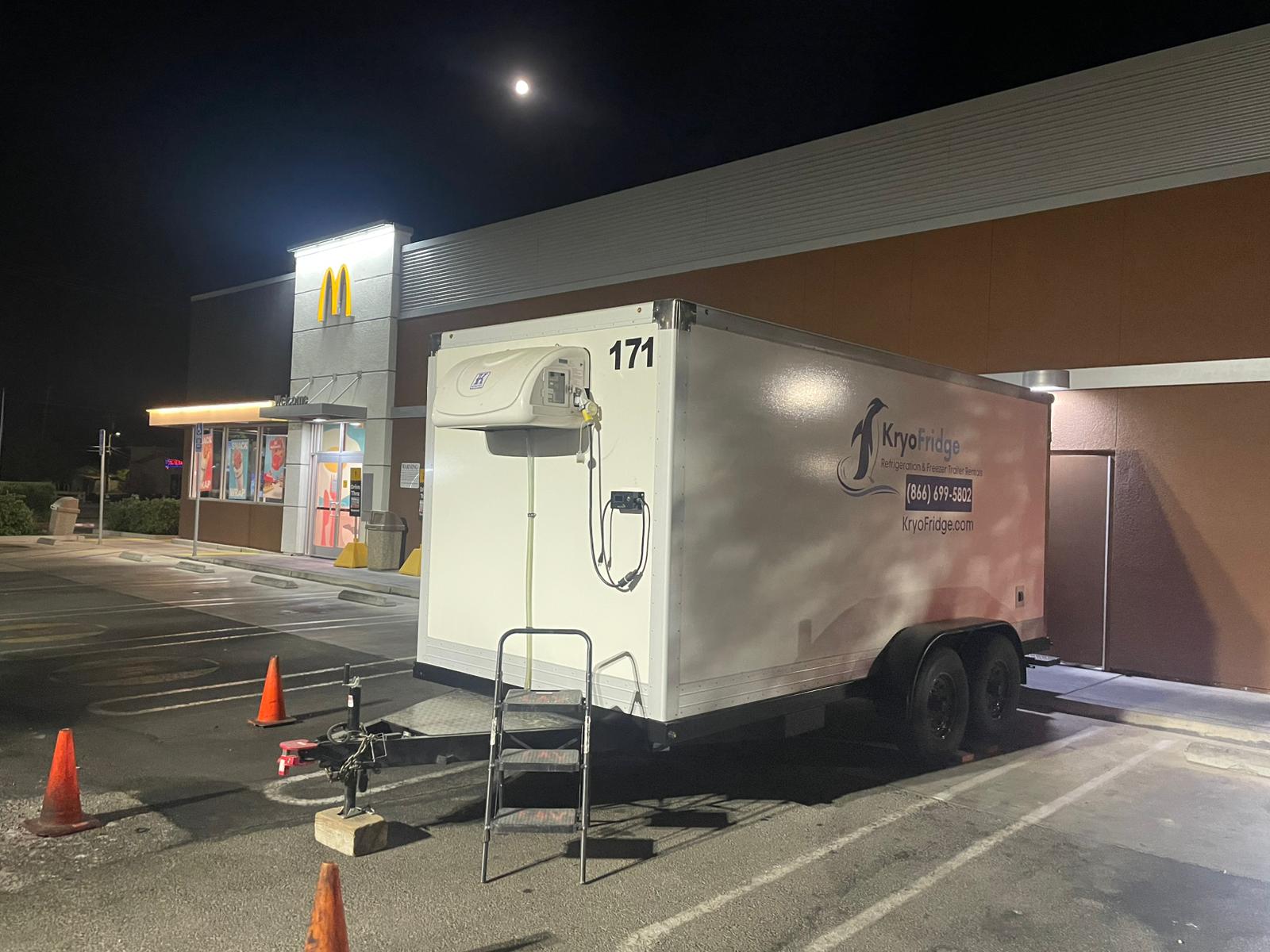 McDonald's
Freezer capacity staged on site through kitchen refits, keeping frozen stock at spec while the walk-in was down.
national account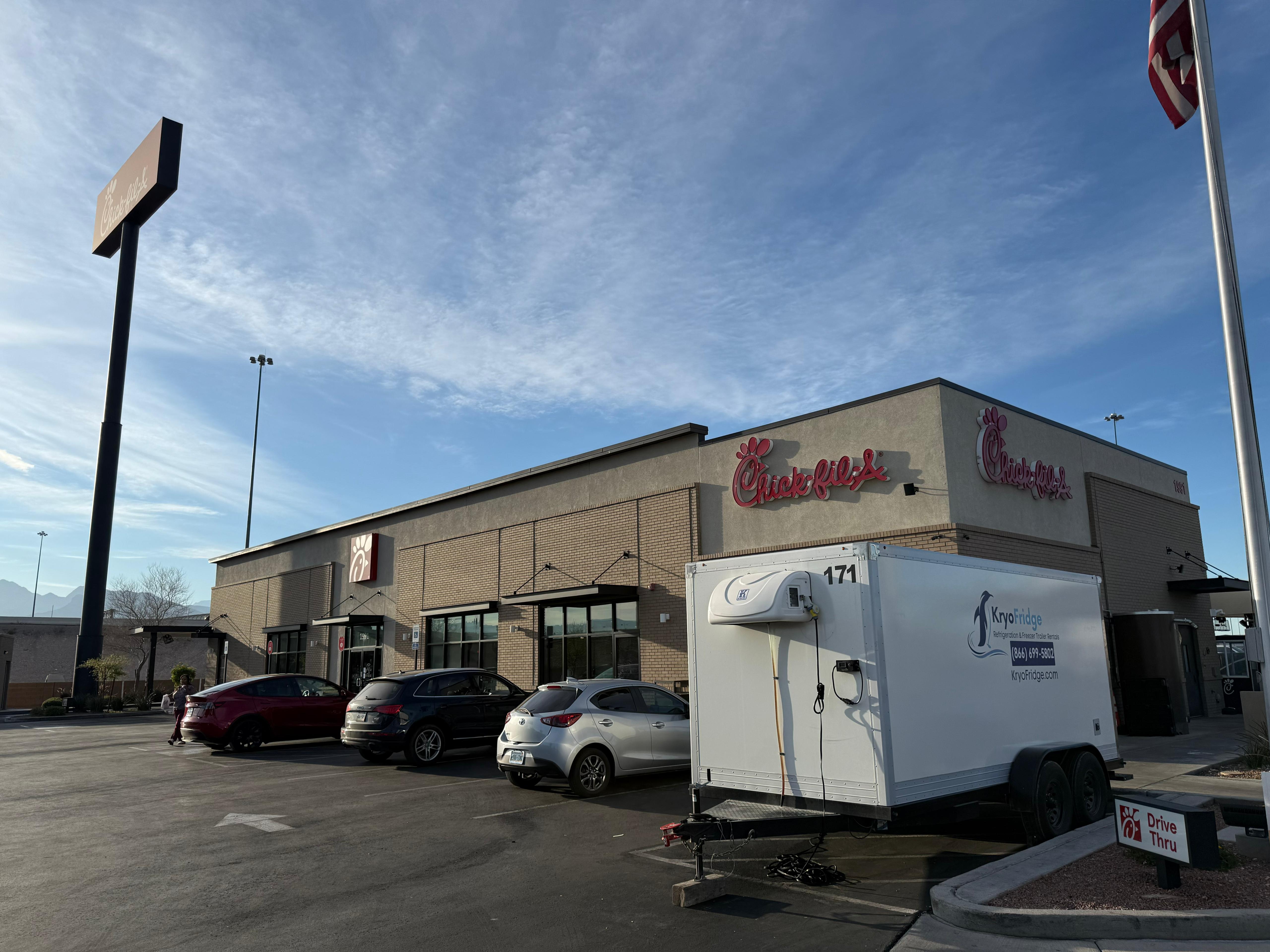 Chick-fil-A
Trailer cold storage through store remodels so frozen prep stock stayed at temperature from teardown to reopening.
zero thaw loss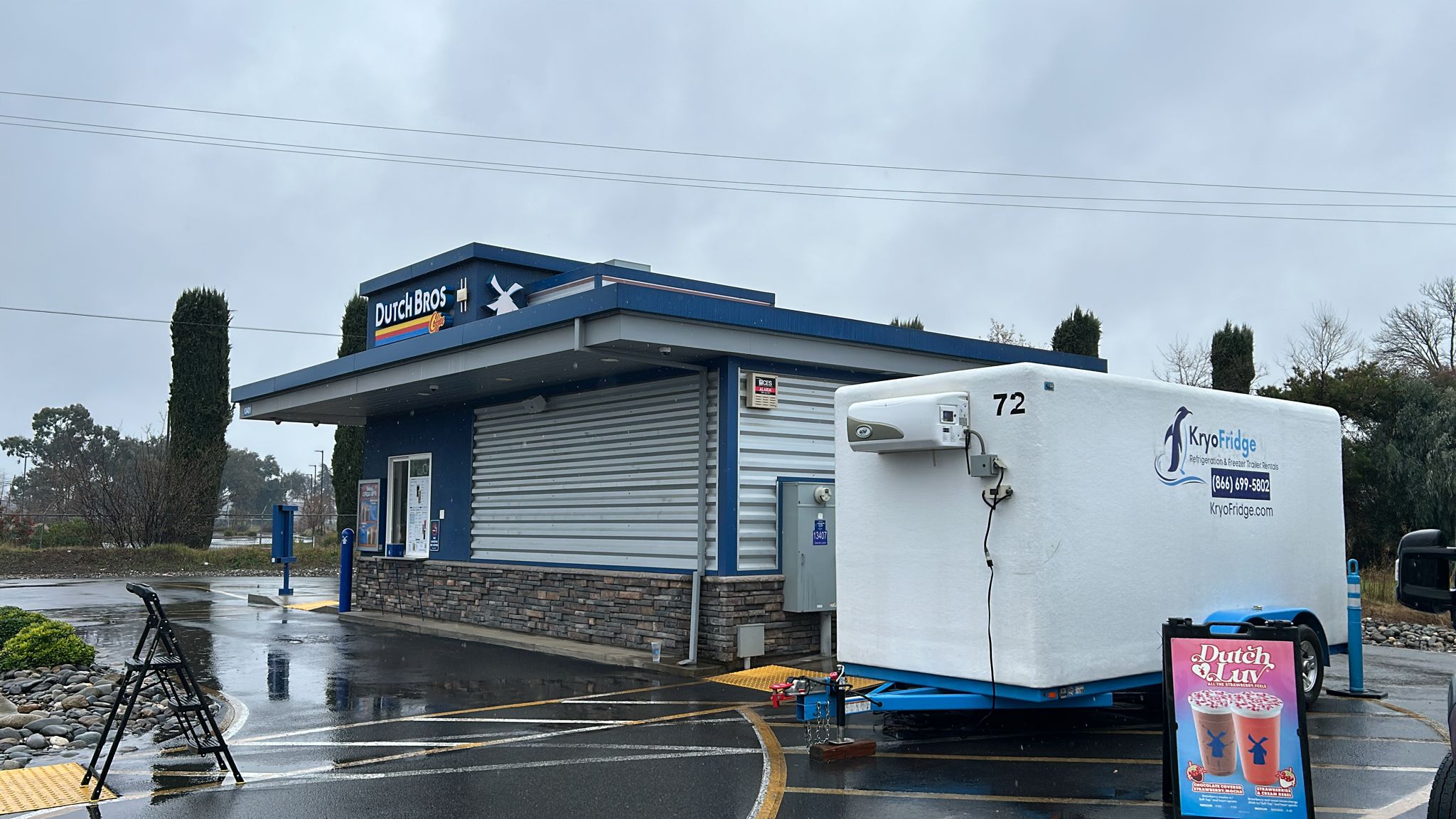 Dutch Bros
Trailer capacity holding frozen and dairy inventory for multi-stand markets between deliveries.
multi-site account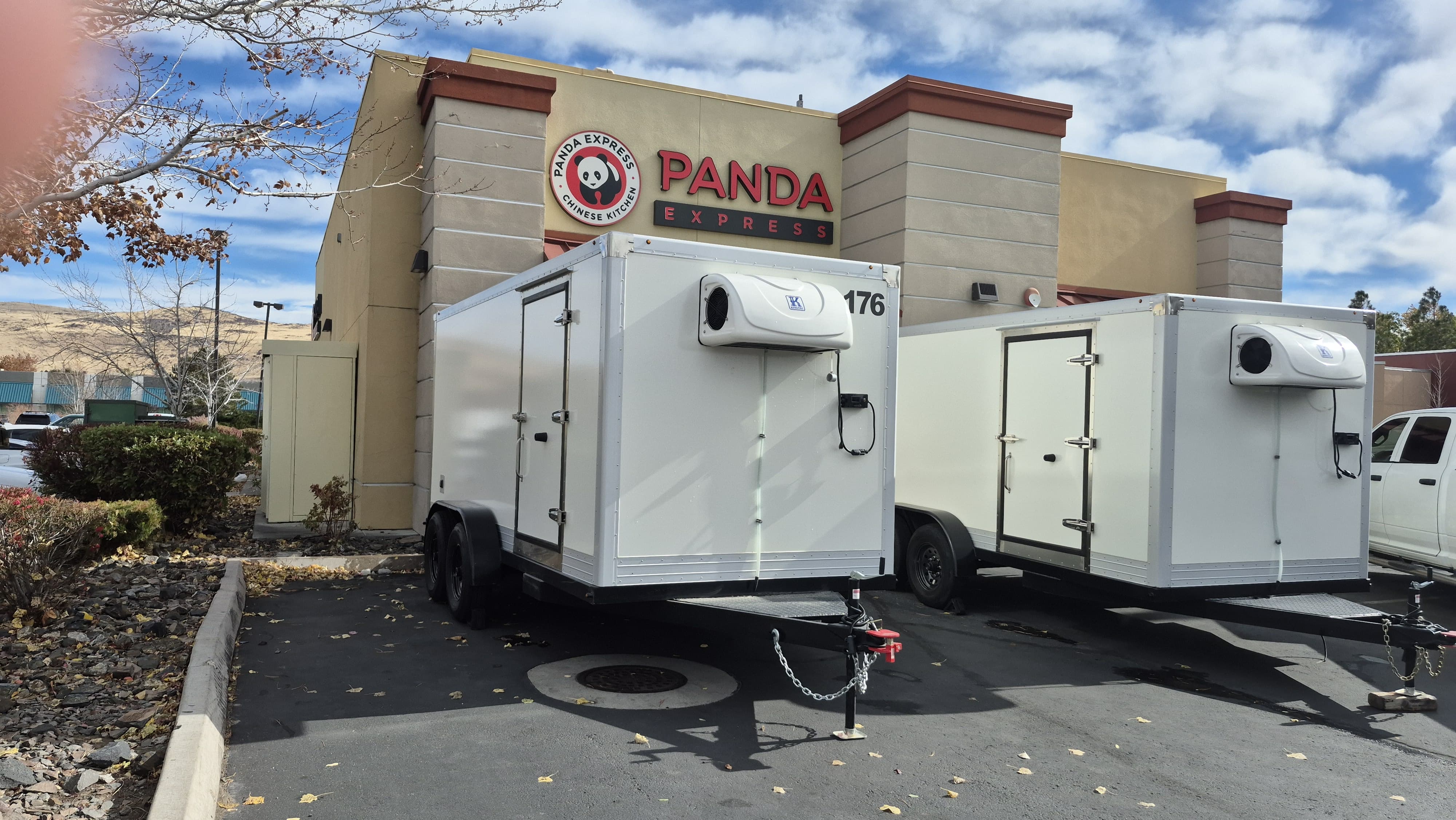 Panda Express
Overflow freezer space behind high-volume locations, holding bulk frozen product between distributor drops.
bulk overflow"Our dock cooler died with two inbound trucks already on the road. They had a unit backed in before the second truck got here and we never stopped receiving."
"Set to 34 and it stayed at 34 for eleven days. That is all I wanted."
"We were holding product for three straight match days with no kitchen space left near the stadium. The trailer hit our delivery window and the temperature log was clean every morning. The driver knew the vendor approval steps better than our own packet did."
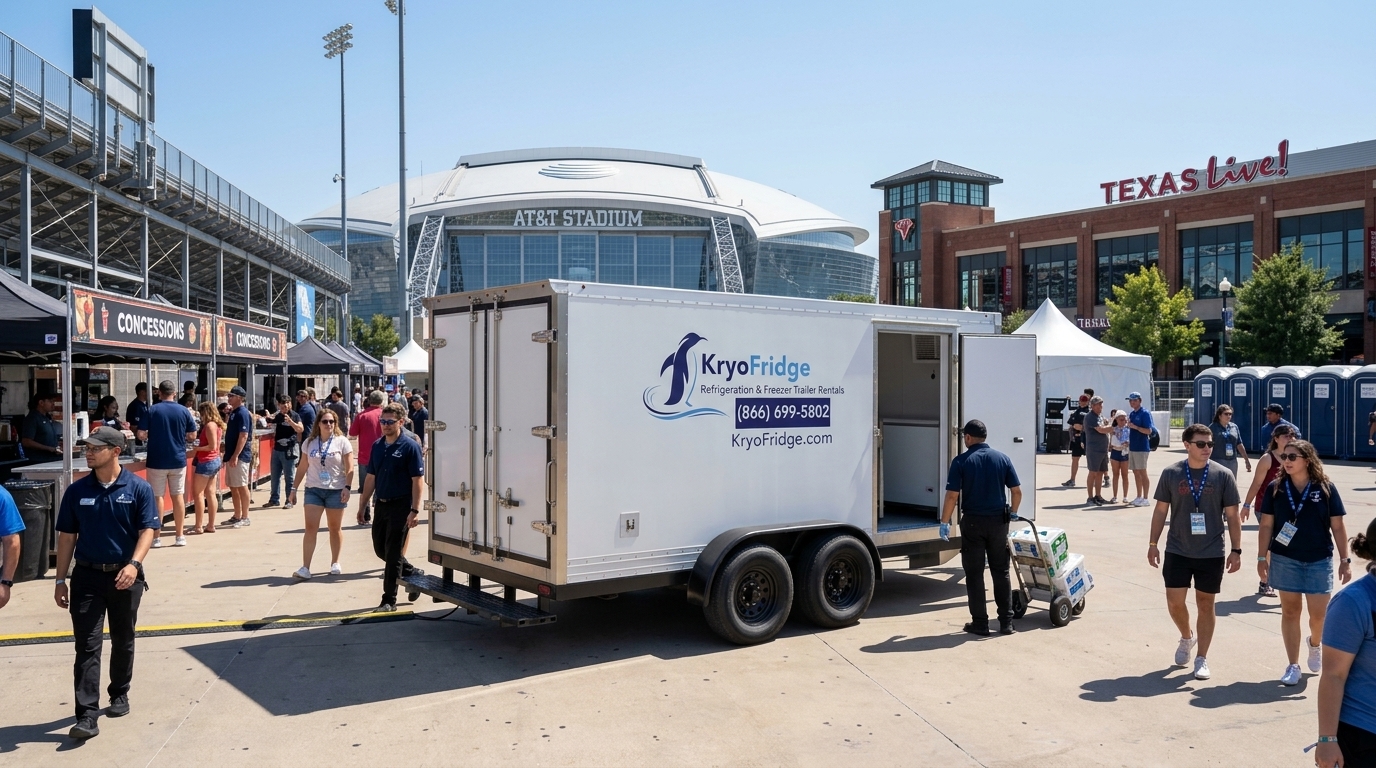
For a Texas Live! kitchen or a hotel dock off AT&T Way, the KF12 is usually the first unit we send. It takes a real pallet run and still fits a service lane built for box trucks.
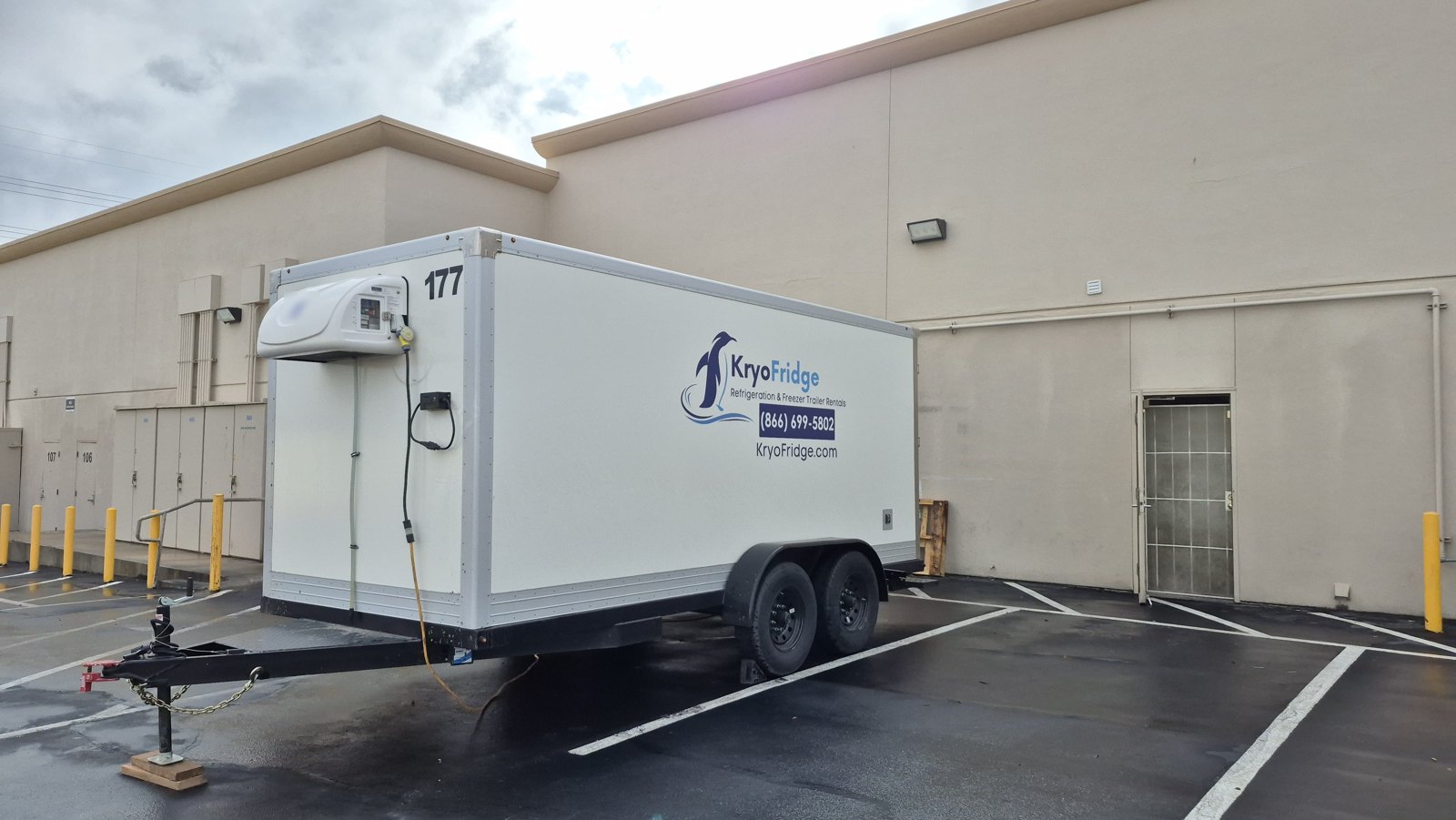
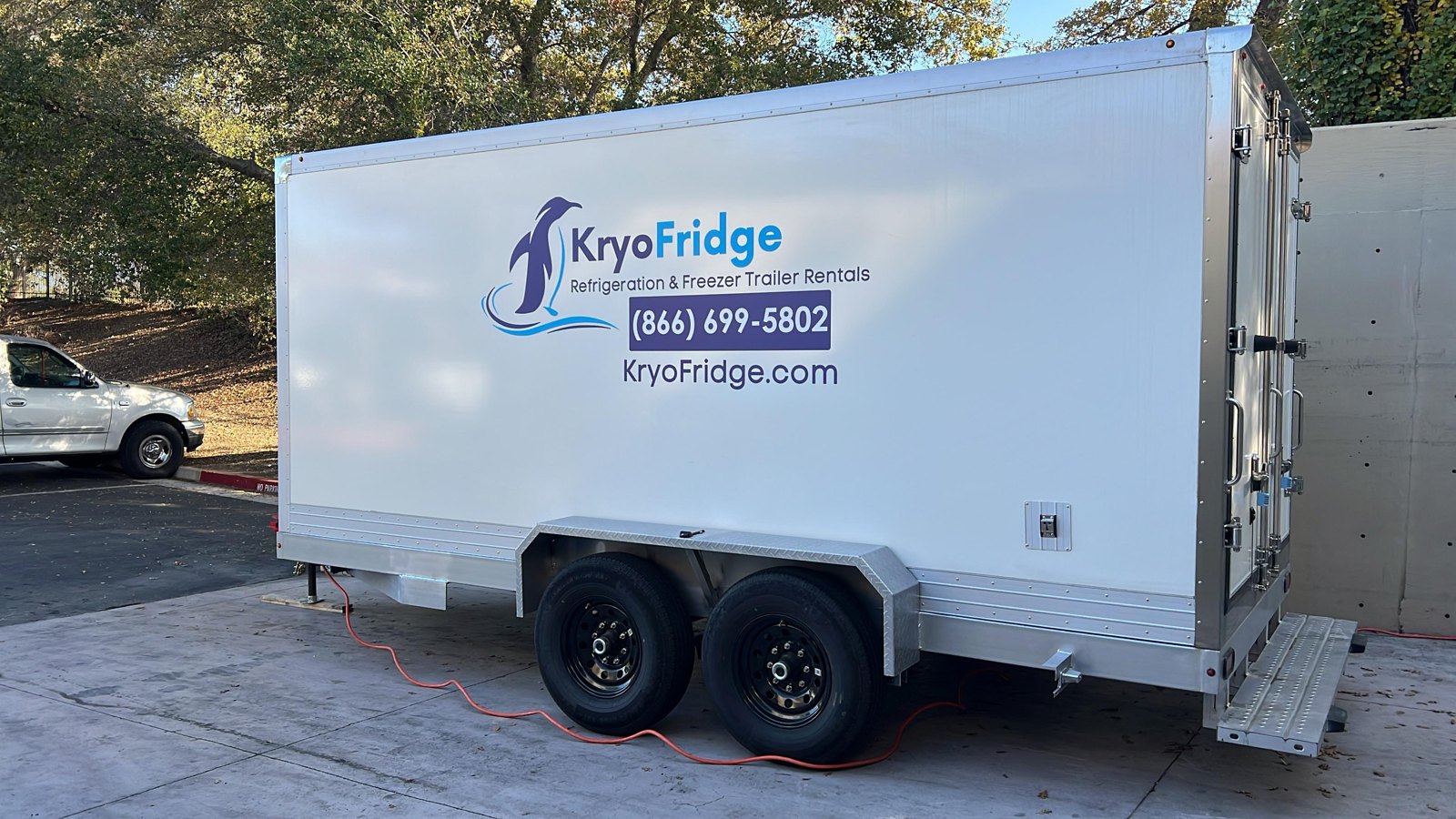
The 16' Utility is the trailer our crews reach for when the job is serious. A 16-foot insulated box on a tandem axle holds anything from -10°F deep-freeze to 50°F fresh-cold on one precise digital set-point, with NSF-approved surfaces throughout. Rear double doors take pallet loads straight off a dock, and the side utility door lets a cook grab one tray without opening the whole box to the heat.
We own every one of these units, so the trailer that shows up is fueled, pre-cooled, and maintained in-house. It runs on a dedicated 120V, 20-amp circuit or a generator we supply, and it holds its number through triple-digit afternoons. When a walk-in dies or a harvest runs long, this is the box that carries the load.
| Spec | What you get |
|---|---|
| Temperature range | Roughly -10°F deep-freeze up to about 50°F fresh-cold |
| Mode | Dual-purpose: freezer or refrigerator on one precise digital set-point |
| Power | A dedicated 120V, 20-amp circuit within about 100 feet, or a generator we supply |
| Food safety | NSF-approved for direct food contact, food-safe surfaces, proper drainage |
| Footprints | 6x8, 6x12, and 6x16, from a tight retail lot to distribution scale |
| Backing | Owned in-house, fully licensed and insured, with 24/7 emergency dispatch |
Each unit holds a precise digital set-point and runs on a dedicated 120V/20A circuit or a generator. The trailers are not wired for 208 to 240V building service, so we confirm your hookup before the truck rolls.
Our trucks cover the city grid, the industrial corridor toward Grand Prairie, and the growth south through Mansfield. Arlington sits almost exactly halfway between Dallas and Fort Worth, which means a unit headed here can serve two metros from one pad. Businesses comparing us against our Santa Clarita freezer trailer rentals out in California find the same dispatch standard behind every stop, because it is one fleet and one crew standard everywhere we run.
Neighborhoods and towns we cover include Entertainment District, Downtown Arlington, North Arlington, South Arlington, East Arlington, West Arlington, Dalworthington Gardens, Pantego, Kennedale, Grand Prairie, Mansfield, Fort Worth, Irving, Euless, Bedford, Hurst, Colleyville, Grapevine, Forest Hill, Everman, Crowley, Burleson.
From the busiest commercial corridors to the quietest side streets, these are the Arlington area communities we serve every week.
Approved vendor access, a fixed delivery window and a shared staging area are the norm on a match day. We book the window with the venue first, because a truck without one sits at the gate.
Main and Abram are narrow and half of downtown is a construction zone right now. We scout the approach and the door swing before committing to a spot, especially near the Front Street and Division projects.
Service drives, class change traffic and an active demolition at the University Center all shape the timing here. Early morning drops work best on campus.
Wide lots, real dock height and long placements. A unit that lands out here often sits for months, so we set it where it will not block a pick path in six weeks.
Newer commercial pads out this way often have power close but not at the dock. We sort the circuit question on the phone rather than at the curb.
Traffic between the two metros can add a half hour to a delivery in the wrong part of the day. We build that into the schedule instead of missing a window.
One call sizes the trailer, sets the delivery window, and locks your quote for Arlington. Call now, or send the quick quote request and we will call you.
Three kinds of work keep our trucks moving through this city: seafood and produce distribution, breweries and wineries, and funeral homes needing mortuary holding. Each one has its own temperature and its own clock, and each one has its own idea of what a bad day looks like. We have parked units on all three.
Nine matches ran through the stadium between June 14 and July 14, more than any other venue in the tournament. Catering crews working that calendar held days of product at once, not one service worth.
The park opened its 65th season on February 28 and runs food service for months with about 3,900 people on staff at peak. New attractions add new concession points faster than built in cold space can follow.
A 1.4 billion dollar plant rebuild keeps contractor crews on site for years. The plant cafeteria was never sized for them, so crew catering brings its own cold space.
A food hall under construction has to feed a kitchen before the kitchen exists. We hold product through the fit out and pull the unit when the permanent equipment lands.
A dock cooler comes offline for four or five days during a remodel. A unit at the receiving door holds the frozen and refrigerated inventory until the fixed equipment is back.
About fifty free shows a year run downtown, and the food vendors working them have no kitchen behind the stage. One shared cold box covers a vendor row for a whole run.
What ties these together is the clock. Nobody budgets a freezer trailer into next quarter. They reach for one the hour a compressor quits, or the evening before a party when the stack of rented ice chests suddenly looks laughably undersized. Since our units sit staged around Arlington instead of a couple counties down the freeway, "can I get it today" is an ordinary ask here, not a stretch.
Add it up the way an owner in Arlington has to. One restaurant walk-in routinely sits on a small fortune in proteins, dairy, and prepped product. Scale that to a grocery rack or a warehouse freezer bay and the exposure balloons. Now knock the power or the compressor out on a triple-digit afternoon, and that whole inventory is in jeopardy inside a few hours. Then stack on the sales you lose while the line sits dark and the wages you burn paying staff to triage what can still be saved.
Hold a pre-staged trailer up against that risk and it reads like cheap insurance, a fixed, predictable expense parked in front of a loss with no ceiling. That is exactly why the businesses that got stung once tape our number by the phone. There is never a second scramble, because the next time they dial before the product has a chance to warm. Owning every trailer ourselves means we can scale the answer to fit. A single compact box suits a corner cafe. A clustered setup covers a warehouse floor. Either turns around the same day.
August 23, 2026 brought an Extreme Heat Warning with forecast temperatures up to 109 degrees, and the state called an Ozone Action Day for the whole metro the same day. A heat advisory naming Arlington stayed up into early September. People were told to stay off the pavement between 2 and 7 p.m. But fixed refrigeration does not get that option. It pushes all day against a hot condenser and a hot slab, and the failures cluster on the afternoons when a kitchen has the least room to lose a load.
Winter turns the same problem inside out. Winter Storm Fern crossed the region from January 23 to 27, 2026, laying down about a half inch of ice and then 2 to 5 inches of icy rain and snow. More than 82,000 Texas customers lost power, and in the worst pockets restoration ran past two weeks. Two weeks is not a bad night. A grocer, a caterer or a hospital kitchen with no backup loses the entire box.
So we plan placement like it matters, because it does. A unit shoved against a west facing wall heats up every afternoon and fights itself. Pulled out four feet with the condenser clear, that same trailer holds its set point through triple digits. In an ice week we get the generator on site before the roads turn. We would rather move a truck early than explain a spoiled inventory later.
The Great Southwest Industrial District sits between Arlington and Grand Prairie, and it is one of the biggest industrial footprints in the country. Product moves through it on I-20, I-30 and US 287 all day. Seafood flies into DFW International and gets hauled south within hours. Produce comes up from the valley on the same corridors. When a dock cooler quits in the middle of that, the inbound trucks do not stop. Nobody pauses a supply chain for a compressor.
Seafood and produce want different numbers, and that trips people up. Fin fish and shellfish want to sit just above freezing, close to 30 to 34 degrees on ice. Most produce struggles down there and does better around 38 to 40. Berries and leafy greens forgive almost nothing. We set the box to the product, not to a factory default, and we walk through what is going in before we set it.
Door traffic is the other half of the math. A cold box that gets opened four times a day holds steady without thinking about it. The same box on a receiving dock, opened every eleven minutes for a seven hour shift, spends most of its day recovering. So we size up on those jobs. We also talk about where the box sits relative to the pick path, because a unit twenty feet closer to the door saves more temperature than a bigger compressor does. Grocery resets along Cooper Street run the same way, and so do the produce drops the Tarrant Area Food Bank moves through this county.
Summer is when the phone rings hardest out here. Loading docks in this part of town are wide open asphalt with no shade, and a fixed unit that has been pushing since April has nothing left on the worst afternoon of the year. We stage cooling ahead of a forecast when a customer asks us to. The same heat math drives our Tempe refrigerated trailer rentals over in Arizona, and the lesson is identical in both places. Keep the condenser clear and keep the box out of the west sun. Stop treating placement as an extra step.
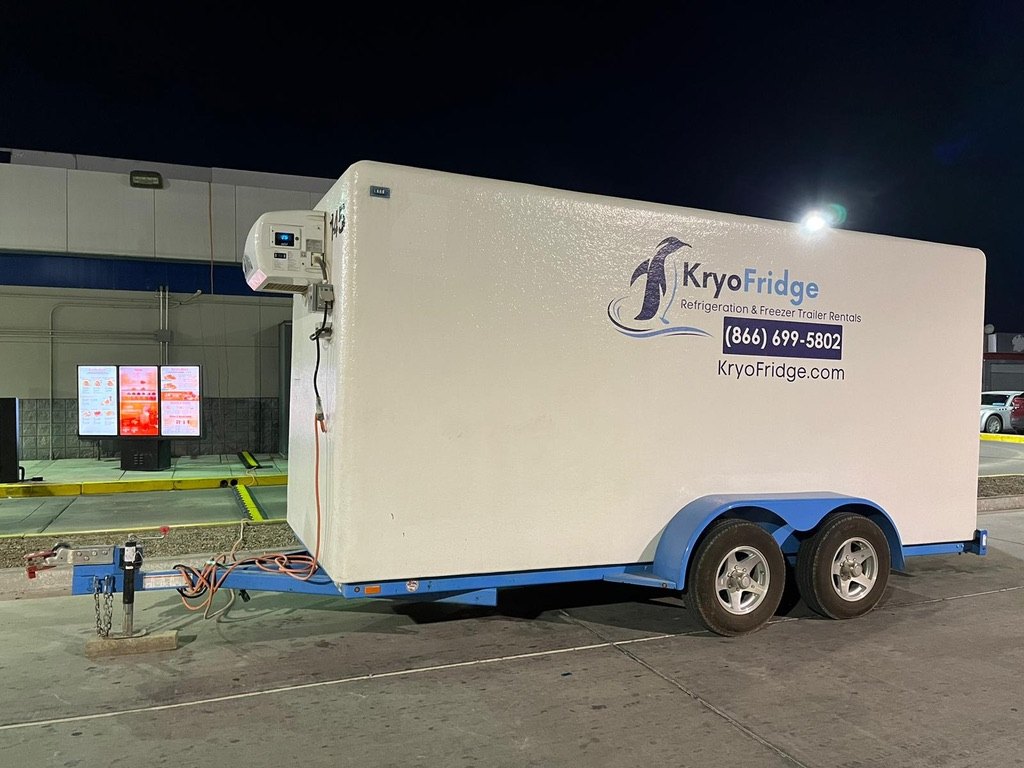
Every KryoFridge box is a true walk-in, not a highway reefer with a door cut into the side. You step in and load standing up. You work it like the cold room you already have. The KF8 gives you about 268 cubic feet and a 3,000 pound payload, which covers a small kitchen or a back room. The KF12 runs about 416 cubic feet and 4,300 pounds. That is our most common Arlington drop. The KF16 tops out near 564 cubic feet and 6,690 pounds, sized for a distribution dock or a vendor row feeding a stadium crowd. All three dial from about 50 degrees down to about negative 10, so the same box holds produce in April and hard frozen product in August.
Power goes one of two ways. A dedicated 120 volt, 20 amp circuit within reach runs the unit fine, or we bring a generator and the question disappears. Downtown hotel docks and grocery back lots usually have the circuit. A vendor row on a closed street during race weekend does not. So we settle it before the truck leaves the yard. Nobody should be hunting for an outlet with a pallet of seafood going soft behind them.
And the depth matters more than the spec sheet on a busy week. KryoFridge runs one of the largest refrigerated and freezer fleets in every market we serve, which is the difference between a yes and a callback when half the Entertainment District wants cold space on the same Thursday. The same three sizes go out on our St. George cold storage trailer rentals up in Utah, so the numbers above do not change when the ZIP code does. One unit behind a taproom or six across an industrial yard, same fleet either way.
Arlington has a real beer scene now, and most of it sits within a couple of miles of downtown. Legal Draft Beer Co. has been pouring on East Division Street for years. Division Brewing runs a taproom off East Main. Push northwest and you hit Rahr and Sons and Martin House over in Fort Worth. Push north and you are in Grapevine wine country, where GrapeFest pulls a crowd every September. All of them share one problem. Cold space is the first thing they run out of and the last thing they can afford to build.
Brewing has two temperatures that matter to us. Cold crash sits near 34 degrees and drops yeast and haze out of a finished beer before packaging. Cellar and keg storage lives closer to 38. A brewery that lands a big keg order for a Rangers home game stretch suddenly has forty kegs and room for twelve. That is a rental, not a construction project. We set the box and they roll kegs straight in. The taproom keeps selling.
Event weeks are their own animal here. Globe Life Field averages close to 29,593 fans a game, and Texas Live! carries eleven restaurants and twenty two bars a hundred yards from the gates. Levitt Pavilion runs about fifty free concerts a year downtown. A brewery supplying any of that is holding product for a weekend it cannot restock in the middle of, and a portable cold box behind the building is how that inventory survives the run.
We also do the boring long jobs. A cellar expansion that takes four months is four months of holding somewhere, and the box parks on the gravel out back and gets forgotten in the best possible way. We service it on a schedule so nobody has to chase us. Most brewery lots have a circuit we can use. When one does not, the generator comes with the delivery and we handle the fuel.
This work is quiet and it is steady. Funeral homes along Bowen Road and Pioneer Parkway run small fixed coolers sized for a normal week, and the Tarrant County Medical Examiner in Fort Worth covers the whole county from one building. A normal week is fine. The trouble comes when a storm, a heat run, or a hard flu season stacks up more than the fixed space was ever built to hold.
What this job asks for is different from a kitchen job. The box holds a steady 36 to 38 degrees and does not drift. It locks. It sits out of public view, behind the building or inside a screened yard, not in the front lot where a family parks. It runs quiet enough for a street with houses across from it. We deliver these after hours when the home asks us to, and our driver does not make a production out of it.
The January storm week of 2026 made the point for the whole region. Ice came in on the 23rd, and icy rain and snow followed. Power stayed out for days in the worst pockets. Everything downstream backed up. When transport slows down and services get pushed, holding capacity is the constraint nobody planned for, and it shows up over a weekend when no equipment dealer is answering.
The other half of this work is planned. A cooler replacement, a chapel remodel, a building addition, each one needs somewhere to hold for weeks at a stretch. We set a temporary cold storage unit on a level pad and hand over the keys. Discreet delivery, locked doors, one number that gets answered at two in the morning.
"Cold" is not one number. Different product stays safe inside different temperature windows, which is the entire reason a precise digital set-point matters, and in the middle of a heat wave in Arlington, a load that slips out of its window is a load you write off. Use the chart below as the reference our customers lean on when they size a rental.
| Product | Target holding band | Trailer mode |
|---|---|---|
| Ice cream and frozen desserts | -10°F to 0°F | Deep freeze |
| Frozen proteins, seafood, prepared meals | 0°F or below | Freezer |
| Fresh meat and poultry (short hold) | 28°F to 32°F | Refrigerated |
| Dairy, deli, packaged produce | 34°F to 38°F | Refrigerated |
| Beverages, florals, catering trays | 38°F to 45°F | Refrigerated |
One figure matters more than everything in that chart, and it is not listed there: 40°F. Food-safety guidance treats the band between 40°F and 140°F as the zone where bacteria thrive, and the clock on perishable product starts ticking the moment it crosses 40 on the way up. Roughly four cumulative hours above that line and most refrigerated inventory is no longer safe to serve. Picture that countdown running on a 100-degree afternoon in Arlington with the walk-in dark, and the urgency of a quick trailer drop stops being abstract.
Tell us the single coldest item you are holding when you call, and we dial the trailer to that. One unit carries a straight freezer load with no fuss. But when your list mixes deep-freeze desserts with fresh-cold produce for the same remodel or event, we will usually point you toward a split setup or a second box so neither side of the load has to settle for the wrong temperature.
Powering one of our trailers is refreshingly simple, and there are precisely two ways to do it. Either you have a dedicated 120-volt, 20-amp circuit reachable within roughly 100 feet of the parking spot, or we bring a generator. What the units will not accept is standard 208 to 240V building service, so a quick question about your outlet before dispatch heads off any surprise on delivery day.
On placement, all the unit really asks for is a fairly flat patch with enough room for the delivery truck to maneuver it in and set it straight, plus either a power source in reach or space for a generator. We lock down the exact drop point before dispatch, and our drivers know the Arlington layout cold, so the delivery is one clean trip instead of a guessing game on the property.
Street closures for the Java House Grand Prix went in early on a Thursday, and a vendor row inside the circuit had no cold space and no way to drive one in after Friday morning. We set a generator powered unit at 6 a.m. Thursday, before the barriers went up. It held product for all three days of the March race weekend, and not one truck had to cross the course.
During the January ice storm a distribution dock in the Great Southwest Industrial District lost power with inbound trucks already rolling. We had a generator powered trailer backed to the dock that afternoon. They kept receiving through the outage and never took a spoiled product write off.
A keg cooler quit two days before a release that a distributor pickup date was already built around. We delivered a box set to cellar temperature that same afternoon and rolled the kegs straight across. The release poured on schedule.
We stage close to the district during event weeks. Arlington's Entertainment District drew 15.6 million visitors and 2.8 billion dollars in visitor spending in 2023, and the 2026 calendar was heavier still. When that many people eat inside one square mile, cold space gets tight fast. We keep units staged near the district on big weeks so a same day call is a short drive instead of a wish.
On a bad day, booking should be the part that does not add stress. Four steps, an upfront number, and a single person who owns the whole thing.
Tell us whether it is freezer or fridge product, a ballpark volume, and your rough window. That is enough for us to call the right size.
We pair you with a unit, confirm whether you have a dedicated circuit or need a generator, and pin the exact drop point so the truck makes one trip.
We arrive on your schedule, about 45 minutes for a true emergency, set the trailer, energize it, and let it drive down to your number.
It holds the set-point for your entire term while our line stays live the whole way through. Wrap up, and we swing back for the pickup.
Arlington runs its own retail and temporary food permitting through city Health Services instead of handing it all to the county. A Temporary permit covers 1 to 14 days and gets pulled per vendor, tied to a permitted special event. A Seasonal permit covers 15 to 180 days, which is the one that fits a full theme park season or a long hotel and event cycle rather than a single weekend. Get it in at least 10 days ahead. Late fees start after that. The permitting office is at 817-459-6693.
One thing changed on July 1, 2026 that catches people out. Mobile food vendors now pull their annual permit from the Texas Department of State Health Services instead of from the City of Arlington, while the city still permits temporary mobile units tied to a specific event. There is also a commissary requirement worth knowing: a stationary cart under a temporary authorization has to return to its commissary at the end of every business day. A placed cold box on site changes that math for a vendor working a multi day run.
Placement splits into two worlds here. On private property the site owner decides. The real limits there are level ground, a clear cord run, and enough room for the door to swing. Inside a closed street or a public right of way, the event footprint and its clock decide instead. The fire lane still has to stay clear, the same way it does for a booth. If you are running heavy wash downs at a big site, hauled liquid waste falls under state transporter registration through the Texas Commission on Environmental Quality, which almost never touches a self contained cold trailer but is worth knowing before someone assumes.
One caveat we always state plainly: we supply the food-safe, temperature-holding hardware itself, but we are not a temperature-logging or alarm-monitoring service. If your program requires continuous written records, line that vendor up on your own.
Our signature 16 foot Utility series leads the fleet. It is the trailer we send on most jobs, and crews like it for the side utility access door. We build three footprints in all, so a single kitchen holding overflow stock has a fit and so does a distribution floor in a disaster. Every unit is dual purpose by design: one adjustable system swings between freezer and refrigerator on a digital set point. Each trailer runs on a dedicated circuit or on a generator.
| Trailer | Best for | Temp range |
|---|---|---|
| 6x16 Utility ⭐ | Our signature series: distribution, large events, disaster response, side utility door | Heavy-duty reefer |
| 6x12 | Grocers, caterers, mid-size events | Deep-freeze capable |
| 6x8 | Tight lots, small kitchens, short overflow | -10°F to 50°F |
Each unit holds a precise digital set-point and runs on a dedicated 120V/20A circuit or a generator.
Think eight or so pallet spots, and the unit to grab when square footage is the whole problem. It slips into the pinched service yards and cramped back-of-house corners that a larger box cannot even swing into. One cafe or small-market walk-in goes down, and this is almost always enough cold to cover it, plus the simplest unit to set in a small space.
Call it fourteen pallet spots, deep-freeze rated, and far and away the size people ask for most. It lands right in the middle: roomy enough for a multi-day catering job or a restaurant that needs true walk-in-equivalent room while the kitchen is torn up. Roomy enough that nobody is playing Tetris with shelves, yet still small enough to set in most commercial back lots without a site survey.
Roughly twenty pallet spots paired with a heavy-duty reefer plant engineered to keep deep-freeze locked in even when the ambient air is merciless. Reach for it when a warehouse bay drops, when a large festival needs an anchor, or when a relief operation is carrying its own cold chain.
Not sure which size fits? Most customers land on the 16 foot Utility, and we will tell you honestly if a smaller footprint covers your job. Tell us roughly what you are storing and for how long, and we will spec it for you.
The questions that surface once the basics are settled. Tap any topic to open it.
The pop-up walk-in cooler. Cheap to rent and easy to set up, but it chills, it does not freeze, and it draws every watt it needs from your building while depending on a calm ambient temperature around it. The second your building loses power, your cooler loses it too.
The refrigerated box truck. Designed to haul product on the interstate, not to sit in a lot and babysit it. Parked, it burns fuel all day, broadcasts compressor noise across a storefront or an event lawn, and pins down a tractor plus a driver you probably do not need.
The freezer trailer we deliver. Built from the ground up to be dropped on a pad and to defend a temperature for as long as the job runs. It freezes deep, carries NSF approval, locks, stays quiet near guests, and lives on nothing more than one dedicated circuit or a generator.
Even a rented box has to satisfy the county environmental health office that licenses and inspects every food facility. Show an inspector a unit that cannot document its temperature or was not built for food contact, and they have the authority to halt service immediately.
That is a bar each of our trailers clears: NSF-approved throughout, food-safe interior surfaces, proper drainage, and a digital controller that puts the set-point in plain view. We supply the food-safe, temperature-holding hardware itself, but we are not a temperature-logging or alarm-monitoring service.
For a typical kitchen or market, one box does the job. Distribution floors, big fairs, and full-scale disaster response routinely need more, and because the fleet is ours, we can cluster several units and bring them online in waves as the work expands. Match the cold capacity to the operation rather than make the operation squeeze itself into one box.
The clock is yours to set. Some jobs are a handful of days for an emergency or a single event. Others stretch across weeks or months for a remodel or a seasonal swell, and a few become standing contracts for businesses that want capacity parked on standby. Name your window and you will get a clean quote, no penalty for an honest "not sure yet."
Building permanent cold storage is a capital project in every sense: you hire a refrigeration contractor, schedule the electrical, pull a building permit, and wait weeks before a single pallet goes inside. A rental turns that equation on its head. You bring in precisely the cold you need, for precisely the stretch you need it, and the trailer is holding temperature that same week, frequently that same day, with the commitment ending the moment your need is over.
Three engineered elements carry the load. Thick insulated panels and tightly gasketed doors lock the sun outside and the cold inside. A self-contained reefer condensing system specified with surplus capacity keeps stripping heat out of the box even when the air outside is brutal. And a digital thermostat locks onto your chosen number and cycles the compressor to hold the line. Run those three together and a trailer baking on open asphalt behaves like one tucked in a cool warehouse. That is also why power is the first thing we ask about: the design delivers its safety margin only on steady, uninterrupted power.
"Delivered after hours, parked behind the building, locked. Handled the way I would have handled it myself."
"Berries leave zero room for error and my crew opens that door all day. They talked me into the bigger box instead of selling me the one I asked for. They were right."
"We landed a keg order for a home game stretch that was double what we had room for. One call, box on the gravel the next morning, kegs rolled straight in."
"Ice storm week. Power was out, and our walk-in was a warm closet. I was watching thousands of dollars tick up in temperature. They ran a generator unit to us that afternoon and I did not lose a case."
"Got it in before the barriers went up, which nobody else would even try to schedule."
"Four day remodel turned into six and they just extended it. No drama, no arguing, no surprise about the extra days."
"We feed crews on a long job and the cafeteria was never built for our headcount. The unit sat on our laydown yard for five months and got serviced without me chasing anyone."
"The paperwork side was the surprise. Insurance certificate and licensing came over the same day I asked, which never happens with rental companies."
"We needed holding space while our cooler was replaced and it ran quiet enough for the houses behind us. Six weeks, steady the whole time, pulled the day they said."
Yes, and both extremes showed up here in the same year. August 2026 brought a 109 degree afternoon. January brought Winter Storm Fern, with ice, icy rain and outages that ran for days. Our boxes carry a roof mounted condenser and insulation sized for sustained load, not mild weather. In heat, placement decides it, so we keep the unit off a west facing wall with airflow clear. In an ice event we bring a generator ahead of the storm.
Both, plus a few things people do not expect. Unit size, how long you hold it, whether you need a generator, the drive distance, and how much site work the placement takes all move a quote. A long placement on an industrial yard is a very different job than a three day drop inside a closed street with an approved delivery window. Tell us the product, the volume and the dates and we will put real numbers in front of you.
Start with pallets, then adjust for the door. The KF8 covers a small back room. The KF12 handles most restaurant and brewery work, and the KF16 is the dock and vendor row unit. Then ask how often that door opens. A box opened four times a day and a box opened every ten minutes on a receiving shift are doing completely different work, and the second one needs more room and better placement to keep up. We would rather size it right on the phone than fix it on delivery day.
You call the same number and we move. Dispatch is staffed around the clock, so a 2 a.m. failure gets a live person. Most issues get fixed on site by a tech. If it cannot be fixed quickly, we bring a replacement unit and transfer the product, and we own that timeline. Running one of the largest fleets in our markets is why a swap is a real option instead of a promise.
Earlier than feels necessary. The Entertainment District packed nine World Cup matches into one calendar year on top of a full Rangers season and a 65th Six Flags season, and cold space across the metro got tight on the same days every time. For a known event week, book weeks out. For a home game stretch or a concert run, a couple of weeks is usually fine. Emergencies are different, and we hold capacity back for them.
The doors lock and you hold the keys, which covers most of it. Beyond that, put the unit inside your existing fence line or camera coverage if you have one, and face the door toward the building instead of the street. On downtown and campus sites we usually set it where it is visible from an occupied window. For funeral and mortuary work we go the other direction and place it out of public view behind a screen or a fence.
On private property, usually not. The site owner makes the call, and the real limits are level ground, a clear cord run and door clearance. On a closed street or a public right of way, the event permit and its footprint decide how long the unit can stay. If the trailer supports a food operation, the food permit is the piece that matters most. Temporary covers 1 to 14 days, and Seasonal covers 15 to 180. Applications go in at least 10 days ahead.
One box holds one set point, so it cannot be 38 degrees and negative 10 degrees at once. What our units do is dial anywhere between about 50 and negative 10, so the same trailer you use as a cooler in April becomes a freezer in July with a setting change. Customers who genuinely need both at once take two units, and that is common on distribution docks and long catering runs. We will tell you which way to go once we know the product mix.
They are, but the timing is everything. The IndyCar street circuit is built through public roads in the district, so once the barriers go up the delivery route disappears. We set units before closures begin, usually a day or two ahead, and we plan the pull for after the course comes apart. Race weekend crowds ran 75,000 to 80,000 people across three days, so you cannot just wing a truck through that footprint on a Saturday.
Depends on whether your problem is volume or traffic. If you simply need more space, one KF16 beats two smaller boxes and takes less site work. If you have two crews, two product types, or two ends of a big site, two units win. Seasonal food permits run 15 to 180 days here, so a long park is normal in this city, and we build the service schedule around it either way.
Because a fixed unit has been pushing since April with no break. Summer 2026 stacked triple digit afternoons and warm nights, so the equipment never got the overnight recovery it was designed around. Add a dirty condenser coil and a hot slab and a marginal compressor picks the worst possible week to quit. If you are inside a rough stretch, clean the coils and have a backup plan on paper before you need it, not during the failure.
Different footprint, different job, same fleet and the same crew standard behind it.
Event work in this city is not like event work anywhere else, because the venues sit on top of each other. AT&T Stadium, Globe Life Field, Texas Live! and the Loews hotels are inside about one square mile, and a single weekend can put six figures of people through that footprint. If you are feeding any part of it, the question is not how much product you own. It is how much you can hold, reach and replace inside a footprint that becomes a traffic problem by Friday noon.
Start with the load, in pallets. Count what you plan to have on site at the peak, not the average. Most catering crews guess low here because they picture the start of the weekend instead of the middle of it, when yesterday's backup stock and tomorrow's delivery are both in the box at the same time. The KF8 holds about 268 cubic feet. The KF12 holds about 416, and the KF16 about 564. Pick off the peak day.
Most cold storage rentals get picked on one question, which is availability. That is how people end up unhappy. Anybody can park a box. But what separates companies is the bad day, and you cannot find that out after the compressor quits. Here is what we would ask if we were the ones calling around this city.
Ask who actually owns the trailer. Plenty of listings you find are brokers who will call a company like ours after you pay them. That middle layer costs you hours on an emergency and gives you nobody to hold accountable when a delivery window slips. Ask directly. A company that owns its fleet answers the question straight, without dodging it.
Further reading: City of Arlington retail and temporary food inspection program.
The delivery goes well or badly based on decisions made before the truck leaves our yard. Almost every rough drop we have had in this metro traces back to one of four things: ground, power, clearance or access. None of them are hard to solve a week out. All of them are miserable to solve with a driver stuck waiting in your lot.
Ground first. The pad needs to be level and firm enough to hold the unit without settling. Asphalt and concrete are ideal, and compacted gravel works. A grass area after three days of rain does not. Arlington clay holds water longer than people expect, and a spot that looked solid on Monday can rut on Thursday. If your only option is soft, tell us and we will bring support blocks.
The clock starts before anybody realizes the clock has started. A walk-in that quits at midnight can sit at a safe temperature until breakfast, which is why most failures get discovered late and why the first person to notice is usually a line cook, not a manager. What you do in the next hour and a half decides whether this is an expense or a disaster.
Minute one: stop opening the door. A full, closed box holds cold far longer than people expect, and every open resets that clock. Get a thermometer reading from inside the product, not from the air. Write down the number and the time next to it. That note is the most useful thing you will have later, whether you end up talking to an inspector or an insurance agent.
Further reading: USDA food safety during a power outage.
Give us a call at 866-699-5802 or send the quote request. Tell us what needs to stay cold and how much of it there is. Then tell us when you need it. You get a straight answer and a size recommendation right away. We also have a delivery plan ready the same day.