
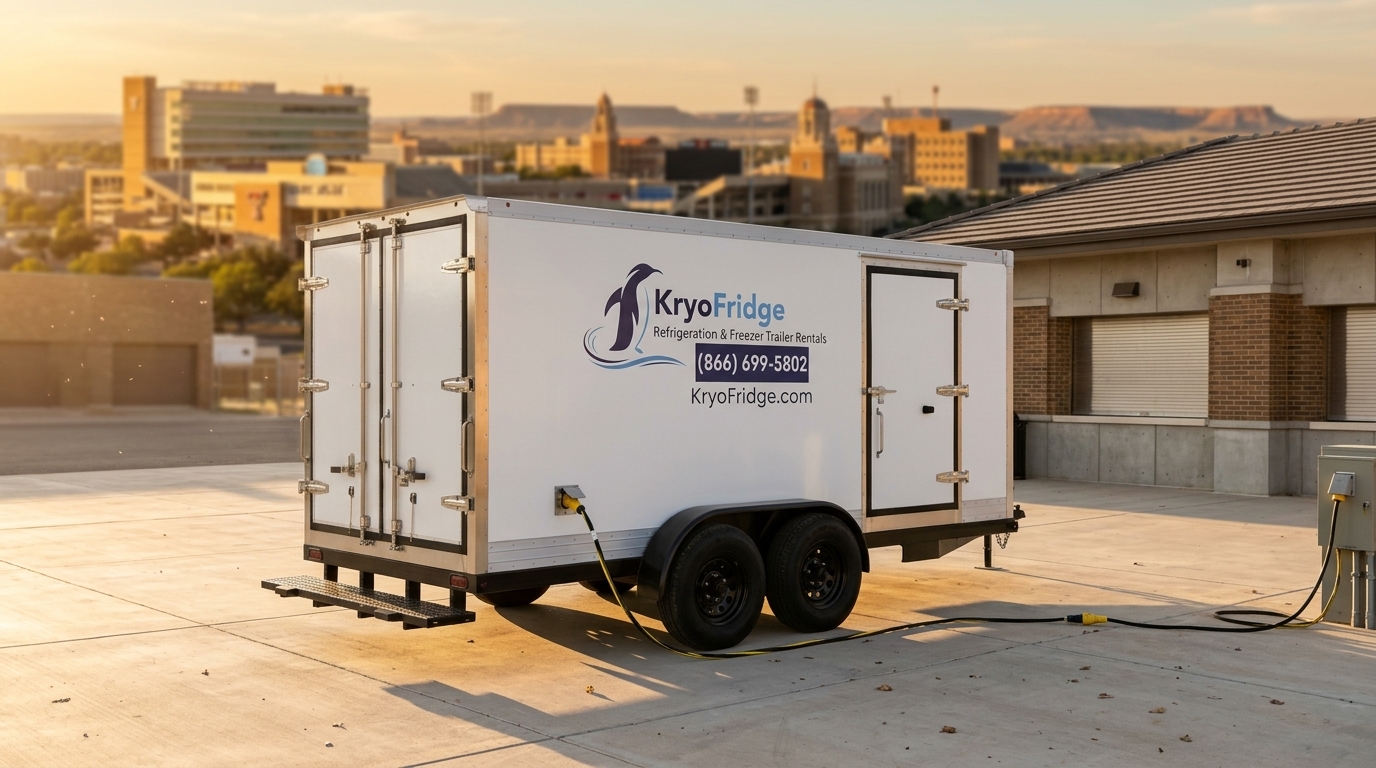
KryoFridge runs same-day cold storage into Lubbock, seven days a week. Tell us what quit and how much has to stay frozen, and we bring a walk-in freezer trailer to your lot, set it level, plug it in, and hand it over already holding temperature. We have parked units behind downtown kitchens, out at the South Plains Fairgrounds, and on clinic docks along Quaker Avenue. Call now, or request a free quote, and we will confirm the drop before your product warms up.
A walk-in quits at 2 a.m. and the spoiled product clock starts on everything inside it. We answer that call the same day, roll portable cold storage onto your lot, and stop the loss at the box that failed instead of letting it run through the rest of your inventory. KryoFridge has been in the rental business more than 30 years. We own every trailer we send, and no broker sits between you and the yard. That is why we are the first call for emergency cold in this market. Call us now or ask for a free quote, and you will get an honest delivery window before you hang up.
Dial 866-699-5802 and you reach someone who knows which trailers are sitting on the lot today. No ticket queue. No promise of a callback.
Every unit dials from about 50 degrees down to about negative 10. A produce hold in spring and a hard freeze in October can be the same trailer, so you are not renting twice for two jobs.
Either a dedicated 120 volt, 20 amp circuit within 100 feet, or our generator. We ask about it on the first call so nobody is hunting an outlet on delivery day.
KryoFridge is not a broker handing your job to whoever has a trailer free that week. The fleet is ours and the crew that services it works for us.
We came out of a rental family with more than 30 years in event and equipment rental. It shows up in small things, like knowing a fairgrounds drop has to happen before the midway sets up.
Certificates go out without a chase. Hospital and school jobs in this market ask for them up front, and we keep them waiting rather than scrambling.
The names below have all run our trailers on real jobs. When a brand this size hands you their frozen inventory, they have already checked everything worth checking.
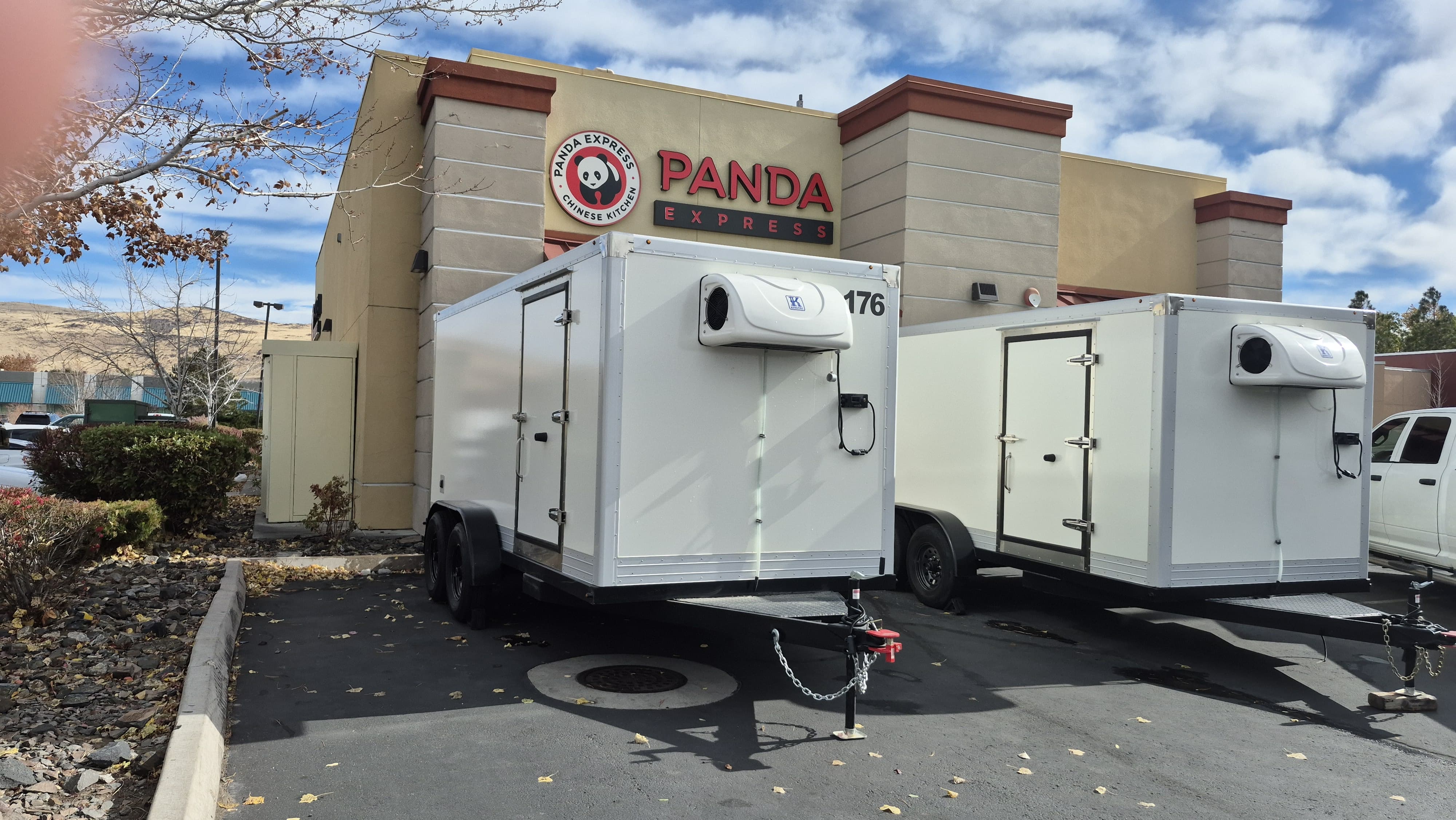 Panda Express
Overflow freezer space behind high-volume locations, holding bulk frozen product between distributor drops.
bulk overflow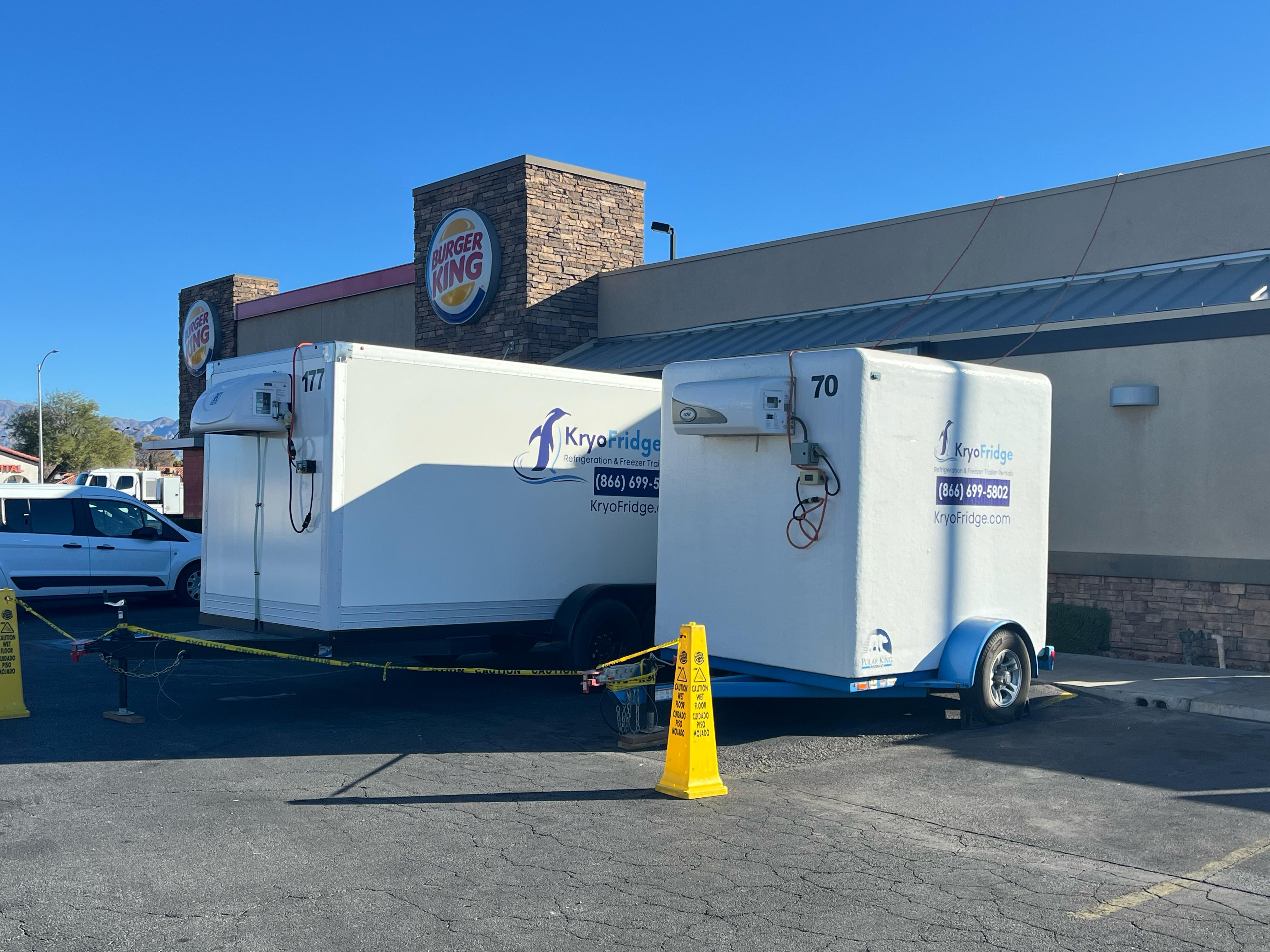 Burger King
Frozen stock held at spec through a compressor replacement so the location never dropped a menu item.
same-day swap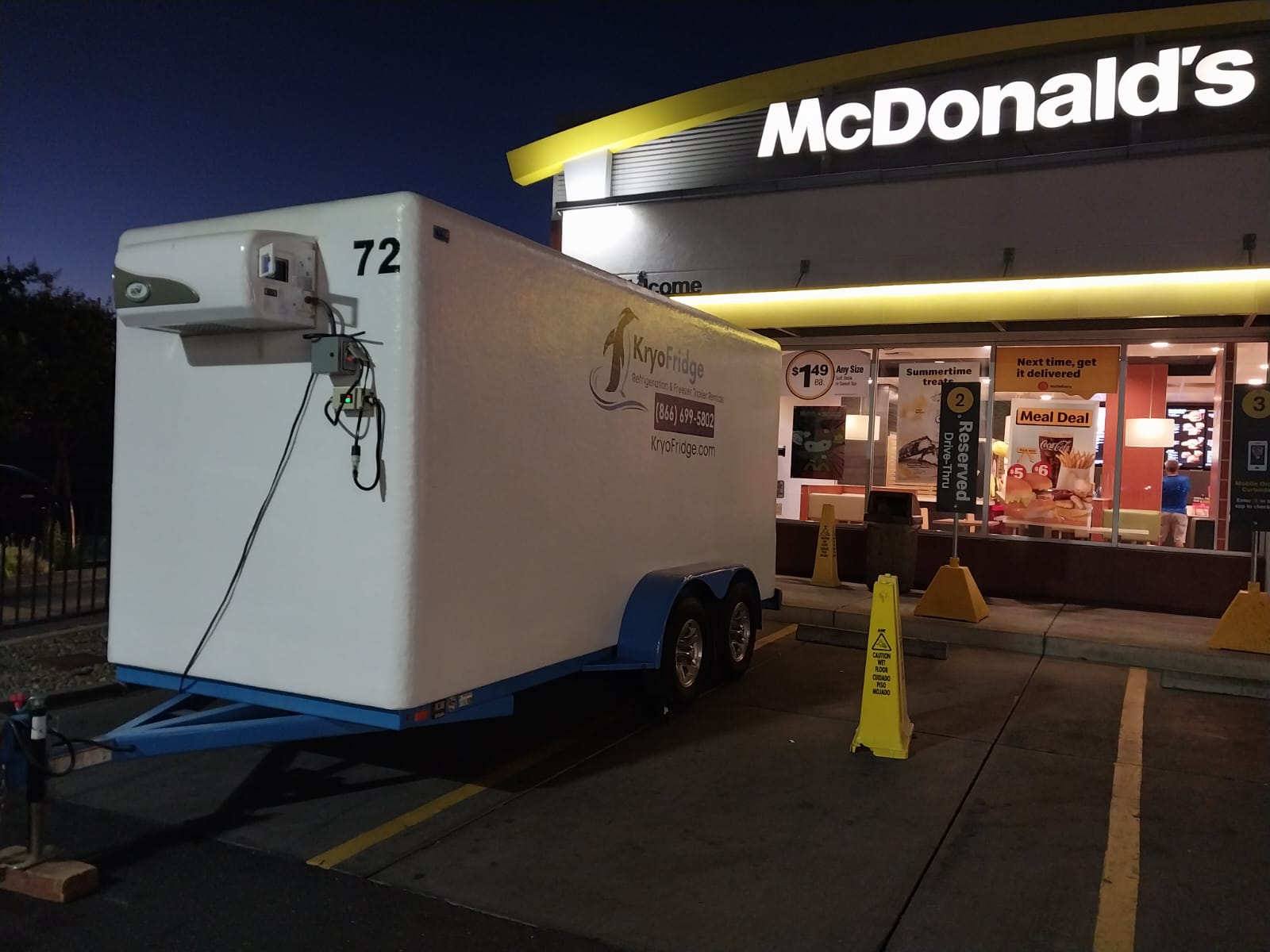 McDonald's
Overflow frozen holding behind high-volume locations during remodels and equipment swaps, so the menu never shortens.
national account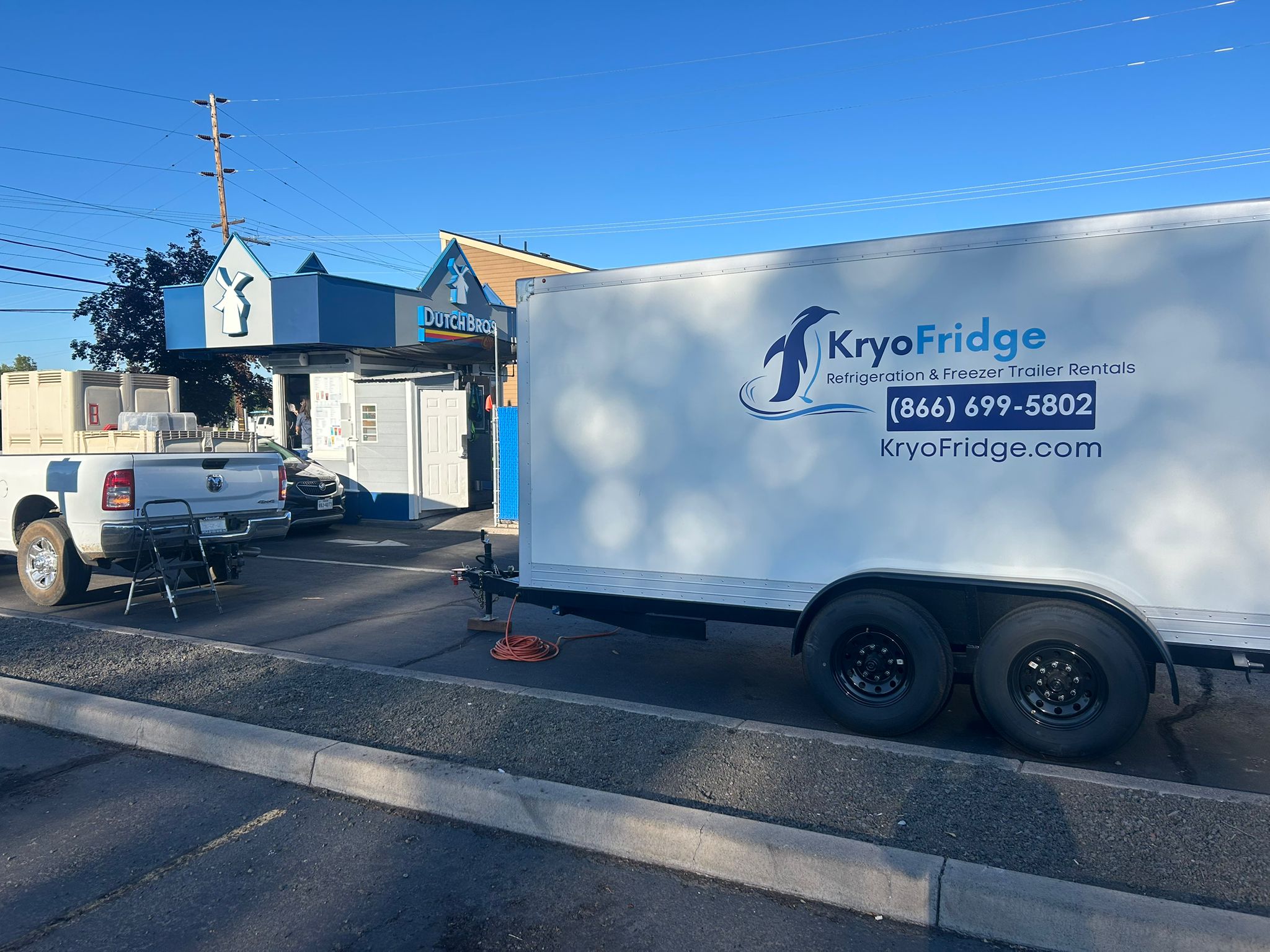 Dutch Bros
Trailer capacity holding frozen and dairy inventory for multi-stand markets between deliveries.
multi-site account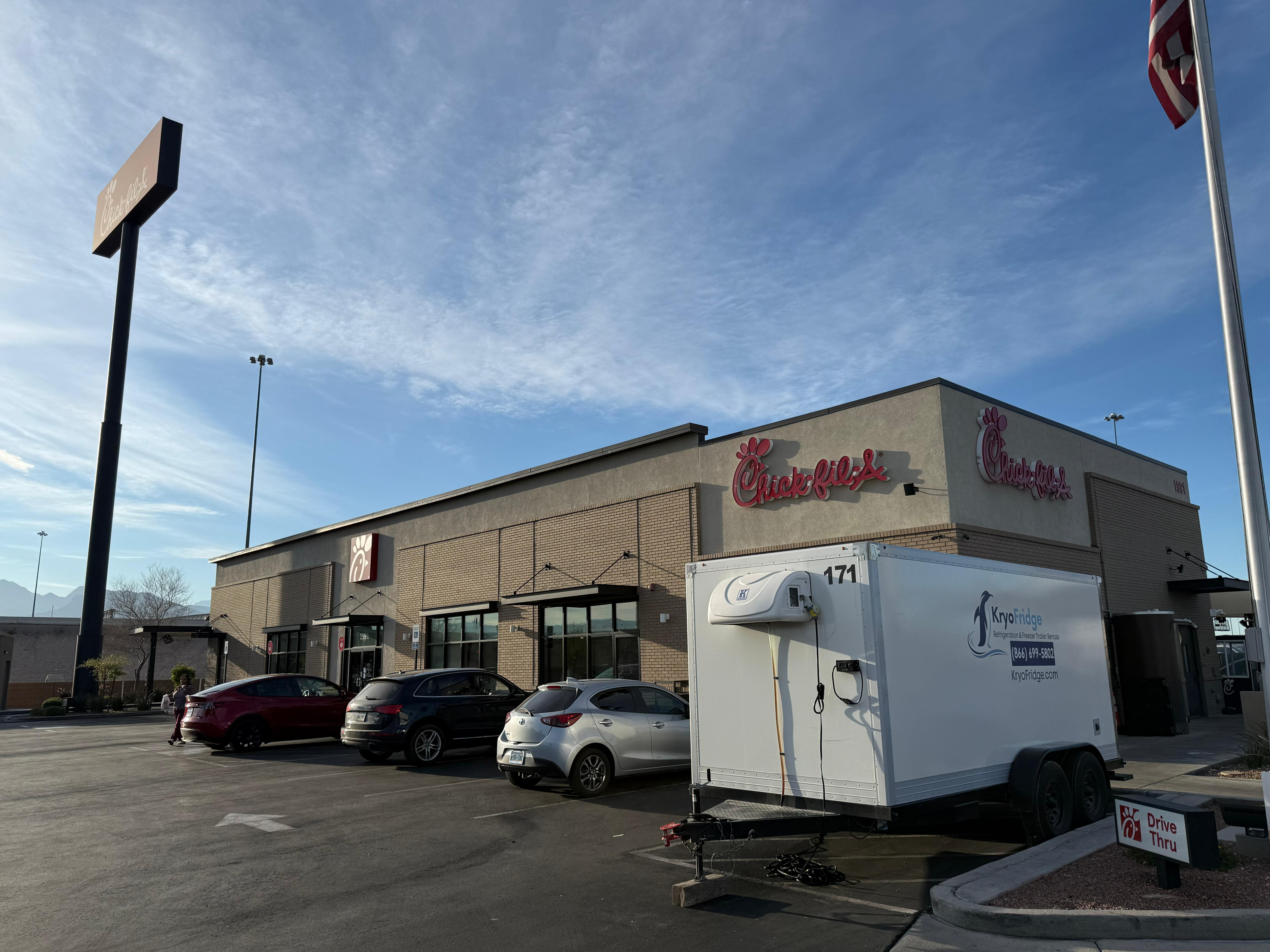 Chick-fil-A
Trailer cold storage through store remodels so frozen prep stock stayed at temperature from teardown to reopening.
zero thaw loss"Cooling unit loop failed in the middle of crush. They had a refrigerated unit on my pad the same afternoon and it held the cold-soak temperature I asked for. That saved a whole block of fruit."
"Our walk-in went down on a Wednesday. The trailer was in the alley before the dinner prep started and we never closed."
"We lost power after a hail storm and I expected to throw out the frozen aisle. Their driver showed up with a generator already on the truck. Zero write-offs, which I still have a hard time believing."
For a downtown taproom or a Broadway storefront kitchen, the KF12 is usually the first unit we send, roomy enough for a real pallet run and still narrow enough to back down a service alley.
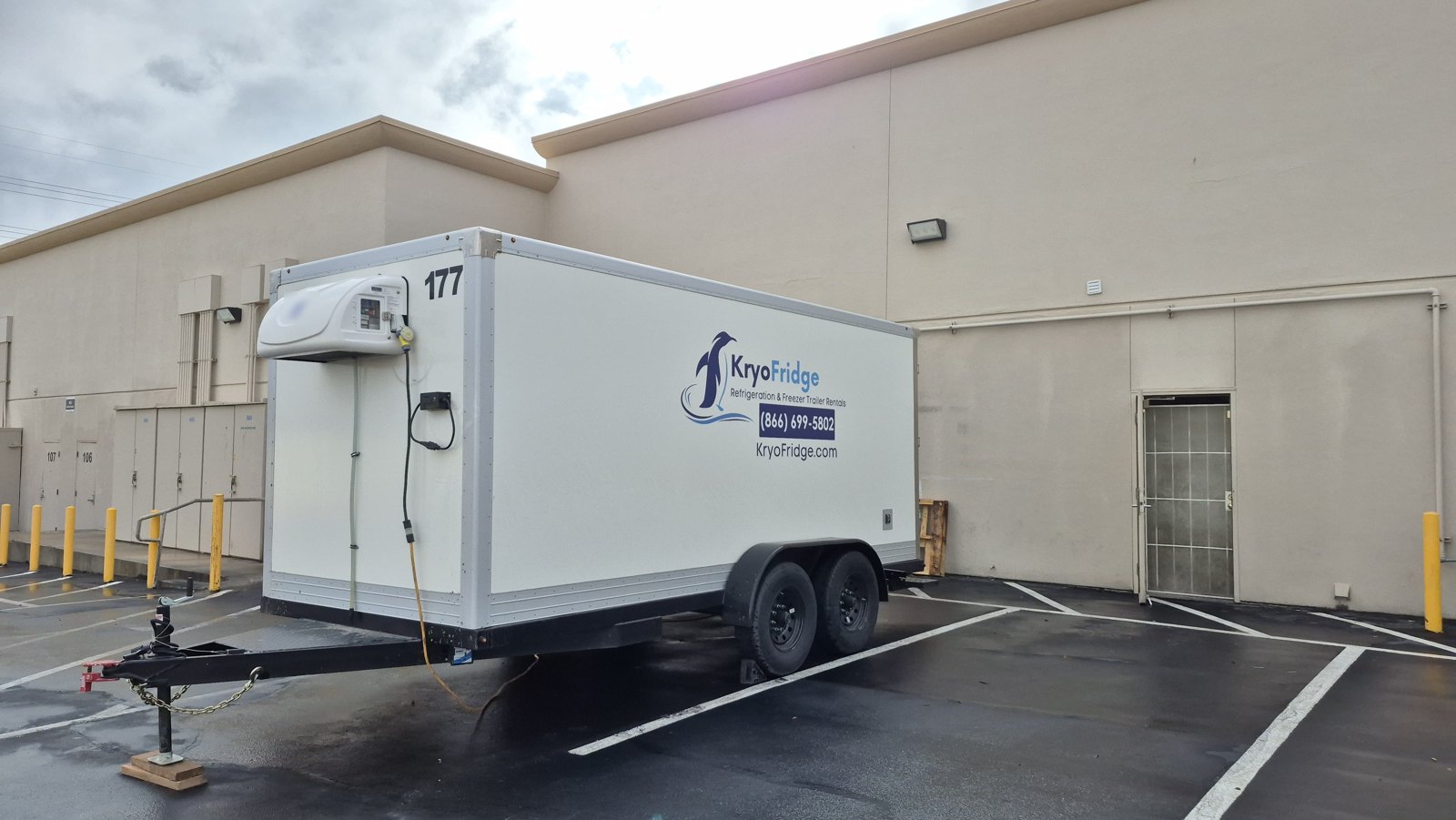
The 16' Utility is the trailer our crews reach for when the job is serious. A 16-foot insulated box on a tandem axle holds anything from -10°F deep-freeze to 50°F fresh-cold on one precise digital set-point, with NSF-approved surfaces throughout. Rear double doors take pallet loads straight off a dock, and the side utility door lets a cook grab one tray without opening the whole box to the heat.
We own every one of these units, so the trailer that shows up is fueled, pre-cooled, and maintained in-house. It runs on a dedicated 120V, 20-amp circuit or a generator we supply, and it holds its number through triple-digit afternoons. When a walk-in dies or a harvest runs long, this is the box that carries the load.
| Spec | What you get |
|---|---|
| Temperature range | Roughly -10°F deep-freeze up to about 50°F fresh-cold |
| Mode | Dual-purpose: freezer or refrigerator on one precise digital set-point |
| Power | A dedicated 120V, 20-amp circuit within about 100 feet, or a generator we supply |
| Food safety | NSF-approved for direct food contact, food-safe surfaces, proper drainage |
| Footprints | 6x8, 6x12, and 6x16, from a tight retail lot to distribution scale |
| Backing | Owned in-house, fully licensed and insured, with 24/7 emergency dispatch |
Each unit holds a precise digital set-point and runs on a dedicated 120V/20A circuit or a generator. The trailers are not wired for 208 to 240V building service, so we confirm your hookup before the truck rolls.
Our trucks cover the city grid, the Loop 88 corridor, and the farm towns out toward Levelland and Plainview. Customers who weigh this market against our Tulare refrigerated trailer rentals find the same fleet and the same delivery standard behind every stop. Same equipment. Same yard. We route larger drops through the business park and freight corridors that local haulers already use, which keeps a wide trailer out of a tight residential street.
Neighborhoods and towns we cover include Downtown Lubbock, Cultural District, Depot District, Tech Terrace, Overton Park, South Overton, Maxey Park, Clapp Park, North Overton, Lubbock Business Park, Reese Technology Center, South Plains Fairgrounds, Wolfforth, Shallowater, Slaton, Idalou, New Deal, Ransom Canyon, Levelland, Plainview, Abernathy, Brownfield, Littlefield, Post.
Each community around Lubbock has its own venues, its own events, and its own cold storage headaches. We work all of them.
Wolfforth went from about 3,670 residents in 2010 to an estimated 9,329, and the buildout shows on every corner. Most jobs out here are new construction or a restaurant fit-out. We plan for a generator until the meter is live.
Levelland sits 30 miles west on the Llano Estacado, with cotton, oil work and South Plains College behind most of its food service. Rentals here tend to run longer. A replacement compressor takes days to reach town, and everybody knows it.
Plainview is a food-processing town about 45 miles north, with Wayland Baptist University in the middle of it. Cold storage demand here leans agricultural and seasonal rather than event driven, so holds are measured in weeks.
Shallowater sits at the north end of the Loop 88 corridor, a quick run for our trucks. School and church kitchens make up most of what we deliver there, usually a single unit on a Friday.
Slaton anchors the south end of the same loop, close to the rail line. Jobs down here are usually longer holds on a private lot, and generator power is the norm rather than the exception.
These east-side communities are small but close, which keeps response time short. Most calls are one unit covering a local event or a small grocer whose freezer quit overnight.
One call sizes the trailer, sets the delivery window, and locks your quote for Lubbock. Call now, or send the quick quote request and we will call you.
Wineries and breweries, restaurant kitchens, and grocery cold overflow. Those three account for most of what we drop in this city. Each one has its own clock and its own power situation, and we have staged units for all three on real ground here.
Food vendors work the fairgrounds for nine straight days each fall, and the run lands in late September. One unit can cover a whole vendor row for the full stretch instead of each booth fighting over ice.
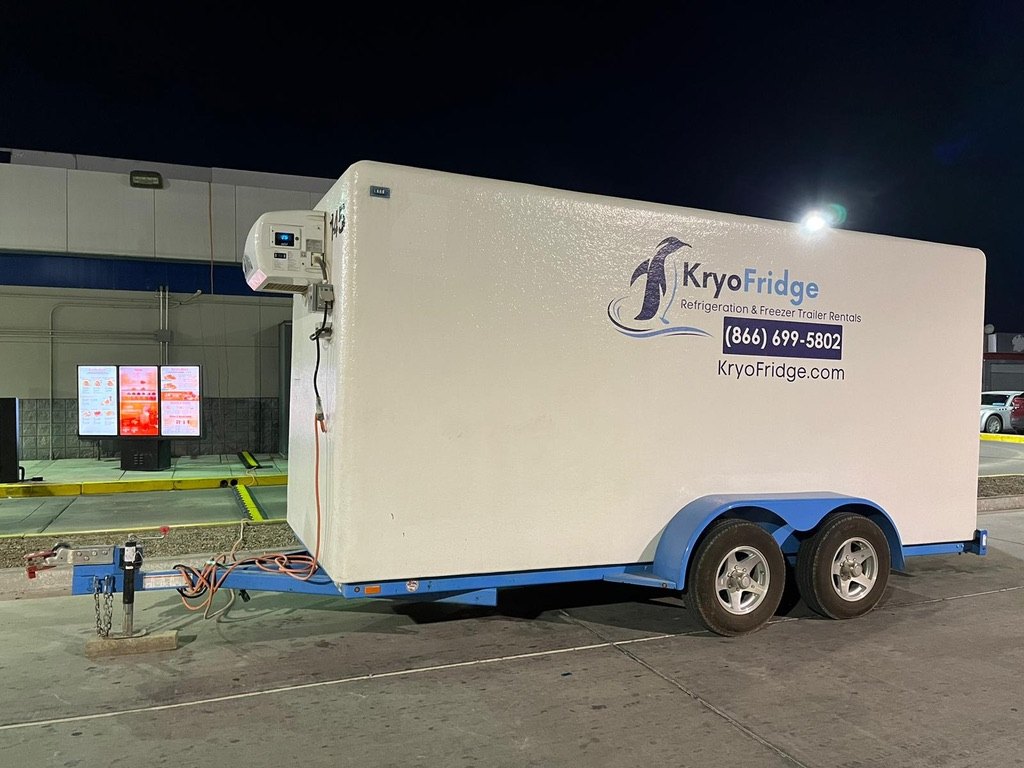
Home football weekends push several days of product into kitchens sized for a normal week. A trailer at the back of the lot holds the overflow and keeps the door close to the line.
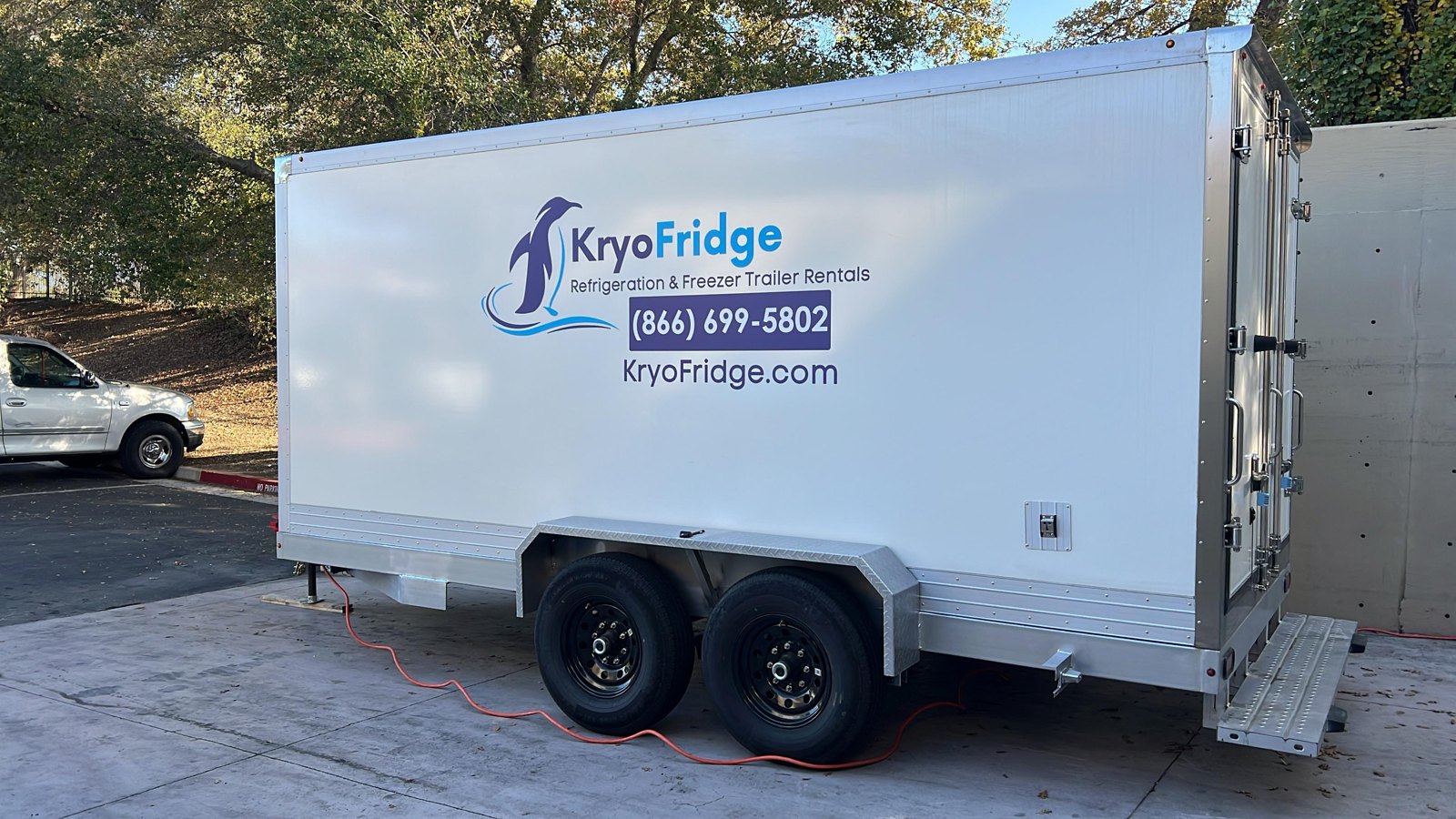
A dairy plant adding silos keeps producing while the new equipment gets set. Rented cold space holds product through the cutover instead of stacking it in a hallway.
Both hospital systems had renovation permits filed in 2026. Pharmacy and lab cold storage cannot go dark during a cutover, so a unit on the dock covers the window.
This city sits on the southwest edge of Tornado Alley, and one spring storm can pull power across whole blocks. A generator-fed unit keeps a kitchen or a store in range until the lights come back.
Grain, sorghum and cotton set the fall calendar across the South Plains. Smaller food businesses and co-ops rent cold space for a few weeks rather than buy a walk-in they use once a year.
What ties these together is the clock. Nobody budgets a freezer trailer into next quarter. They reach for one the hour a compressor quits, or the evening before a party when the stack of rented ice chests suddenly looks laughably undersized. Since our units sit staged around Lubbock instead of a couple counties down the freeway, "can I get it today" is an ordinary ask here, not a stretch.
Add it up the way an owner in Lubbock has to. One restaurant walk-in routinely sits on a small fortune in proteins, dairy, and prepped product. Scale that to a grocery rack or a warehouse freezer bay and the exposure balloons. Now knock the power or the compressor out on a triple-digit afternoon, and that whole inventory is in jeopardy inside a few hours. Then stack on the sales you lose while the line sits dark and the wages you burn paying staff to triage what can still be saved.
Hold a pre-staged trailer up against that risk and it reads like cheap insurance, a fixed, predictable expense parked in front of a loss with no ceiling. That is exactly why the businesses that got stung once tape our number by the phone. There is never a second scramble, because the next time they dial before the product has a chance to warm. Owning every trailer ourselves means we can scale the answer to fit. A single compact box suits a corner cafe. A clustered setup covers a warehouse floor. Either turns around the same day.
Summer here is a real load on fixed refrigeration. The average summer high is 91.6 degrees, about 92 days a year reach 90 or better, and roughly 13 days top 100. The all-time record is 114 degrees, set on June 27, 1994. A compressor that was fine in April is working much harder by July. That is when the phone starts ringing.
Wind and dust matter more than people expect. The city averages 12.4 mph and ranks among the windiest in the country. Blowing dust off dry cropland coats condenser coils and packs door seals until neither one works right. We set our units with the condenser end out of the prevailing wind wherever the lot allows it, and we check the coil at every service stop instead of waiting for a high-temp complaint.
Winter is milder but it is not nothing. Lubbock averages about 7 inches of snow a year, and the record low is 17 below zero, set February 8, 1933. A hard cold snap drops power lines just as readily as a summer storm does. Our boxes are insulated in both directions, so a unit holding 38 degrees during a freeze is not fighting the outside air to do it.
Lubbock sits in the middle of the Texas High Plains growing region, which supplies most of the wine grapes crushed in this state. Llano Estacado Winery has been making wine here since 1976. McPherson Cellars works out of the old Coca-Cola bottling plant downtown. When fruit starts coming off the High Plains in late August, a cellar has to get it cold fast, and cold is not something you improvise once the gondola is already in the yard.
Crush is the pinch point. A glycol loop that limped through July will pick harvest week to fail, and there is no waiting on parts once fermentation is moving. We stage a refrigerated unit at the crush pad so fruit and juice have somewhere to go. Cold soaking whites. Holding must. Parking finished barrels out of the heat. One box does all of it at whatever temperature setting the cellar asks for.
Breweries hit the same wall from another side. Two Docs Brewing Co. and the taprooms around downtown keep kegs, hops and yeast under tight cold, and a 1930s building was never wired for a second walk-in. Cutting a cold room into a taproom footprint is not realistic. Parking a mobile cold storage unit in the back lot is. We have done it during a bottling run and again during a remodel, and the door ended up a few steps from the cellar door.
There is a seasonal side to this trade too. First Friday Art Trail brings vendors downtown on the first Friday of every month, 6 to 9 p.m., and pouring events push a small cellar past what it holds day to day. Broadway Market, the food hall going up downtown with eleven craft kitchen stalls and a rooftop bar, will add another block of that same demand once the doors open. And the crews building it out need cold room on site while the permanent equipment is still on a truck somewhere.
Every unit in our fleet is a true walk-in box with a side man-door, not a reefer with a hole cut in the side. You step in and load standing up. The KF8 holds about 268 cubic feet and 3,000 pounds, which suits a small kitchen or a pharmacy back room. The KF12 gives you about 416 cubic feet and 4,300 pounds, and it is the size we drop most often here. The KF16 runs near 564 cubic feet and 6,690 pounds for a loading dock or a fairground vendor row. All three dial from about 50 degrees down to about negative 10, so one box covers a produce hold in May and a hard freeze in October.
Power works two ways, and only two. A dedicated 120 volt, 20 amp circuit within 100 feet of the trailer will run it. Or we bring a generator and the circuit stops mattering. A Broadway storefront usually has the outlet. A fairgrounds lot or a field site out past Shallowater usually takes the generator instead. We settle that on the phone, before the truck leaves the yard.
And there is real depth behind the fleet. KryoFridge keeps one of the largest refrigerated and freezer trailer fleets in every market we serve, which matters most during fair week, when half the food vendors in the county want cold storage at the same time. Businesses weighing our Tempe freezer trailer rentals against what we run out here find the same equipment and the same dispatch standard. Same boxes. Same voice on the phone.
Health care, education and retail are the three biggest employment blocks in this city, and all three feed people every day. Texas Tech passed 45,000 students in 2026. The campus, the hospitals and the restaurant row along Broadway all work out of kitchens built tight, with no corner left for a spare cooler. So when a walk-in trips, the fix has to arrive. It cannot be built.
Game Saturdays raise the stakes. Galaxy Stadium, which carried the Jones AT&T name until a new naming deal was signed on July 17, 2026, seats about 60,454 and fills most of those seats in the fall. Concession and hospitality kitchens around campus stage several days of product ahead of a home game, not one night's worth. We have worked that schedule and built the drop around road closures instead of a normal delivery window.
Catering carries its own exposure. A caterer who loses a walk-in two days out from a wedding at the Lubbock Memorial Civic Center has exactly one job, which is keeping proteins and prepped trays in range until the doors open. That same building hosts the Lubbock Arts Festival each spring, a two-day run with more than 100 artists and the food service that comes with them. A rented cold box at the loading dock buys back the whole weekend.
Remodels are the quiet half of this work. Tenant build-outs filed with the city in 2026 include a Chick-fil-A renovation and an Old Navy renovation, and a kitchen under renovation still has inventory that has to sit somewhere in range. We drop a temporary cold storage unit in the parking lot and run the cord. The crew keeps working. No shutdown week.
United Supermarkets is headquartered right here at 7830 Orlando Avenue, and as of April 2025 the company ran 99 grocery stores across Texas and New Mexico plus 41 convenience stores. It has been an Albertsons subsidiary since 2014. A chain that size resets and remodels stores constantly, and every reset takes a dock cooler offline for days at a stretch.
Distribution is growing on the same ground. Chick-fil-A is building a distribution center at 407 Lubbock Business Park Blvd, with completion targeted by mid-2027, and UPS filed for a Lubbock Gateway expansion in April 2026. A cold-chain building under construction has no working cold rooms in it yet. That gap gets covered with rented units, month by month, until the permanent racks finally pull down to temperature.
Dairy is the biggest piece of it. Leprino Foods is expanding a Lubbock-area dairy plant expected to bring 600 jobs online by 2026, and the company filed a silo addition permit with the city in April 2026. Plants at that scale commission in stages. Line one produces while line two is still being set, and product coming off the running line needs somewhere cold to sit that is not a half-finished cooler.
Smaller food businesses work the same angle with less room for error. Pops Meat Market showed up in the city's May 2026 permit filings. A small food business out toward Plainview cannot carry a spare walk-in on the books, and buying a used reefer to cover three busy weeks a year makes no sense at all. Renting does. We size the box to the pallet count and take it back when the season ends.
"Cold" is not one number. Different product stays safe inside different temperature windows, which is the entire reason a precise digital set-point matters, and in the middle of a heat wave in Lubbock, a load that slips out of its window is a load you write off. Use the chart below as the reference our customers lean on when they size a rental.
| Product | Target holding band | Trailer mode |
|---|---|---|
| Ice cream and frozen desserts | -10°F to 0°F | Deep freeze |
| Frozen proteins, seafood, prepared meals | 0°F or below | Freezer |
| Fresh meat and poultry (short hold) | 28°F to 32°F | Refrigerated |
| Dairy, deli, packaged produce | 34°F to 38°F | Refrigerated |
| Beverages, florals, catering trays | 38°F to 45°F | Refrigerated |
One figure matters more than everything in that chart, and it is not listed there: 40°F. Food-safety guidance treats the band between 40°F and 140°F as the zone where bacteria thrive, and the clock on perishable product starts ticking the moment it crosses 40 on the way up. Roughly four cumulative hours above that line and most refrigerated inventory is no longer safe to serve. Picture that countdown running on a 100-degree afternoon in Lubbock with the walk-in dark, and the urgency of a quick trailer drop stops being abstract.
Tell us the single coldest item you are holding when you call, and we dial the trailer to that. One unit carries a straight freezer load with no fuss. But when your list mixes deep-freeze desserts with fresh-cold produce for the same remodel or event, we will usually point you toward a split setup or a second box so neither side of the load has to settle for the wrong temperature.
Powering one of our trailers is refreshingly simple, and there are precisely two ways to do it. Either you have a dedicated 120-volt, 20-amp circuit reachable within roughly 100 feet of the parking spot, or we bring a generator. What the units will not accept is standard 208 to 240V building service, so a quick question about your outlet before dispatch heads off any surprise on delivery day.
On placement, all the unit really asks for is a fairly flat patch with enough room for the delivery truck to maneuver it in and set it straight, plus either a power source in reach or space for a generator. We lock down the exact drop point before dispatch, and our drivers know the Lubbock layout cold, so the delivery is one clean trip instead of a guessing game on the property.
Fruit was coming off the High Plains and the cellar lost pressure in its cooling unit loop on a Monday morning, with two more gondolas due that afternoon. We had a refrigerated unit on the crush pad by early afternoon, set at cold-soak temperature. The fruit went in cold and the ferment started on schedule.
A hospital renovation needed the pharmacy refrigeration circuit down for most of a day, and the inventory inside it could not float. We staged a unit at the dock before dawn and held the temperature setting through the cutover. The trailer went back the next morning, once the permanent equipment was verified.
A spring storm took power out across several blocks on the east side, and the frozen aisle had maybe four hours before it mattered. Our driver got there with a generator-fed unit inside that window. Nothing in the freezer case got written off.
A hub city carrying more cold than its size suggests. Lubbock is the medical hub for the stretch between I-35 and the Rockies, serving close to 2 million people, and UMC and Covenant together employ around 9,000. A city of roughly 273,000 carrying that much clinical and food-service load means a cold chain failure here reaches well past the city limits. We staff the yard for the region, not for the population count.
On a bad day, booking should be the part that does not add stress. Four steps, an upfront number, and a single person who owns the whole thing.
Tell us whether it is freezer or fridge product, a ballpark volume, and your rough window. That is enough for us to call the right size.
We pair you with a unit, confirm whether you have a dedicated circuit or need a generator, and pin the exact drop point so the truck makes one trip.
We arrive on your schedule, about 45 minutes for a true emergency, set the trailer, energize it, and let it drive down to your number.
It holds the set-point for your entire term while our line stays live the whole way through. Wrap up, and we swing back for the pickup.
Texas food safety runs through the Department of State Health Services, and the Texas Food Establishment Rules set the floor that every city and county in the state adopts. The line that matters most to a rental customer is cold holding. Time and temperature control foods, meaning anything with milk, eggs, meat or seafood in it, hold at 41 degrees or below. An inspector's thermometer does not care that your compressor died Tuesday. A unit on site keeps you inside the rule while the repair happens.
Temporary food service has its own permit track. A single-event permit from DSHS covers one booth at one event and stays valid for 14 consecutive days from its effective date, while a multiple-event permit covers the same booth across events for up to two years. Registered 501(c) nonprofits are handled separately, which matters at the fair, where more than 35 nonprofit stands work the grounds. But the temperature rule still applies to every one of them. Equipment has to be adequate in number and capacity to hold those temperatures first day to last.
Placement follows a different rulebook depending on the ground under the trailer. On private property the site owner decides, and the practical limits are level ground and a clear cord run. On a closed street or a public right of way, the city permit and its clock set how long a unit can stay. That holds whether we are talking about a Broadway street closure here or our St. George cold storage trailer rentals out in Utah, because a cold chain does not get a pass for crossing a state line.
One caveat we always state plainly: we supply the food-safe, temperature-holding hardware itself, but we are not a temperature-logging or alarm-monitoring service. If your program requires continuous written records, line that vendor up on your own.
Our signature 16 foot Utility series leads the fleet. It is the trailer we send on most jobs, and crews like it for the side utility access door. We build three footprints in all, so a single kitchen holding overflow stock has a fit and so does a distribution floor in a disaster. Every unit is dual purpose by design: one adjustable system swings between freezer and refrigerator on a digital set point. Each trailer runs on a dedicated circuit or on a generator.
| Trailer | Best for | Temp range |
|---|---|---|
| 6x16 Utility ⭐ | Our signature series: distribution, large events, disaster response, side utility door | Heavy-duty reefer |
| 6x12 | Grocers, caterers, mid-size events | Deep-freeze capable |
| 6x8 | Tight lots, small kitchens, short overflow | -10°F to 50°F |
Each unit holds a precise digital set-point and runs on a dedicated 120V/20A circuit or a generator.
Think eight or so pallet spots, and the unit to grab when square footage is the whole problem. It slips into the pinched service yards and cramped back-of-house corners that a larger box cannot even swing into. One cafe or small-market walk-in goes down, and this is almost always enough cold to cover it, plus the simplest unit to set in a small space.
Call it fourteen pallet spots, deep-freeze rated, and far and away the size people ask for most. It lands right in the middle: roomy enough for a multi-day catering job or a restaurant that needs true walk-in-equivalent room while the kitchen is torn up. Roomy enough that nobody is playing Tetris with shelves, yet still small enough to set in most commercial back lots without a site survey.
Roughly twenty pallet spots paired with a heavy-duty reefer plant engineered to keep deep-freeze locked in even when the ambient air is merciless. Reach for it when a warehouse bay drops, when a large festival needs an anchor, or when a relief operation is carrying its own cold chain.
Not sure which size fits? Most customers land on the 16 foot Utility, and we will tell you honestly if a smaller footprint covers your job. Tell us roughly what you are storing and for how long, and we will spec it for you.
The questions that surface once the basics are settled. Tap any topic to open it.
The pop-up walk-in cooler. Cheap to rent and easy to set up, but it chills, it does not freeze, and it draws every watt it needs from your building while depending on a calm ambient temperature around it. The second your building loses power, your cooler loses it too.
The refrigerated box truck. Designed to haul product on the interstate, not to sit in a lot and babysit it. Parked, it burns fuel all day, broadcasts compressor noise across a storefront or an event lawn, and pins down a tractor plus a driver you probably do not need.
The freezer trailer we deliver. Built from the ground up to be dropped on a pad and to defend a temperature for as long as the job runs. It freezes deep, carries NSF approval, locks, stays quiet near guests, and lives on nothing more than one dedicated circuit or a generator.
Even a rented box has to satisfy the county environmental health office that licenses and inspects every food facility. Show an inspector a unit that cannot document its temperature or was not built for food contact, and they have the authority to halt service immediately.
That is a bar each of our trailers clears: NSF-approved throughout, food-safe interior surfaces, proper drainage, and a digital controller that puts the set-point in plain view. We supply the food-safe, temperature-holding hardware itself, but we are not a temperature-logging or alarm-monitoring service.
For a typical kitchen or market, one box does the job. Distribution floors, big fairs, and full-scale disaster response routinely need more, and because the fleet is ours, we can cluster several units and bring them online in waves as the work expands. Match the cold capacity to the operation rather than make the operation squeeze itself into one box.
The clock is yours to set. Some jobs are a handful of days for an emergency or a single event. Others stretch across weeks or months for a remodel or a seasonal swell, and a few become standing contracts for businesses that want capacity parked on standby. Name your window and you will get a clean quote, no penalty for an honest "not sure yet."
Building permanent cold storage is a capital project in every sense: you hire a refrigeration contractor, schedule the electrical, pull a building permit, and wait weeks before a single pallet goes inside. A rental turns that equation on its head. You bring in precisely the cold you need, for precisely the stretch you need it, and the trailer is holding temperature that same week, frequently that same day, with the commitment ending the moment your need is over.
Three engineered elements carry the load. Thick insulated panels and tightly gasketed doors lock the sun outside and the cold inside. A self-contained reefer condensing system specified with surplus capacity keeps stripping heat out of the box even when the air outside is brutal. And a digital thermostat locks onto your chosen number and cycles the compressor to hold the line. Run those three together and a trailer baking on open asphalt behaves like one tucked in a cool warehouse. That is also why power is the first thing we ask about: the design delivers its safety margin only on steady, uninterrupted power.
"Rented a unit for a two-day festival weekend. It arrived early, sat level, and held temperature the entire run."
"Our building is ninety years old and there is nowhere to put a second walk-in. Parking a unit in the back lot solved it for the whole bottling run. We rented again three months later."
"They handled a renovation cutover for us at five in the morning without a single problem. Insurance paperwork came through before I even asked."
"Kept one on our site for four months while the permanent cooler got built. Service stops were on time every week."
"Our freezer compressor quit two days before school started back. A unit was on the pad the next morning and the menu never changed."
"Deer season fills my cooler every year. Renting for six weeks beats buying a walk-in I would use once."
"We staged one unit for an entire vendor row during fair week. It ran the full nine days without a hiccup, and the crew set it exactly where I asked rather than where it was easy."
"Straight answers on the phone about power and placement. No surprises when the truck got here."
"Small job, and they still treated it like it mattered. The unit was clean inside, which is not something I expected from a rental."
Every unit dials from about 50 degrees down to about negative 10, and you set the point on the door. On arrival we pull the box down before we hand it over, so it is already in range when you start loading. Recovery after a door opening depends on how loaded the box is and what the outside air is doing. A full trailer recovers faster than an empty one, because the product itself holds the cold. In a 100 degree Lubbock afternoon, keep the door swings short and the box will keep up.
There is a side man-door you walk through, so you are not climbing into a reefer box. Most crews load by hand cart or pallet jack, and we talk through ramp needs before delivery based on your dock height. The interior comes empty on purpose. Bring your own wire shelving and set it the way your rotation works, because the racks you already know beat whatever a rental company would have bolted in.
We size it. Tell us the pallet count or roughly what is in your current walk-in, plus how often the door will open, and we name the box. The KF8 fits a small kitchen or a pharmacy back room. The KF12 is our most common drop in this city. The KF16 goes to docks and fairground vendor rows. Oversizing costs you money and undersizing costs you a second delivery, so the five minutes on the phone is worth it.
Same-day is the standard we hold ourselves to on an emergency, and we will tell you a real window on the first call rather than a hopeful one. Your site needs level ground, room for the truck to back in and swing, and either a dedicated 120 volt 20 amp circuit within 100 feet or a spot for our generator. Clear the parking spaces before we arrive if it is a busy lot. That one step saves more time than anything else on delivery day.
Size, how long you keep it, and whether you need freezer temperatures or cooler temperatures. Power is the next piece, because a generator adds fuel and service that a wall circuit does not. Distance matters on the outlying towns, so a drop in Plainview is not identical to a drop on Broadway. Season matters too, since fair week and harvest tighten the fleet. We would rather walk you through those drivers than have you guess.
Yes, and it is the reason fleet depth matters. If a unit faults, we swap it. Our own crew services these trailers, so a diagnosis does not wait on a third-party tech with a Thursday opening. Call the same number you called to order and you get the same yard. Product moves from one box to the other and the hold continues.
Late September through early October is the tightest stretch, because fair week and home football weekends overlap. Harvest pulls units out to the farm towns at the same time. Spring storm season creates its own spikes with no notice at all. If your need is planned, book three to four weeks out for those windows and a week or two for the rest of the year. Emergencies we handle on the day, which is exactly why we keep spare boxes on the lot during those weeks.
It keeps working, but placement changes. In extreme heat we want the condenser end clear of walls and out of the afternoon sun so it can breathe, and we watch the coil for dust buildup at every service stop. In a freeze the insulation works the other direction and the box holds fine. What actually threatens you in either case is losing power, which is the argument for the generator option on any site where the grid is shaky.
It works the same, with two differences worth knowing. Service stops get scheduled around the drive, so we set a cadence that fits your site instead of a city route. And generator power is more common out there, because job sites rarely have a spare dedicated circuit sitting at the trailer. Long holds of several months are normal for us on construction and processing work.
We run them for that work regularly, and both of the big hospital systems in this city had renovation permits filed in 2026. The unit holds a digital temperature setting you read at the door. We do not provide a temperature monitoring or logging service, so if your compliance program requires logged records you bring your own data logger and put it inside the box. Ask us early and we will place the unit where your staff can reach it without crossing the construction zone.
If you need cold for a few weeks a year, renting wins and it is not close. A used reefer means you now own the compressor and give up a yard spot to store it. Repairs also tend to show up at the worst possible time. Renting puts the maintenance, the swap plan and the insurance on us. Buying starts to make sense only when the box would run most of the year, and at that point most businesses build a permanent cold room instead.
Need a different size or a different city? The same fleet and the same crew stand behind every one of these.
Sizing a rental comes down to two questions, and neither one is how much room you have in the lot. First, how much product has to stay in range. Second, how often the door opens. A box holding twelve pallets that gets opened twice a day behaves nothing like the same box on a vendor row where the door swings every four minutes.
Start with pallet math. A standard 48 by 40 pallet takes about 13 square feet of floor once you allow clearance to walk around it. The KF8 at roughly 268 cubic feet handles a small kitchen's worth, call it three or four pallets stacked low with room to move. The KF12 at about 416 cubic feet is the usual answer for a restaurant or a mid-size cellar. The KF16, near 564 cubic feet, is what goes to a dock or a fairground row.
Most delivery-day problems in this market are not equipment problems. They are ground problems, power problems and parking problems, and all three are fixable in the twenty minutes before our truck turns onto your street. Here is what we check and what we ask you to check.
Level ground comes first. A refrigerated box works best sitting flat, and a lot with a heavy crown or a soft hard-packed patch will make the door bind. Asphalt, concrete or hard-packed gravel all work. If the only flat spot on the property is where the dumpster lives, move the dumpster before we get there rather than after.
Every food business in this part of Texas is one storm away from a decision it has never practiced. Power goes out, the walk-in starts climbing, and somebody has to decide what moves first. Making that call in advance is worth more than any piece of equipment you could buy.
The risk here is documented and specific. Lubbock sits on the southwestern edge of Tornado Alley, and the May 11, 1970 tornado remains the defining weather event in the city's history. It tracked 8.5 miles across town and caused damage that would run into the billions when adjusted for inflation. That storm also gave the science community its first hard proof that tornadoes contain multiple vortices, which is why the rating scale exists at all.
Further reading: National Weather Service Lubbock forecast office.
Renting cold storage is one of those purchases people make once, under pressure, with no time to compare. So here is the short list of questions worth asking any company in this market, including us. The answers tell you more than a website does. Ask who owns the trailer. Plenty of outfits take your call, mark up somebody else's equipment and disappear when there is a problem. An owner can tell you which units are on the lot today and what condition they came back in last week. A broker cannot, and the difference shows up the first time something goes wrong.
Ask what temperature range the box actually holds. A unit that only refrigerates is fine until you need to freeze. Ours dial from about 50 degrees down to about negative 10, which is why the same trailer can cover a produce hold in spring and a hard freeze in the fall. Get the number, not an adjective.
Nobody quotes cold storage off a menu, and anyone who does is guessing at your job. What we can do is tell you exactly which factors move a quote, so the conversation on the phone is quick and the number that comes back makes sense to you.
Size is the first driver and the most obvious one. A KF8 and a KF16 are different pieces of equipment with different transport requirements, and the gap between them is real. This is why we push back on customers who want to order the biggest box available. You are paying for volume you will not fill. Duration is the second. Short emergency rentals carry the cost of an unplanned dispatch, while a multi-month hold spreads the delivery and pickup across many weeks. Construction and plant commissioning jobs almost always land in the second category, and they are quoted differently from a weekend save.
Further reading: Texas DSHS retail food establishment permitting information.
Call 866-699-5802 or send the quote request form. Tell us what has to stay cold, how much of it there is, and when you need it on the ground, and you will get a delivery window we can actually hit.