
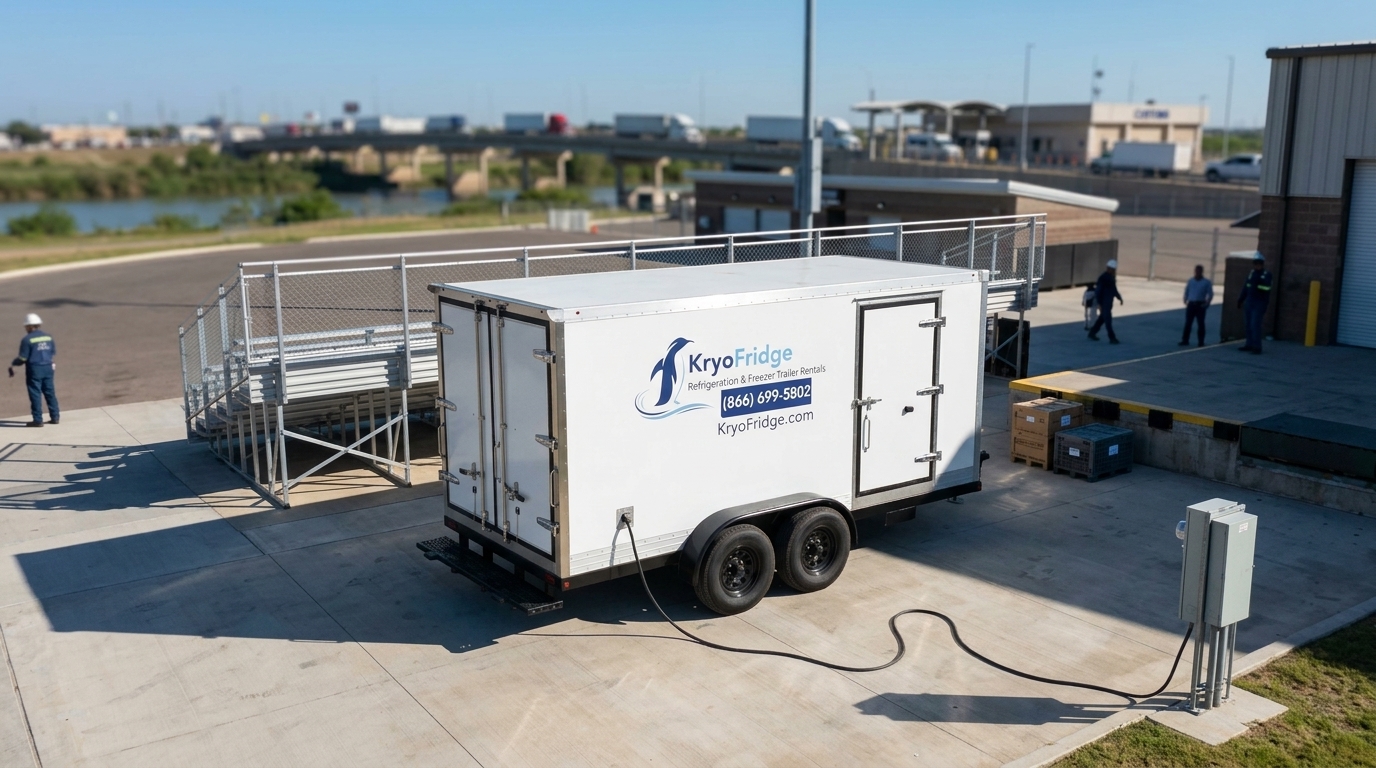
KryoFridge is the crew Laredo kitchens and warehouse teams call when cold storage cannot wait. The trailer shows up clean and already holding your number, whether the drop is a Mines Road dock near the World Trade Bridge or a tight lot downtown. Same day when we have a unit staged close. Call now or request a free quote and we will lock in a delivery window today.
Depth is the reason to book us. We keep more than one unit staged for this region, so if a compressor quits on your lot at two in the morning, we bring you another trailer instead of leaving your product to warm while somebody hunts for a part. That is a different promise than one rental unit and a phone number. We have been in the rental business more than 30 years and we own every trailer we send out. We are licensed and insured, and we are SAM.gov registered for agency work. Call now or request a free quote and we will talk through your product and your power before you commit to anything.
The same trailer works as a cooler or a freezer. A booking that starts as produce overflow can flip to hard frozen without a second delivery and a second invoice.
We bought them, we service them, and our own people deliver them. That is why we can tell you the real condition of the unit that is coming instead of reading you a listing.
This family has been renting equipment for more than 30 years. Long enough to know which parts quit in July, and to keep the spares on the shelf before anybody asks.
Licensed, insured and SAM.gov registered. School districts, hospitals and agency buyers get their documents without a three day scramble.
Quick service chains with drive through lines out the door keep our number in the manager's binder. They do not give a second chance to a unit that showed up late once.
Our South Texas stock sits close to the I-35 and US-83 split, not in another state waiting on a dispatcher. A Mines Road drop and a downtown drop get the same window.
National brands do not take chances with refrigeration. They put our trailers behind their busiest locations because the equipment holds temperature and the company behind it answers the phone.
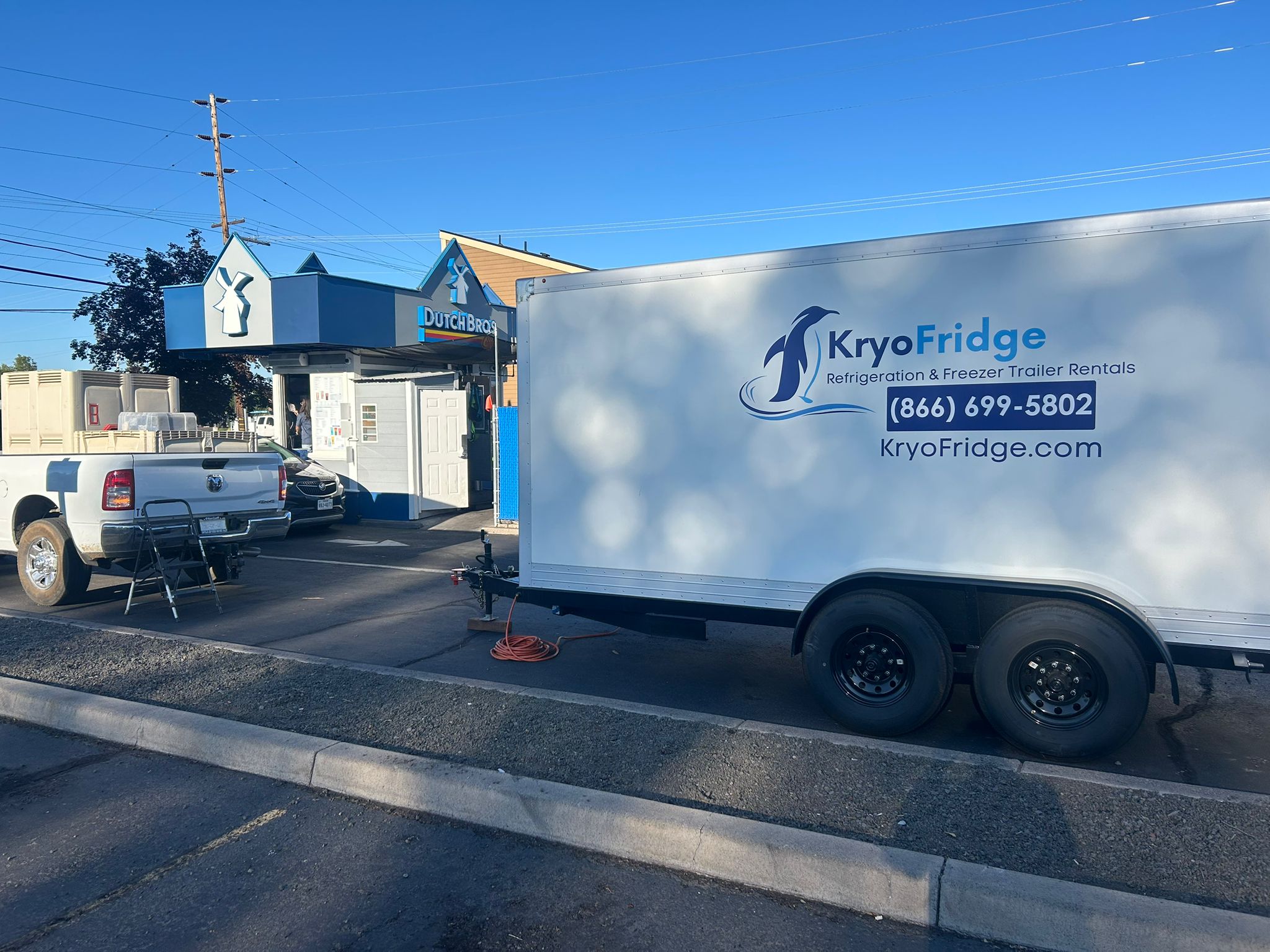 Dutch Bros
Trailer capacity holding frozen and dairy inventory for multi-stand markets between deliveries.
multi-site account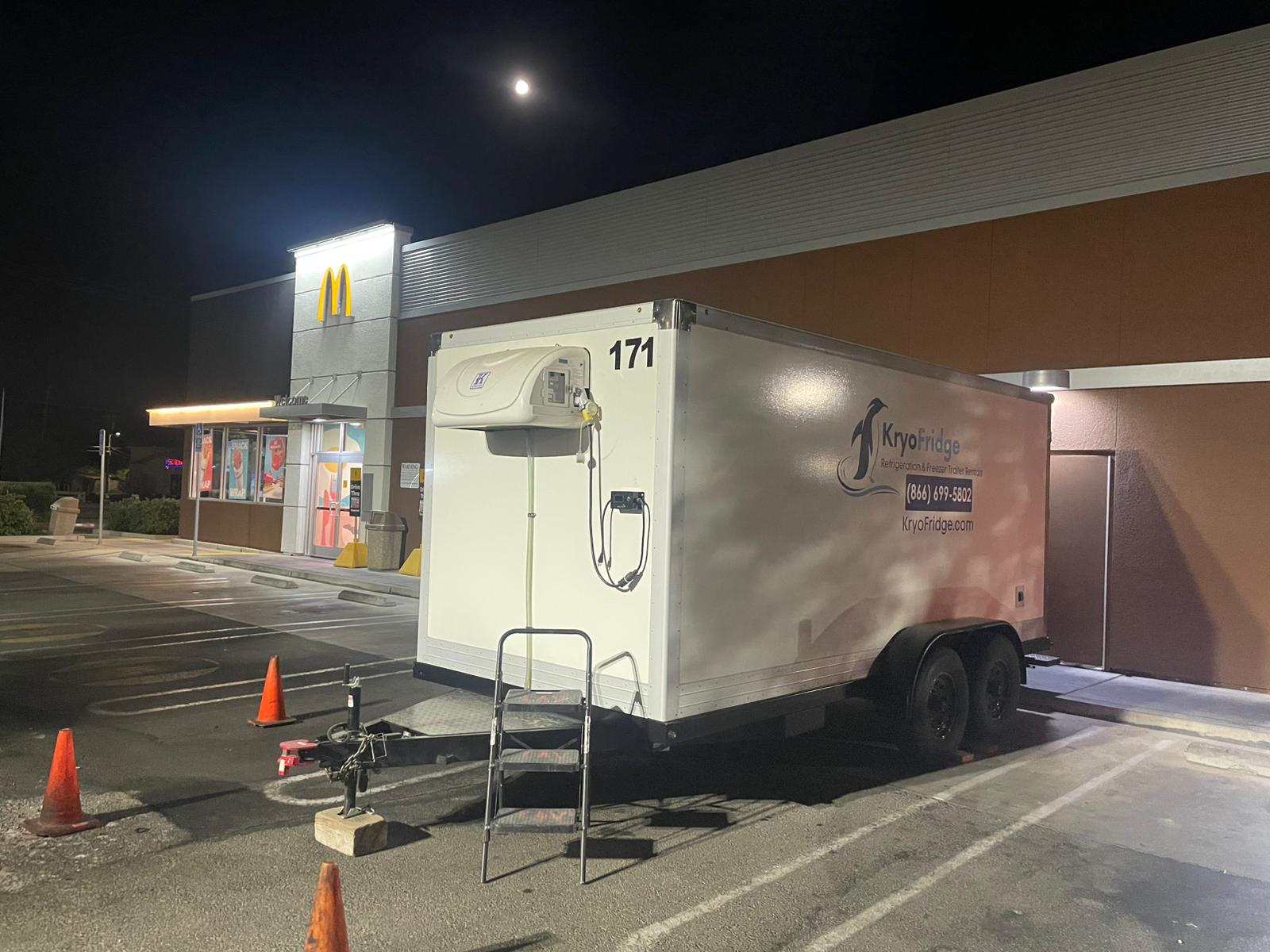 McDonald's
Overflow frozen holding behind high-volume locations during remodels and equipment swaps, so the menu never shortens.
national account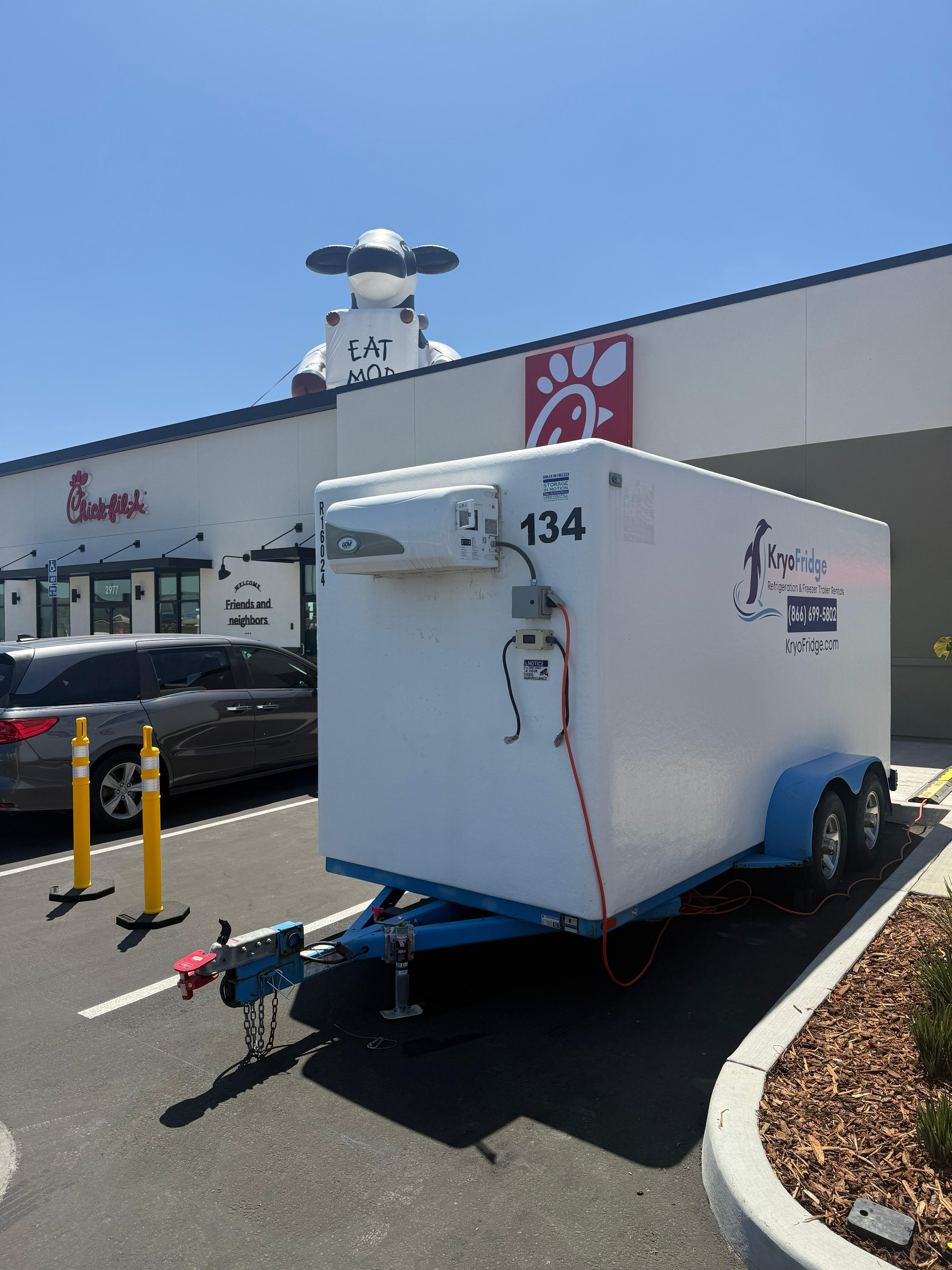 Chick-fil-A
On-site frozen holding during equipment changeouts, with staff pulling stock straight from the trailer between rushes.
zero thaw loss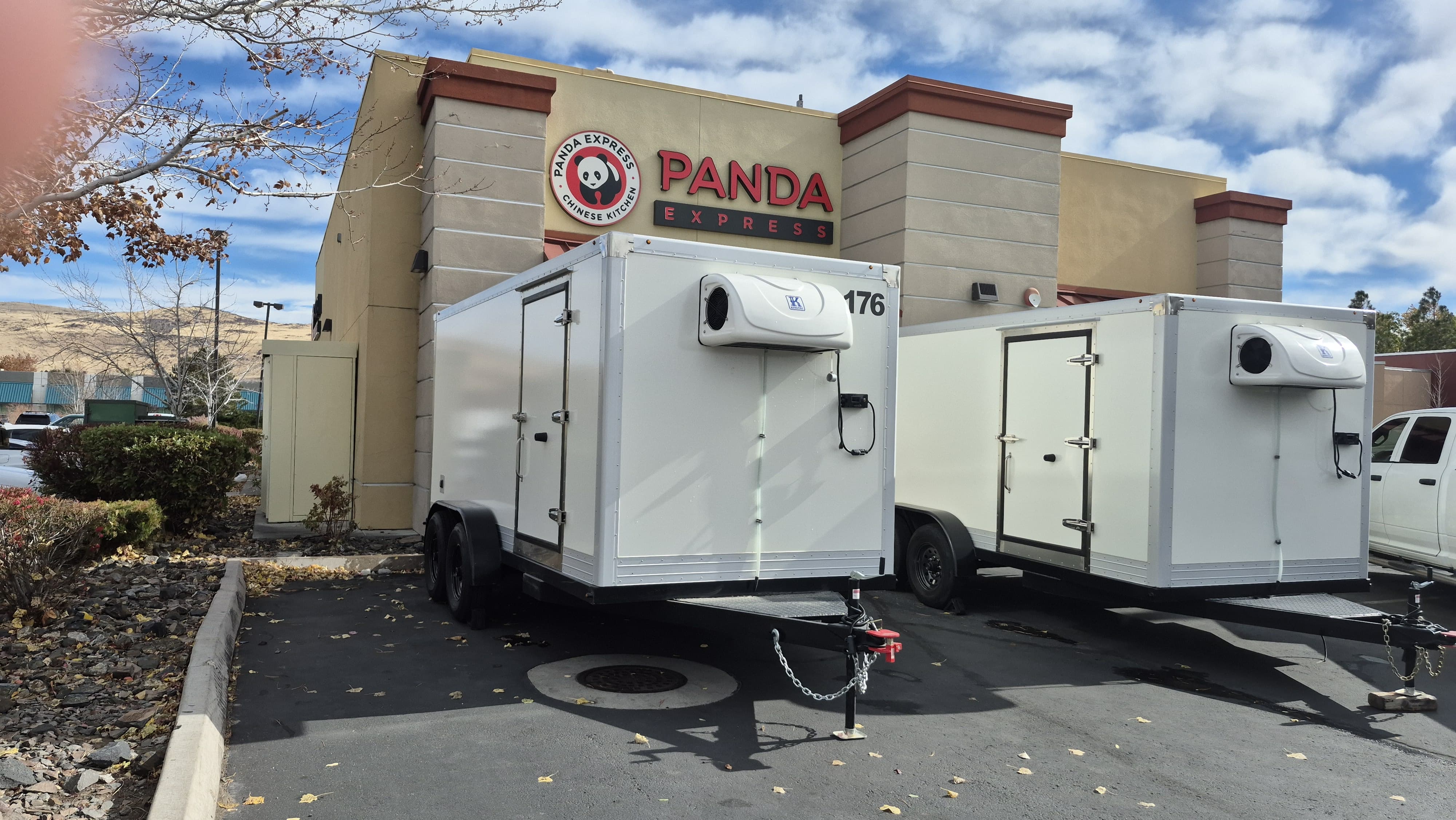 Panda Express
Overflow freezer space behind high-volume locations, holding bulk frozen product between distributor drops.
bulk overflow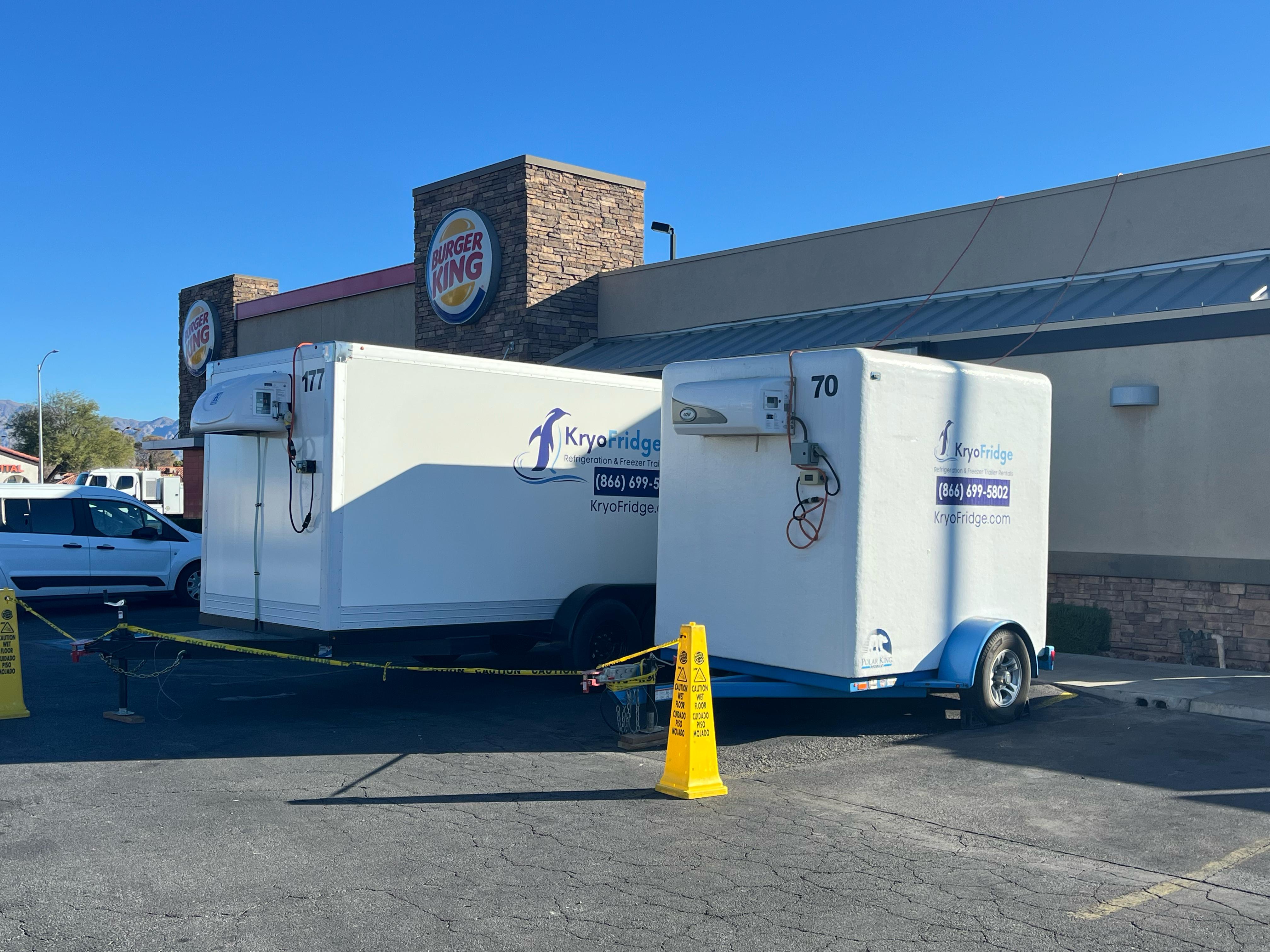 Burger King
Frozen stock held at spec through a compressor replacement so the location never dropped a menu item.
same-day swap"Our dock cooler dropped out on a Wednesday with two chilled loads already committed. They had a trailer against our dock face by that afternoon and we never stopped loading. Nine days, no drama."
"I work the plaza events and I have never had cold space that I did not have to beg a restaurant for. This was mine for the whole weekend."
"Dairy case went down on a Saturday morning in June. They answered on the second ring and the unit was in our lot that same day, already pulled down to temperature. We moved everything in about forty minutes and lost nothing. The driver even backed it in himself instead of making my guys guide him."
Laredo sits near 100 degrees for weeks every summer, and that is when a tired compressor finally gives up. So we pull your temperature down in the yard first, then check it again once the trailer is spotted and the door is shut.
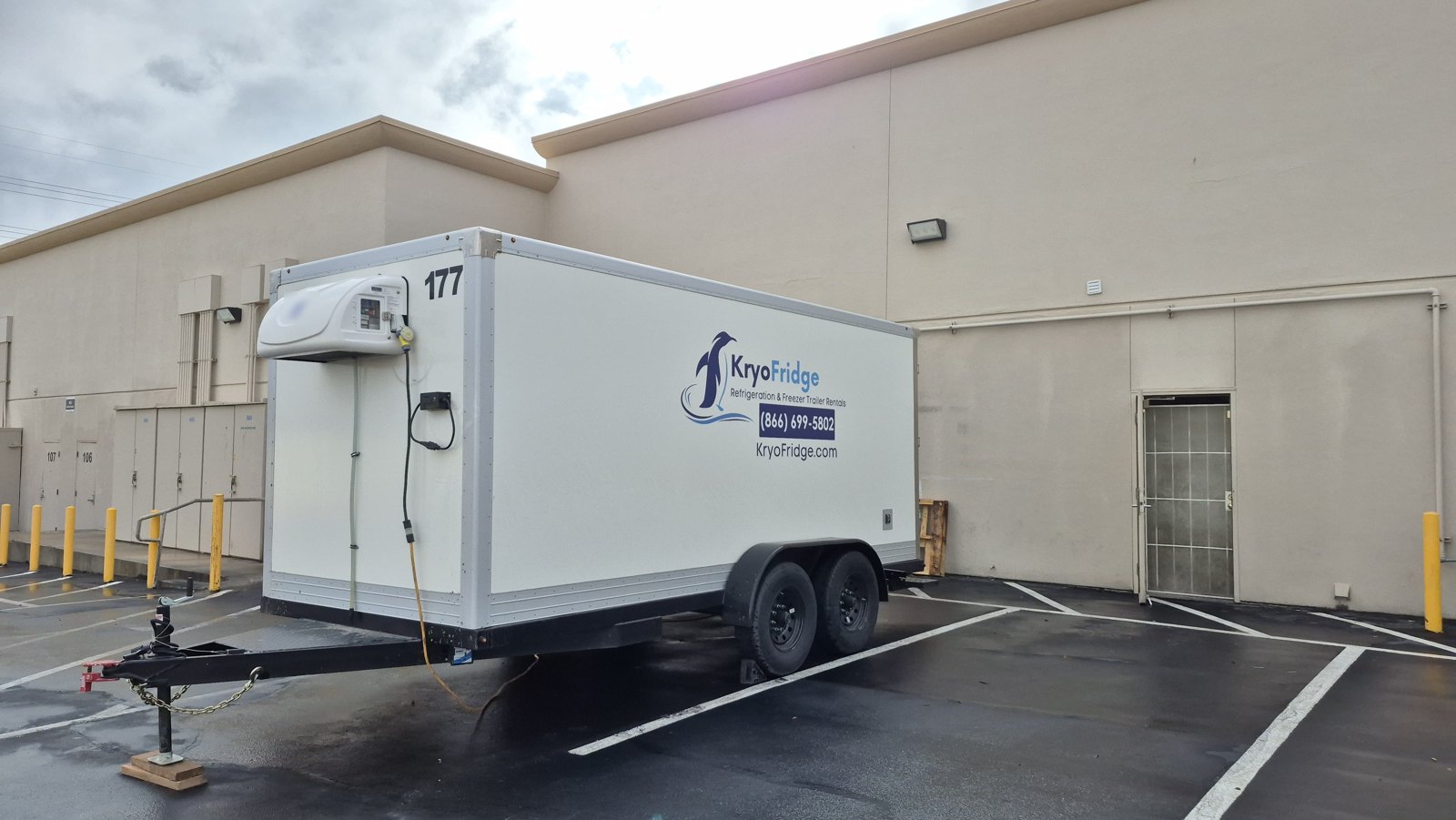
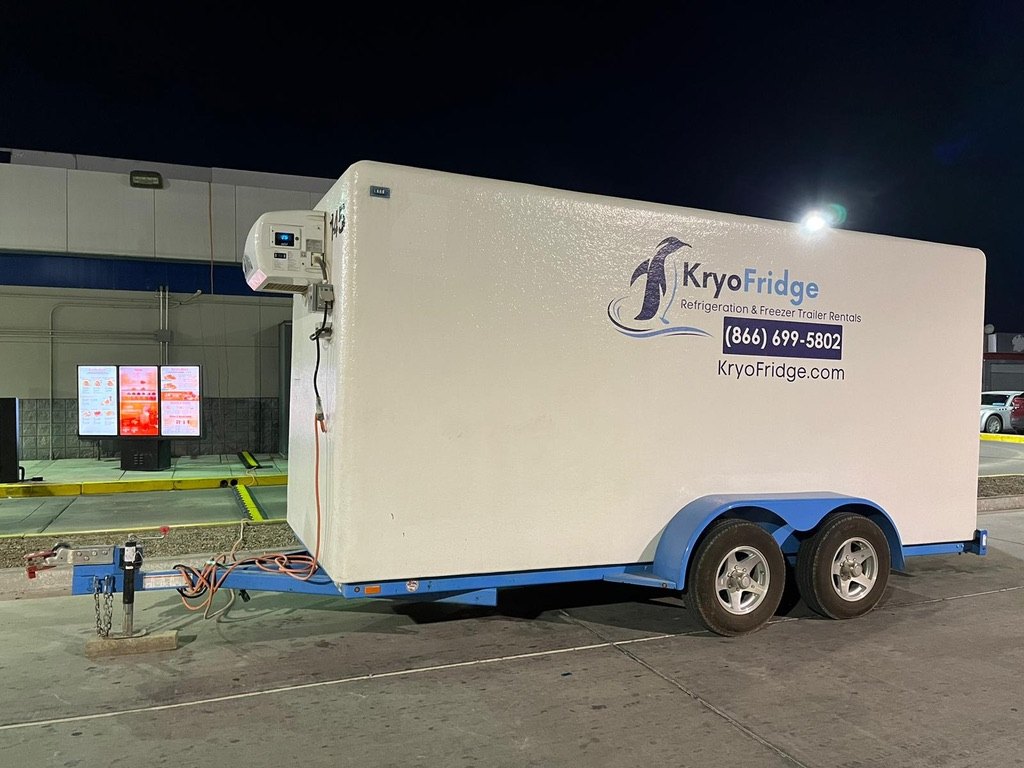
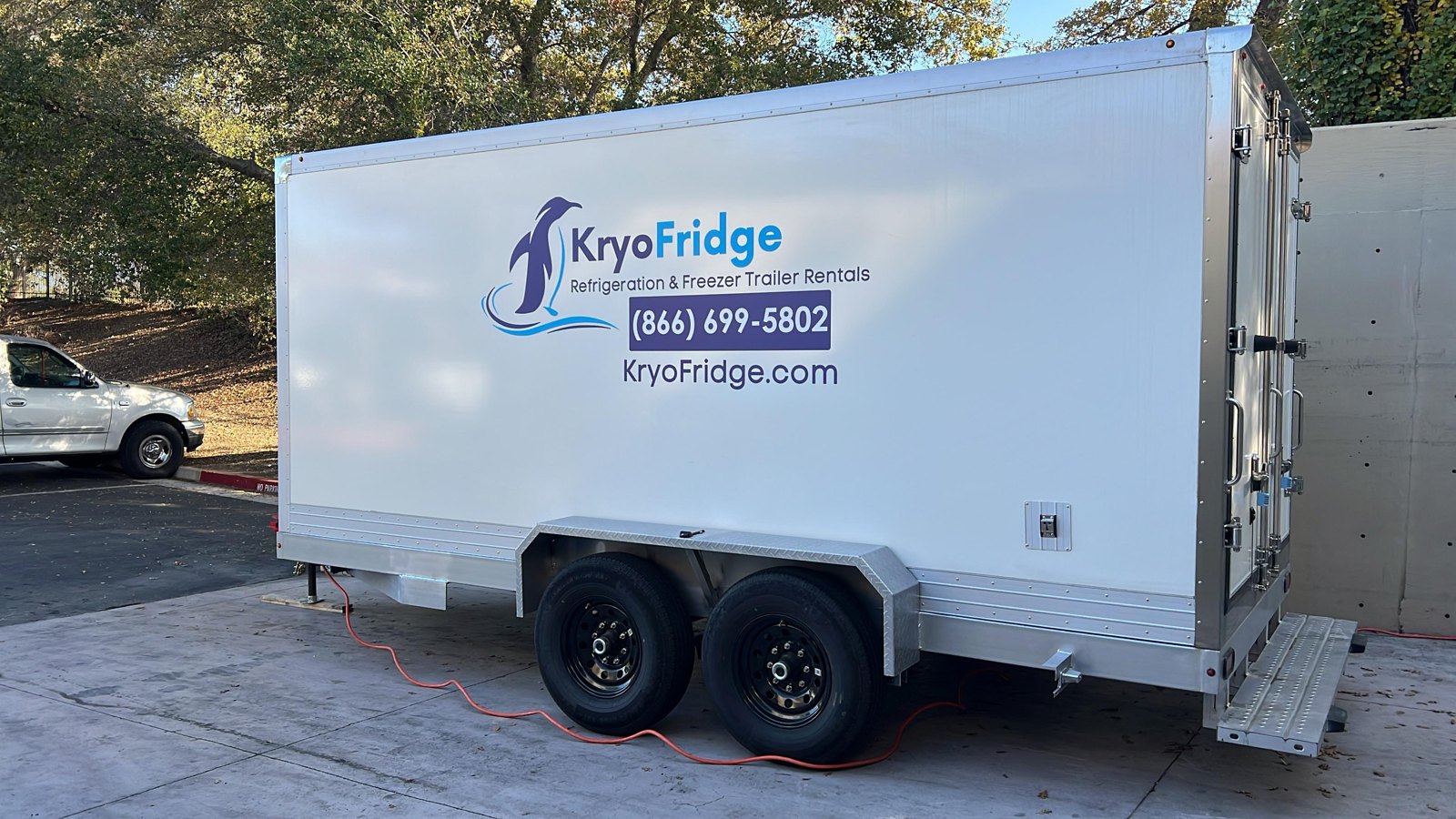
When the stakes are real, the 16' Utility is what we send. Sixteen feet of insulated, NSF-approved box on a tandem axle, running one precise digital set-point that covers deep freeze at -10°F all the way up to a 50°F cooler. The rear double doors handle pallet work off a dock, and the side utility door means a cook can pull one tray without letting the heat in.
The trailer that shows up is one of ours, prepped in our own shop, fueled and pre-cooled before it leaves the yard. It takes a dedicated 120V, 20-amp circuit or the generator we provide, and it will hold that set-point through a triple-digit stretch without drama.
| Spec | What you get |
|---|---|
| Temperature range | Roughly -10°F deep-freeze up to about 50°F fresh-cold |
| Mode | Dual-purpose: freezer or refrigerator on one precise digital set-point |
| Power | A dedicated 120V, 20-amp circuit within about 100 feet, or a generator we supply |
| Food safety | NSF-approved for direct food contact, food-safe surfaces, proper drainage |
| Footprints | 6x8, 6x12, and 6x16, from a tight retail lot to distribution scale |
| Backing | Owned in-house, fully licensed and insured, with 24/7 emergency dispatch |
Each unit holds a precise digital set-point and runs on a dedicated 120V/20A circuit or a generator. The trailers are not wired for 208 to 240V building service, so we confirm your hookup before the truck rolls.
Laredo is the county seat of Webb County and the largest inland port in the country, with four international road bridges and two rail bridges clustered near the river. Webb County itself covers 3,375 square miles, the largest county in South Texas. We stage near the I-35 and US-83 split, which is why a bridge corridor drop and a South Laredo drop get the same day rather than one of them waiting on the other.
Neighborhoods and towns we cover include Downtown Laredo, San Agustin Historical District, Del Mar Hills, North Laredo, Alexander Estates, San Isidro, Wolf Creek, Los Presidentes, Hillside, Plantation, La Bota Ranch, South Laredo, Mines Road, Loop 20 corridor, Fort McIntosh, TAMIU area, Laredo International Airport, World Trade Bridge, Colombia Solidarity Bridge, Rio Bravo, El Cenizo, Zapata, Cotulla, Hebbronville.
Each community around Laredo has its own venues, its own events, and its own cold storage headaches. We work all of them.
The newer side of town, with Alexander Estates and San Isidro anchoring a run of recent retail and grocery construction. Most of our build out calls come from here, usually a new kitchen waiting on permanent refrigeration. Wide lots, easy backing, power close by.
The historic core around San Agustin Plaza holds the oldest buildings and the tightest loading. Bridge traffic and parade routes on San Bernardo Street close streets for stretches of February. We scout the approach before we commit to a drop time here. Mornings are easier.
Del Mar Hills sits in the middle of the city with shopping and everyday business around it, and McPherson Road carries the medical corridor up past Doctors Hospital. Pharmacy and clinic calls come off this stretch more than anywhere else in town.
La Bota Ranch on one side, South Zapata Highway heading out of town on the other, and the Buena Vista Sports Complex finished its first phase of ball fields in early 2025. Tournament weekends put food service on open ground. No building, no dock, no outlet.
This is the warehouse spine of the city, feeding the World Trade Bridge with cross dock and transload freight all day. Yards are big and the truck traffic is constant, so we schedule around the shift change instead of fighting it. Early beats midday here.
The university sits out this way on 300 acres with dining halls and athletics of its own. Campus events and conference weekends are the pattern here, plus the newer commercial pads filling in along the loop.
One call sizes the trailer, sets the delivery window, and locks your quote for Laredo. Call now, or send the quick quote request and we will call you.
Trailers land here for all kinds of reasons. But three jobs fill most of our Webb County calendar, and each one looks different on the ground.
Two solid weeks. Midway food service out of trailers and tents that have no cold room at all. We drop units at the edge of the grounds and leave them for the full run.
Concessions for a full house, then a dark week, then another full house. Booking cold space by the night beats paying for a walk in that sits empty between shows.
A district building new schools under a voter approved bond ends up with dining halls waiting on permanent refrigeration and inspection sign off. We bridge that gap so the first lunch service is not the problem.
New retail and restaurant space keeps going up on the north side. A tenant with product ordered and a walk in still on a truck somewhere needs cold space on the lot this week, not next quarter.
Crew catering for field work means feeding people a long way from a grocery store. A generator powered unit on the pad keeps the meal program from turning into a daily supply run.
Air freight moves fast until it does not. A missed connection or a paperwork hold leaves chilled cargo sitting, and a trailer on the ramp side is cheaper than a rebooked load.
What ties these together is the clock. Nobody budgets a freezer trailer into next quarter. They reach for one the hour a compressor quits, or the evening before a party when the stack of rented ice chests suddenly looks laughably undersized. Since our units sit staged around Laredo instead of a couple counties down the freeway, "can I get it today" is an ordinary ask here, not a stretch.
Add it up the way an owner in Laredo has to. One restaurant walk-in routinely sits on a small fortune in proteins, dairy, and prepped product. Scale that to a grocery rack or a warehouse freezer bay and the exposure balloons. Now knock the power or the compressor out on a triple-digit afternoon, and that whole inventory is in jeopardy inside a few hours. Then stack on the sales you lose while the line sits dark and the wages you burn paying staff to triage what can still be saved.
Hold a pre-staged trailer up against that risk and it reads like cheap insurance, a fixed, predictable expense parked in front of a loss with no ceiling. That is exactly why the businesses that got stung once tape our number by the phone. There is never a second scramble, because the next time they dial before the product has a chance to warm. Owning every trailer ourselves means we can scale the answer to fit. A single compact box suits a corner cafe. A clustered setup covers a warehouse floor. Either turns around the same day.
Heat is the headline. This is hot semi arid country, and summer here holds maximum temperatures around 104 degrees for weeks without a break. The July average high runs about 100 degrees and the average low still sits near 77. The all time record is 115. Refrigeration under that kind of load does not fail politely. A walk in that was marginal in April gives out in August, on the exact week a kitchen is carrying the most perishable product it will carry all year.
Then the river. The City of Laredo declared a local disaster at one in the morning on July 17, 2026, ahead of heavy rain expected to push the Rio Grande up around the international bridges and the low ground near them. The advisory held until that Sunday afternoon. It is not the first time. The 1954 flood crested at close to 62 feet here and tore apart the international bridge, and it is still the second largest flood in the city's record. Water near the bridges takes out power and access at the same time, and a lot of the food business in this city sits on that low ground.
Hard freezes are rare and they are real. The record low on the books is 11 degrees. February 2021 put record cold across all 254 Texas counties and knocked power out for most of the state for the better part of two days. Plenty of businesses here rewrote their backup plan that month, and a generator ready cold unit is what a lot of those plans now name.
February is the month that sets our calendar here. The Washington's Birthday Celebration has run since 1898 and now stretches close to a month, from the middle of January to the end of February, pulling roughly 400,000 people through the city. There is a two week carnival inside it. There is a jalapeno festival that has been going since 1978 and once crowned a contestant who ate 266 peppers in fifteen minutes. The Budweiser parade came down San Bernardo Street on February 21 in 2026, the same day as the 128th Abrazo Ceremony out on Bridge Two. A caterer working that run is not cooking one dinner. They are holding product for weeks in a row.
The air show at Laredo International Airport is its own animal. In 2026 it landed on February 15, out on open pavement with no back of house anywhere near the food line. Same problem, smaller crowd, at the Border Olympics over at the Benavides Boys and Girls Club on Moctezuma Street. And the UETA Jamboozie festival at San Agustin Plaza in March puts food trucks and vendor booths on a downtown plaza with old wiring and no spare cold room. We drop a unit on the closest hard surface, run it off our generator, and the vendor line keeps moving.
Indoor work has a tighter clock. Sames Auto Arena out at 6700 Arena Boulevard seats 8,065 and opens up to 9,622 for a concert. The kitchen behind that floor was never sized for a sold out regional Mexican show plus a rodeo weekend back to back. Graduations fill the same building every spring. A catering team bidding those nights needs somewhere to stage frozen product for three days, not somewhere to store it forever. We spot the trailer where the load in happens and pull it when the building goes dark.
Campus events are steadier than people expect. Texas A&M International University had 9,137 students enrolled in fall 2025 on a 300 acre campus with Division II athletics. Laredo College keeps two campuses of its own, the old Fort McIntosh grounds downtown and the South Campus out on South Zapata Highway. Graduation week and conference tournaments both hit a dining program that is already full. We handle the same kind of festival overflow behind our Indio mobile refrigeration rentals in California, and the lesson carries: book the unit when you book the venue, not the week you realize the walk in is full. Call us early and we will hold the date.
Every KryoFridge unit dials from about 50 degrees down to negative 10. The same box that holds a produce load at 38 this week can sit hard frozen for a caterer next month. Same trailer, either job. You set the number on a digital control and the unit holds it. Inside, the walls are built for food contact and the floor takes a pallet jack. We clean and stage each trailer in our own yard first. Nobody should open a rented door and find the last customer's spill.
We are the same company in every market we work. The crew behind our Tempe freezer trailer rentals in Arizona works off the same checklist we use here in Webb County, and so does the team that handles our St. George portable cold storage rentals in Utah. We own the fleet. So nobody hands your booking to a broker who has never laid eyes on the trailer, and nobody trucks a unit in from two states away after you call. We stage ours near the work, within a short run of the bridge corridor.
Power stays simple on purpose. You get a generator we bring and fuel, or a dedicated 120 volt, 20 amp circuit within 100 feet of the unit. Not 208 to 240 volt service. Warehouse yards out on Mines Road usually have a circuit to spare. A hard-packed pad off a ranch road does not, and we settle the generator plan before delivery day instead of after. We walk the spot with you first so nobody is running a cord across a truck aisle at six in the morning.
Port Laredo built three refrigerated inspection docks across its two commercial bridges. No other Texas crossing into Mexico has that. They exist so a load of fresh produce or a pallet of temperature sensitive freight does not break its cold chain while it clears Customs and Border Protection. The port's bridge director has said out loud that holding temperature from origin to destination matters to North American trade. It is written into the building they inspect in.
The volume behind those docks is the part that matters. Roughly 14,000 commercial trucks a day cross the World Trade Bridge and the Colombia Solidarity Bridge together. Another 213,008 rail cars crossed here in 2025. That is one crossing. Laredo International Airport moved more than 616 million pounds of air cargo the same year. With that many loads in motion, a receiving yard backing up or a dock compressor dropping out is not a rare event. We get those calls most weeks, usually before eight in the morning.
Most of the warehouse work in this city is cross dock and transload, which means freight comes off one truck and goes onto another instead of sitting in racks for a month. That model has a specific weak point. Dry goods can wait in the yard. A pallet of chilled product cannot. When a transfer slips a day, the freight needs somewhere cold to sit right now, on your own lot, under your own lock. We back a unit against the dock face and you keep loading. Same morning, usually.
Grocery is the other half of this. H-E-B employs about 1,626 people in Laredo and McDonald's about 1,200, and every one of those stores and kitchens depends on refrigeration that has to work every single day. Produce likes the middle thirties. Seafood wants the bottom of the dial. One trailer covers either, which is why a store manager can call us for a dairy case failure in June and a frozen overstock hold in November and get the same box both times.
Most medicine that has to stay cold lives between 36 and 46 degrees. Vaccines and insulin sit in that band. So do lab samples. It is a narrow window, and the under counter fridge holding it was never built to ride out a long outage. Doctors Hospital of Laredo sits at 10700 McPherson Road with 180 beds and Level III trauma status, and Laredo Medical Center carries the other half of the city's acute care. Both run a pharmacy cold chain on top of a kitchen that feeds patients three times a day.
Retail is spread wider and fails quieter. Pharmacy counters sit inside grocery stores all over North Laredo and along McPherson, and clinics line the same corridor. When a feeder goes down on that stretch, it rarely takes one building. A store manager can lose a cooler and a pharmacy fridge in the same hour. We pre chill a unit at the yard, deliver it with the door shut, and you move product across in one go. One pass, not six.
Door discipline is the part people get wrong. The thing that ruins a hold is not the Texas heat, it is a nervous staff opening the door eleven times to check on the load. We say that on the phone before we ever hitch up. A dialed trailer sitting at 40 degrees does not swing, and it does not need anybody babysitting it overnight. We do not sell a temperature logging service, and we will tell you that straight. You set the number and the unit holds it.
Cross border pharma adds one more wrinkle. Freight clearing the refrigerated inspection docks is already under federal import rules before it ever reaches your receiving door, so a delay downstream of that inspection lands on your receiving door with the clock already running. And if the outage is regional and your circuit is dead too, the generator comes with the trailer rather than after it. Ask about that up front, before storm season rather than during it.
"Cold" is not one number. Different product stays safe inside different temperature windows, which is the entire reason a precise digital set-point matters, and in the middle of a heat wave in Laredo, a load that slips out of its window is a load you write off. Use the chart below as the reference our customers lean on when they size a rental.
| Product | Target holding band | Trailer mode |
|---|---|---|
| Ice cream and frozen desserts | -10°F to 0°F | Deep freeze |
| Frozen proteins, seafood, prepared meals | 0°F or below | Freezer |
| Fresh meat and poultry (short hold) | 28°F to 32°F | Refrigerated |
| Dairy, deli, packaged produce | 34°F to 38°F | Refrigerated |
| Beverages, florals, catering trays | 38°F to 45°F | Refrigerated |
One figure matters more than everything in that chart, and it is not listed there: 40°F. Food-safety guidance treats the band between 40°F and 140°F as the zone where bacteria thrive, and the clock on perishable product starts ticking the moment it crosses 40 on the way up. Roughly four cumulative hours above that line and most refrigerated inventory is no longer safe to serve. Picture that countdown running on a 100-degree afternoon in Laredo with the walk-in dark, and the urgency of a quick trailer drop stops being abstract.
Tell us the single coldest item you are holding when you call, and we dial the trailer to that. One unit carries a straight freezer load with no fuss. But when your list mixes deep-freeze desserts with fresh-cold produce for the same remodel or event, we will usually point you toward a split setup or a second box so neither side of the load has to settle for the wrong temperature.
Powering one of our trailers is refreshingly simple, and there are precisely two ways to do it. Either you have a dedicated 120-volt, 20-amp circuit reachable within roughly 100 feet of the parking spot, or we bring a generator. What the units will not accept is standard 208 to 240V building service, so a quick question about your outlet before dispatch heads off any surprise on delivery day.
On placement, all the unit really asks for is a fairly flat patch with enough room for the delivery truck to maneuver it in and set it straight, plus either a power source in reach or space for a generator. We lock down the exact drop point before dispatch, and our drivers know the Laredo layout cold, so the delivery is one clean trip instead of a guessing game on the property.
A transfer slipped and left chilled freight with nowhere to sit while the outbound truck was still six hours out. We had a unit backed to their dock face that morning and they loaded straight off the forklift. It stayed nine days while the schedule reset. No loss.
Permanent refrigeration was on site but not signed off, and the first day of classes was not moving. So we set a trailer beside the kitchen door with a generator and left it six weeks. Meal service started on the calendar date.
Opening weekend brought in more harvested deer than the lease had cold space for, twenty miles down a ranch road with no three phase power anywhere. We delivered on a Friday afternoon and picked up after the late season closed.
One yard covers four towns on four calendars. Hunting season around Hebbronville, field camp work near Cotulla, February festival weeks in Laredo, and lake season down at Zapata all peak at different times of year. That is unusual, and it works in your favor. A single regional fleet can cover all four without every account fighting for the same trailer in the same month.
On a bad day, booking should be the part that does not add stress. Four steps, an upfront number, and a single person who owns the whole thing.
Tell us whether it is freezer or fridge product, a ballpark volume, and your rough window. That is enough for us to call the right size.
We pair you with a unit, confirm whether you have a dedicated circuit or need a generator, and pin the exact drop point so the truck makes one trip.
We arrive on your schedule, about 45 minutes for a true emergency, set the trailer, energize it, and let it drive down to your number.
It holds the set-point for your entire term while our line stays live the whole way through. Wrap up, and we swing back for the pickup.
Texas retail food rules follow the FDA Food Code model, and the number at the center of it is 41 degrees. Cold food that needs time and temperature control has to be held at 41 or below, and an inspector checks that first. It does not matter whether the product is sitting in a permanent walk in or a rented trailer on your lot. The standard is the same. Every unit we send out is set to hold under that line with room to spare. A box that only just makes it on a mild morning will not make it at three in the afternoon in July.
Permits and inspection here come through City of Laredo and Webb County public health staff, the same local layer any Texas city this size runs. If you are staging food service at a festival or a ball tournament rather than a fixed address, ask them about the temporary event permit early instead of the week of. Texas also wants a certified food protection manager with supervisory authority on staff, and that applies to a first time booth vendor the same way it applies to a restaurant.
Power and placement are where we do most of the coaching. A unit on a dedicated 120 volt, 20 amp circuit within 100 feet is the simple path for a business with a yard. That call takes five minutes. A generator setup on public ground or at a temporary event is worth a call to the city fire marshal before event day, because placement and fuel handling are their call, not ours. We hold the same discipline behind our Santa Clarita refrigerated trailer rentals in California, where the agencies are different and the physics are not.
One caveat we always state plainly: we supply the food-safe, temperature-holding hardware itself, but we are not a temperature-logging or alarm-monitoring service. If your program requires continuous written records, line that vendor up on your own.
Our signature 16 foot Utility series leads the fleet. It is the trailer we send on most jobs, and crews like it for the side utility access door. We build three footprints in all, so a single kitchen holding overflow stock has a fit and so does a distribution floor in a disaster. Every unit is dual purpose by design: one adjustable system swings between freezer and refrigerator on a digital set point. Each trailer runs on a dedicated circuit or on a generator.
| Trailer | Best for | Temp range |
|---|---|---|
| 6x16 Utility ⭐ | Our signature series: distribution, large events, disaster response, side utility door | Heavy-duty reefer |
| 6x12 | Grocers, caterers, mid-size events | Deep-freeze capable |
| 6x8 | Tight lots, small kitchens, short overflow | -10°F to 50°F |
Each unit holds a precise digital set-point and runs on a dedicated 120V/20A circuit or a generator.
Think eight or so pallet spots, and the unit to grab when square footage is the whole problem. It slips into the pinched service yards and cramped back-of-house corners that a larger box cannot even swing into. One cafe or small-market walk-in goes down, and this is almost always enough cold to cover it, plus the simplest unit to set in a small space.
Call it fourteen pallet spots, deep-freeze rated, and far and away the size people ask for most. It lands right in the middle: roomy enough for a multi-day catering job or a restaurant that needs true walk-in-equivalent room while the kitchen is torn up. Roomy enough that nobody is playing Tetris with shelves, yet still small enough to set in most commercial back lots without a site survey.
Roughly twenty pallet spots paired with a heavy-duty reefer plant engineered to keep deep-freeze locked in even when the ambient air is merciless. Reach for it when a warehouse bay drops, when a large festival needs an anchor, or when a relief operation is carrying its own cold chain.
Not sure which size fits? Most customers land on the 16 foot Utility, and we will tell you honestly if a smaller footprint covers your job. Tell us roughly what you are storing and for how long, and we will spec it for you.
The questions that surface once the basics are settled. Tap any topic to open it.
The pop-up walk-in cooler. Cheap to rent and easy to set up, but it chills, it does not freeze, and it draws every watt it needs from your building while depending on a calm ambient temperature around it. The second your building loses power, your cooler loses it too.
The refrigerated box truck. Designed to haul product on the interstate, not to sit in a lot and babysit it. Parked, it burns fuel all day, broadcasts compressor noise across a storefront or an event lawn, and pins down a tractor plus a driver you probably do not need.
The freezer trailer we deliver. Built from the ground up to be dropped on a pad and to defend a temperature for as long as the job runs. It freezes deep, carries NSF approval, locks, stays quiet near guests, and lives on nothing more than one dedicated circuit or a generator.
Even a rented box has to satisfy the county environmental health office that licenses and inspects every food facility. Show an inspector a unit that cannot document its temperature or was not built for food contact, and they have the authority to halt service immediately.
That is a bar each of our trailers clears: NSF-approved throughout, food-safe interior surfaces, proper drainage, and a digital controller that puts the set-point in plain view. We supply the food-safe, temperature-holding hardware itself, but we are not a temperature-logging or alarm-monitoring service.
For a typical kitchen or market, one box does the job. Distribution floors, big fairs, and full-scale disaster response routinely need more, and because the fleet is ours, we can cluster several units and bring them online in waves as the work expands. Match the cold capacity to the operation rather than make the operation squeeze itself into one box.
The clock is yours to set. Some jobs are a handful of days for an emergency or a single event. Others stretch across weeks or months for a remodel or a seasonal swell, and a few become standing contracts for businesses that want capacity parked on standby. Name your window and you will get a clean quote, no penalty for an honest "not sure yet."
Building permanent cold storage is a capital project in every sense: you hire a refrigeration contractor, schedule the electrical, pull a building permit, and wait weeks before a single pallet goes inside. A rental turns that equation on its head. You bring in precisely the cold you need, for precisely the stretch you need it, and the trailer is holding temperature that same week, frequently that same day, with the commitment ending the moment your need is over.
Three engineered elements carry the load. Thick insulated panels and tightly gasketed doors lock the sun outside and the cold inside. A self-contained reefer condensing system specified with surplus capacity keeps stripping heat out of the box even when the air outside is brutal. And a digital thermostat locks onto your chosen number and cycles the compressor to hold the line. Run those three together and a trailer baking on open asphalt behaves like one tucked in a cool warehouse. That is also why power is the first thing we ask about: the design delivers its safety margin only on steady, uninterrupted power.
"The unit came pre chilled and set where we asked, so we were not standing there watching a thermometer climb. That is the whole thing."
"Two shows in one week and our back of house is sized for one. We book a trailer for the load in and they pull it Monday. Easy."
"Our new kitchen was built but not signed off, and school was starting whether we were ready or not. They set a trailer by the service door with a generator and left it six weeks. First lunch went out on the calendar date, which nobody thought was going to happen in July."
"Twenty miles of ranch road and they still showed up when they said. Delivered Friday, picked up after the late season closed."
"Three of us split a trailer for a weekend festival and it was the first year none of us threw product away on Sunday night. They walked me through the power setup on the phone before I signed anything."
"I need the bottom of the dial and I need it to stay there. It did. That is more than I can say for the last outfit I rented from."
"Convention week hit and my walk in was already full on Monday. They had a unit in the service drive Tuesday morning and I kept it through the run. No cord across the driveway, no complaints from the front desk, nothing."
"Out on a pad there is no grocery store and no second chance. Their generator setup ran the whole rotation and the crew ate on schedule every day."
"We remodeled the kitchen and stayed open the whole time, which only worked because the cold storage moved outside with us. Clean trailer too. That surprised me more than it should have."
The same thing your walk in needs. Product held at 41 degrees or below, on clean food contact surfaces. Stack it so nothing drips onto anything else. We deliver units washed out and already pulled down, so the temperature is right the first time an inspector opens the door. Keep your own thermometer inside and check it the way you check any other cold holding space. If your permit is a temporary event permit rather than a fixed address, talk to city and county health staff early, because their questions about the setup are easier to answer before the event than during it.
Any time both products have to sit at once for more than a few hours. One trailer holds one temperature setting, so if you need 38 degrees for produce and negative 5 for boxed protein on the same day, that is two boxes. Plenty of customers split it a different way. They run one unit frozen for the week, then dial it up to cooler temperature once the frozen inventory clears. Tell us the product list on the first call and we will tell you honestly whether one will cover it.
Most of our drops are ground level, not dock height, so plan on a ramp and a pallet jack rather than a forklift driving straight in. The floor is rated for a jack and the rear opening takes a standard pallet. If you are loading loose cases instead of pallets, bring shelving carts and load them outside first, then make one trip in. That habit matters more than anything else we could tell you, because every open door costs you temperature. For a yard on Mines Road with a real dock face, we back right up to it and you skip the ramp entirely.
Usually yes, and the reasons are simple. A planned booking lets us route the delivery with other work instead of pulling a truck off the schedule, and a longer term spreads the delivery and pickup across more days. Distance matters too, so a drop in Hebbronville prices differently than a drop off McPherson Road. Frozen temperature settings work the machine harder than cooler temperature settings. Generator jobs carry fuel that a wall circuit does not. Tell us the dates, the temperature and the address and you will get a real number instead of a range.
February is our tightest month in this city by a wide margin, and the celebration runs close to four weeks. Caterers and midway vendors reach for the same equipment in the same weeks. So do hotel kitchens. Book that window in the fall if you can. Deer season in the counties around us overlaps the tail of it, which tightens things further. Outside that stretch, most weeks we can cover a next day request and often a same day one.
Yes. It is a padlock, nothing fancy. The rear door takes one and you hold the only key, which is the right setup for a yard that other trades walk through during the day. Park it where your existing cameras already look if you have them, and put the door side toward the building rather than the street. On event grounds we usually spot the unit inside the vendor perimeter so overnight security is already covering it. A running unit also makes noise, which is worth knowing if your lot backs up to housing.
The unit works harder in a 105 degree afternoon, so we allow for that when we set it and we ask you to keep the door shut during the worst part of the day. Shade on the condenser side helps more than people expect. Cold snaps are the opposite problem and they are rarer here, but a hard freeze can take out your building power while the trailer keeps going on a generator. That is the scenario most of our storm season calls turn out to be.
We wash and clean every unit in our yard between rentals, so you are not inheriting the last customer's spill. On your end, sweep it out and pull your own product and packaging before we arrive. If you had a leak from a case of protein, tell us instead of hosing it yourself. We would rather handle a food contact cleanup with the right chemicals than guess at what went on the floor. Just say so on the pickup call.
Every week. Zapata is about 50 miles south on US-83 and Hebbronville about 55 miles southeast. Cotulla sits about 90 miles up I-35. All three are same day territory from our yard. The one thing we ask for out there is a real gate contact and an honest description of the road, because a hard-packed two track after a rain is a different delivery than a paved lot. Send a pin drop if you have one.
A dedicated 120 volt, 20 amp circuit within 100 feet of where the trailer will sit. Not a shared circuit that already carries a dock light and an air compressor. Not 208 to 240 volt service. If your electrician cannot confirm a dedicated line, take the generator and stop worrying about it. We size and fuel it, and we place it where the exhaust is not pointed at your door.
Same day when we have a trailer staged nearby, and that is most days. Storm weeks are the exception, because water near the bridges takes out access and power together and the whole corridor calls at once. During the July 2026 river declaration the low ground near the bridges was the problem, not the rain itself. If your address is in that zone, call us before the forecast lands rather than after. We would rather stage a unit early and cancel than tell you we are two hours out.
We run more than one kind of trailer out of South Texas, so look through the rest of the fleet if this one is not the right fit for your job.
Most people call us and ask for a big one. That is not a size. The useful questions are how much product has to sit and in what shape. Then how long, and how often somebody opens the door to get at it. Answer those and the size answers itself in about a minute on the phone.
Start with shape. Palletized freight and loose cases behave completely differently inside a box. A warehouse near the bridge corridor thinks in pallet positions because that is how the freight arrives and leaves. A restaurant thinks in cases and sheet pans. If your product is already on pallets, count the positions and add one for working room, because a trailer packed wall to wall with no aisle means somebody unloads half of it to reach the back.
There is a right way and a wrong way to load a cold box in July here, and the difference shows up on your thermometer within twenty minutes. Summer afternoons in this city sit near triple digits for weeks at a stretch. Every minute that rear door stands open, you are pouring that in.
Pre chill first, load second. We bring the unit down to your temperature setting at our yard and deliver it with the door shut for exactly this reason. If you open it on arrival to admire it, you undo part of that. Let it sit closed until your product is staged and your crew is ready to move. A box that arrives at negative 5 and gets opened three times before anybody loads anything is starting the day behind.
Further reading: Texas Department of Insurance heat safety resources.
If your business sits anywhere near the bridge corridor, the next two years are going to change how freight moves past your door. The City of Laredo, TxDOT and the Federal Highway Administration are advancing a plan for an entirely new eight lane bridge dedicated to northbound commercial traffic. It would run parallel to the existing World Trade Bridge. Two more southbound lanes get added to the span that is already there.
The new structure would sit on right of way the city acquires, with eight northbound lanes and a safety walkway. New lighting and electronic signage come with it. Public input meetings ran through the spring of 2026 and officials have said work could begin as early as that summer, with a more conservative read putting the start in late 2026 and completion targeted for late 2027. The city held its first International Bridge Week in 2026 to put the project in front of the businesses it affects.
Further reading: the TxDOT World Trade Bridge expansion project page.
Ranch country south and east of Laredo keeps a calendar most city businesses never think about. In Jim Hogg County the general season for the 2025 to 2026 cycle opened September 27 and ran through October 31. It picked back up November 1 and ran to January 18. Then a special late season from January 19 to February 1. The bag limit was five deer, no more than three of them bucks.
Do the math on a lease with a dozen hunters across those months and you get a volume problem that arrives in bursts. Opening weekend and the holiday stretch bring in more harvested animals in two days than the rest of the month combined. A lease with one chest freezer in a bunkhouse is fine in the third week of December and completely underwater on the opener.
Further reading: Texas Parks and Wildlife county season rules for Jim Hogg County.
We do not publish numbers, because two customers with the same trailer can have very different jobs. But the things that move a quote are not secrets, and knowing them lets you shape the booking instead of just reacting to it.
Length of rental is the biggest lever. A booking measured in weeks or months spreads the delivery and pickup across more days and lets us schedule the truck alongside other work. A two day emergency drop does neither. If you know you need cold space for a remodel that might run six weeks, book six weeks rather than renewing week to week.
Call now or send a quote request and we will confirm the size and the power setup before a truck leaves our yard, then hold a delivery window for you. Tell us what you are holding and the unit shows up already set to your number.