
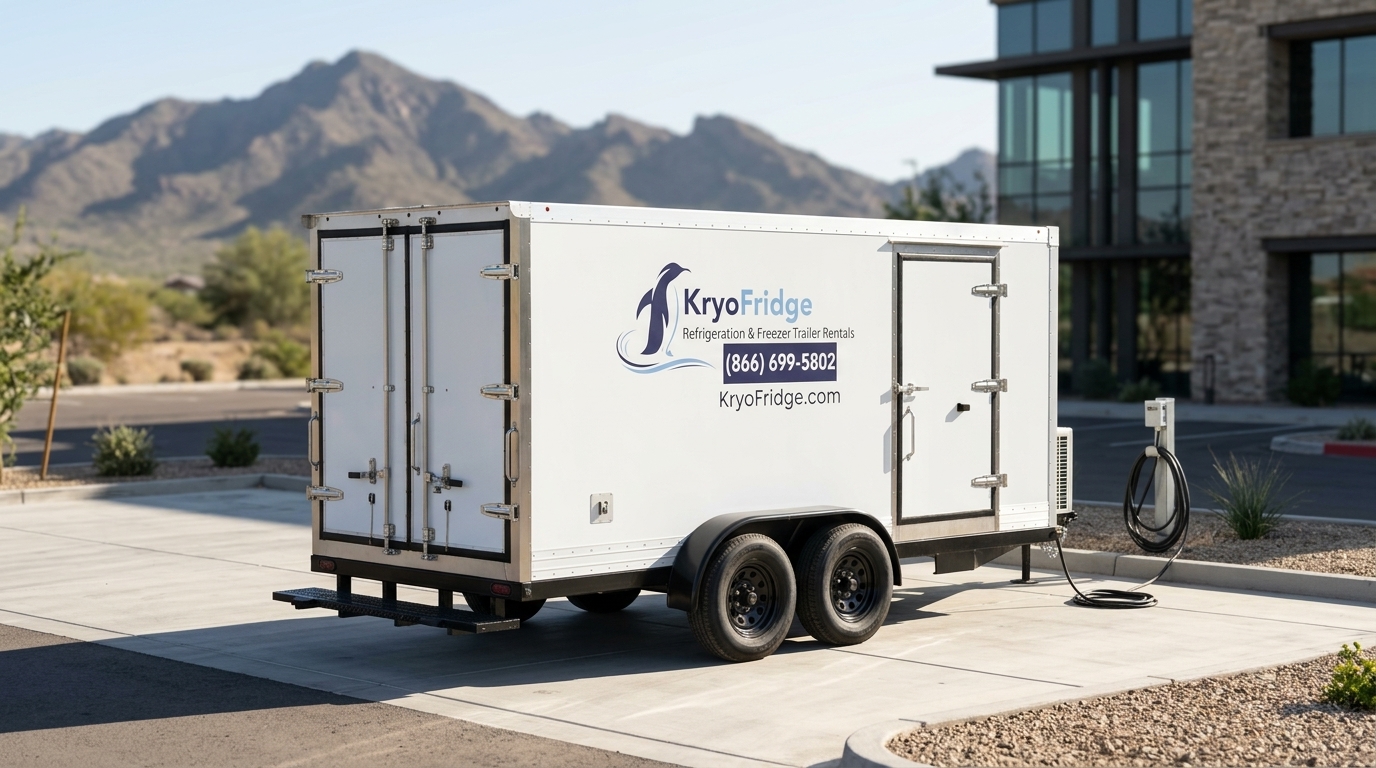
KryoFridge is the first call in Surprise, Arizona when a cooler quits and the product has nowhere to go. We keep walk-in cold boxes staged near the Loop 303 corridor, so a unit can be on your lot the same day, plugged in and pulling down before your crew starts moving pallets. One fleet covers all of it. A Bell Road grocery stock room, a taproom cooler, a school kitchen, a concessions stand out at Surprise Stadium. Call 866-699-5802 now, or request a free quote, and we will confirm your dates today.
A walk-in dies at two in the morning and nobody finds out until the opener pulls the door. By then the count is already moving the wrong way. We answer at that hour. We load a box and get it to your lot the same day, so the loss stops at the one machine that failed instead of eating your whole stock. Our drivers have backed into the grocery aprons off Bell Road and the tight service alleys along Grand Avenue, and they know which gates up in the Asante corridor want a code before a truck rolls. Call 866-699-5802 and you get someone who can tell you what is sitting in the yard right now, or request a free quote and we will pencil in the dates while you check with your crew. Businesses weighing our Tempe cold storage trailer rentals against what we run on this side of the metro get the same boxes and the same delivery promise either way.
Dial 866-699-5802 and somebody who can see the lot picks up. They know what came back Thursday and what goes out in the morning. No ticket number and no promise to call you back.
Every unit dials from about 50 degrees down to about negative 10. Change your mind on Tuesday and you change a setting, not a contract.
A dedicated 120 volt, 20 amp circuit within 100 feet, or our generator comes along. We ask on the first call, every time, because an outlet nobody checked is how a good rental turns bad.
KryoFridge is not a broker passing your job down the line. The fleet is ours and the drivers are ours. The person who answers knows the unit that is coming to you.
We came out of a rental family with more than 30 years in event and equipment rental. It shows in small things, like getting a stadium drop through the gate before the concessions crew starts setup.
We rent cold boxes. We do not sell a temperature monitoring service, and we will say so up front rather than let you assume it. Honest scope beats a surprise during an inspection.
If the nation's largest chains trust us to protect their inventory, your kitchen is in good hands. These are brands that vet a cold-storage partner the same careful way they vet a food supplier, and they keep calling us back.
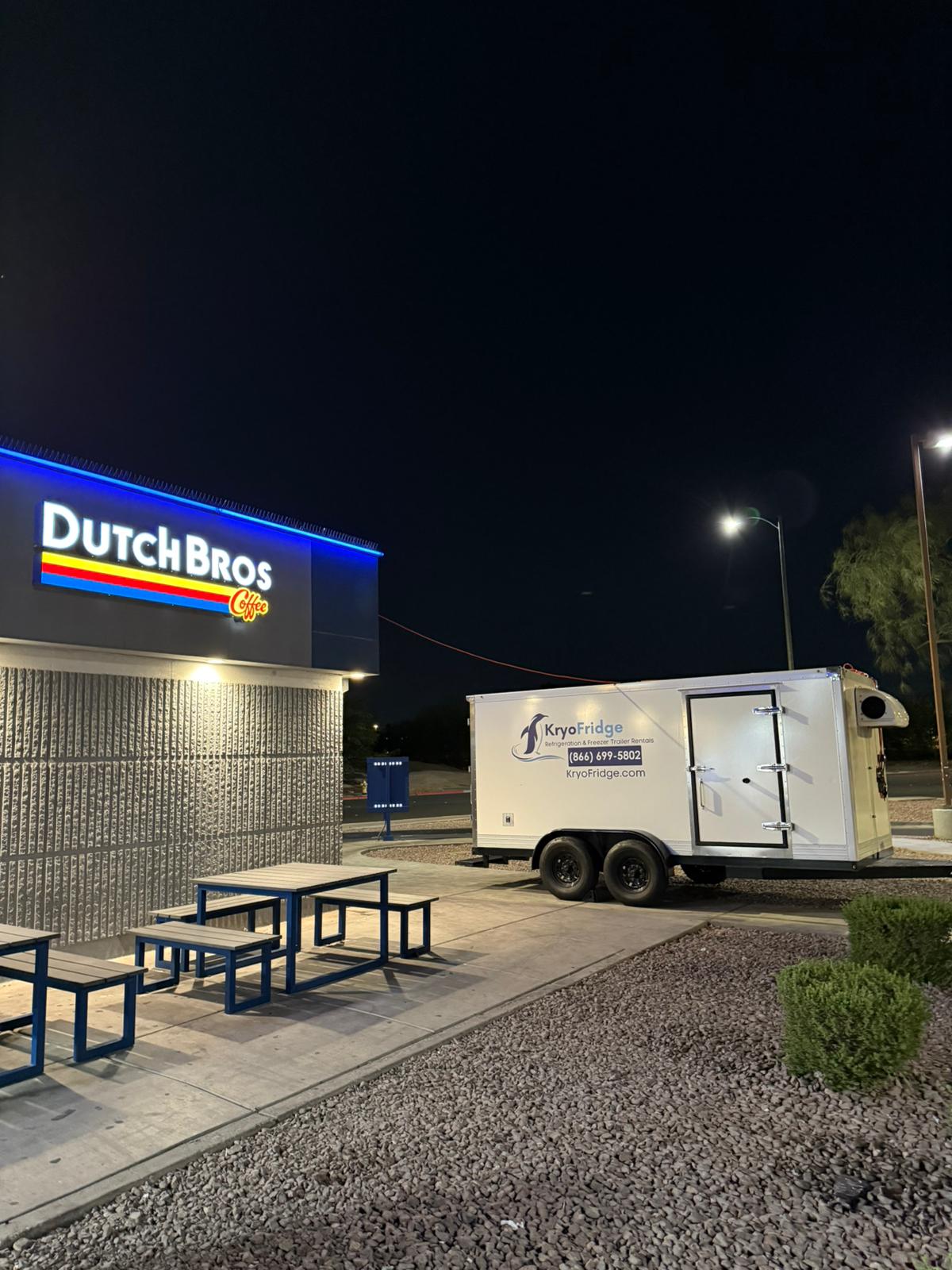 Dutch Bros
Trailer capacity holding frozen and dairy inventory for multi-stand markets between deliveries.
multi-site account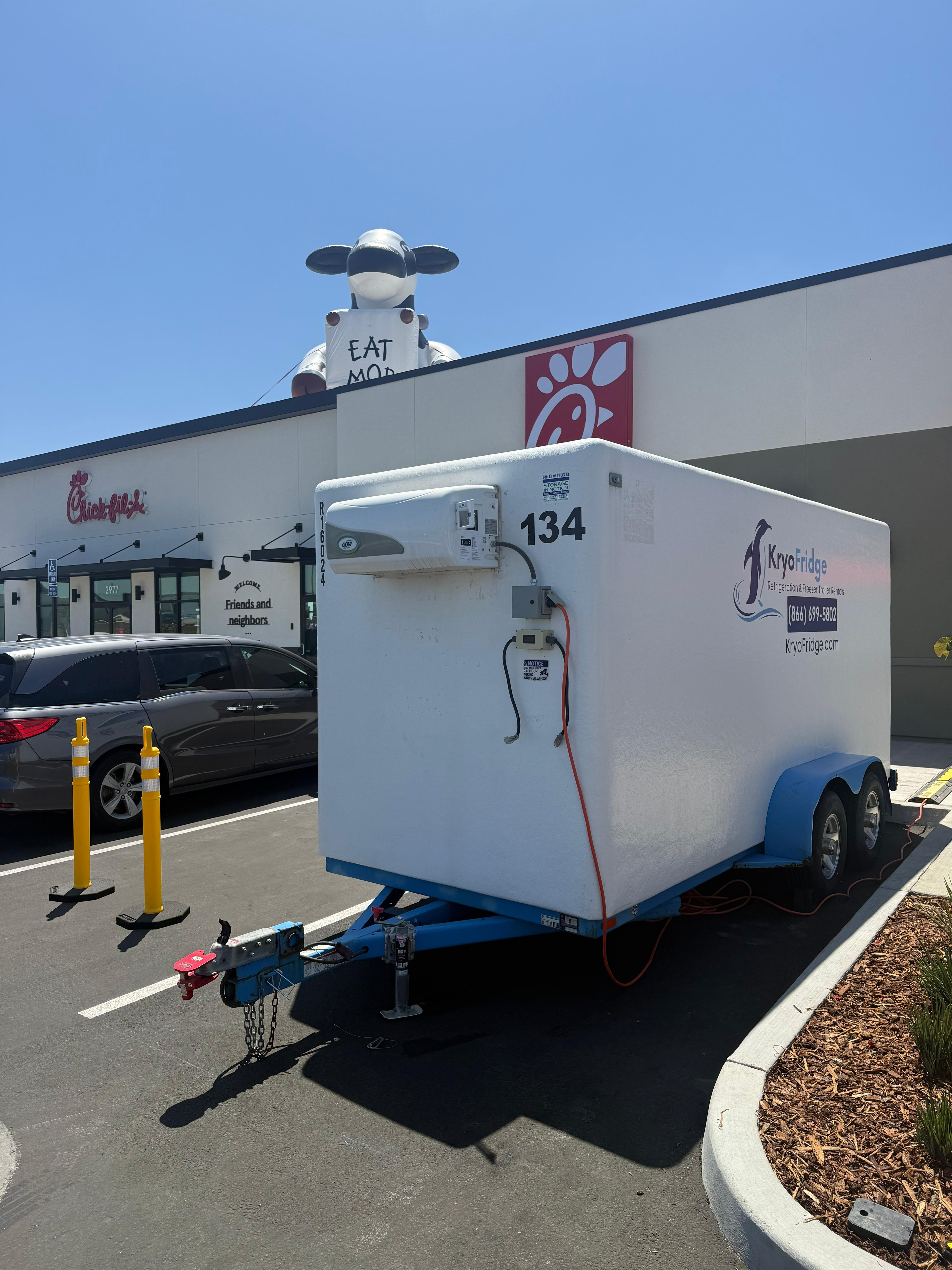 Chick-fil-A
Trailer cold storage through store remodels so frozen prep stock stayed at temperature from teardown to reopening.
zero thaw loss Burger King
Frozen stock held at spec through a compressor replacement so the location never dropped a menu item.
same-day swap McDonald's
Overflow frozen holding behind high-volume locations during remodels and equipment swaps, so the menu never shortens.
national account Panda Express
Trailer cold storage during equipment service so frozen prep stock stayed within reach of the wok line.
bulk overflow"Power went out in a dust storm and I was watching the frozen aisle clock. They showed up with a generator unit and we did not write off a thing. That number lives in my phone now."
"Three week remodel, two boxes on the dock, zero product loss. We ran it again in the spring."
"Our back room cooler quit on a Saturday night and the part was ten days out. The small unit fit in the service yard with room to open the door. Nobody got told to drive to another store."
The KF16 is the box our trucks drop most often here, because a Surprise grocery backroom or a Railplex warehouse dock usually needs pallet room rather than shelf room. On a tight Original Town Site lot we step down to the KF12 and keep the tongue clear of the alley.
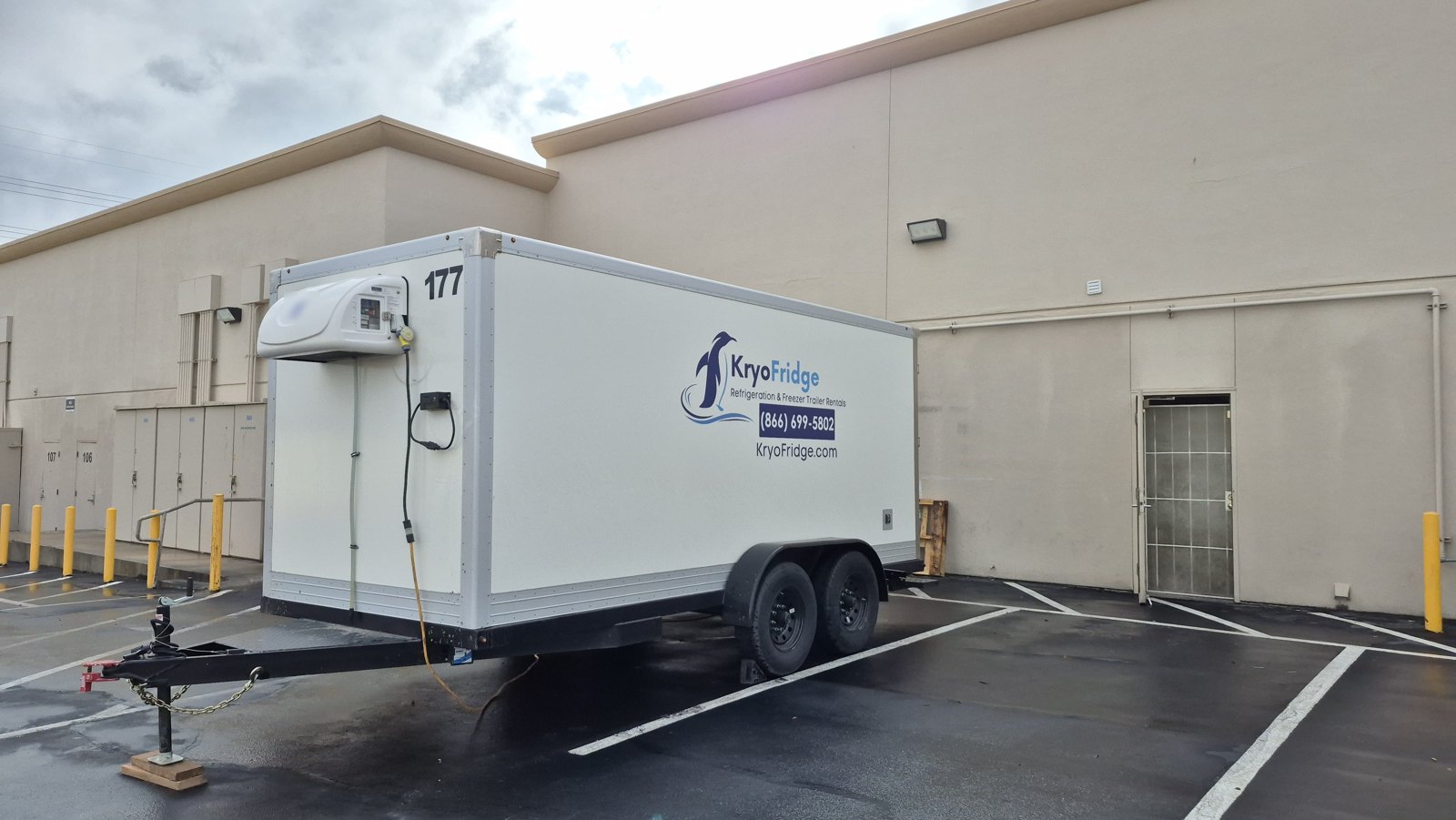
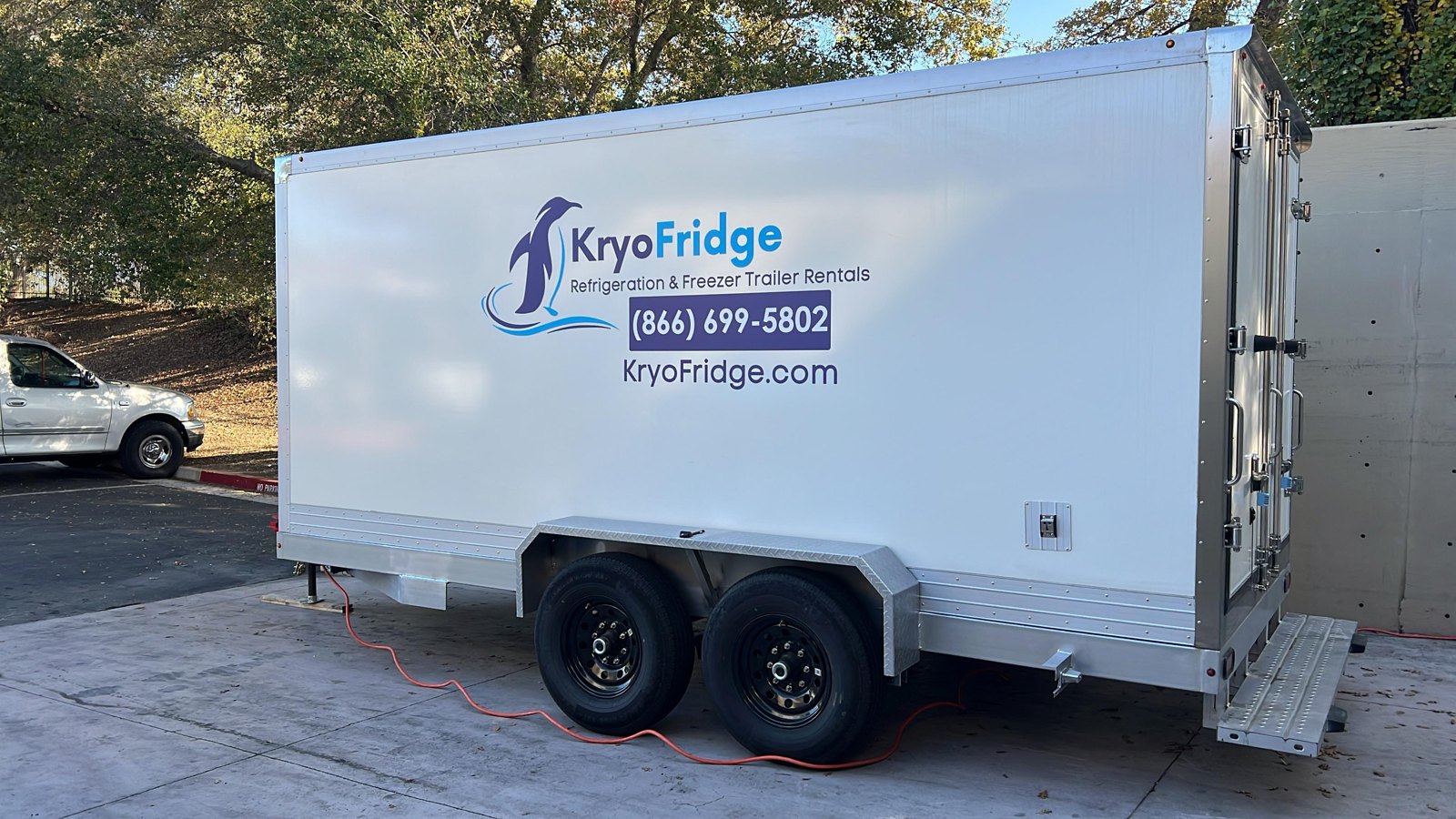
The 16' Utility earned its flagship spot the hard way, on jobs where a few degrees of drift would have cost somebody their inventory. The box is 16 feet long and fully insulated, riding on a tandem axle. The interior is NSF approved. One digital set point covers everything from -10°F frozen storage to a 50°F produce cooler. There are two ways in: rear double doors for pallets, and the side utility door for everyday grab-and-go.
Because we own and service the entire fleet, the trailer on your lot was prepped in our yard, not scrambled together after your call. It lives on a dedicated 120V, 20-amp circuit or a generator we supply, and it keeps its temperature whether the job runs a weekend or a full season.
| Spec | What you get |
|---|---|
| Temperature range | Roughly -10°F deep-freeze up to about 50°F fresh-cold |
| Mode | Dual-purpose: freezer or refrigerator on one precise digital set-point |
| Power | A dedicated 120V, 20-amp circuit within about 100 feet, or a generator we supply |
| Food safety | NSF-approved for direct food contact, food-safe surfaces, proper drainage |
| Footprints | 6x8, 6x12, and 6x16, from a tight retail lot to distribution scale |
| Backing | Owned in-house, fully licensed and insured, with 24/7 emergency dispatch |
Each unit holds a precise digital set-point and runs on a dedicated 120V/20A circuit or a generator. The trailers are not wired for 208 to 240V building service, so we confirm your hookup before the truck rolls.
Surprise covers 110.52 square miles at 1,385 feet, and the city has grown from 30,848 residents in 2000 to more than 167,000 today. That is a lot of ground for one service map. Loop 303, Grand Avenue and Bell Road do the heavy lifting, and a single staging point on that spine reaches the Railplex docks, the Sun City West clubhouse belt, the Prasada pads and the far northwest phases in Asante without a second yard. We keep the wide drops on the freight roads local haulers already use. Customers comparing this market against our St. George walk-in freezer trailer rentals up in Utah find the same fleet and the same delivery standard behind every stop.
Neighborhoods and towns we cover include Original Town Site, Marley Park, Asante, Sun Village, Sun City Grand, Sun City West, Surprise Stadium, Surprise Recreation Campus, Surprise Tennis & Racquet Complex, Mark Coronado Park, Elm Street City Center, Prasada, Cotton Lane, Loop 303 Corridor, Southwest Railplex, Bell Road, Grand Avenue, White Tank Mountain Regional Park, Waddell, El Mirage, Youngtown, Sun City, Peoria, Litchfield Park.
Every part of the Surprise area rents cold storage for its own reasons. We know each one, and we deliver to all of them.
Peoria counted 190,985 residents in 2020, which makes it larger than Surprise and the ninth biggest city in Arizona. Peoria Sports Complex has been the spring home of the Padres and Mariners since 1994, so a caterer working both stadium circuits is covering two big kitchens in the same six week window.
An unincorporated retirement community of 25,806 people on just under 12 square miles, bordering Surprise on three sides. Median age was 74.4 in 2020. Seven golf courses and a packed recreation calendar mean clubhouse kitchens and catered events are the steady cold storage work out here, not warehouse pallets.
Buckeye grew 79.9 percent between 2010 and 2020 and was the fastest growing city in the country three separate years. At 393 square miles it is Arizona's second largest city by land area, and its northern limits nearly touch Surprise. Data center work out there keeps crews on ground with no permanent power.
Both sit inside the Dysart Schools footprint, which spans 140 square miles and takes in all of El Mirage plus pieces of Glendale and Youngtown. Smaller commercial kitchens and school sites here usually take a KF8 or KF12, and the drive from our staging area is short enough for a morning delivery.
Luke supports roughly 7,500 military members, about 15,000 family members, and an estimated 80,000 retired military in the greater Phoenix area. Contractors doing food service near the base need backup cold storage that can clear Security Forces screening, so we build gate time into the delivery window instead of promising a drive time we cannot keep.
White Tank Mountain Regional Park forms the city's western boundary against public desert land. Trailhead events, group camps and hunting season holds out here have no circuit to plug into, which is why a generator is standard on any run past Cotton Lane.
One call sizes the trailer, sets the delivery window, and locks your quote for Surprise. Call now, or send the quick quote request and we will call you.
Cold storage is not one job. A taproom wants a boring, steady 36 degrees and a lock. A produce dock wants pallet room and a wide door. A pharmacy back room wants a narrow band and nothing else. The three below are what our phone rings for most in this city.
The 10,500 seat stadium on the 124 acre Surprise Recreation Campus is the shared spring home of the Texas Rangers and Kansas City Royals. Six to eight weeks of daily game day volume outruns what the fixed coolers were built to hold, and the Big 12 baseball tournament in May stacks another week on top of it.
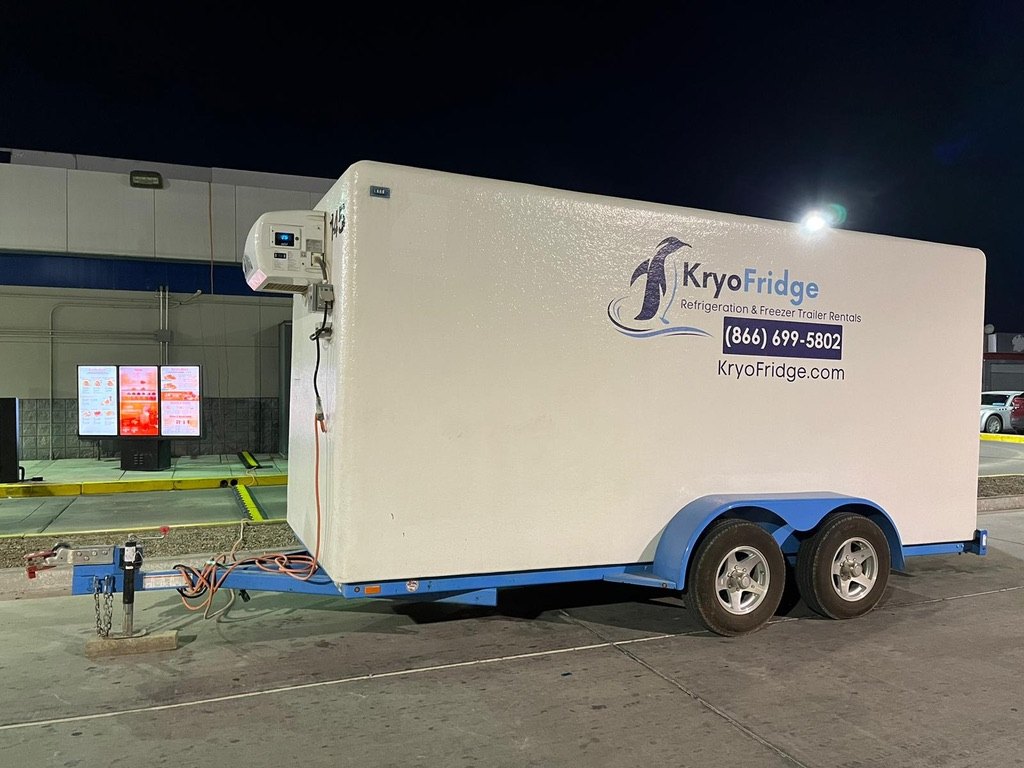
First Thursday of the month, ten to two, more than 70 vendors, October through April. Several of those booths sell produce, dairy or frozen novelties out of a personal cooler. One shared unit at the end of the row covers the whole market for a season.
The district feeds roughly 24,000 students across 26 schools on a 140 square mile footprint. A central kitchen refrigeration failure is a district wide meal service problem, not a one building inconvenience, so a same day bridge unit keeps the trays moving.
Prasada East includes a confirmed 35,100 square foot Whole Foods Market inside a 98,000 square foot center. Every new grocery or restaurant kitchen in that corridor needs somewhere cold to stage product during buildout, before its own equipment passes inspection.
The city's Original Square Mile celebration puts food vendors on public ground with no permanent kitchen. Add the SciTech Festival over at Mark Coronado Park and you have two civic events a year where mechanical cold beats a wall of ice chests.
The White Tank Mountains rise to 4,083 feet at Barry Goldwater Peak on public land west of the city, and Arizona runs its big game seasons through a statewide tag draw. Hunters and small game processing shops book short frozen holds for a few weeks every year.
What ties these together is the clock. Nobody budgets a freezer trailer into next quarter. They reach for one the hour a compressor quits, or the evening before a party when the stack of rented ice chests suddenly looks laughably undersized. Since our units sit staged around Surprise instead of a couple counties down the freeway, "can I get it today" is an ordinary ask here, not a stretch.
Add it up the way an owner in Surprise has to. One restaurant walk-in routinely sits on a small fortune in proteins, dairy, and prepped product. Scale that to a grocery rack or a warehouse freezer bay and the exposure balloons. Now knock the power or the compressor out on a triple-digit afternoon, and that whole inventory is in jeopardy inside a few hours. Then stack on the sales you lose while the line sits dark and the wages you burn paying staff to triage what can still be saved.
Hold a pre-staged trailer up against that risk and it reads like cheap insurance, a fixed, predictable expense parked in front of a loss with no ceiling. That is exactly why the businesses that got stung once tape our number by the phone. There is never a second scramble, because the next time they dial before the product has a chance to warm. Owning every trailer ourselves means we can scale the answer to fit. A single compact box suits a corner cafe. A clustered setup covers a warehouse floor. Either turns around the same day.
Two weather problems matter here, and they land in the same months. The first is the heat itself. Phoenix has logged a record 113 straight days at or above 100 degrees and a record 61 days at or above 110 in a single year. For a refrigeration unit that is a mechanical stress story. A compressor working a multi week stretch above 110, mounted on a metal skin taking direct desert sun, is doing far more work than the same machine in a mild market. Your single point of failure cooler has its worst odds in exactly the season when spoiled product is discarded fastest.
The second problem is the North American Monsoon, roughly June through mid September, wettest by mid July. Phoenix is one of the most haboob prone metro areas in the country. A collapsing thunderstorm pushes cold air down and kicks up a wall of dust that can run tens of miles wide, with peak winds of 22 to 62 miles per hour arriving with almost no warning. Those winds take down lines and transformers. Flash flooding does its own damage in the washes. The failure mode is different from a slow compressor breakdown, because the building is fine and the grid is not.
So we plan the Surprise calendar around that overlap. From June through mid September we keep more units staged and more generators fueled, because the calls that come in during those weeks are not scheduled work. They are somebody watching a thermometer climb with no power in the building. A generator powered box on your lot inside the same day is the difference between losing one machine's worth of product and losing the room.
Beer is perishable and people forget it. Let a pallet of packaged product climb into the seventies for a weekend and you get a flat, papery pint that customers push away without saying why. Cold conditioning and packaged storage both want a temperature that never moves. What moves it is almost never the beer. It is a compressor, a tripped breaker, or a storm that takes a block off the grid for six hours on a July afternoon.
Peoria Artisan Brewery sits a short drive southeast of Surprise and is the nearest named brewery inside our delivery radius. The drive tells you something about how this market works. Beverage stock out here moves between taprooms, restaurant accounts and event tents across three or four cities in a single week, and the weak point is never the taproom cooler. It is the gap in between. A case sitting in a closed delivery van at 110 degrees is cooked by the time it reaches the next stop. We stage a cold box at whichever end of that run has the volume, and the product stops riding around in the heat.
The wine side is the same problem with a thinner margin for error. Restaurant wine lists in the Prasada retail corridor keep real inventory on hand, and craft fairs and vendor shows over in Sun City West put bottles on folding tables in the open. Heat does not announce itself in a bottle. Nobody tastes it that day. It shows up weeks later as a cooked, stewed flavor, and by then you have poured it for a customer. A KF8 parked behind the tent line holds a whole vendor row's stock at cellar temperature for the length of a show.
We have learned to ask two questions first on any beverage job. How often does the door open, and who is opening it. A taproom cooler that a bartender raids every ten minutes needs more room than the case count suggests, because every swing dumps cold air the unit has to earn back. A storage-only hold can pack tighter. And we set the box where the afternoon shade lands, not where it is convenient at nine in the morning.
Every KryoFridge unit is a real walk-in box with a side door. You step in flat and load standing up. No dock plate. Nobody climbs into a refrigerated truck here. The KF8 holds about 268 cubic feet and 3,000 pounds, which covers a pharmacy back room, a taproom or a small kitchen. The KF12 gives you about 416 cubic feet and 4,300 pounds. The KF16 runs near 564 cubic feet and 6,690 pounds, and that is the one we send when a grocery stock room or a warehouse dock needs pallet room instead of shelf room.
All three dial from about 50 degrees down to about negative 10. One box, either job. A produce hold in March and a hard freeze in September can be the same trailer, so nobody signs twice for two different needs. Power has exactly two answers. A dedicated 120 volt, 20 amp circuit within 100 feet of where the unit sits, or our generator. A Bell Road shopping center almost always has the circuit. A raw pad out on the Loop 303 frontage usually does not, and the generator goes on the truck before we leave. We settle that on the first call. Half the bad rental stories in this trade start with somebody assuming an outlet was there.
And the fleet behind it is deep. KryoFridge keeps one of the largest walk-in and refrigerated trailer fleets in the markets we serve, which matters in a metro where one bad afternoon puts four accounts on the phone inside the same hour. We own the trailers. We are not a broker handing your job to whichever yard has something free that week, and the crew servicing the unit works for us. Customers comparing our Indio mobile refrigeration rentals against what we run in Arizona get the same equipment and the same standard on either side of the state line.
Surprise has a freight side that people outside the city miss. The Southwest Railplex Industrial District is a designated Foreign Trade Zone with direct rail access to the BNSF Railway on the Phoenix Subdivision, and BNSF bought 4,000 acres on the city's northern edge for an intermodal hub. Loop 303 carries the rest. There is more than five million square feet of warehouse and logistics space under construction along that corridor at any given time, with roughly three million of it inside the city's own industrial district.
Fresh product moving through that kind of freight corridor lives and dies on holding time. Chilled seafood wants to sit just above freezing, and every hour it drifts upward comes off the shelf life at the far end. Produce is fussier. Different items want different numbers. The distribution side of this market already knows that. Bashas', headquartered down in Chandler, runs a distribution center with more than 16 acres under roof and climate zones that go from a 55 degree ripening room all the way down to negative 10 freezer rooms. Sprouts Farmers Market, based in Phoenix, now runs 483 stores across 24 states. That is the scale of cold chain feeding this corner of the Valley.
One link in a chain that size has a bad day. The product does not stop arriving. A rail delay, a dock door stuck open in August, a remodel that takes a cooler offline for three weeks, a truck that shows up early with no room waiting for it. We drop a KF16 on the dock and it comes up to temperature before the first pallet crosses. The inbound schedule keeps its shape. We have moved units onto Railplex and Loop 303 docks with nothing but a generator and a level pad, because plenty of those buildings are still going up around the tenant.
Two things we plan for out here that crews in milder markets do not. First, we get the box on site early on any produce or seafood job, because loading warm product into a cold trailer asks the refrigeration to pull down and hold at the same time. Second, we ask where the sun lands at four in the afternoon. A unit on black asphalt with west sun on it all day works measurably harder than one tucked against a north wall.
A pharmacy cooler is a small machine carrying an expensive load. Vaccines, insulin, biologics and a long list of everyday prescriptions want a narrow band, and the band is narrow enough that a failed unit is not a slow problem. It is a same-shift problem. Surprise has more of this work than its size suggests. Sun Health Foundation is the fourth largest employer in the city at about 570 jobs, running senior living and health services where food service and medication storage both sit on refrigeration that has to keep working. Fry's Food and Drug, with roughly 550 local jobs, puts a drug counter inside a grocery store, which means two separate cold chains under one roof.
We get called for three versions of the same story. A back room cooler fails and the replacement part is ten days out. A clinic remodels and the cold storage has to live somewhere for a month. Or a building loses power and a supervisor is standing there doing math on how long the door can stay shut. A KF8 fits in a fenced service yard with room to swing the door, and it draws power from a dedicated 120 volt circuit the building already has. Nobody on the appointment schedule gets bumped.
We do not sell a temperature monitoring service. That is worth saying plainly. No remote alerts, no logged records from our side, no alarm package. The unit has a digital setpoint and it holds it. Your own logging stays yours, the same way it does for the cooler inside your building. Plenty of rental outfits blur that line. We would rather you hear it on the first call than find out during an audit.
The senior living side adds its own wrinkle. Sun City West alone counts 25,806 residents with 83.9 percent of them 65 or older, and the clubhouse kitchens and catered events across that belt feed people for whom a spoiled meal is a health event, not an inconvenience. When a kitchen out there books a backup unit ahead of a big catered weekend, that is risk management, not an extra. Insurance certificate out the door without three reminder emails, driver briefed on the gate, box cold before the food arrives.
"Cold" is not one number. Different product stays safe inside different temperature windows, which is the entire reason a precise digital set-point matters, and in the middle of a heat wave in Surprise, a load that slips out of its window is a load you write off. Use the chart below as the reference our customers lean on when they size a rental.
| Product | Target holding band | Trailer mode |
|---|---|---|
| Ice cream and frozen desserts | -10°F to 0°F | Deep freeze |
| Frozen proteins, seafood, prepared meals | 0°F or below | Freezer |
| Fresh meat and poultry (short hold) | 28°F to 32°F | Refrigerated |
| Dairy, deli, packaged produce | 34°F to 38°F | Refrigerated |
| Beverages, florals, catering trays | 38°F to 45°F | Refrigerated |
One figure matters more than everything in that chart, and it is not listed there: 40°F. Food-safety guidance treats the band between 40°F and 140°F as the zone where bacteria thrive, and the clock on perishable product starts ticking the moment it crosses 40 on the way up. Roughly four cumulative hours above that line and most refrigerated inventory is no longer safe to serve. Picture that countdown running on a 100-degree afternoon in Surprise with the walk-in dark, and the urgency of a quick trailer drop stops being abstract.
Tell us the single coldest item you are holding when you call, and we dial the trailer to that. One unit carries a straight freezer load with no fuss. But when your list mixes deep-freeze desserts with fresh-cold produce for the same remodel or event, we will usually point you toward a split setup or a second box so neither side of the load has to settle for the wrong temperature.
Powering one of our trailers is refreshingly simple, and there are precisely two ways to do it. Either you have a dedicated 120-volt, 20-amp circuit reachable within roughly 100 feet of the parking spot, or we bring a generator. What the units will not accept is standard 208 to 240V building service, so a quick question about your outlet before dispatch heads off any surprise on delivery day.
On placement, all the unit really asks for is a fairly flat patch with enough room for the delivery truck to maneuver it in and set it straight, plus either a power source in reach or space for a generator. We lock down the exact drop point before dispatch, and our drivers know the Surprise layout cold, so the delivery is one clean trip instead of a guessing game on the property.
A dust storm took the block off power just after four and the taproom had packaged stock plus two weeks of cold conditioning at risk. We had a generator unit on the side lot before the walk-in lost its margin, and the crew moved cases straight across. They reopened the next morning with nothing dumped.
Their cooler was coming offline while a contractor rebuilt the evaporator wall, and inbound freight was not going to pause for it. Two KF16 units went to the dock the afternoon before, cold and ready. Product stayed in spec the entire window, and they booked the same setup for the following spring before the first one was even picked up.
The back room cooler quit overnight and the part was ten days out. A KF8 fit inside the fenced service yard with room to swing the door, and it drew power from a dedicated circuit the building already had. Nobody's prescription got moved to another store.
We route around Bell Road and the 303, not around a map app. One yard on the Loop 303 spine reaches the Railplex docks, the Bell Road retail belt, Sun City West's clubhouse kitchens and the Prasada pads without a second staging point. Grand Avenue gets us back toward central Phoenix on a different line than the freeway when the freeway is stacked. And we keep long trailers off the Marley Park residential loops at school pickup time, because a driver who has done it once never wants to do it twice.
On a bad day, booking should be the part that does not add stress. Four steps, an upfront number, and a single person who owns the whole thing.
Tell us whether it is freezer or fridge product, a ballpark volume, and your rough window. That is enough for us to call the right size.
We pair you with a unit, confirm whether you have a dedicated circuit or need a generator, and pin the exact drop point so the truck makes one trip.
We arrive on your schedule, about 45 minutes for a true emergency, set the trailer, energize it, and let it drive down to your number.
It holds the set-point for your entire term while our line stays live the whole way through. Wrap up, and we swing back for the pickup.
Start with temperature, because it sets everything else. The USDA defines roughly 40 to 140 degrees as the danger zone, the range where bacteria in food multiply fast. Food that can spoil and sits in that range for more than two hours is a discard. Not a delay. That single line is the reason a grocery backroom or a school kitchen cannot wait out a dead cooler. Coolers hold at or below 40 degrees and freezers at or below zero, and a rented box that arrives already at setpoint keeps you inside those numbers.
Arizona runs retail and temporary event food safety through the state health department, with Maricopa County handling day to day inspections on the ground. A vendor booth at the Sun Village market, a concessions stand during spring training and a catered clubhouse event are all short duration food operations on ground with no permanent kitchen, and each one carries its own event permit on top of the cold holding expectation above. Check your specific paperwork with the county rather than assuming last season's approval carries over. We give you the unit's footprint, weight and power draw in writing for the application, the same package we hand crews on our Tulare portable cold storage rentals.
Arizona also added statewide outdoor heat rules in 2026, folded into an updated heat program that asks employers with outdoor crews to provide water, shade and rest and to write the plan down. That rule is aimed at workers rather than at food, but it tells you the posture a safety officer or a general contractor already expects on an Arizona site in July. On private property, where a trailer can actually sit usually comes down to your lease, your site plan and the fire lane. Keep the unit out of the fire lane and off the accessible parking aisle and you are generally fine. We tell you what the box needs. You confirm what your property allows.
One caveat we always state plainly: we supply the food-safe, temperature-holding hardware itself, but we are not a temperature-logging or alarm-monitoring service. If your program requires continuous written records, line that vendor up on your own.
Our signature 16 foot Utility series leads the fleet. It is the trailer we send on most jobs, and crews like it for the side utility access door. We build three footprints in all, so a single kitchen holding overflow stock has a fit and so does a distribution floor in a disaster. Every unit is dual purpose by design: one adjustable system swings between freezer and refrigerator on a digital set point. Each trailer runs on a dedicated circuit or on a generator.
| Trailer | Best for | Temp range |
|---|---|---|
| 6x16 Utility ⭐ | Our signature series: distribution, large events, disaster response, side utility door | Heavy-duty reefer |
| 6x12 | Grocers, caterers, mid-size events | Deep-freeze capable |
| 6x8 | Tight lots, small kitchens, short overflow | -10°F to 50°F |
Each unit holds a precise digital set-point and runs on a dedicated 120V/20A circuit or a generator.
Think eight or so pallet spots, and the unit to grab when square footage is the whole problem. It slips into the pinched service yards and cramped back-of-house corners that a larger box cannot even swing into. One cafe or small-market walk-in goes down, and this is almost always enough cold to cover it, plus the simplest unit to set in a small space.
Call it fourteen pallet spots, deep-freeze rated, and far and away the size people ask for most. It lands right in the middle: roomy enough for a multi-day catering job or a restaurant that needs true walk-in-equivalent room while the kitchen is torn up. Roomy enough that nobody is playing Tetris with shelves, yet still small enough to set in most commercial back lots without a site survey.
Roughly twenty pallet spots paired with a heavy-duty reefer plant engineered to keep deep-freeze locked in even when the ambient air is merciless. Reach for it when a warehouse bay drops, when a large festival needs an anchor, or when a relief operation is carrying its own cold chain.
Not sure which size fits? Most customers land on the 16 foot Utility, and we will tell you honestly if a smaller footprint covers your job. Tell us roughly what you are storing and for how long, and we will spec it for you.
The questions that surface once the basics are settled. Tap any topic to open it.
The pop-up walk-in cooler. Cheap to rent and easy to set up, but it chills, it does not freeze, and it draws every watt it needs from your building while depending on a calm ambient temperature around it. The second your building loses power, your cooler loses it too.
The refrigerated box truck. Designed to haul product on the interstate, not to sit in a lot and babysit it. Parked, it burns fuel all day, broadcasts compressor noise across a storefront or an event lawn, and pins down a tractor plus a driver you probably do not need.
The freezer trailer we deliver. Built from the ground up to be dropped on a pad and to defend a temperature for as long as the job runs. It freezes deep, carries NSF approval, locks, stays quiet near guests, and lives on nothing more than one dedicated circuit or a generator.
Even a rented box has to satisfy the county environmental health office that licenses and inspects every food facility. Show an inspector a unit that cannot document its temperature or was not built for food contact, and they have the authority to halt service immediately.
That is a bar each of our trailers clears: NSF-approved throughout, food-safe interior surfaces, proper drainage, and a digital controller that puts the set-point in plain view. We supply the food-safe, temperature-holding hardware itself, but we are not a temperature-logging or alarm-monitoring service.
For a typical kitchen or market, one box does the job. Distribution floors, big fairs, and full-scale disaster response routinely need more, and because the fleet is ours, we can cluster several units and bring them online in waves as the work expands. Match the cold capacity to the operation rather than make the operation squeeze itself into one box.
The clock is yours to set. Some jobs are a handful of days for an emergency or a single event. Others stretch across weeks or months for a remodel or a seasonal swell, and a few become standing contracts for businesses that want capacity parked on standby. Name your window and you will get a clean quote, no penalty for an honest "not sure yet."
Building permanent cold storage is a capital project in every sense: you hire a refrigeration contractor, schedule the electrical, pull a building permit, and wait weeks before a single pallet goes inside. A rental turns that equation on its head. You bring in precisely the cold you need, for precisely the stretch you need it, and the trailer is holding temperature that same week, frequently that same day, with the commitment ending the moment your need is over.
Three engineered elements carry the load. Thick insulated panels and tightly gasketed doors lock the sun outside and the cold inside. A self-contained reefer condensing system specified with surplus capacity keeps stripping heat out of the box even when the air outside is brutal. And a digital thermostat locks onto your chosen number and cycles the compressor to hold the line. Run those three together and a trailer baking on open asphalt behaves like one tucked in a cool warehouse. That is also why power is the first thing we ask about: the design delivers its safety margin only on steady, uninterrupted power.
"I called about a cooler that was drifting and expected a sales pitch. Got a guy who asked how often my door opens and then told me the smaller box would be fine. It was."
"We cook for a lot of people who really cannot afford a bad meal. Having a backup box on site for the big weekends took that worry off the list, and the driver was early both times."
"Truck showed early, no room on the dock. One phone call, box on site the same afternoon, already cold. That is the whole review."
"Six weeks of daily games and our fixed coolers were never going to keep up. They set two units behind the stand and we stopped running to the store between innings. Setup took under an hour."
"Equipment swap that was supposed to take two days took nine. They just extended us without a lecture about it."
"We needed insurance paperwork before anything could roll onto district property and it came back the same day, correct the first time. The unit was clean inside too, which I checked."
"One shared cold box at the end of the vendor row replaced about fifteen personal coolers. Vendors liked it more than I expected, and a few asked me who to call for their own shops."
"Discreet delivery, no branding questions from neighbors, and they set it exactly where I asked. Ran for two months without a hiccup."
"Our walk-in went down during a heat wave and I was told by another company that Monday was the soonest. KryoFridge had a box here that afternoon. I have used them twice since and sent them to two other kitchens."
Start with pallets, not square feet. A standard grocery pallet is 48 by 40 inches. The KF8 gives you about 268 cubic feet and the KF12 about 416. The KF16 runs about 564, and those numbers shrink once you leave room for an aisle to walk in and clearance in front of the evaporator. Then adjust for traffic. A warehouse dock that opens twice a shift can pack tighter than a vendor row where the door swings every ninety seconds. Heavy door traffic in a Surprise July means size up, not down.
One box holds one temperature. So you pick the setpoint, or you take two units. Every KryoFridge trailer dials from about 50 degrees down to about negative 10, which covers either job. Most kitchens solve it by putting frozen in the rental and keeping the chilled product in whatever cooler is still working, or by taking a KF8 alongside a KF16. Tell us your split on the first call and we will tell you which way is cheaper to live with.
Our units have a side man door you walk into flat, so a pallet jack or a cart goes straight in on most level pads. On a sloped lot we bring what is needed to get you level and safe. Shelving is not standard. If you are storing cases rather than pallets, plan on your own racks or speak up early. And leave air space at the top. Stacking to the ceiling blocks the return air path. The unit reads a false number while the product at floor level starts drifting.
Four things move it. Duration, because a two day emergency hold and a six week remodel are different commitments. Power, because a dedicated circuit and a generator are not the same job. Size, since the KF8, KF12 and KF16 are three different trailers. And distance, because an in-town Surprise address, a Peoria site and a run out past Cotton Lane are not the same drive. Give us those four on the call and you get a real number instead of a range.
Both, and the answer depends on the month. Emergencies are what we staff for, so call the minute a cooler starts drifting. But two windows on the local calendar fill up fast. Spring training runs six to eight weeks across February and March, and the monsoon stretch from June into mid September puts steady pressure on the fleet. If you already know you want coverage for either one, get on the calendar early and you will not be depending on what happens to be sitting in the yard that day.
Yes. The man door locks and you hold the key for the whole rental. Nobody from our side opens it unless you are standing there. On an open pad along the 303 frontage we set the box so the door faces your building or your camera, never the street, and plenty of customers hang their own padlock on top of ours. Mention your lighting when you call, because a dark corner changes where we put it.
Yes. Heat is the one we plan for out here. The units are built for commercial duty and they hold setpoint through a string of 110 degree afternoons. What helps is placement. Shade on the west side, clear air around the condenser and a level pad. Cold snaps are the easy direction in this climate, though a hard overnight drop can matter if you are holding produce that does not want to freeze, in which case we set the dial higher and walk you through it.
Every unit gets washed out and checked between rentals, and it shows up clean and dry with the box already pulled down to your setpoint. Food contact surfaces are your product's packaging and your own pans, so bring the same practices you use inside your building. If you are coming off a failure and moving product that has been sitting warm, tell us. We will get the trailer there early so it is at temperature before the first case crosses the threshold.
Same day is the standard we hold ourselves to, and most in-town calls are a lot quicker than that. We stage on the Loop 303 spine, which puts the Railplex, the Bell Road retail belt and the Sun City West line inside a short run. Outage calls come in bunches during monsoon weeks, so the earlier you call the better your spot in the queue. Generator power comes standard on any outage job, since the thing that failed is the grid and not your building.
A level spot the trailer can back into, clear of the fire lane and the accessible parking aisle. Either a dedicated 120 volt, 20 amp circuit within 100 feet or a clear plan for our generator, including somewhere the fuel can be topped off. Enough swing room to open the door fully with a cart in front of it. And a name and number for whoever is on site at delivery, because the fastest jobs are the ones where the driver does not have to find somebody.
KryoFridge handles more than cold boxes in this market, so if your job needs something else on the same lot, start here.
Monsoon season takes power off a block in this city with almost no warning. One minute the line is up, the next a wall of dust crosses Grand Avenue and half the retail belt goes dark. What you do in the next sixty minutes decides whether you lose a machine's worth of product or a room's worth.
Do not open the door. That is the first rule and the hardest one to follow, because everybody's instinct is to check. A closed walk-in holds usable temperature far longer than most people assume, and every swing of that door spends part of your margin. If you have a thermometer you can read from outside, read it. If you do not, write down the time the power went out and treat that as your clock.
Further reading: National Weather Service Phoenix monsoon information.
Most people rent a cold box once every few years, which means most people are buying something they have no practice buying. The rental companies know this. These are the questions that separate a smooth week from an expensive one, in roughly the order you should ask them.
Start with ownership. Do you own this trailer, or are you brokering it? A broker takes your call, takes a margin and hands the actual job to whoever has a spare unit. When something goes wrong at nine at night, you find out fast which kind of company you hired. Ask it directly and listen to how quickly the answer comes.
Further reading: USDA Food Safety and Inspection Service: the danger zone.
Retail keeps arriving on the west side of Surprise. The Village at Prasada and Prasada East have added grocery, restaurant and mixed use space along Waddell Road and Cotton Lane, and every one of those tenants goes through the same sequence before a customer ever walks in. That sequence has a cold storage gap in it, and most first time tenants do not see it coming.
The gap is in the schedule. Your permanent refrigeration gets installed late in the buildout, then it gets commissioned, then it gets inspected. Meanwhile your opening date is fixed, your first product order is scheduled against that date, and your training staff needs real inventory to train on. So product arrives before the coolers are signed off. That window is usually one to three weeks, and it is where a temporary unit earns its keep.
A walk-in fails and the question arrives fast. Do we fix this, or do we replace it. What do we do with the product in the meantime. Those are three separate decisions. People mash them into one, usually under pressure, usually at the worst hour.
Separate the third one first. Whatever you decide about repair or replacement, the product has to go somewhere in the next couple of hours. Getting a cold box on site buys you the room to make the other two decisions calmly instead of while a thermometer climbs. That is the whole argument for a bridge rental and it does not depend on which way you eventually go.
Tell us what you are holding, where it has to sit and how long you need it. Call 866-699-5802 or request a free quote, and we will confirm sizing, power and a delivery window on the same call.