
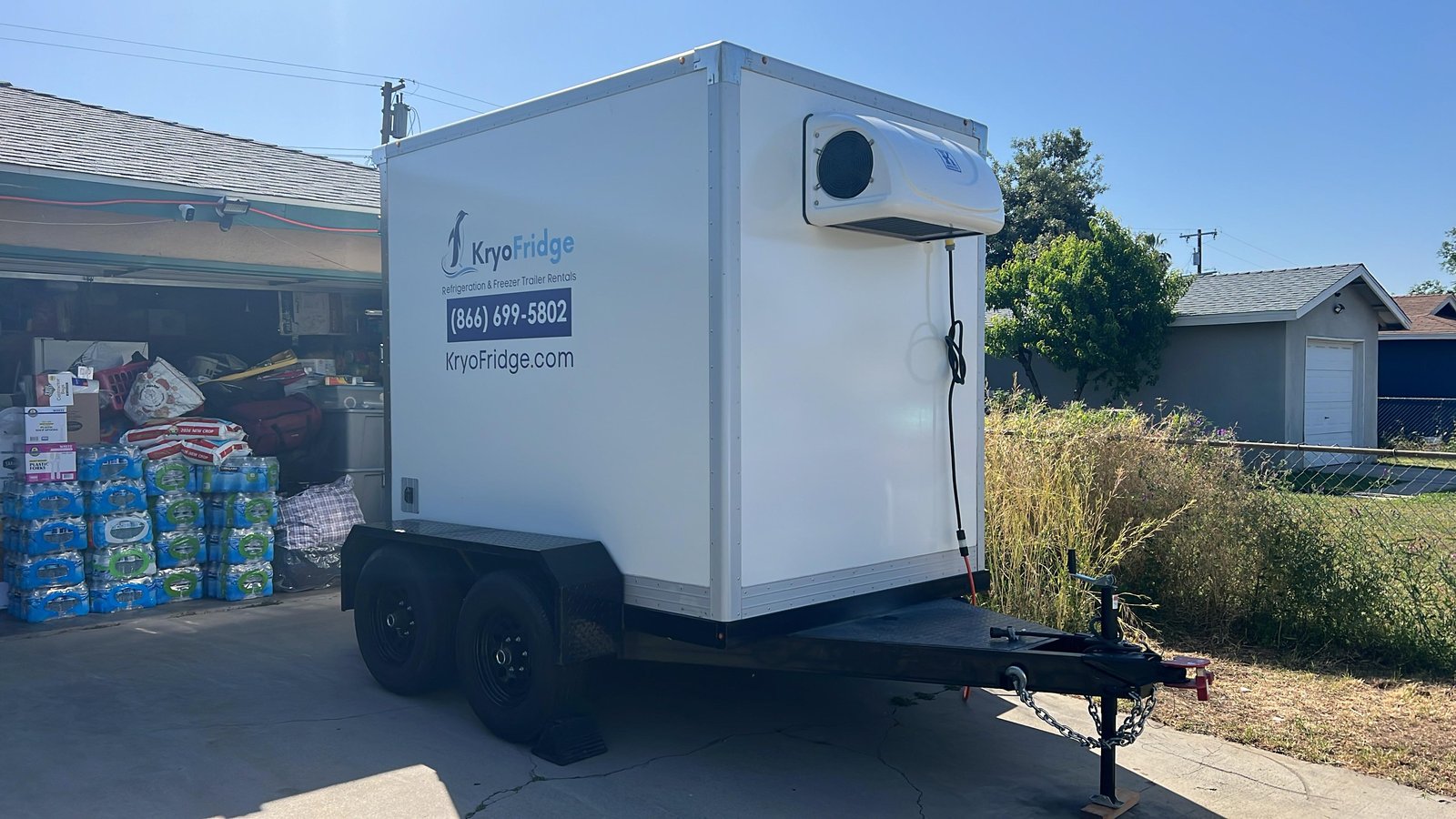
KryoFridge brings mobile cold storage on wheels to West Covina, delivered pre-cooled and set up so you can load it the day it lands. We park trailers behind restaurants and grocers along the I-10 corridor, beside school kitchens and clinics, and on event lots near the Civic Center. One trailer holds anything from a hard freeze at -10 degrees up to a 50 degree cooler setting. Call us now or request a free quote, and we will lock in your size and dates.
Any trailer can look good sitting closed in a yard. The real test in West Covina is a door that swings open every ninety seconds during a night market rush at City Hall, while the set-point stays put the whole time. Our units are built for that kind of day, with heavy insulation and a refrigeration plant sized to pull the box back down fast after every open door. A home freezer or a cheap chest unit climbs a few degrees with each opening and never catches up. We own every trailer in the fleet, we service them in-house, and we are backed by more than 30 years in the equipment rental business. You deal with us directly, not a broker who has never seen the unit. KryoFridge is a direct fleet owner, not a reseller, with SAM.gov registration for public agency work and an A+ BBB rated network behind every booking. Call us today or request a quote, and we will match a trailer to your door traffic before it ever leaves the yard.
Every trailer we send belongs to us and gets serviced by our own crew. Nobody hands your job off to a stranger with an unknown unit.
Each unit works as a freezer or a cooler on the same controller. You can switch it between jobs, or even halfway through a long rental.
Plug into a dedicated 120 volt, 20 amp circuit within 100 feet, or let us bring a generator. Most West Covina lots have one of the two ready.
Coolers fail at bad hours. Our dispatch line runs around the clock, every day of the year.
We carry the licenses and insurance that property managers, school districts and hospitals ask to see. Paperwork goes out quickly when you ask for it.
Our home base covers the San Gabriel Valley, and the same fleet serves customers in all 50 states for long-term and emergency jobs.
The names below have all run our trailers on real jobs. When a brand this size hands you their frozen inventory, they have already checked everything worth checking.
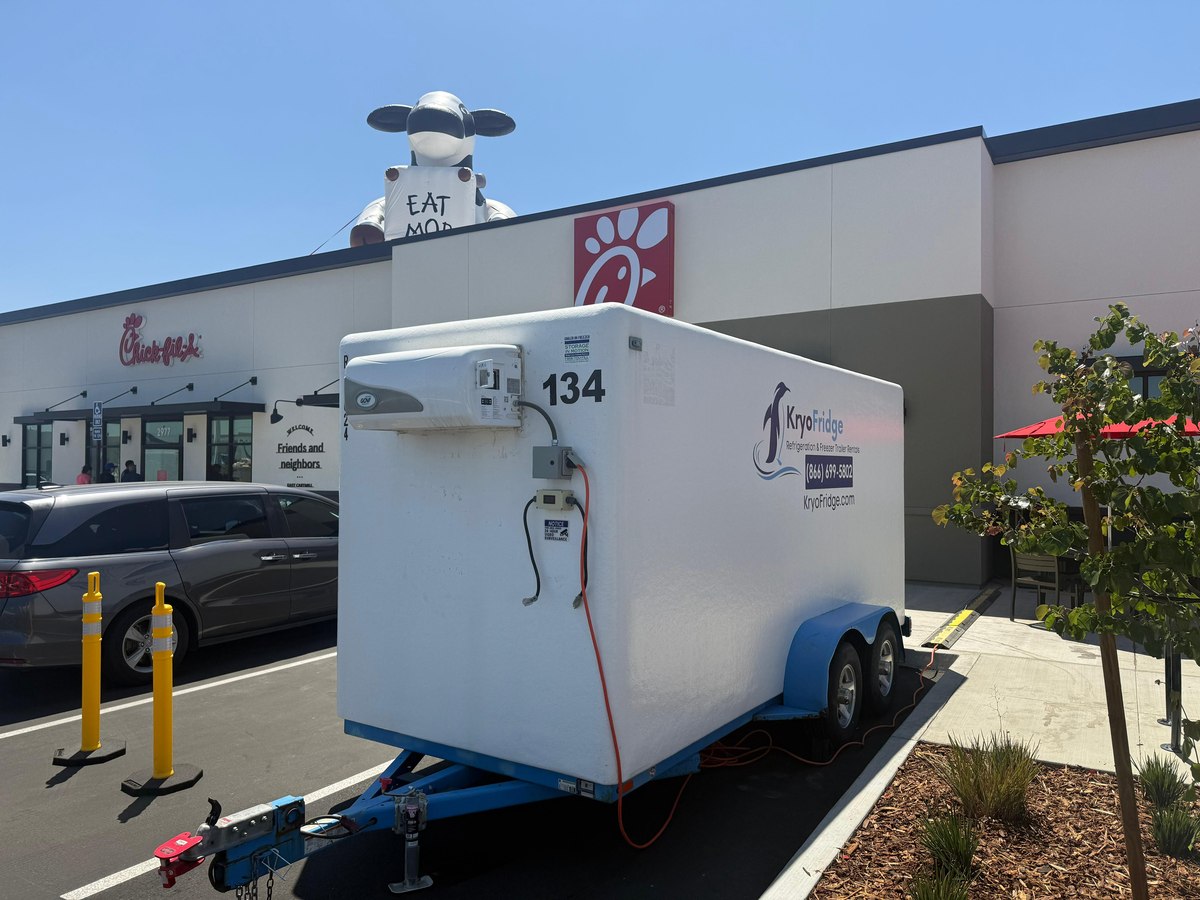 Chick-fil-A
Cooler or freezer capacity through store remodels, delivered and set up by our own crew.
Remodel support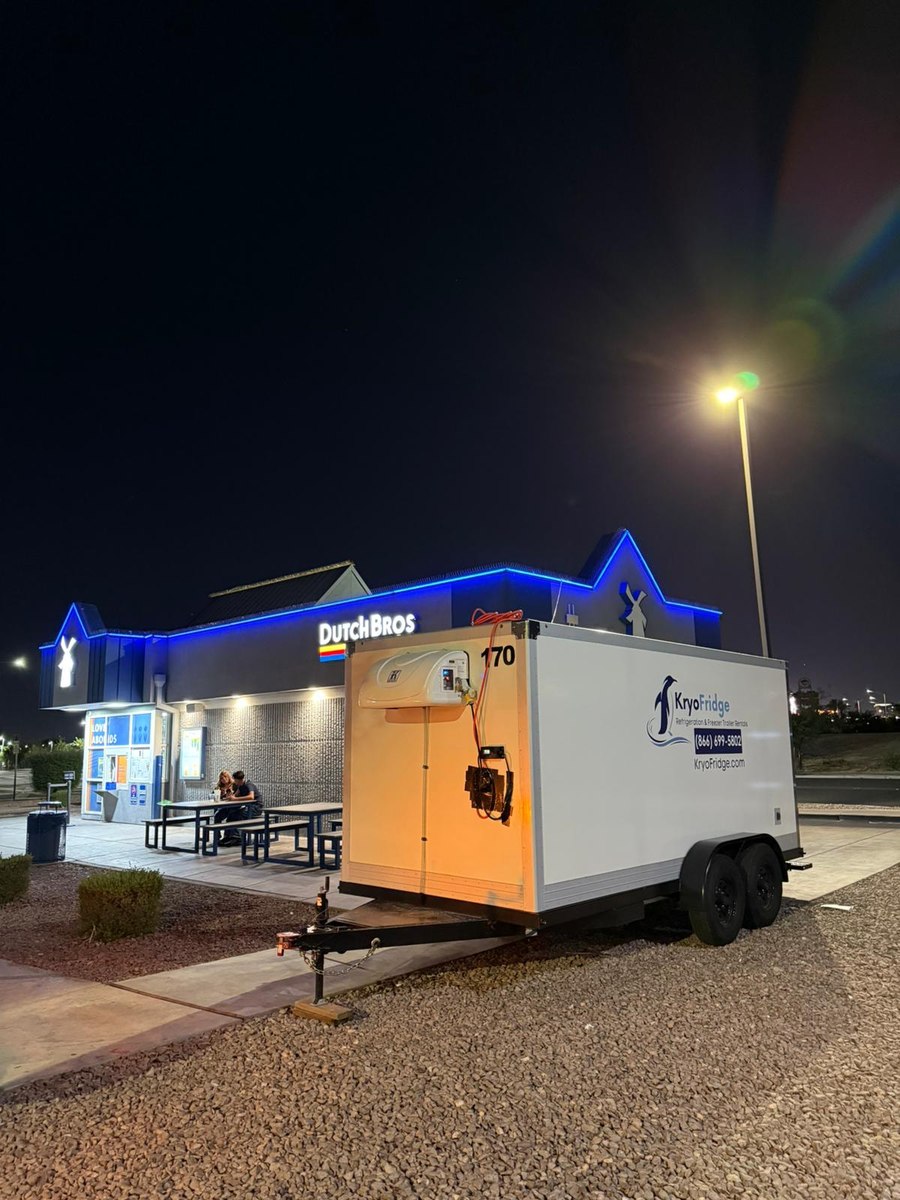 Dutch Bros
Cooler space for dairy and cold stock during store equipment work.
Dairy cooler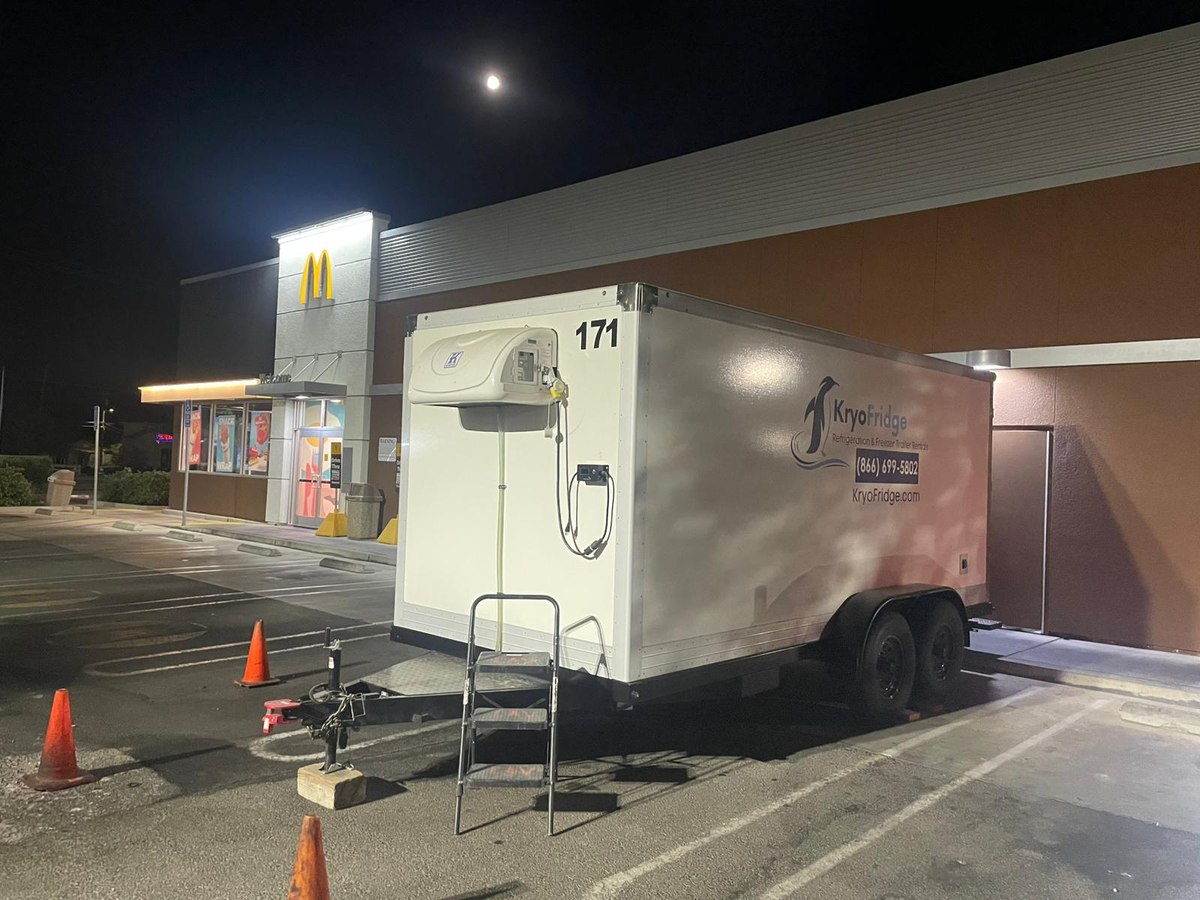 McDonald's
Extra frozen holding parked on site during remodels and equipment swaps.
Remodel support"We sell ice cream bars and shaved ice, and heat is our enemy. The trailer stayed at -10 all evening even with all of us opening the side door every few minutes. Nothing went soft."
"Our walk-in compressor quit on a Tuesday morning. They had a cold trailer in the back lot before lunch, and we moved everything over without losing a case."
"Very respectful team. The trailer was plain, clean, and parked exactly where we asked. They kept their visits short, which our families appreciated."
For West Covina jobs, most customers take the 16 foot Utility, since its side door lets a server grab one case without opening the rear doors to a hot afternoon on Azusa Avenue.
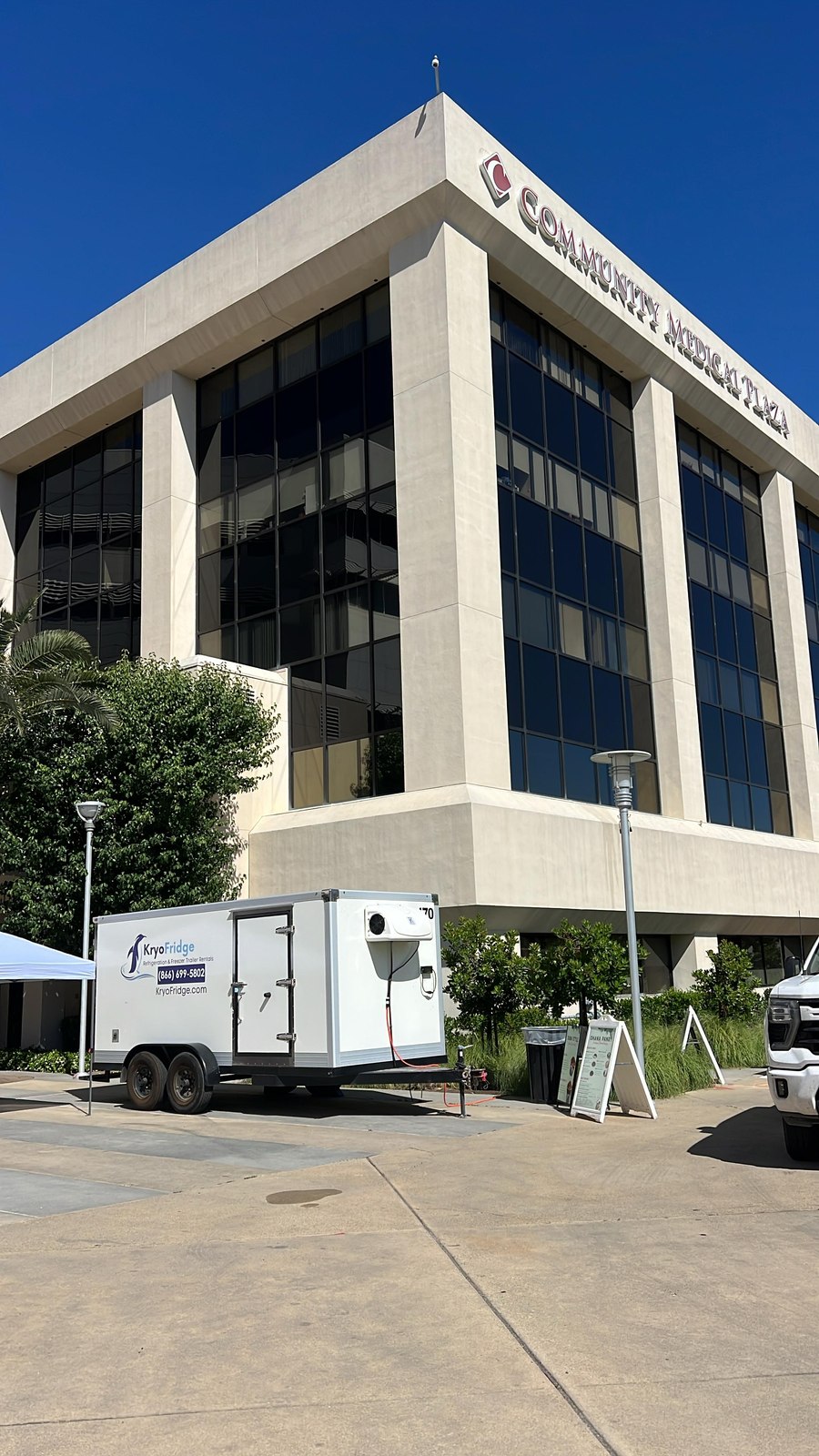
Ask any of our drivers which trailer they would send to a job that cannot fail, and they will point at the 16' Utility. Sixteen feet of insulated box rides on a tandem axle and swings from deep-freeze to fresh-cold on one digital set-point, every interior surface NSF approved. The rear doors swallow pallets off a loading dock while the side utility door gives your staff a quick in and out without dumping the cold air.
Every one of these is ours, not a unit we sourced from somebody else after you called. That means it arrives fueled, already pulled down to temperature, and serviced by our own shop. Plug it into a dedicated 120V, 20-amp circuit or run it on a generator we bring, and it will hold its number through the hottest week of the year.
| Spec | What you get |
|---|---|
| Temperature range | Roughly -10°F deep-freeze up to about 50°F fresh-cold |
| Mode | Dual-purpose: freezer or refrigerator on one precise digital set-point |
| Power | A dedicated 120V, 20-amp circuit within about 100 feet, or a generator we supply |
| Food safety | NSF-approved for direct food contact, food-safe surfaces, proper drainage |
| Footprints | 6x8, 6x12, and 6x16, from a tight retail lot to distribution scale |
| Backing | Owned in-house, fully licensed and insured, with 24/7 emergency dispatch |
Each unit holds a precise digital set-point and runs on a dedicated 120V/20A circuit or a generator. The trailers are not wired for 208 to 240V building service, so we confirm your hookup before the truck rolls.
We deliver cold storage trailers to every part of West Covina and the cities around it, from the foothills in Azusa to the warehouses in the City of Industry. The same fleet also handles Santa Clarita freezer trailer rentals on the north side of the county, and it serves long-term and emergency jobs in all 50 states. Call us with your address and we will confirm timing.
Neighborhoods and towns we cover include West Covina, Covina, Baldwin Park, La Puente, Azusa, Glendora, Walnut, Diamond Bar, Hacienda Heights, City of Industry, El Monte, Irwindale, Duarte, Charter Oak, Valinda, West Puente Valley, Avocado Heights, South San Jose Hills, Citrus, Vincent, San Dimas, Rowland Heights.
Every part of the West Covina area rents cold storage for its own reasons. We know each one, and we deliver to all of them.
Older shops and small restaurants line this street, and most have tight back lots. The 6x8 fits where larger trailers cannot, and it plugs into a standard dedicated circuit.
City events at City Hall and programs at Cameron Park Community Center draw big crowds with food vendors. Event trailers here usually need a generator and a spot that stays clear of foot traffic.
Big League Dreams sits on land that was once the BKK landfill, cleaned up and turned into ball fields. Caterers for tournaments and company picnics need a trailer that sits on pavement near the service gate.
The mall and the freeway frontage hold the city's busiest restaurants. Walk-in failures here cost the most, so we plan fast drop-offs and short setup times for this stretch.
Emanate Health Queen of the Valley Hospital anchors a cluster of clinics and pharmacies nearby. Customers in this area mostly ask for outage backup and a cooler setting they can log.
Homes and churches near Galster Wilderness Park sit on hilly streets with narrow driveways. We scout the access before delivery so the trailer lands level on the first try.
One call sizes the trailer, sets the delivery window, and locks your quote for West Covina. Call now, or send the quick quote request and we will call you.
Most calls we get from this part of Los Angeles County fall into a few groups. Three of them need more care than a standard kitchen overflow job, so here is how we handle each one.
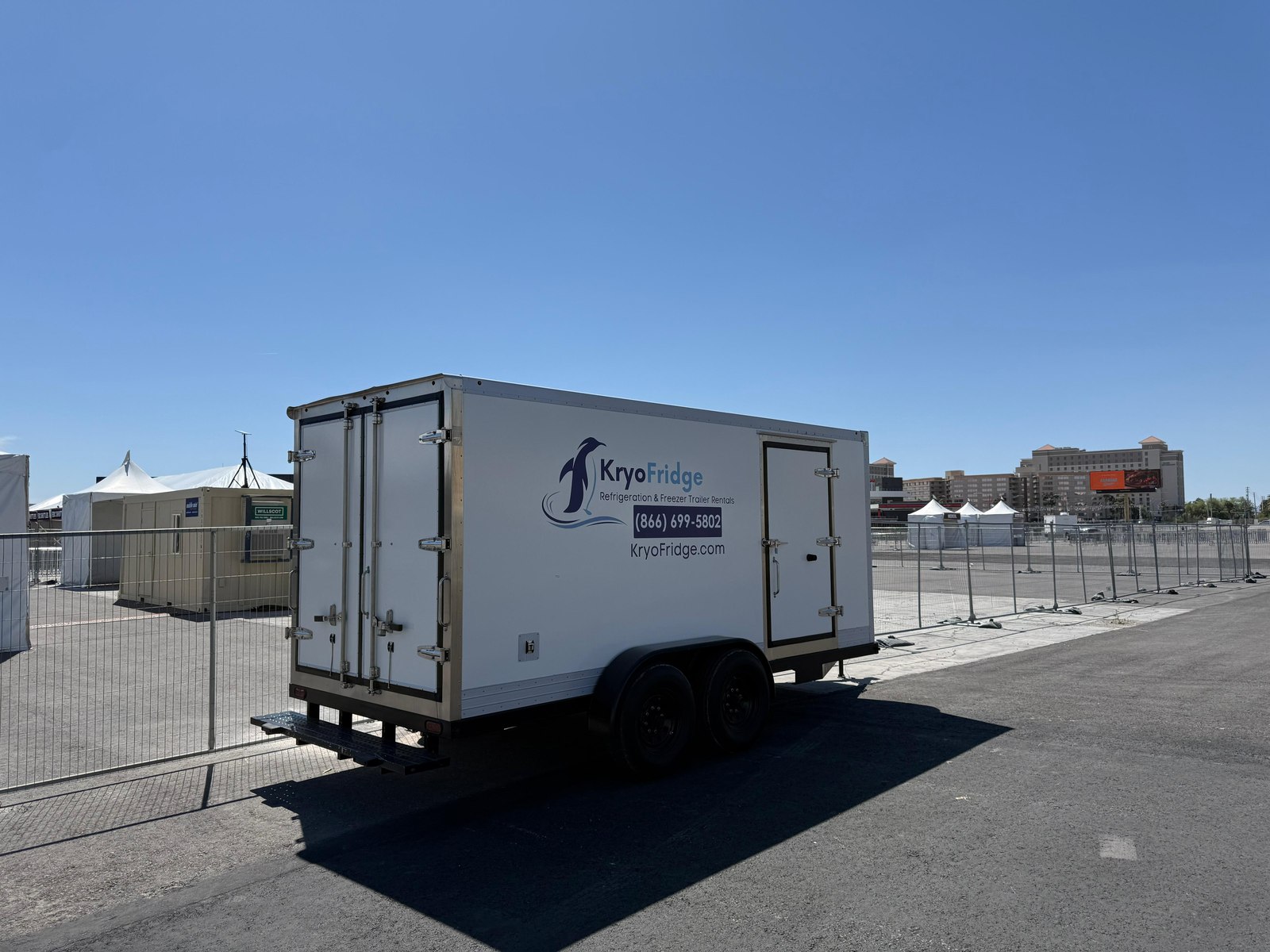
A dead walk-in during a busy week can cost a full inventory. We bring a pre-cooled trailer to your back lot so staff can move stock before it warms up. Most kitchens load it within an hour of arrival.
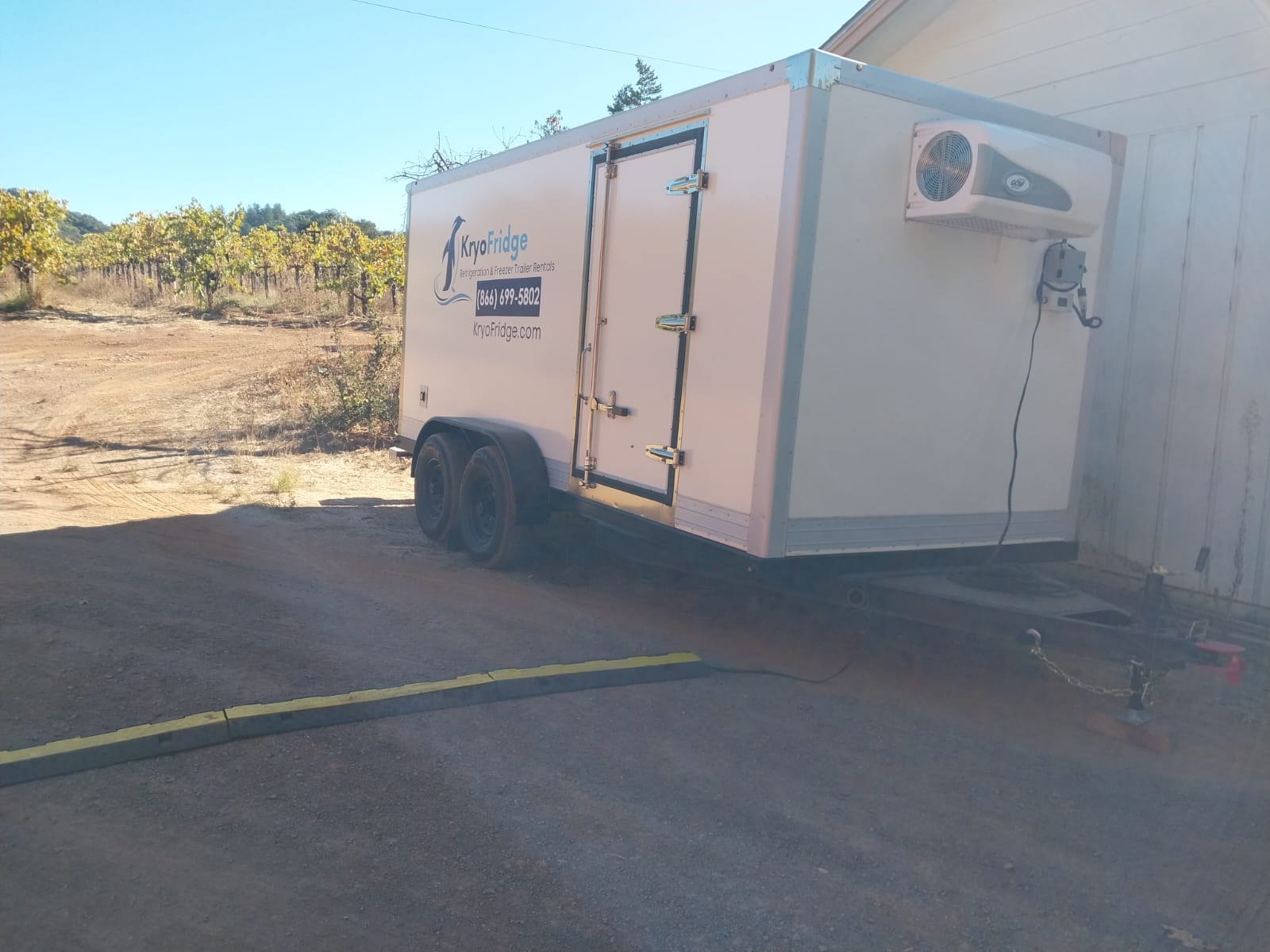
Two school districts serve West Covina, and both run large food programs. A trailer covers summer meal programs, kitchen remodels and freezer repairs without cutting meals.
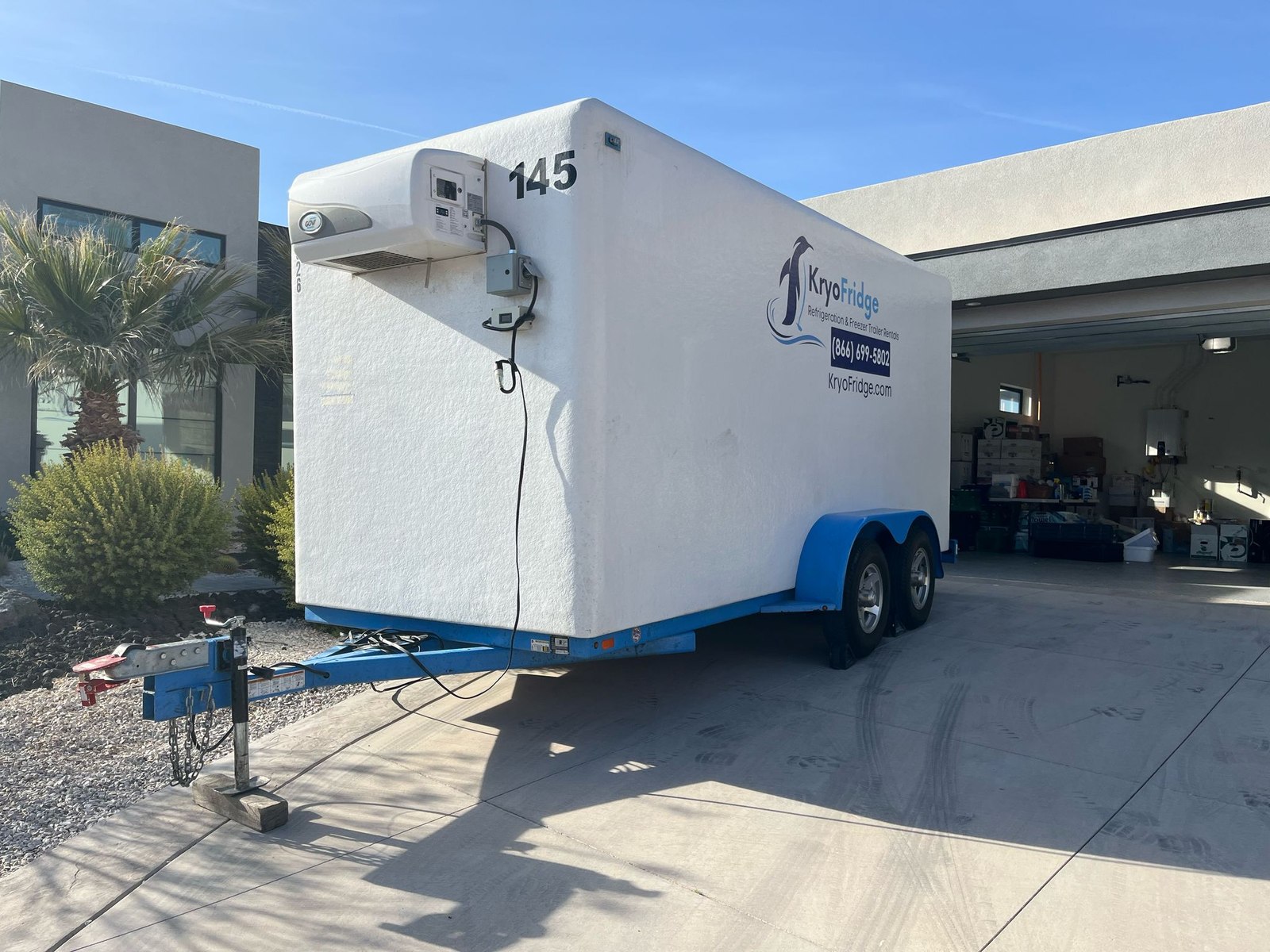
Supermarkets in the area run large meat, produce and bakery counters that swell before Thanksgiving and Christmas. A 16 foot Utility in the back lot adds a full walk-in of space for the rush.
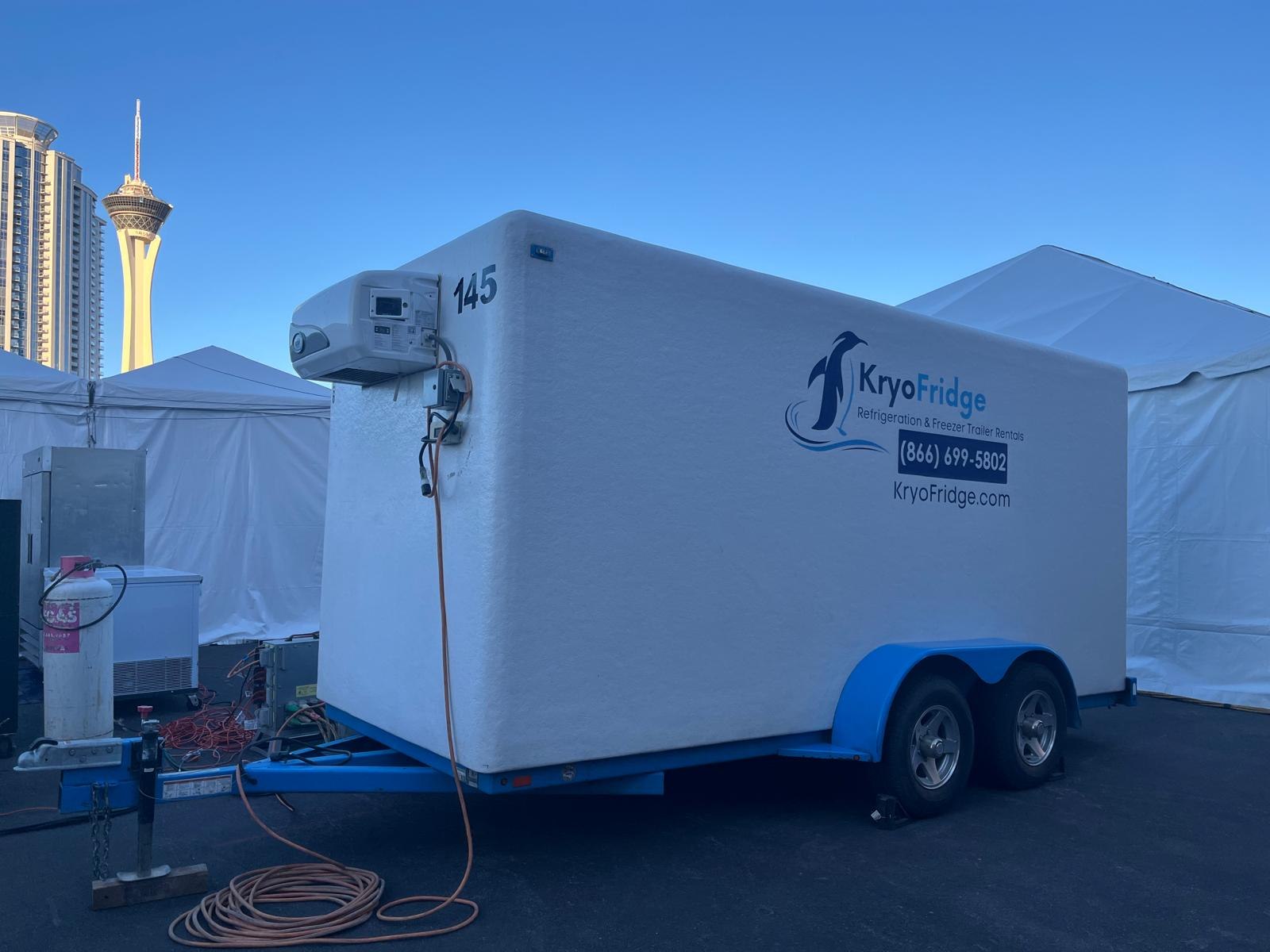
The sports park on Azusa Avenue hosts company softball days, picnics and youth tournaments. Caterers use a trailer for drinks, ice and frozen food behind the fields.
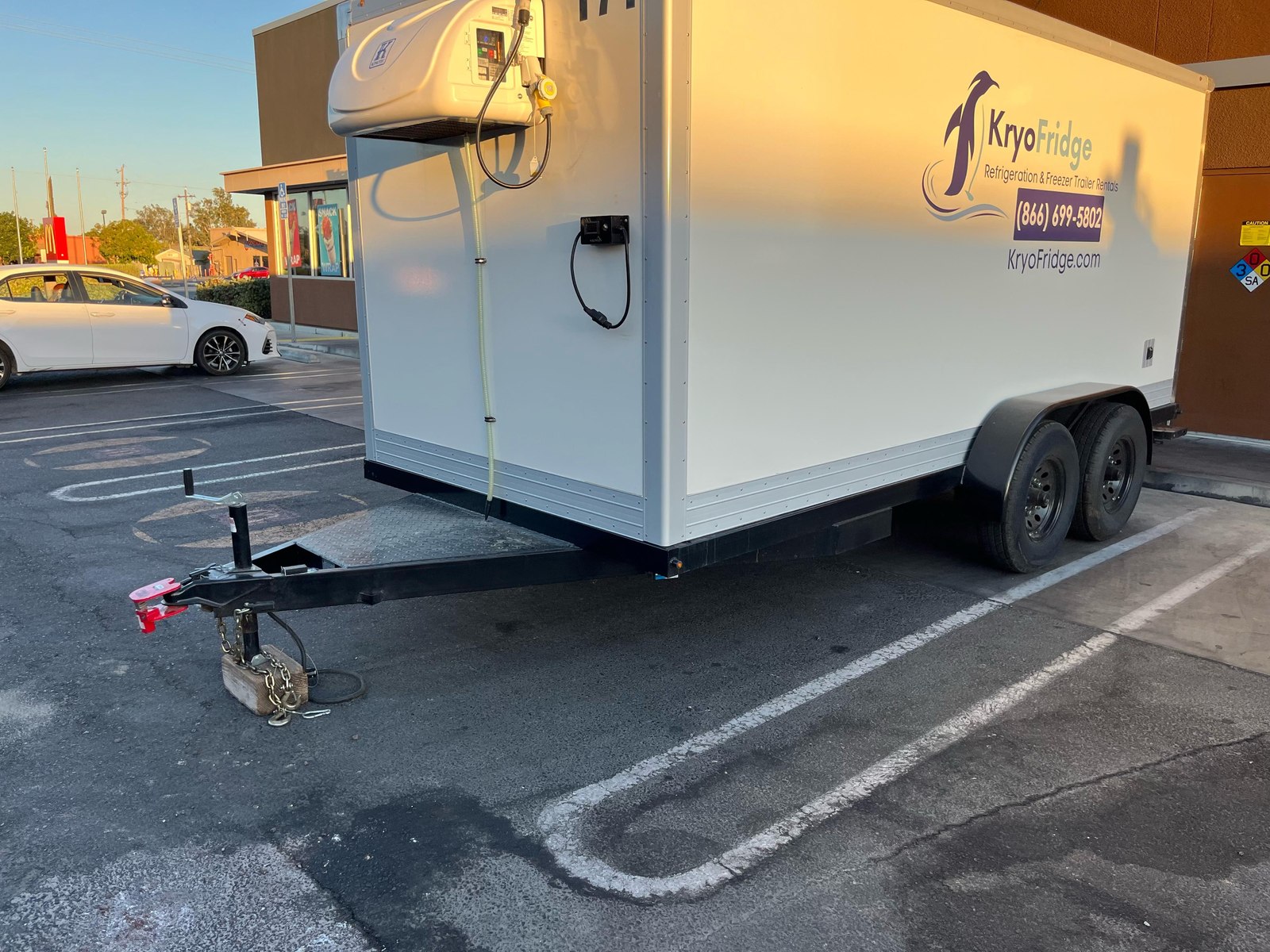
Parish festivals, holiday dinners and funeral repasts need more cold than a church kitchen holds. A 6x8 or 6x12 fits most church lots and holds food safely until serving time.
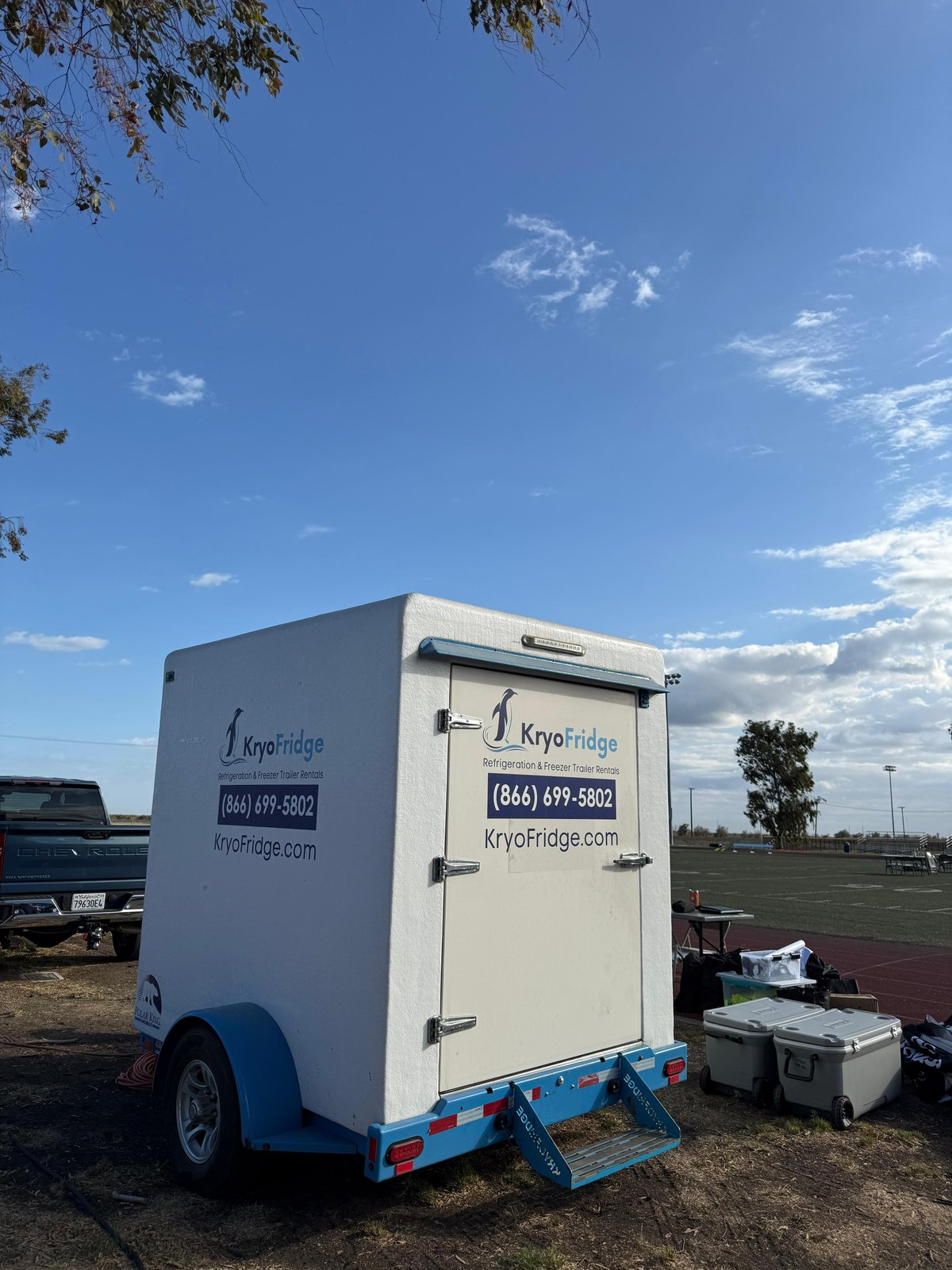
Warehouses and food banks south of the city sometimes take in more product than their coolers hold. A trailer at the dock gives extra space for a week or a season.
What ties these together is the clock. Nobody budgets a freezer trailer into next quarter. They reach for one the hour a compressor quits, or the evening before a party when the stack of rented ice chests suddenly looks laughably undersized. Since our units sit staged around West Covina instead of a couple counties down the freeway, "can I get it today" is an ordinary ask here, not a stretch.
Add it up the way an owner in West Covina has to. One restaurant walk-in routinely sits on a small fortune in proteins, dairy, and prepped product. Scale that to a grocery rack or a warehouse freezer bay and the exposure balloons. Now knock the power or the compressor out on a triple-digit afternoon, and that whole inventory is in jeopardy inside a few hours. Then stack on the sales you lose while the line sits dark and the wages you burn paying staff to triage what can still be saved.
Hold a pre-staged trailer up against that risk and it reads like cheap insurance, a fixed, predictable expense parked in front of a loss with no ceiling. That is exactly why the businesses that got stung once tape our number by the phone. There is never a second scramble, because the next time they dial before the product has a chance to warm. Owning every trailer ourselves means we can scale the answer to fit. A single compact box suits a corner cafe. A clustered setup covers a warehouse floor. Either one is booked with a single call.
Frozen desserts are the hardest product we hold at an outdoor event. Ice cream that melts a little and freezes again turns icy, and no customer wants that. We set the trailer at -10 degrees for bulk storage and let vendors pull only what they will scoop in the next hour.
West Covina puts on events where this matters. The Electric Boba Fest and Night Market at City Hall runs from late afternoon into the night, and the Summer Concert Series brings crowds to the Civic Center on warm evenings. Vendors selling shaved ice, ice cream bars and frozen boba toppings all need a cold place behind the booths.
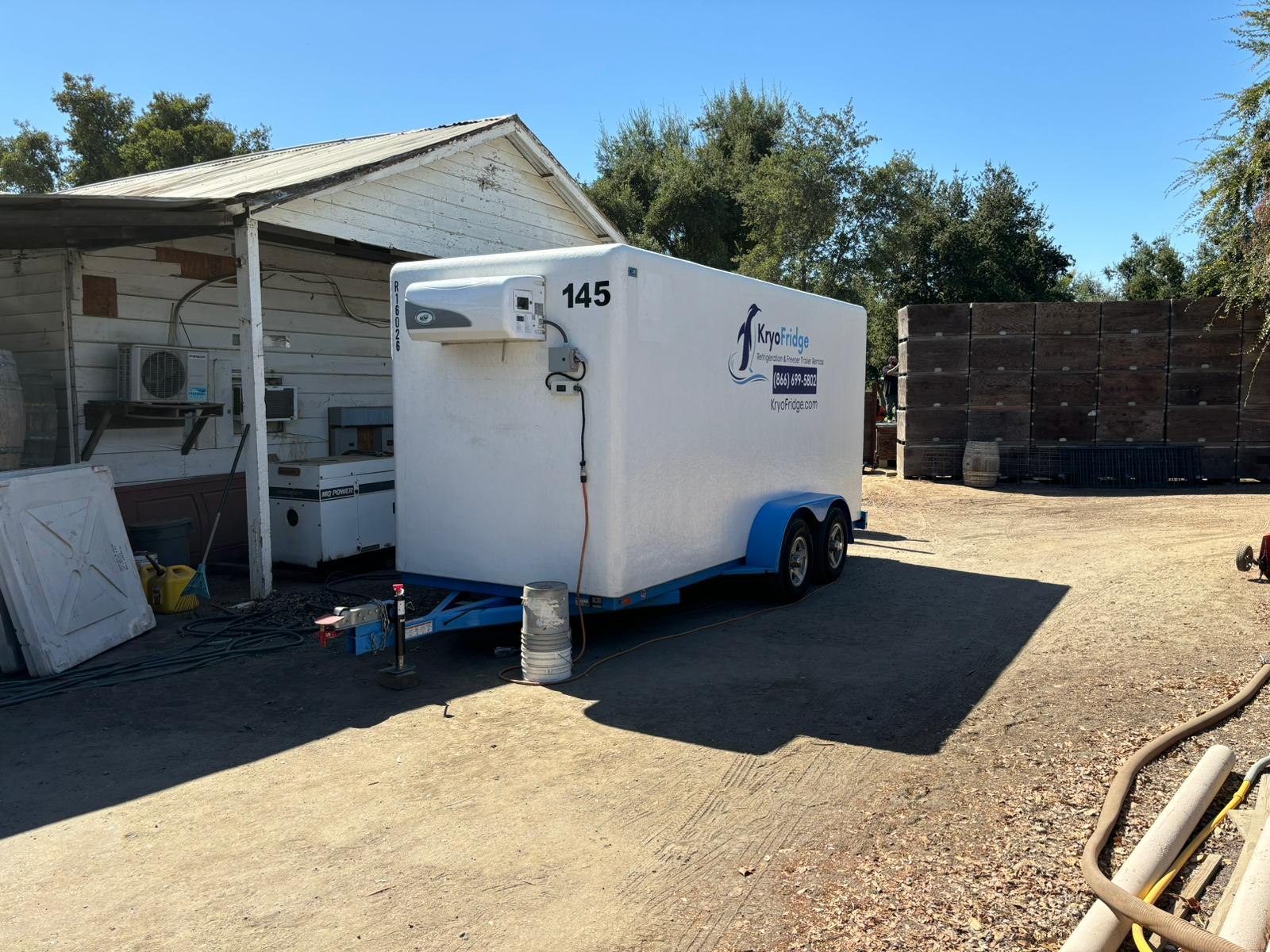
Door traffic is the real problem at these events. Ten vendors sharing one trailer can open it every minute or two for hours. We place the unit so the side door faces the vendor row and the rear doors stay shut, which keeps the cold air where it belongs.
Dessert shops and small makers also call us when a display freezer dies or when a big catering order lands. A 6x8 behind a shop on Glendora Avenue can hold a week of stock while a repair tech waits on parts. Call us with your product list and we will set the trailer before your first delivery.
Our fleet comes in three footprints: a compact 6x8, a mid-size 6x12, and the 16 foot Utility that leads the lineup. Every one of them works as either a freezer or a cooler. You pick the number on a digital controller, anywhere from -10 degrees up to 50 degrees, and the unit holds it.
The 16 foot Utility is the one we send on most jobs around the San Gabriel Valley. It rides on a tandem axle and has rear double doors for pallets plus a side utility door for quick grabs. Smaller lots behind strip centers often fit the 6x8 or 6x12 better, and we will tell you straight if a smaller unit covers the job.
Power is simple. Each trailer plugs into a dedicated 120 volt, 20 amp circuit within 100 feet, or it draws from a generator we bring. Nothing else is needed on site beyond a level spot, and the unit arrives already cold so you can start loading right away.
Funeral homes do not call us often, but when they do it is usually urgent and always private. The usual reasons are a failed cooler, a remodel, or a short stretch when more families need care than the building can hold.
We treat these jobs with care. The trailer comes clean, plain white, with no loud graphics, and it locks. We set it where your staff wants it, usually a rear lot or a service drive out of public view, and we keep our own visits short and quiet.
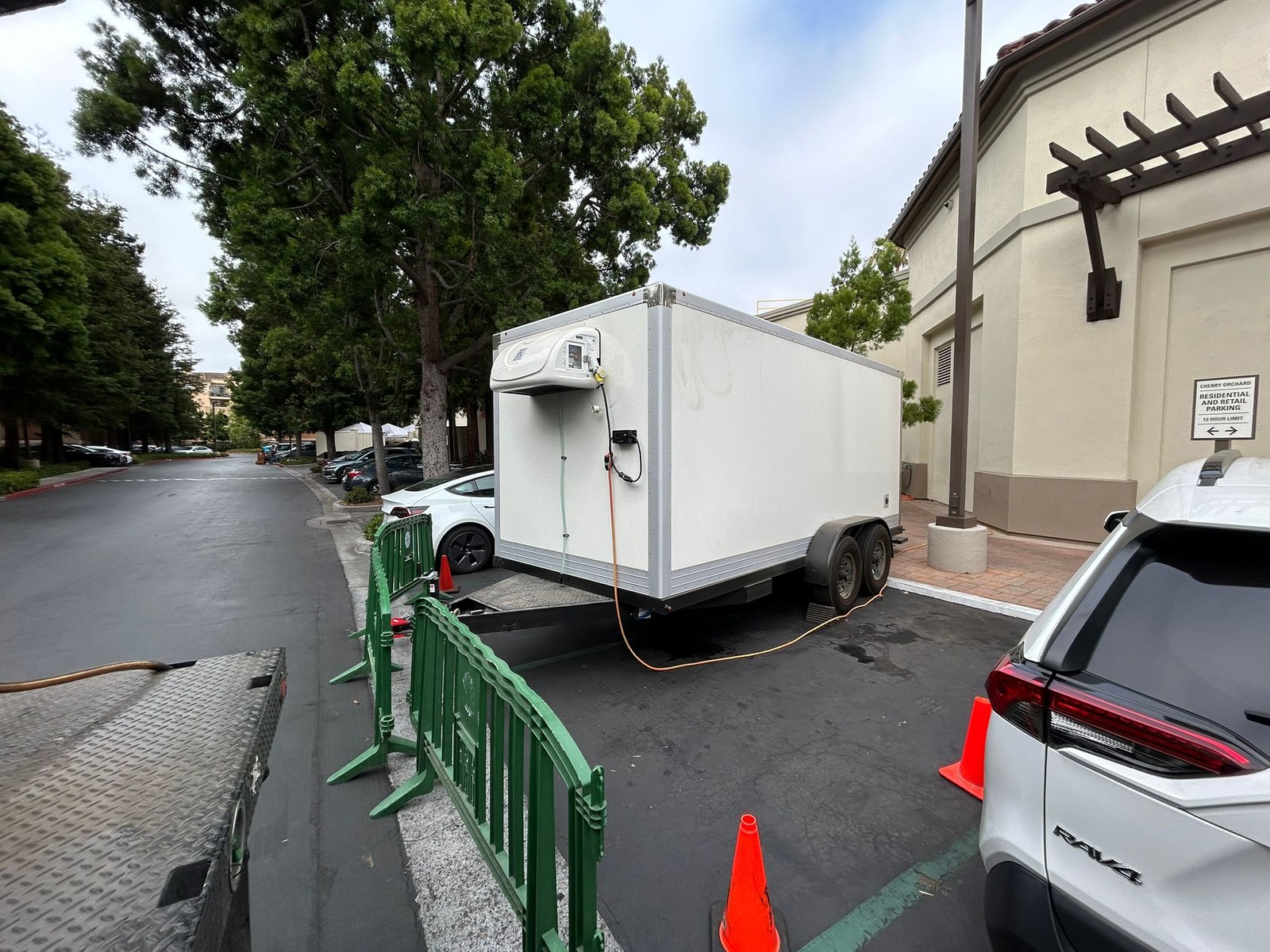
Most funeral homes run the unit on a cooler setting in the mid-30s, and the digital controller holds that number day and night. The Utility's side door lets staff reach inside without opening the full rear to the lot. Your license and your own procedures still govern how you use the space.
Heat waves and flu season are the two times these calls cluster in the San Gabriel Valley. If your building has an older cooler, it makes sense to talk with us before either season starts so a trailer is ready. Call us and we will walk through the plan with you by phone.
Pharmacies and clinics face a harder problem than restaurants when the power drops. Food can be thrown out and replaced, while a fridge full of temperature-sensitive stock is expensive and slow to replace. A cold storage trailer gives you a backup space that does not depend on the building's power.
West Covina has a 24-hour hospital on Sunset Avenue, plus independent pharmacies and clinics across the city. Southern California Edison can cut power ahead of Santa Ana winds, and many small practices have only a single reach-in fridge between them and a big loss.
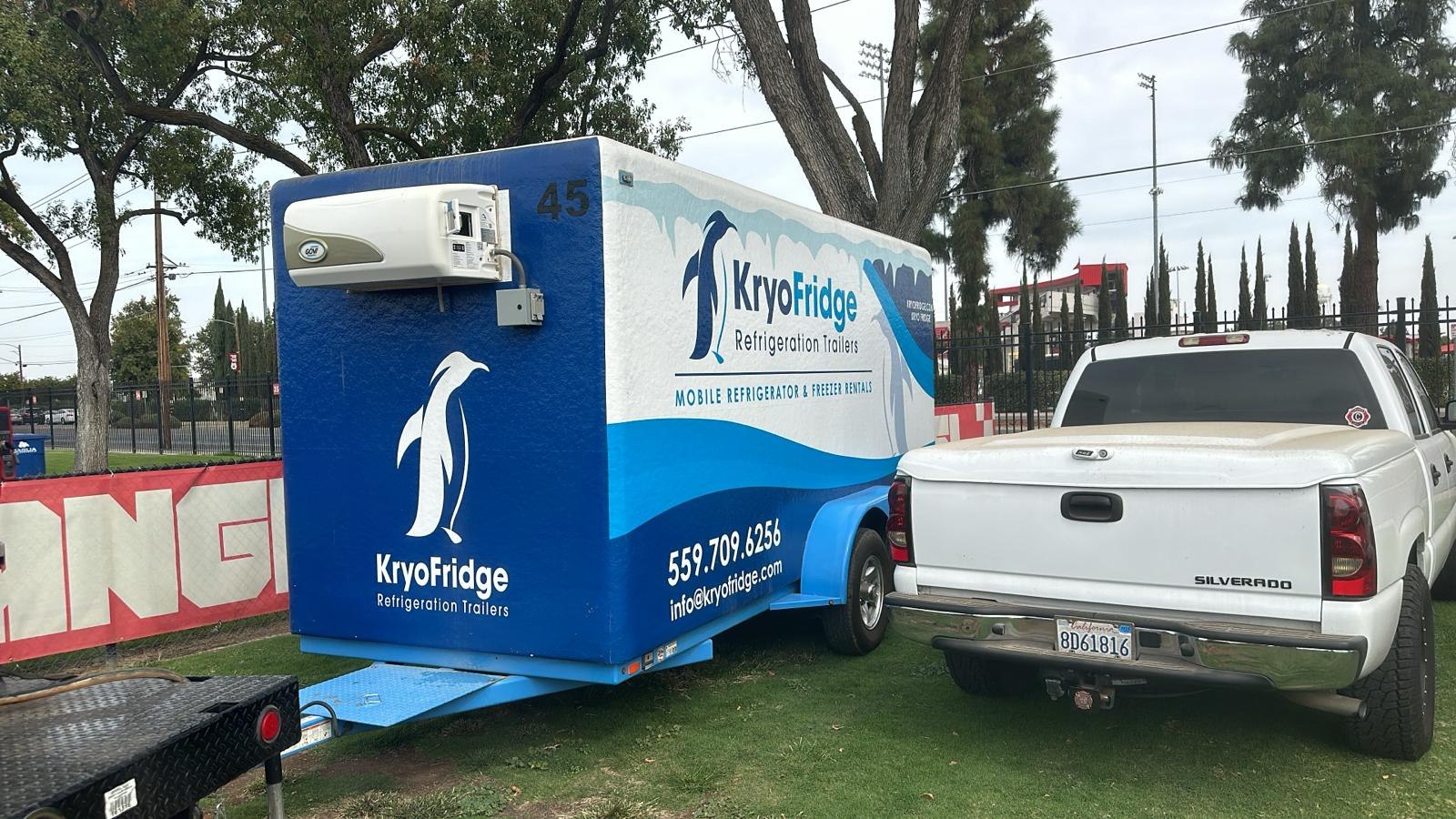
We are honest about what our trailers are. They are commercial refrigerated trailers with a steady digital controller, not a medical-grade vaccine refrigerator. Most pharmacies use them for backup space and bulk stock, and keep their own data logger inside so the pharmacist has a record. We set the controller to whatever number your pharmacist names.
Placement matters for these jobs. We set the trailer close to the back door, lock it, and plan power so it does not share a circuit with the building. For outage backup, a generator we supply keeps it running even when the whole block is dark. Request a quote now and we will talk through setup with your team.
"Cold" is not one number. Different product stays safe inside different temperature windows, which is the entire reason a precise digital set-point matters, and in the middle of a heat wave in West Covina, a load that slips out of its window is a load you write off. Use the chart below as the reference our customers lean on when they size a rental.
| Product | Target holding band | Trailer mode |
|---|---|---|
| Ice cream and frozen desserts | -10°F to 0°F | Deep freeze |
| Frozen proteins, seafood, prepared meals | 0°F or below | Freezer |
| Fresh meat and poultry (short hold) | 28°F to 32°F | Refrigerated |
| Dairy, deli, packaged produce | 34°F to 38°F | Refrigerated |
| Beverages, florals, catering trays | 38°F to 45°F | Refrigerated |
One figure matters more than everything in that chart, and it is not listed there: 40°F. Food-safety guidance treats the band between 40°F and 140°F as the zone where bacteria thrive, and the clock on perishable product starts ticking the moment it crosses 40 on the way up. Roughly four cumulative hours above that line and most refrigerated inventory is no longer safe to serve. Picture that countdown running on a 100-degree afternoon in West Covina with the walk-in dark, and the urgency of a quick trailer drop stops being abstract.
Tell us the single coldest item you are holding when you call, and we dial the trailer to that. One unit carries a straight freezer load with no fuss. But when your list mixes deep-freeze desserts with fresh-cold produce for the same remodel or event, we will usually point you toward a split setup or a second box so neither side of the load has to settle for the wrong temperature.
Powering one of our trailers is refreshingly simple, and there are precisely two ways to do it. Either you have a dedicated 120-volt, 20-amp circuit reachable within roughly 100 feet of the parking spot, or we bring a generator. What the units will not accept is standard 208 to 240V building service, so a quick question about your outlet before dispatch heads off any surprise on delivery day.
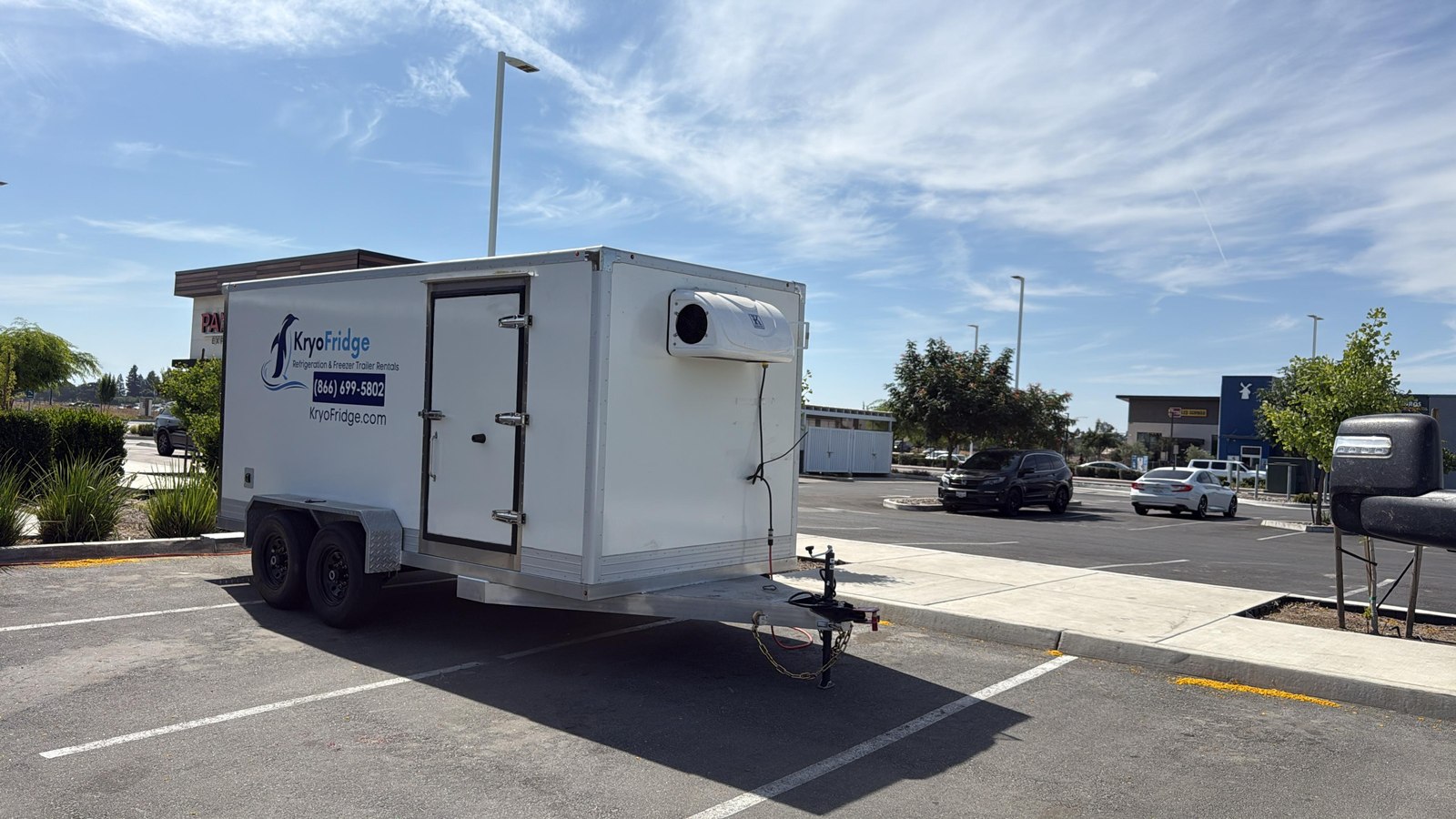
On placement, all the unit really asks for is a fairly flat patch with enough room for the delivery truck to maneuver it in and set it straight, plus either a power source in reach or space for a generator. We lock down the exact drop point before dispatch, and our drivers know the West Covina layout cold, so the delivery is one clean trip instead of a guessing game on the property.
A typical setup for a dessert vendor row looks like this: we set a 16 foot Utility behind the booths the afternoon before and bring it down to -10 degrees overnight. The side door faces the vendors so they can grab one case at a time. The rear doors stay closed until pickup. We plan power from a generator, since most event lots have no dedicated circuit near the booths.
A typical setup for a funeral home with a failed cooler looks like this: we place a plain trailer in the rear lot, out of view of the chapel entrance. Staff pick the cooler setting, and the controller holds it through the repair. The trailer locks, and only your team keeps the key. We come back only when you call.
A typical setup for a small clinic during a Santa Ana wind watch looks like this: the trailer arrives cold before the forecast peak, with a generator already hooked up. Staff move backup stock inside and put their own data logger on the shelf. If the building loses power, the trailer holds its setting on generator power. We pick it up once the watch ends and the lights stay on.
Planned around Santa Ana season. When the wind forecast turns in fall, we pair trailers with generators for customers in the foothill cities north of West Covina, since Edison can cut power there ahead of high winds.
On a bad day, booking should be the part that does not add stress. Four steps, an upfront number, and a single person who owns the whole thing.
Tell us whether it is freezer or fridge product, a ballpark volume, and your rough window. That is enough for us to call the right size.
We pair you with a unit, confirm whether you have a dedicated circuit or need a generator, and pin the exact drop point so the truck makes one trip.
We arrive on your schedule, about 45 minutes for a true emergency, set the trailer, energize it, and let it drive down to your number.
It holds the set-point for your entire term while our line stays live the whole way through. Wrap up, and we swing back for the pickup.
West Covina has no health department of its own. Food safety here falls under the Los Angeles County Department of Public Health, Environmental Health division. For community events, each temporary food booth needs a permit, and the county asks for applications at least 30 days before the event. Late filings cost extra, so plan early.
The county expects cold food held at 41 degrees or below, and frozen food at 0 degrees or below. The California Retail Food Code sets the same freezer line. Our trailers hold well below both numbers, and a thermometer inside the box gives your staff a reading they can write down for an inspector.
Power rules are a separate issue. The California Public Utilities Commission lets Southern California Edison shut off power to cut wildfire risk during high winds, and it requires notice to customers first. That notice gives you time to call us. We work the permit questions and power plan with you, so your trailer fits the rules before it arrives.
One caveat we always state plainly: we supply the food-safe, temperature-holding hardware itself, but we are not a temperature-logging or alarm-monitoring service. If your program requires continuous written records, line that vendor up on your own.
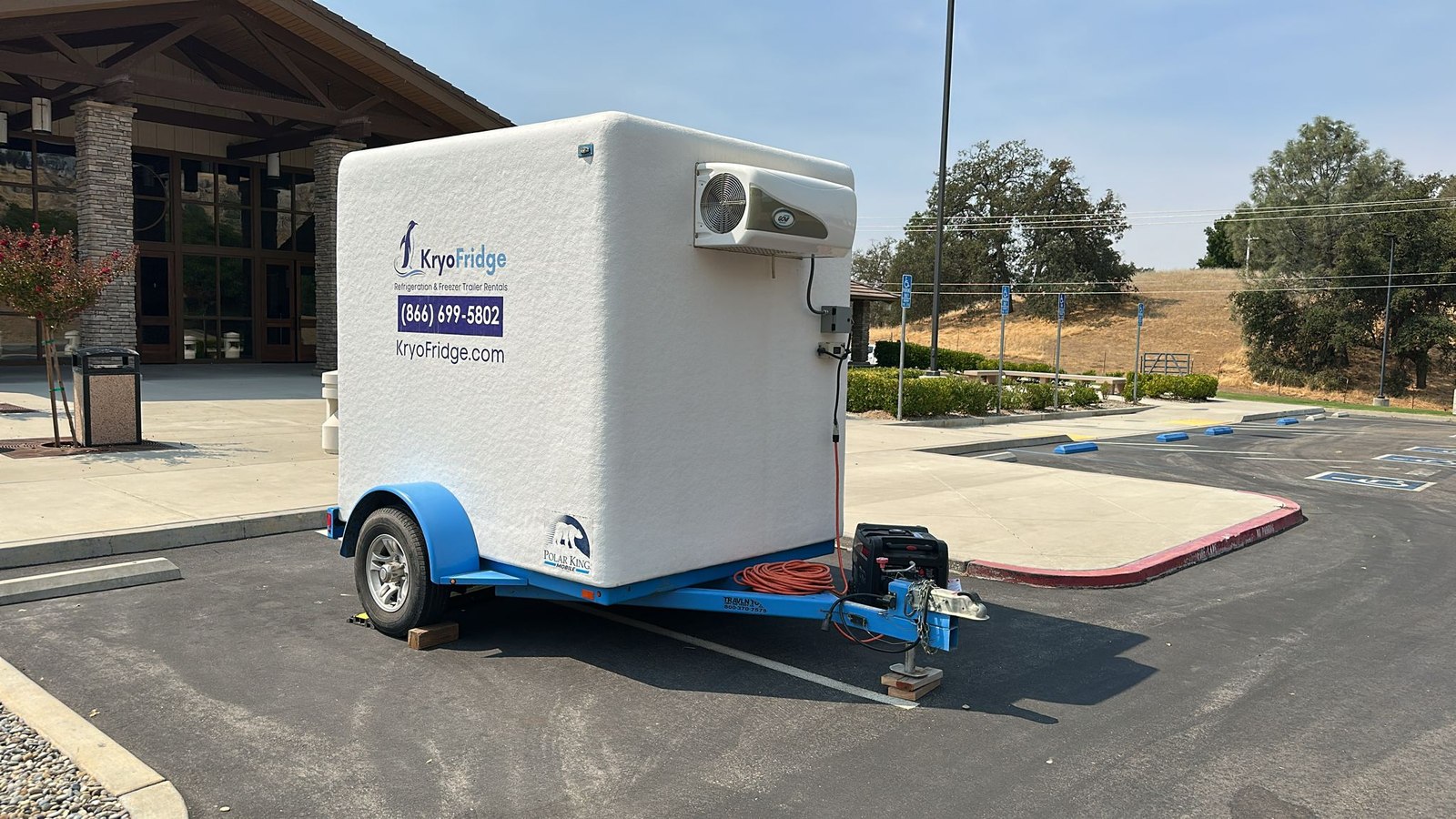
Our signature 16 foot Utility series leads the fleet. It is the trailer we send on most jobs, and crews like it for the side utility access door. We build three footprints in all, so a single kitchen holding overflow stock has a fit and so does a distribution floor in a disaster. Every unit is dual purpose by design: one adjustable system swings between freezer and refrigerator on a digital set point. Each trailer runs on a dedicated circuit or on a generator.
| Trailer | Best for | Temp range |
|---|---|---|
| 6x16 Utility ⭐ | Our signature series: distribution, large events, disaster response, side utility door | Heavy-duty reefer |
| 6x12 | Grocers, caterers, mid-size events | Deep-freeze capable |
| 6x8 | Tight lots, small kitchens, short overflow | -10°F to 50°F |
All three sizes switch between freezer and cooler mode, so the choice comes down to footprint and how much product you need to hold.
It's the unit to grab when square footage is the whole problem. It slips into the pinched service yards and cramped back-of-house corners that a larger box cannot even swing into. One cafe or small-market walk-in goes down, and this is almost always enough cold to cover it, plus the simplest unit to set in a small space.
Deep-freeze rated, and far and away the size people ask for most. It lands right in the middle: roomy enough for a multi-day catering job or a restaurant that needs true walk-in-equivalent room while the kitchen is torn up. Roomy enough that nobody is playing Tetris with shelves, yet still small enough to set in most commercial back lots without a site survey.
Our biggest footprint, paired with a heavy-duty reefer plant engineered to keep deep-freeze locked in even when the ambient air is merciless. Reach for it when a warehouse bay drops, when a large festival needs an anchor, or when a relief operation is carrying its own cold chain.
Not sure which size fits? Most customers land on the 16 foot Utility, and we will tell you honestly if a smaller footprint covers your job. Tell us roughly what you are storing and for how long, and we will spec it for you.
The questions that surface once the basics are settled. Tap any topic to open it.
The pop-up walk-in cooler. Cheap to rent and easy to set up, but it chills, it does not freeze, and it draws every watt it needs from your building while depending on a calm ambient temperature around it. The second your building loses power, your cooler loses it too.
The refrigerated box truck. Designed to haul product on the interstate, not to sit in a lot and babysit it. Parked, it burns fuel all day, broadcasts compressor noise across a storefront or an event lawn, and pins down a tractor plus a driver you probably do not need.
The freezer trailer we deliver. Built from the ground up to be dropped on a pad and to defend a temperature for as long as the job runs. It freezes deep, carries NSF approval, locks, stays quiet near guests, and lives on nothing more than one dedicated circuit or a generator.
Even a rented box has to satisfy the county environmental health office that licenses and inspects every food facility. Show an inspector a unit that cannot document its temperature or was not built for food contact, and they have the authority to halt service immediately.
That is a bar each of our trailers clears: NSF-approved throughout, food-safe interior surfaces, proper drainage, and a digital controller that puts the set-point in plain view. We supply the food-safe, temperature-holding hardware itself, but we are not a temperature-logging or alarm-monitoring service.
For a typical kitchen or market, one box does the job. Distribution floors, big fairs, and full-scale disaster response routinely need more, and because the fleet is ours, we can cluster several units and bring them online in waves as the work expands. Match the cold capacity to the operation rather than make the operation squeeze itself into one box.
The clock is yours to set. Some jobs are a handful of days for an emergency or a single event. Others stretch across weeks or months for a remodel or a seasonal swell, and a few become standing contracts for businesses that want capacity parked on standby. Name your window and you will get a clean quote, no penalty for an honest "not sure yet."
Building permanent cold storage is a capital project in every sense: you hire a refrigeration contractor, schedule the electrical, pull a building permit, and wait weeks before a single pallet goes inside. A rental turns that equation on its head. You bring in precisely the cold you need, for precisely the stretch you need it, and the trailer is holding temperature within days, not months, with the commitment ending the moment your need is over.
Three engineered elements carry the load. Thick insulated panels and tightly gasketed doors lock the sun outside and the cold inside. A self-contained reefer condensing system specified with surplus capacity keeps stripping heat out of the box even when the air outside is brutal. And a digital thermostat locks onto your chosen number and cycles the compressor to hold the line. Run those three together and a trailer baking on open asphalt behaves like one tucked in a cool warehouse. That is also why power is the first thing we ask about: the design delivers its safety margin only on steady, uninterrupted power.
"I wanted backup for our fridge stock during the wind season. They were honest that it is not a medical-grade fridge, and they helped me set it up with my own logger. That honesty is why I booked."
"Summer meals kept going while our freezer was replaced. The driver set the trailer right by the kitchen door and showed us the controller in five minutes."
"Two days of softball, a few hundred players, and all my drinks and ice in one trailer. The generator was quiet enough that nobody complained."
"We needed extra cold for holiday orders. The 6x12 fit our narrow lot with room to spare."
"Our parish dinner feeds hundreds of people and our church fridge is small. The trailer held everything and they picked it up the next morning like they said they would."
"They showed up before the wind watch started with a generator already attached. We lost power for most of a day and the trailer never moved off its setting."
"We took in more frozen product than our dock freezers could hold. One call and a 16 foot trailer was at the dock. We kept it three weeks and it never gave us a problem."
"Good communication from the first call to pickup. They planned the spot with our site team so it stayed out of the walkway." See also: cold storage trailer rentals in Indio and Tulare refrigerated trailer rentals.
Yes. Every trailer is washed and sanitized inside before it leaves our yard, and the interior surfaces are food-safe. We also check the door seals and the controller on every unit. If your health inspector asks, we can describe our cleaning steps in writing. Most customers simply load it the moment it arrives.
On private property, most short rentals do not need a separate permit, though your landlord or property manager may have rules. Parking on a public street or in a city lot is a different story, and you should check with the City of West Covina first. For food events, the county permit for your booth is the one that matters most. We will tell you what we have seen work on similar sites before you book.
It depends on how much product you hold and how often staff go in. A kitchen that pulls stock a few times an hour usually does fine with a 6x12. A busy kitchen that opens the door every few minutes does better in the 16 foot Utility, because the side door lets staff grab one case without opening the rear doors. Tell us your busiest hour and we will size it for that, not for a slow morning.
Our trailers lock, and you keep the key. Most customers park them close to a building wall or inside a fenced yard. For long rentals on open lots, some customers add a wheel lock or a camera, which we are happy to plan around. We have not seen theft be a problem at well-lit commercial sites.
Once a job runs past a few weeks, a monthly term usually costs less than stacking short rentals. Grocers holding holiday overflow, schools covering a kitchen remodel and warehouses riding out a busy season often go monthly. We can also set up seasonal terms that start and stop on the same dates each year. Ask about it when you call.
Each trailer holds one set-point at a time, so a single unit is either a freezer or a cooler. For mixed needs, most customers rent two trailers and set one cold and one frozen. Another choice is to switch one trailer halfway through a job, since the controller moves between modes easily. We will help you decide which makes more sense for your product mix.
Delivery is often same day, subject to availability, and planned deliveries go out on the date you pick. Your site needs a level, paved spot the truck can reach, plus a dedicated 120 volt, 20 amp outlet within 100 feet. If you do not have that outlet, we bring a generator. Clear the path of parked cars before the driver arrives and setup goes quickly.
The biggest drivers are trailer size, how long you keep it, and whether you need a generator. Delivery distance and after-hours timing also play a part. Emergency calls at night cost more to run than a planned delivery booked a week ahead. Call us with your dates and we will give you a clear quote.
They do. In fall and winter, Southern California Edison can shut off power during high winds, and the foothill areas just north of the city are the most likely to see it. For customers who rely on building power, we suggest pairing the trailer with a generator during wind season. We watch the forecast with you and plan ahead of the wind.
Yes, and it is one of the best uses for one. We set the unit to -10 degrees and deliver it the day before, so it is fully cold when your stock arrives. Keep scooping freezers at the booth and restock from the trailer in small batches. That keeps the bulk product hard all day, even on a hot evening.
Many funeral homes use refrigerated trailers during cooler repairs or busy seasons. We deliver plain, clean units that lock, and we set them in a private spot you choose. Your license and state rules still govern how you use the space. We keep our visits short and quiet out of respect for the families you serve.
Deeper reading for local businesses, from the failure-hour playbook to compliance and seasonal planning. Tap any guide to open it.
Most businesses in West Covina have never written down what they would do if the power went out for a full day. That is normal. The trouble is that the answer usually gets made up on the spot, with a walk-in slowly warming and a manager calling around for help. A simple plan written in advance saves product and saves stress.
A good plan fits on one sheet of paper. It lists what you store, where a backup trailer would park, how it gets power, and who makes the call. Tape it inside the office door and review it once a year, ideally in late summer before wind season begins. New managers should read it on their first week, since they are often the ones on shift when something goes wrong.
Further reading: FDA food safety during power outages.
A cold storage trailer is only as good as the way people use it. We see the same mistakes on busy jobs around the San Gabriel Valley, and nearly all of them come down to how product goes in and how often the door opens. A few habits make a big difference.
The biggest one is door discipline. Every time the door opens, warm air rushes in and the refrigeration plant has to pull the box back down. A trailer can handle a lot of openings, yet it recovers faster when each one is short. Teach staff to know what they need before they open the door, grab it, and close it right away. Propping a door open for a long unload is the fastest way to lose several degrees.
Further reading: National Weather Service forecast for West Covina.
Timing is the part of a rental that most people leave to the last minute. For planned jobs, booking early gets you the size you want on the day you want it. For emergency jobs, knowing the busy seasons helps you understand why a trailer may be harder to find at certain times of the year.
West Covina sits in the middle of a busy part of Los Angeles County. The city has about 107,000 residents, and the I-10 frontage alone carries hundreds of thousands of cars a day past its restaurants and shops. The neighbors are busy too, from the warehouses in the City of Industry to the foothill towns. Demand for cold storage in this area rises and falls with the same seasons, so when one business is looking for a trailer, many others are too.
Further reading: California PUC on Public Safety Power Shutoffs.
Renting a refrigerated trailer looks simple from the outside. A trailer shows up, you load it, and it gets picked up later. The details behind that are where rentals go wrong, and a few good questions up front will tell you whether a company can actually deliver.
Ask for specifics, not promises. A company that knows its fleet can tell you the size of each trailer, the doors it has, and how it gets power, all in the first few minutes of a call. Vague answers often mean the person on the phone has never seen the unit that will show up at your door.
Call us with your address, your product and your dates, and we will match the right size and power setup. Request a quote online if you would rather hear back by email.