
KryoFridge delivers freezer trailer rentals across Salem seven days a week. Tell us what has to stay cold and how much of it there is. A walk-in unit lands on your lot, set level, plugged in and already holding temperature. That lot might sit behind a downtown kitchen or out at the fairgrounds on 17th Avenue NE, and it works just the same on nursery ground north of Keizer. Call now or ask for a free quote, and we will lock a delivery window before anything warms up.
A dead compressor is not the only way cold goes wrong. The grid drops after a wind event. A supplier pulls a lot back and your holding doubles overnight. A truck shows up two days early with product nobody has room for. KryoFridge keeps units staged and ready for exactly those days, and we have been doing that work in the Willamette Valley for years. We own every trailer we send, we are licensed and insured, and the phone gets answered around the clock. Being the crew that can put a cold box on your ground the same day is why we lead this market. Call us now or request a free quote, and we will tell you what is sitting on the yard today.
Call 866-699-5802 and you get somebody who knows which units are sitting on the yard today. No ticket number, no callback promise.
Every trailer dials from about 50 degrees down to about negative 10. A flower cooler in May and a hard freeze in October can be the same rental, so nobody pays twice to solve two problems.
Either a dedicated 120 volt, 20 amp circuit within 100 feet, or our generator. We sort that out before the truck loads instead of hunting an outlet with a trailer sitting in your drive.
KryoFridge is not a broker handing your job to whoever has something free. The fleet is ours and the crew that services it works for us.
More than 30 years in event and equipment rental sits behind this company. It shows in small things, like knowing a fairgrounds drop has to beat the carnival setup.
We are licensed, insured and registered in SAM.gov, and certificates go out without three reminder emails. In a capital city, that comes up more than it does anywhere else we work.
If the nation's largest chains trust us to protect their inventory, your kitchen is in good hands. These are brands that vet a cold-storage partner the same careful way they vet a food supplier, and they keep calling us back.
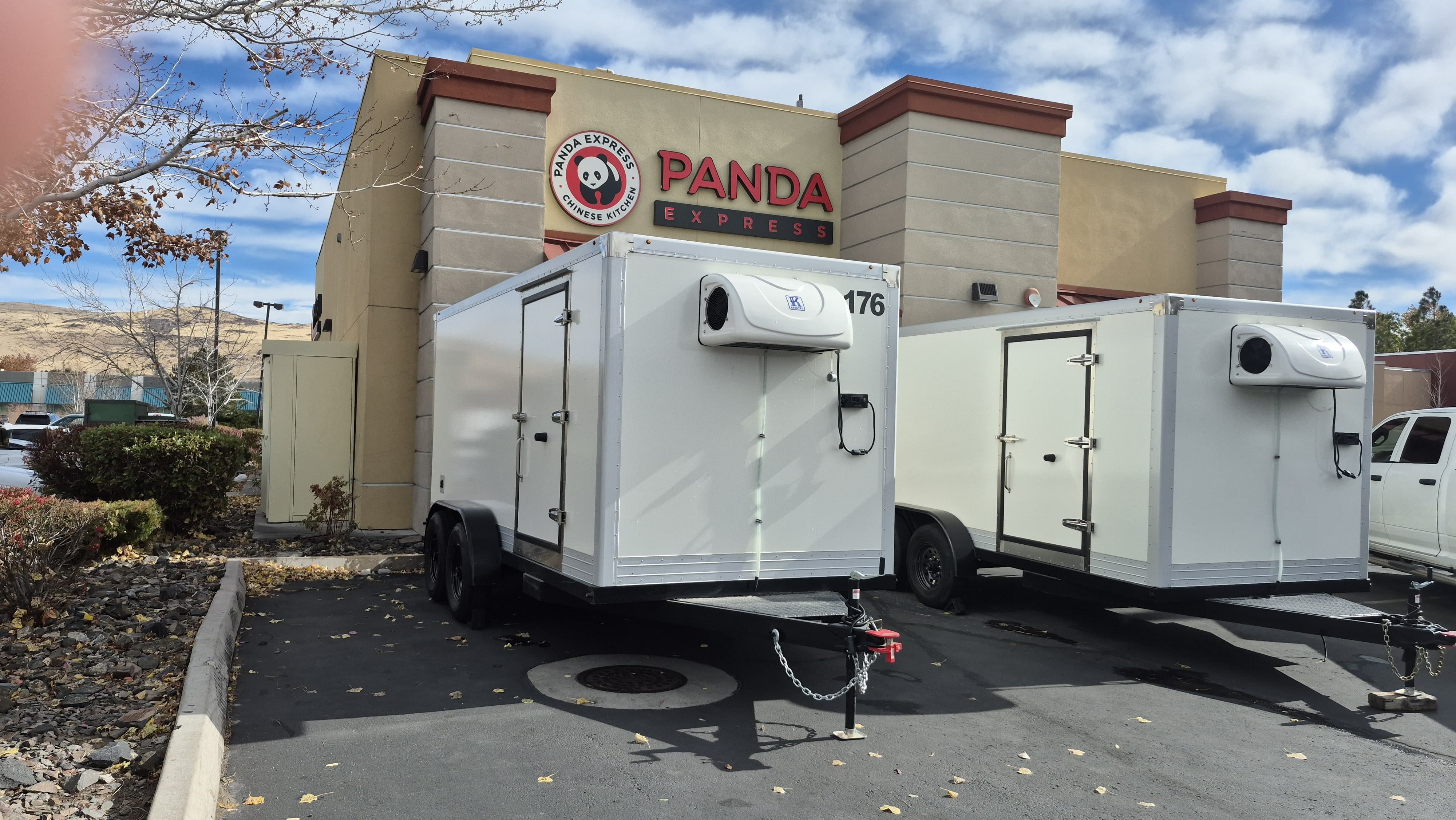 Panda Express
Overflow freezer space behind high-volume locations, holding bulk frozen product between distributor drops.
bulk overflow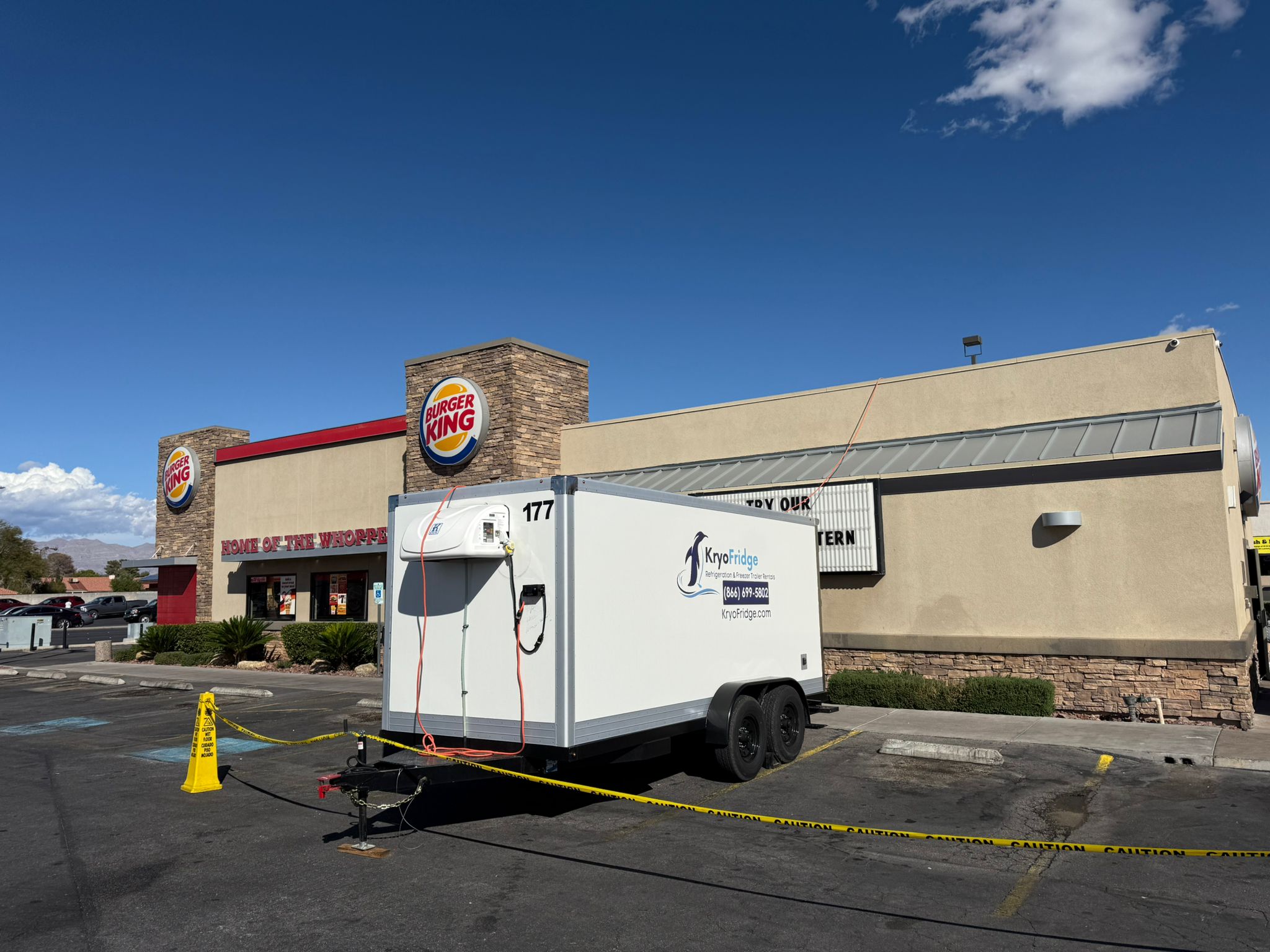 Burger King
Frozen stock held at spec through a compressor replacement so the location never dropped a menu item.
same-day swap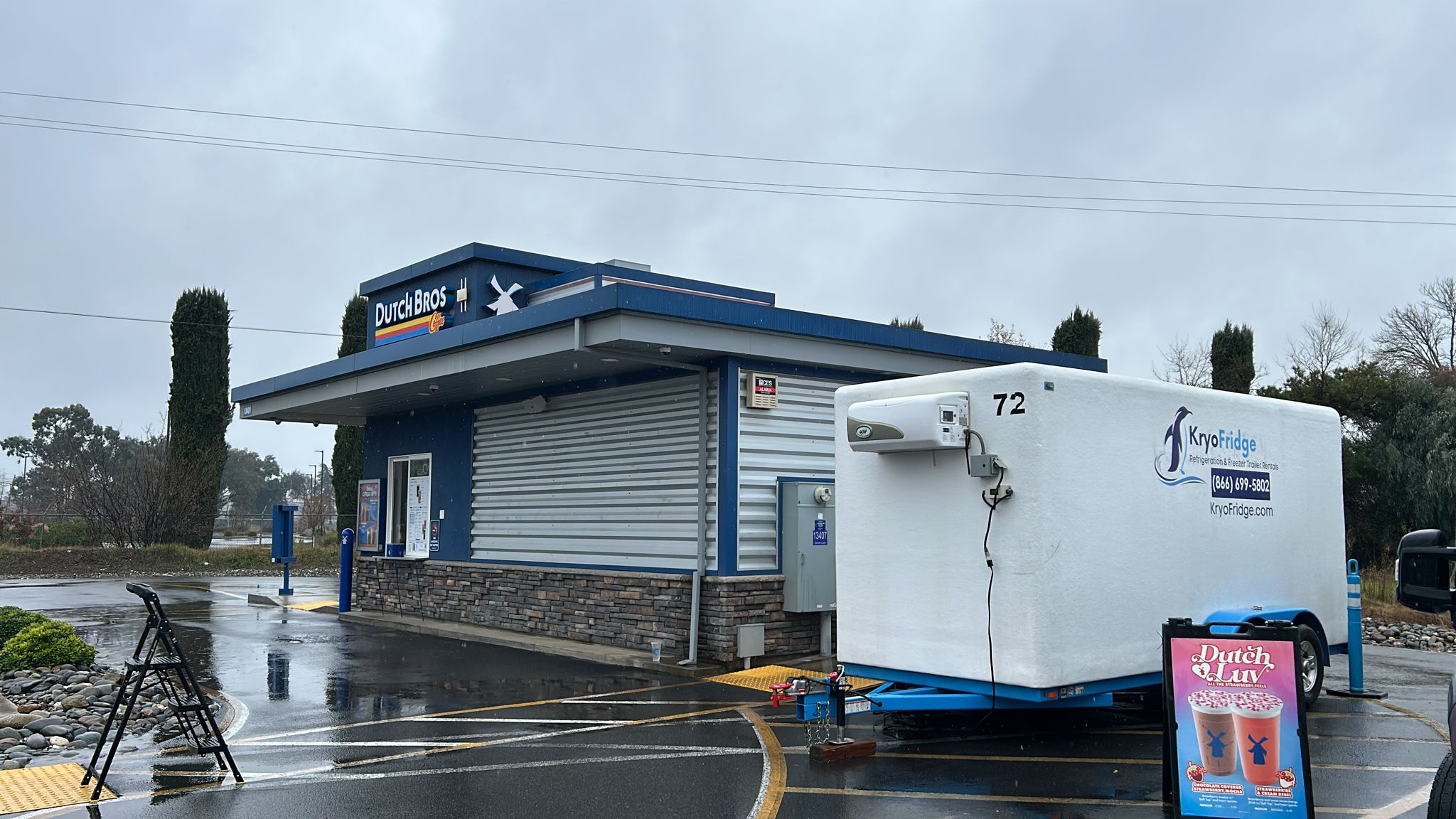 Dutch Bros
Overflow cold storage for dairy and blend stock behind high-volume drive-thru stands.
multi-site account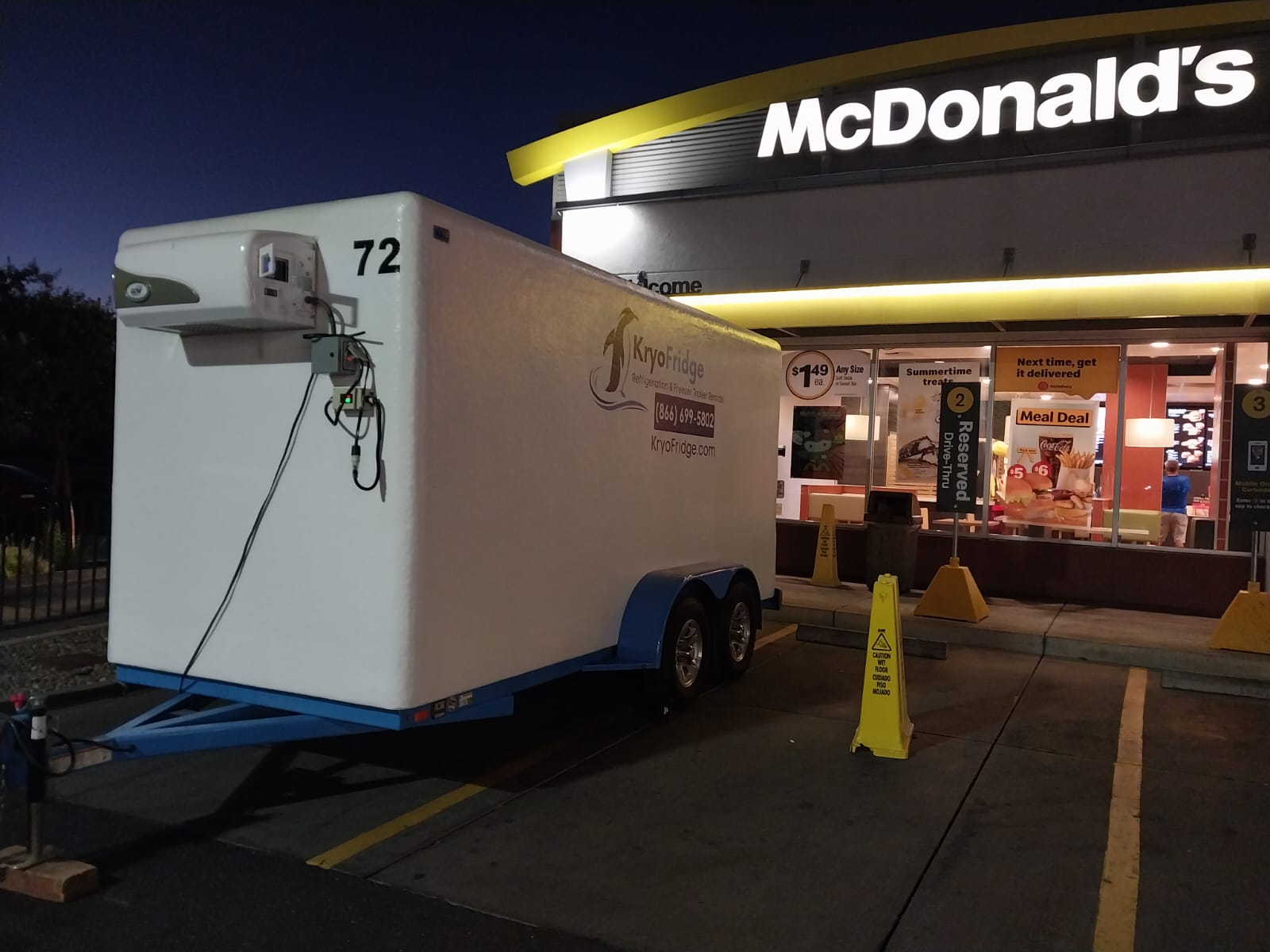 McDonald's
Freezer capacity staged on site through kitchen refits, keeping frozen stock at spec while the walk-in was down.
national account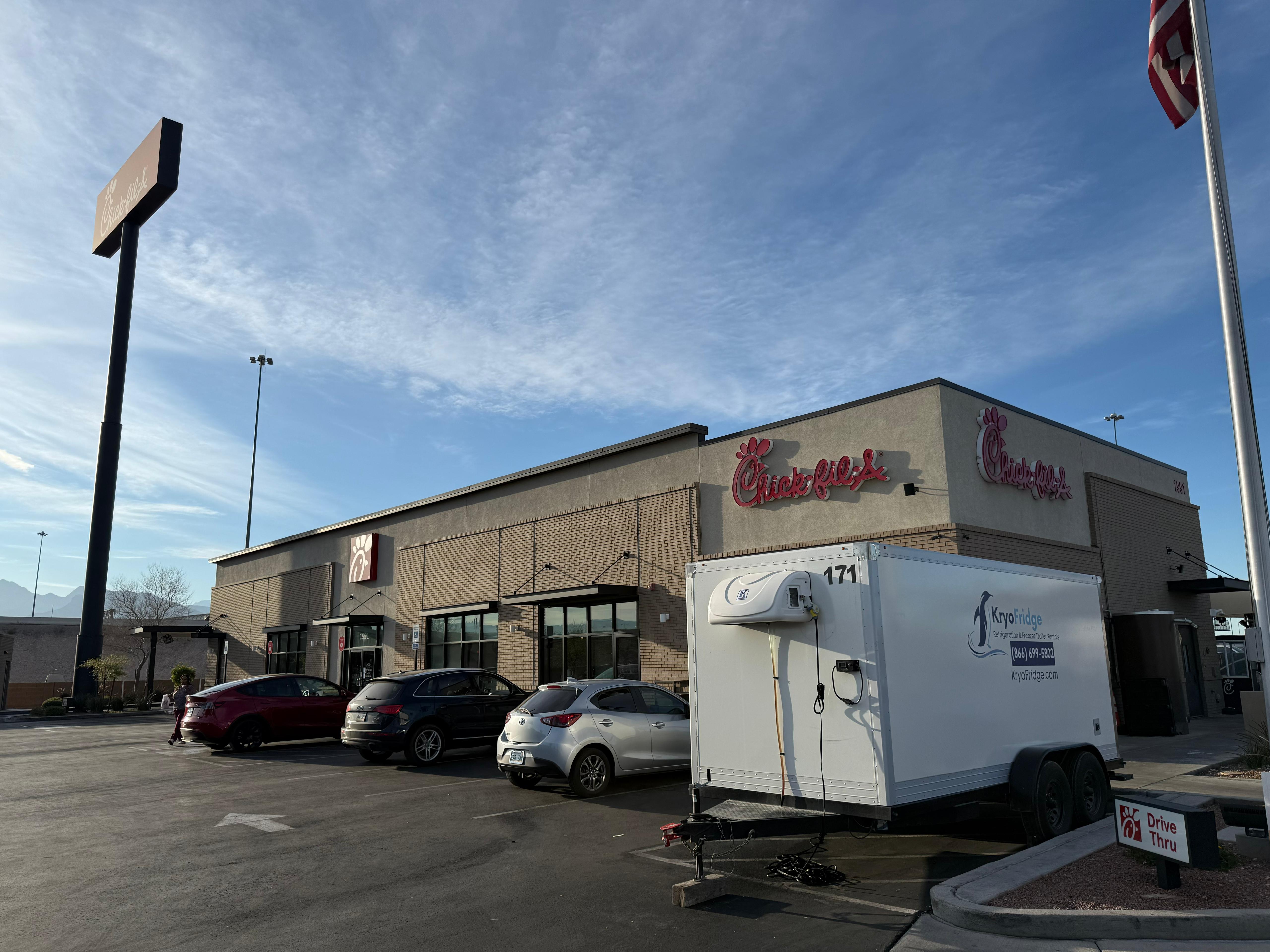 Chick-fil-A
Trailer cold storage through store remodels so frozen prep stock stayed at temperature from teardown to reopening.
zero thaw loss"We cut faster than we can pack for about two weeks every May and it has cost us stems before. The unit was at the shed by seven the next morning and the driver set it where our carts actually go. Stem quality held all the way through."
"Picked fruit was going to sit overnight and I was not happy about it. They brought a box and their generator the same day."
"Handled quietly and with respect, which mattered more to us than anything else on the invoice. The unit was plain white, parked where I asked, and stayed locked. Three weeks, no issues, and the pickup was just as discreet as the drop."
For a downtown kitchen or a shop off Liberty with a tight back lot, the KF12 is the unit we send first. It takes a real pallet run and still tucks in behind the building without eating the alley.
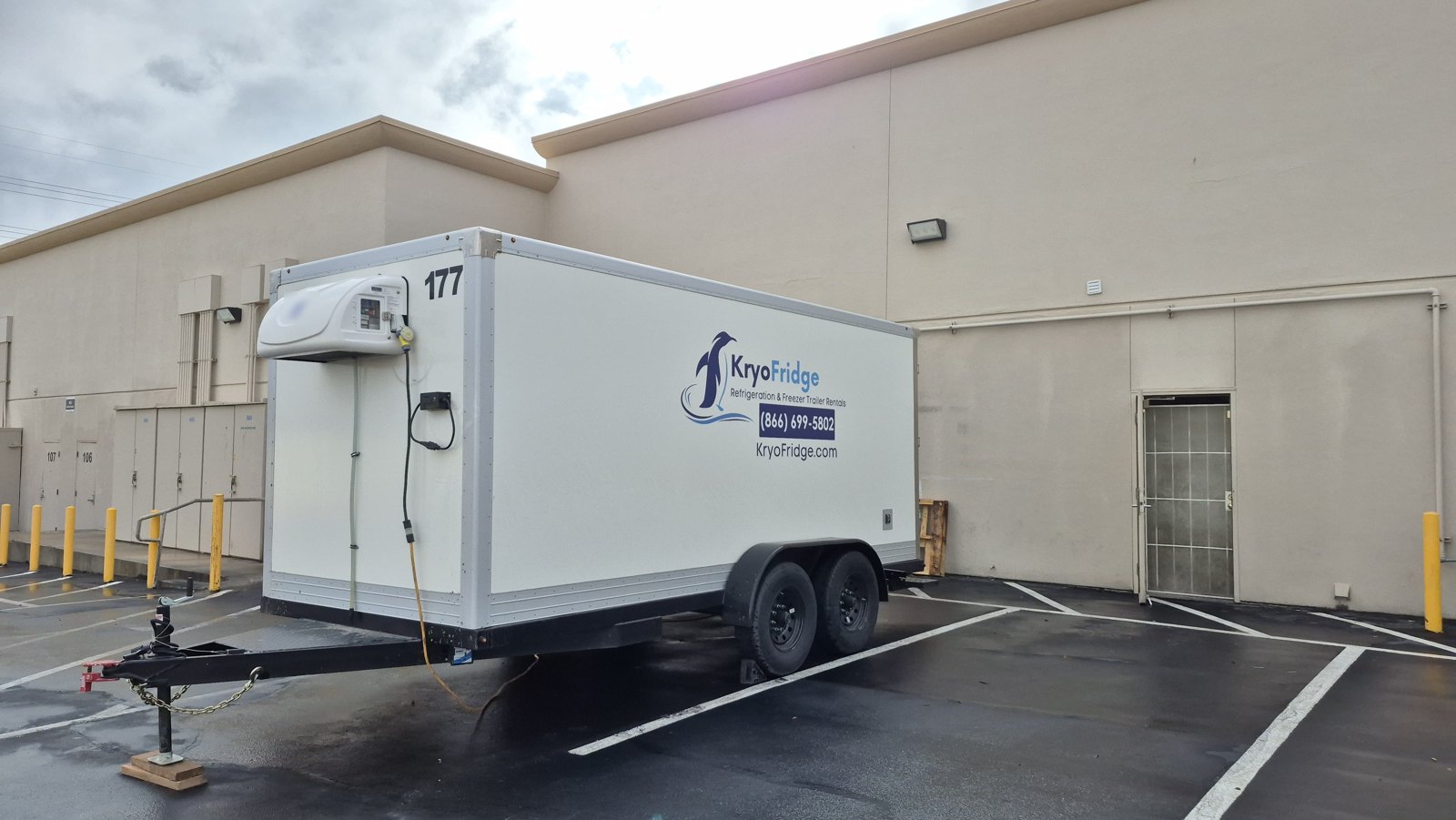
The 16' Utility is the trailer our crews reach for when the job is serious. A 16-foot insulated box on a tandem axle holds anything from -10°F deep-freeze to 50°F fresh-cold on one precise digital set-point, with NSF-approved surfaces throughout. Rear double doors take pallet loads straight off a dock, and the side utility door lets a cook grab one tray without opening the whole box to the heat.
We own every one of these units, so the trailer that shows up is fueled, pre-cooled, and maintained in-house. It runs on a dedicated 120V, 20-amp circuit or a generator we supply, and it holds its number through triple-digit afternoons. When a walk-in dies or a harvest runs long, this is the box that carries the load.
| Spec | What you get |
|---|---|
| Temperature range | Roughly -10°F deep-freeze up to about 50°F fresh-cold |
| Mode | Dual-purpose: freezer or refrigerator on one precise digital set-point |
| Power | A dedicated 120V, 20-amp circuit within about 100 feet, or a generator we supply |
| Food safety | NSF-approved for direct food contact, food-safe surfaces, proper drainage |
| Footprints | 6x8, 6x12, and 6x16, from a tight retail lot to distribution scale |
| Backing | Owned in-house, fully licensed and insured, with 24/7 emergency dispatch |
Each unit holds a precise digital set-point and runs on a dedicated 120V/20A circuit or a generator. The trailers are not wired for 208 to 240V building service, so we confirm your hookup before the truck rolls.
Interstate 5 runs straight through this city about 47 miles south of Portland, and almost everything we deliver moves on it. OR 22 carries us west to Dallas and east into the Santiam Canyon. Both directions, most weeks. OR 99E and the Salem Parkway handle the run north through Keizer to Woodburn. From one yard here, Keizer is three miles out, Woodburn about 17 and Albany about 25, which puts all of them inside a same day window when the unit is on the lot. Companies weighing this market against our St. George portable cold storage rentals in Utah find the same fleet and the same delivery standard behind both. We route wide loads through the freight corridors local haulers already use, because a 16 foot box does not belong on a narrow residential street.
Neighborhoods and towns we cover include Downtown Salem, Capitol Mall, Grant, Highland, Northgate, Englewood, Court-Chemeketa, Lansing, Lancaster corridor, Four Corners, Hayesville, Southeast Salem, Morningside, Sunnyslope, Faye Wright, West Salem, Eola, Salem Industrial, Brooks, Keizer, Turner, Silverton, Stayton, Woodburn.
Each community around Salem has its own venues, its own events, and its own cold storage headaches. We work all of them.
Keizer had 39,376 residents at the 2020 count, which makes it the 14th largest city in Oregon, and it sits about three miles north of downtown. Ornamental horticulture drives the local calendar here, so our busiest Keizer weeks are in May rather than in fall. Bloom sets the schedule. Most drops are short, six to ten days, and booked around a bloom rather than an emergency.
About 17 miles north northeast, Woodburn counted 26,013 people in 2020 and roughly 30,449 by 2024. Nursery ground going back to 1863, food processing and the outlet center give it three different rental patterns in one small city. Add a state youth facility with a full kitchen operation and you have a market that calls for longer holds than Salem does.
Albany sits roughly 25 miles south with 56,472 residents as of 2020, the 11th largest city in the state. ATI Wah Chang works rare metals on a 110 acre site and Oregon Freeze Dry employs over 300 people on food processing, so the industrial accounts down here think in weeks, not days. Summer river events like the Northwest Art and Air Festival add the short bookings.
Marion County holds 20 incorporated cities besides Salem, and these two carry most of the farm and small town food business east of the interstate. Lots are usually open and easy to park, which makes the delivery simple. Power is the variable, and it is a generator more often than not.
Across the river in Polk County, these two run on farm ground, a university campus and a growing hop and wine trade. Rentals here cluster around harvest and around campus event weeks. Two seasons, not one. We route them through West Salem rather than down the interstate.
OR 22 climbs east toward Mill City, Gates, Detroit and Idanha, the towns that took the worst of the 2020 fires. Rebuild work, camps and seasonal food service up there still call for cold, and there is no supplier closer than the valley floor. We plan those runs for daylight and we watch the road report first.
One call sizes the trailer, sets the delivery window, and locks your quote for Salem. Call now, or send the quick quote request and we will call you.
Marion County grows more than any other county in Oregon, and that shapes what we do here. Flowers and nursery stock in spring. Fruit and juice in fall. Plus a steady run of work that has nothing to do with farming at all. These are the three jobs we get called for most in this city.
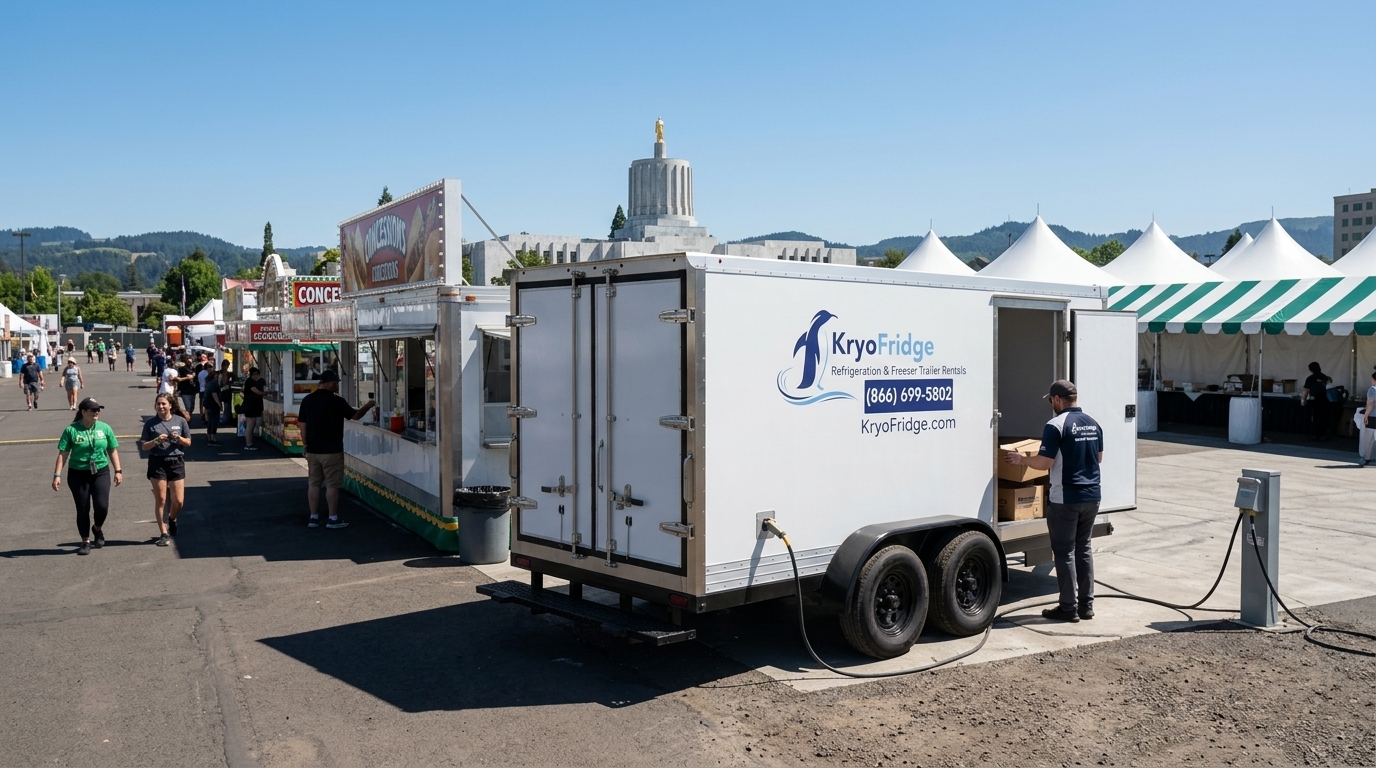
The fairgrounds cover 185 acres and run as an exposition center all year, not just during the fair in late August. Food vendors share very little permanent cold. One unit can carry a whole row instead of every booth hauling chest freezers.
The Capitol has been under a phased accessibility and seismic rebuild since 2016, including 160 base isolators set under the building. Long jobs like that mean big crews, and the caterers feeding them need somewhere cold on a site with no spare room.
A full home schedule plus the state high school baseball championship puts real pressure on a concession setup built for an average night. We park a unit behind the stands for the busy stretches.
The quarter mile track north of us hosts Lucas Oil Series events that pull traveling teams and vendors for multi day weekends. Nobody out there has walk-in space, so cold arrives on wheels or not at all.
Salem Hospital carries 644 acute care beds and feeds a building that never closes. Chemeketa and Willamette run dining halls and event catering on top of that. Cafeteria refrigeration work has to happen without anybody skipping a meal.
Kettle Foods, NORPAC and Oregon Fruit Products anchor a real food processing base in this city. Sanitation shutdowns and line changeovers pull cold rooms offline on a schedule, and finished pallets still have to sit somewhere legal.
What ties these together is the clock. Nobody budgets a freezer trailer into next quarter. They reach for one the hour a compressor quits, or the evening before a party when the stack of rented ice chests suddenly looks laughably undersized. Since our units sit staged around Salem instead of a couple counties down the freeway, "can I get it today" is an ordinary ask here, not a stretch.
Add it up the way an owner in Salem has to. One restaurant walk-in routinely sits on a small fortune in proteins, dairy, and prepped product. Scale that to a grocery rack or a warehouse freezer bay and the exposure balloons. Now knock the power or the compressor out on a triple-digit afternoon, and that whole inventory is in jeopardy inside a few hours. Then stack on the sales you lose while the line sits dark and the wages you burn paying staff to triage what can still be saved.
Hold a pre-staged trailer up against that risk and it reads like cheap insurance, a fixed, predictable expense parked in front of a loss with no ceiling. That is exactly why the businesses that got stung once tape our number by the phone. There is never a second scramble, because the next time they dial before the product has a chance to warm. Owning every trailer ourselves means we can scale the answer to fit. A single compact box suits a corner cafe. A clustered setup covers a warehouse floor. Either turns around the same day.
Most of the year this is a mild place. Then June 2021 happened. The city hit 105 degrees on the 26th, 113 on the 27th, and 117 on the 28th, breaking its own all time record twice in 48 hours before dropping to 61 overnight. Fixed refrigeration built for a 90 degree ceiling does not cope with that. Compressors that were fine in April give up in an afternoon. We got a lot of calls that week. And the boxes we send are built to hold temperature in that kind of heat, which is why our summer phone traffic in this city looks nothing like our winter phone traffic.
Late summer brings smoke instead. In September 2020 the Beachie Creek and Lionshead fires burned a combined 398,042 acres across a footprint that included Marion County, destroyed close to 1,600 structures and took out much of Detroit, Idanha and Gates in the Santiam Canyon, roughly 45 to 50 highway miles east of here on OR 22. Air quality that bad changes how we stage and how long a driver works outside. We start early instead. We plan those deliveries for early morning and we keep the setup time short.
Winter is the wet problem, not the frozen one. Snow is rare in the city and the record low is 12 below, but about 40 inches of rain falls here a year and most of it lands between October and April. Soft ground is what actually stops a delivery. Not the cold. So we ask about the approach, we check the slope so meltwater and washdown drain away from the door, and on a gravel pad we bring cribbing rather than trust a soaked shoulder.
Nursery crops lead Marion County agriculture, ahead of hazelnuts, wine grapes and berries. Keizer is the clearest example. Schreiner's Iris Gardens sits three miles north of downtown and is one of the largest retail iris growers in the country, and the whole town built its May festival around that bloom. We see it every year. Woodburn has been nursery ground since 1863. So when we talk about flower and plant cold storage in this metro, we are talking about a real industry, not a side note.
Cut stems are a clock problem. A field crew can cut faster than a packing shed can move product, and every hour a stem spends warm comes straight off its vase life. Most of the growers we work with are not short on cooler space in February. They are short for about nine days in May. Nine days, not nine months. Renting a portable cooler for that window beats building a room that sits empty the rest of the year.
We set units at the edge of a packing area so a cart run stays short. Ask us about the door before you pick a size. A shed crew in and out every two minutes puts a very different load on a box than a bulb cooler somebody opens twice a day, and the door is usually what decides whether we send a KF12 or the KF16. Bulbs and rooted stock are the other half of this trade, and they hold at different numbers than cut stems, so tell us what is going in before the truck loads.
Ground matters more out here than it does downtown. Nursery roads are gravel, and in a wet spring they get soft fast. We look at the approach before we commit a delivery window, because a loaded trailer that sinks at the turnaround helps nobody. So we look first. If the only firm ground is 60 feet from the power, we would rather know that on the phone and bring the generator.
Every unit we send is a true walk-in box with a side man-door. You step in at ground level and load standing up. No climbing into a reefer off a dock plate. The KF8 holds about 268 cubic feet and 3,000 pounds. It suits a small kitchen or a flower cooler, and it works just as well in a pharmacy back room. The KF12 gives you about 416 cubic feet and 4,300 pounds, and it is the size our drivers drop most often in this city. The KF16 runs near 564 cubic feet and 6,690 pounds. It covers a dock or a crush pad, and it handles a vendor row just as easily.
All three dial from about 50 degrees down to about negative 10. So the same box that holds cut stems at 38 in May can hold hard frozen product in September. That matters here. A lot of our customers have one cold problem in spring and a completely different one at harvest, and they would rather not learn a second piece of equipment.
Power works two ways and only two. Either a dedicated 120 volt, 20 amp circuit within 100 feet of the trailer, or we bring a generator and the outlet stops mattering. A Commercial Street storefront usually has the circuit already. A field edge out toward Brooks usually takes the generator. And there is real depth behind the fleet: KryoFridge keeps one of the largest walk-in cooler and freezer fleets in every market we work, which is what lets us say yes during fair week. Customers comparing this market against our Tempe refrigerated trailer rentals get the same boxes, the same drivers and the same dispatch.
Funeral homes and mortuaries call us for two reasons. Either their own refrigeration is down and the work cannot pause, or the volume in front of them is bigger than the room they have. Both are quiet emergencies. Nobody posts about them online. We handle these deliveries with a plain truck and a plain white box, and we do not put signage on the door.
Salem sits at the center of a three-county care area that runs past 400,000 people, and the region's trauma center is here in the city. A capital city also holds the state's largest institutional campuses. So when a bad stretch hits this metro, it lands in Marion County first. That is just geography. The 2021 heat emergency killed 116 people across Oregon, and every county coroner and funeral home in the valley felt that week in real terms.
Capacity planning is the part most facilities have never had to do. We walk through it on the phone: how many at once, for how many days, and whether the unit sits inside a fenced yard or out where the public can see it. Placement is usually the sensitive part. We treat it that way. We look for a screened side yard or a back bay. A space behind a building line works too, and either way we set the box so the door does not face the street.
Temperature holds steady at the setpoint you give us, and the unit stays locked. A dedicated circuit inside 100 feet covers most facilities. Most buildings have one. Where a building cannot spare one, our generator handles it and we plan the fuel schedule with you. These rentals often run weeks rather than days, and we would rather set it up for a long hold from day one than come back and move it.
Salem sits near the middle of the Willamette Valley wine region, which counted roughly 736 wineries and about 900 vineyards across some 27,202 acres of vines as of 2025. Chemeketa opened its Northwest Wine Studies Center in West Salem back in 2003, the first winemaking and vineyard management program of its kind in the state, with a working vineyard attached. Cold storage demand out here is not seasonal in a vague way. It is a six week problem with a hard start date. Everybody calls at once.
Crush breaks every cellar's plan at least once. Fruit comes in hotter than forecast, or two blocks ripen on the same weekend, and suddenly you need somewhere to hold picked fruit overnight before it goes to the press. A mobile cold storage unit parked beside the crush pad buys you that night. One night is often enough. Cold soak is the other ask we hear, along with somewhere to stage case goods when the warehouse fills up with barrels.
Breweries call for different reasons. Hops and yeast want steady cold, kegs need somewhere to live before a festival weekend, and a cold crash in a small taproom cellar can be the pinch point in the whole schedule. Taprooms downtown and along the Broadway corridor rarely have spare floor. Square footage is the constraint. And a trailer in the back lot does not need a building permit the way a walk-in build does. Customers who rent from us across the West, including our Santa Clarita walk-in freezer trailer rentals, use the same unit for the same reasons.
Two practical notes from doing this in the valley. First, the power question at a rural winery is almost always a generator question, because the panel at the crush pad is already loaded. Second, book earlier than feels necessary. Much earlier. September and October are the tightest weeks of our year here, and the calls come in a cluster because everybody is watching the same numbers.
"Cold" is not one number. Different product stays safe inside different temperature windows, which is the entire reason a precise digital set-point matters, and in the middle of a heat wave in Salem, a load that slips out of its window is a load you write off. Use the chart below as the reference our customers lean on when they size a rental.
| Product | Target holding band | Trailer mode |
|---|---|---|
| Ice cream and frozen desserts | -10°F to 0°F | Deep freeze |
| Frozen proteins, seafood, prepared meals | 0°F or below | Freezer |
| Fresh meat and poultry (short hold) | 28°F to 32°F | Refrigerated |
| Dairy, deli, packaged produce | 34°F to 38°F | Refrigerated |
| Beverages, florals, catering trays | 38°F to 45°F | Refrigerated |
One figure matters more than everything in that chart, and it is not listed there: 40°F. Food-safety guidance treats the band between 40°F and 140°F as the zone where bacteria thrive, and the clock on perishable product starts ticking the moment it crosses 40 on the way up. Roughly four cumulative hours above that line and most refrigerated inventory is no longer safe to serve. Picture that countdown running on a 100-degree afternoon in Salem with the walk-in dark, and the urgency of a quick trailer drop stops being abstract.
Tell us the single coldest item you are holding when you call, and we dial the trailer to that. One unit carries a straight freezer load with no fuss. But when your list mixes deep-freeze desserts with fresh-cold produce for the same remodel or event, we will usually point you toward a split setup or a second box so neither side of the load has to settle for the wrong temperature.
Powering one of our trailers is refreshingly simple, and there are precisely two ways to do it. Either you have a dedicated 120-volt, 20-amp circuit reachable within roughly 100 feet of the parking spot, or we bring a generator. What the units will not accept is standard 208 to 240V building service, so a quick question about your outlet before dispatch heads off any surprise on delivery day.
On placement, all the unit really asks for is a fairly flat patch with enough room for the delivery truck to maneuver it in and set it straight, plus either a power source in reach or space for a generator. We lock down the exact drop point before dispatch, and our drivers know the Salem layout cold, so the delivery is one clean trip instead of a guessing game on the property.
Cutting outran the packing shed by about a third and stems were stacking up warm on the dock. We had a KF12 at the shed edge the next morning, set so the cart run was under 30 feet. They held eight days of peak and went back to their own cooler after.
Their built-in refrigeration was at capacity with more coming, and a repair was not the issue. We delivered a plain unit to a screened side yard the same afternoon and set the door away from the street. It stayed three weeks and left just as quietly.
Two blocks came in together and the press was backed up a full day. We staged a box beside the crush pad on our generator so picked fruit could hold overnight instead of sitting out. They kept it through the end of October.
Wet ground is the Salem variable. Between October and April the ground here holds water, and a lot that looked fine on Tuesday can be soup by Friday. We walk the approach before we commit a window and bring cribbing for gravel and grass. It is the most common reason a valley delivery goes wrong, and it is avoidable.
On a bad day, booking should be the part that does not add stress. Four steps, an upfront number, and a single person who owns the whole thing.
Tell us whether it is freezer or fridge product, a ballpark volume, and your rough window. That is enough for us to call the right size.
We pair you with a unit, confirm whether you have a dedicated circuit or need a generator, and pin the exact drop point so the truck makes one trip.
We arrive on your schedule, about 45 minutes for a true emergency, set the trailer, energize it, and let it drive down to your number.
It holds the set-point for your entire term while our line stays live the whole way through. Wrap up, and we swing back for the pickup.
Oregon runs one statewide food code, and the county environmental health office enforces it locally. In this metro that is Marion County for most of the city and Polk County once you cross the river. The number a rental customer cares about is cold holding. Anything with meat, dairy, eggs, cut produce or seafood in it holds at 41 degrees or below, and frozen product stays hard frozen. An inspector's thermometer has no interest in the fact that your compressor quit on Tuesday. The number is the number. A unit on site keeps you inside the line while the repair happens.
Temporary events run on their own track. A vendor working the fairgrounds or a festival needs a temporary restaurant license from the county health authority, and so does one working a farmers market. The review looks hard at cold holding. Because fees and filing windows change, call the county before you build your booth plan rather than after. What we can tell you is the part we control: the trailer arrives at temperature, holds the setpoint you give us, and sits where your crew can reach it without crossing a service lane.
Placement has its own rules and they come from the city rather than the health office. On private property with the owner's blessing, a unit can usually sit where you want it as long as it is clear of fire lanes, hydrants and the accessible path. Block a sidewalk or a travel lane downtown and you are into right of way territory, which means a permit from the city. Generators bring noise limits into it too, mostly at night in mixed neighborhoods. Ask us early. We have parked units in every one of these situations and we will tell you straight which one you are in.
One caveat we always state plainly: we supply the food-safe, temperature-holding hardware itself, but we are not a temperature-logging or alarm-monitoring service. If your program requires continuous written records, line that vendor up on your own.
Our signature 16 foot Utility series leads the fleet. It is the trailer we send on most jobs, and crews like it for the side utility access door. We build three footprints in all, so a single kitchen holding overflow stock has a fit and so does a distribution floor in a disaster. Every unit is dual purpose by design: one adjustable system swings between freezer and refrigerator on a digital set point. Each trailer runs on a dedicated circuit or on a generator.
| Trailer | Best for | Temp range |
|---|---|---|
| 6x16 Utility ⭐ | Our signature series: distribution, large events, disaster response, side utility door | Heavy-duty reefer |
| 6x12 | Grocers, caterers, mid-size events | Deep-freeze capable |
| 6x8 | Tight lots, small kitchens, short overflow | -10°F to 50°F |
Each unit holds a precise digital set-point and runs on a dedicated 120V/20A circuit or a generator.
Think eight or so pallet spots, and the unit to grab when square footage is the whole problem. It slips into the pinched service yards and cramped back-of-house corners that a larger box cannot even swing into. One cafe or small-market walk-in goes down, and this is almost always enough cold to cover it, plus the simplest unit to set in a small space.
Call it fourteen pallet spots, deep-freeze rated, and far and away the size people ask for most. It lands right in the middle: roomy enough for a multi-day catering job or a restaurant that needs true walk-in-equivalent room while the kitchen is torn up. Roomy enough that nobody is playing Tetris with shelves, yet still small enough to set in most commercial back lots without a site survey.
Roughly twenty pallet spots paired with a heavy-duty reefer plant engineered to keep deep-freeze locked in even when the ambient air is merciless. Reach for it when a warehouse bay drops, when a large festival needs an anchor, or when a relief operation is carrying its own cold chain.
Not sure which size fits? Most customers land on the 16 foot Utility, and we will tell you honestly if a smaller footprint covers your job. Tell us roughly what you are storing and for how long, and we will spec it for you.
The questions that surface once the basics are settled. Tap any topic to open it.
The pop-up walk-in cooler. Cheap to rent and easy to set up, but it chills, it does not freeze, and it draws every watt it needs from your building while depending on a calm ambient temperature around it. The second your building loses power, your cooler loses it too.
The refrigerated box truck. Designed to haul product on the interstate, not to sit in a lot and babysit it. Parked, it burns fuel all day, broadcasts compressor noise across a storefront or an event lawn, and pins down a tractor plus a driver you probably do not need.
The freezer trailer we deliver. Built from the ground up to be dropped on a pad and to defend a temperature for as long as the job runs. It freezes deep, carries NSF approval, locks, stays quiet near guests, and lives on nothing more than one dedicated circuit or a generator.
Even a rented box has to satisfy the county environmental health office that licenses and inspects every food facility. Show an inspector a unit that cannot document its temperature or was not built for food contact, and they have the authority to halt service immediately.
That is a bar each of our trailers clears: NSF-approved throughout, food-safe interior surfaces, proper drainage, and a digital controller that puts the set-point in plain view. We supply the food-safe, temperature-holding hardware itself, but we are not a temperature-logging or alarm-monitoring service.
For a typical kitchen or market, one box does the job. Distribution floors, big fairs, and full-scale disaster response routinely need more, and because the fleet is ours, we can cluster several units and bring them online in waves as the work expands. Match the cold capacity to the operation rather than make the operation squeeze itself into one box.
The clock is yours to set. Some jobs are a handful of days for an emergency or a single event. Others stretch across weeks or months for a remodel or a seasonal swell, and a few become standing contracts for businesses that want capacity parked on standby. Name your window and you will get a clean quote, no penalty for an honest "not sure yet."
Building permanent cold storage is a capital project in every sense: you hire a refrigeration contractor, schedule the electrical, pull a building permit, and wait weeks before a single pallet goes inside. A rental turns that equation on its head. You bring in precisely the cold you need, for precisely the stretch you need it, and the trailer is holding temperature that same week, frequently that same day, with the commitment ending the moment your need is over.
Three engineered elements carry the load. Thick insulated panels and tightly gasketed doors lock the sun outside and the cold inside. A self-contained reefer condensing system specified with surplus capacity keeps stripping heat out of the box even when the air outside is brutal. And a digital thermostat locks onto your chosen number and cycles the compressor to hold the line. Run those three together and a trailer baking on open asphalt behaves like one tucked in a cool warehouse. That is also why power is the first thing we ask about: the design delivers its safety margin only on steady, uninterrupted power.
"Booked one for the run and added a second on day four. Both showed up when they said they would."
"Our walk-in died on a prep day and I had catering going out that night. The trailer was in the back lot in about two hours and already cold. I have used it twice since for remodel work."
"Sanitation shutdown, four days, two boxes on the dock. Nothing got written off. We run the same play every spring now."
"Commencement weekend doubles what we hold and our coolers are sized for a normal Tuesday. The KF16 covered the whole event and the driver set it away from the pedestrian route without me asking."
"Kegs for a festival plus a cold crash at the same time is more than my cellar can do. Rented for ten days and it solved both. Straight answers on power, which I appreciated."
"Power went out on our block overnight and the frozen aisle had a few hours in it. They had a generator fed unit cold inside that window and we moved product across before open."
"Feeding a crew this size on a site with nowhere to put anything is a daily puzzle. The trailer sat six weeks and never gave us a problem."
"Everything arrived on the Thursday and the vendors loaded in without the usual chest freezer chaos. Pickup Monday, right on schedule."
"Gravel road, soft in spring, and they still got it in without tearing up my turnaround. That is not nothing. The driver brought cribbing without me having to ask for it."
The same things they look at inside your building. Cold holding at 41 degrees or below for anything hazardous, frozen product staying hard frozen, and clean food contact surfaces. They will want to see the setpoint and that the product is not sitting in a warm pocket by the door. Keep your own temperature log the way you already do for the walk-in, because we do not provide a monitoring or logging service. Most inspections that go badly with a rental go badly because the box got packed to the ceiling and the air could not move.
Yes. These boxes are built to hold temperature through the kind of heat this city saw in June 2021, and a mild valley winter is not a challenge for them. The real risk in either case is power, not refrigeration. If your building loses the circuit, the trailer loses it too, which is why we ask early whether you want our generator standing by. During a widespread outage that is the difference between holding and losing a load.
The door changes it more than people expect. Count your pallet positions first, then tell us how often somebody opens the door and how long it stays open. A packing crew in and out every two minutes pulls warm air in all day, so we size up and put the unit where the traffic is short. A back stock hold that gets opened twice a shift can go smaller. Leave air space at the top and keep the evaporator clear either way.
On your own property, with the owner's approval, usually not. Keep it clear of fire lanes, hydrants and the accessible path and you are generally fine. If the unit has to sit on a public sidewalk or in a travel lane downtown, that is right of way and the city will want a permit first. Event sites are different again, because the venue and the county health authority both have a say. Tell us where you want it and we will tell you which of those three you are in.
Every trailer is washed and sanitized between rentals and it arrives ready for food contact. On your end treat it like any other cold room. Wipe spills when they happen, keep raw and ready to eat separated on different shelves, and do not store anything directly on the floor. If you are holding flowers or non food product, tell us, because we will handle the turnaround differently before the next customer.
It can. Every box dials from about 50 degrees down to about negative 10 with a digital setpoint, so one trailer covers cooler and freezer work. Pulling down from cooler to frozen takes some hours and it goes faster if the box is not fully loaded, so plan the change for a slow part of your week. Recovery after a door has been standing open is quick as long as the air path inside is not blocked.
There is a side man-door at ground level, so you walk in rather than climbing. No dock plate needed. We can talk through ramp options for pallet jacks when you book, since it depends on the site and the unit. Racks and shelving are fine and most customers bring their own. Just leave the evaporator clear and keep an aisle, because a wall of product in front of the fan is the fastest way to create a warm corner.
You call 866-699-5802 and somebody picks up. Any hour. Most calls get solved on the phone, because the common causes are a tripped circuit or a door left ajar. A blocked fan is the other usual culprit. If it is the equipment, we swap the unit rather than leaving you waiting on a part. That is one of the reasons we keep fleet depth in every market, and it is the single biggest argument for renting from a company that owns its own trailers.
September and October are the tightest weeks of our year in this valley, and late August into fair time is close behind. For those windows, four to six weeks out is realistic. Sooner is better. May gets busy with bloom and festival work, though it moves faster. We hold units back for emergencies year round, so a dead cooler never has to wait for a reservation.
Usually, yes. We run that road for rebuild work, camps and seasonal food service, and the towns up there are roughly 45 to 50 highway miles out. We check the road report before we commit and we schedule for daylight. Daylight only. Power is almost always a generator question at that elevation, so we plan fuel with you rather than assuming a circuit will be live.
Size first, since the KF16 carries more than double what the KF8 does. Then length of rental, because a six week hold and a weekend are quoted differently. Power matters, meaning whether we bring a generator or plug into your dedicated circuit. Distance from the yard and how hard the site is to get into count too, so a drop in Albany is not the same job as one on Commercial Street. Give us pallet count, temperature and dates and you will have a real number the same day.
Need a different size or a different temperature? The same fleet and the same crew stand behind all of it.
The question we get more than any other is what size to rent. People want to answer it with cubic feet. We answer it with two numbers instead. Pallets and door traffic. How many pallet positions you actually have, and how often somebody opens the door. Get those two right and the size picks itself.
Start by counting positions, not cases. Walk your cooler and count how many standard pallets are on the floor right now, then add whatever is coming in during the rental. If your product is on carts or racks, measure the footprint of one cart and count carts. A lot of callers guess high because a walk-in looks full when it is half air. Go count it yourself. It takes five minutes and it is the difference between renting once and renting twice.
Cold storage demand in this valley is not flat. It has a shape, and it repeats every year. Knowing the shape is most of what separates a customer who gets the unit they wanted from one who takes what is left.
January through March is the quiet stretch and the smartest time to plan anything long. Availability is wide open. Kitchen remodels get scheduled now, food plants run changeovers, and grocery resets happen before spring volume arrives. Availability is good. The one wildcard is wind and ice east of the valley floor, which can take power down in the canyon towns for days at a time. Long term deployments get set up in this window too. Contractors doing a phased kitchen rebuild will park a unit for four or five months, and February is when the yard has the depth to say yes without a conversation.
Further reading: National Weather Service Portland forecast office.
We will not put numbers on a web page, because a real quote depends on your job and anything else would be a guess. What we can do is tell you exactly which levers move it, so you can shape the rental before you call.
Size is the first lever and the biggest. Get the count right. The KF16 carries more than double what the KF8 does, and stepping up a size costs less than adding a second delivery later. This is where an honest pallet count pays for itself. A rough count that is 20 percent low is the single most expensive mistake on this list, because it usually shows up on day three when the yard is already committed.
Nearly every rental that goes sideways was decided before the truck arrived. Not by the equipment. By the spot. Here is the walk we do with customers over the phone, and you can do it yourself in about ten minutes.
Start with the ground. Is it paved? If not, is it gravel or grass? Either way, how does it look after three wet days? Between October and April the valley holds water, and a lot that carried a delivery in July can be soft in February. If it is gravel or grass, we bring cribbing. Every time. If it is a slope, we check which way water runs, because you want condensate and washdown moving away from the door rather than pooling at the threshold.
Two very different jobs, one shared timeline. A kitchen remodel is planned and an outage is not, but what has to happen on the ground is close enough that we prepare for both the same way.
For planned work, start three to four weeks out. Decide what is coming out of service and for how long, then add a week, because refrigeration work almost never finishes on the optimistic date. Pick the spot early using the site questions we cover elsewhere, and get your property manager or landlord to sign off on the location before the contractor's schedule locks.
Further reading: FEMA disaster declaration DR-4562 for the 2020 Oregon wildfires.
Call 866-699-5802 or send the quote request form. Tell us what has to stay cold, how much of it there is and when you need it on the ground, and you will get a delivery window we can actually hit.