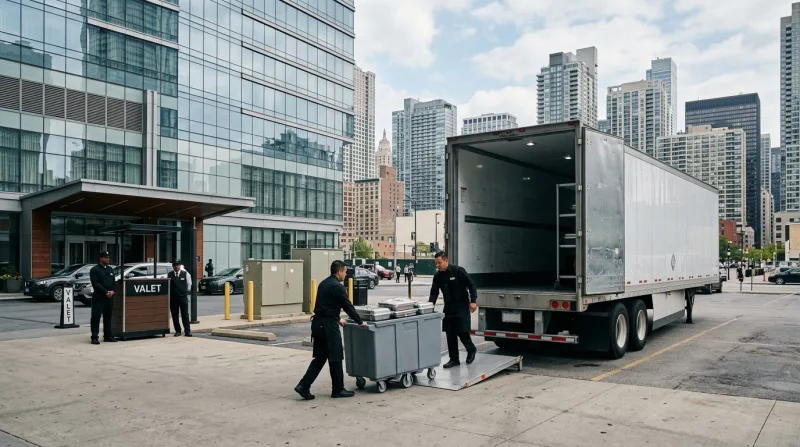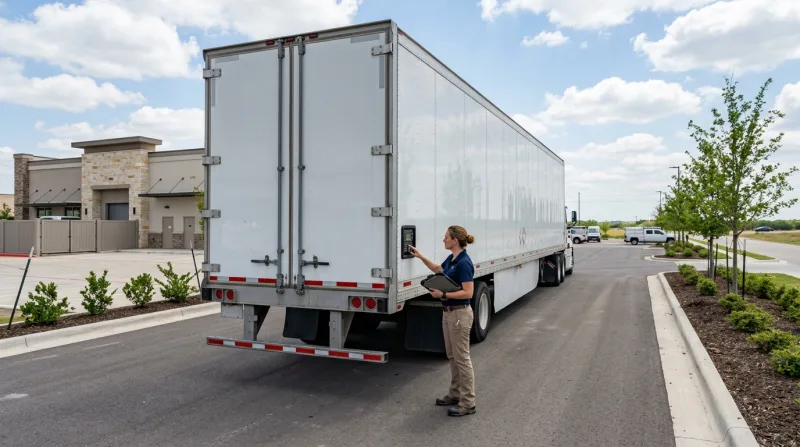

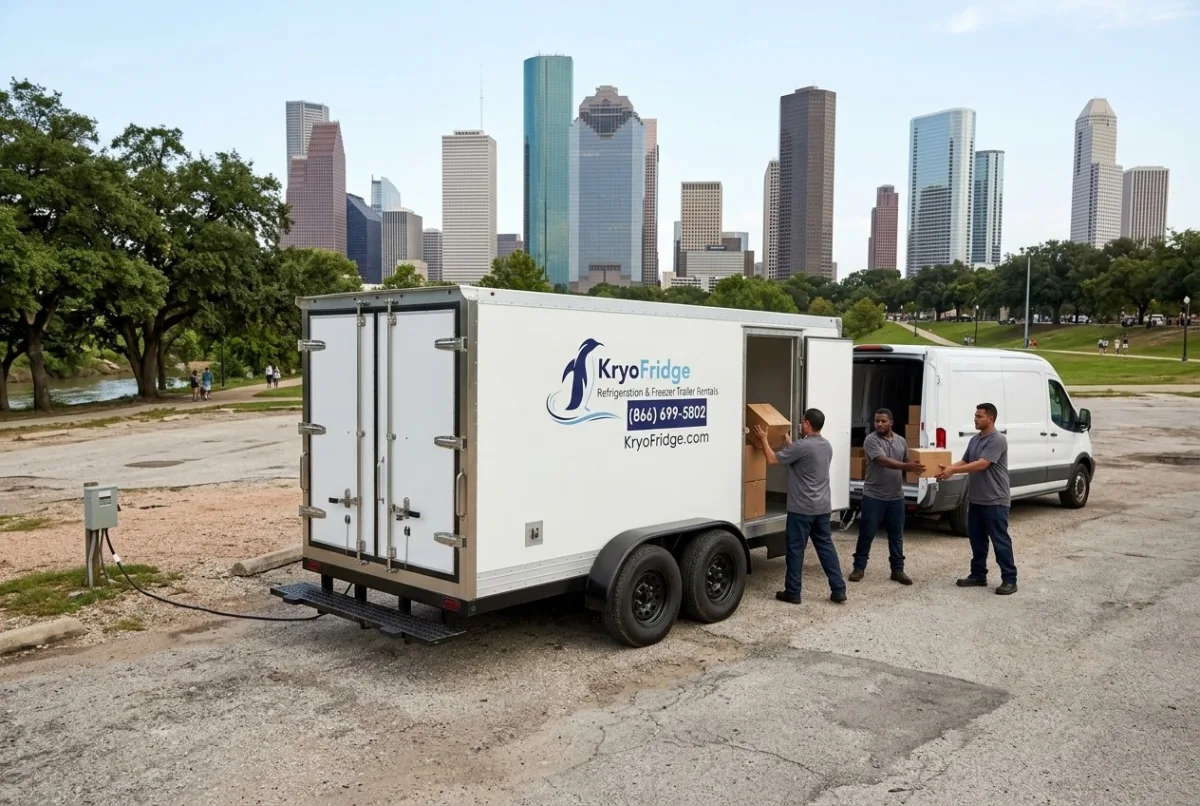
KryoFridge is the go to freezer trailer team in Houston, and every unit arrives cold, set up, and ready to load the day it lands. We deliver into restaurant rear lots in the Heights and along Bellaire Boulevard, grocery pads in Katy and Sugar Land, catering builds at NRG Park, and paved yards along the Ship Channel in Pasadena and Deer Park. Call us or line up a freezer trailer rental quote and we will lock a delivery window around your date.
We are the refrigeration arm of a rental family with more than 30 years behind it, and we own every trailer we send out. That makes us a direct company instead of a broker handing your emergency to somebody else's yard, which is why our dispatch can commit to a time instead of guessing at one. We run one of the largest freezer trailer fleets in the region, we are licensed, insured and NSF ready, and somebody picks up the phone here around the clock. Some of the most recognized restaurant brands in America already keep our number, and our Texas freezer trailer rentals reach every corner of this metro and every state in the country.
Our trailers sit staged around Houston, fueled, pre-cooled, and maintained in-house, parked and waiting for the call rather than being sourced after it. That is why an emergency call usually puts a unit on your lot and pulling temperature in about 45 minutes.
The voice on the phone belongs to the same outfit that owns the trailer and sends the driver. No reseller in the middle quietly marking up somebody else's equipment while your inventory creeps past 40°F on the shelf.
Every unit is ours to own, service, and deliver, and each one swings between deep-freeze and fresh-cold on a precise digital set-point. So we can size the answer to your Houston job and turn it around the same day rather than putting you on next week's list.
National chains do not gamble on refrigeration. A drifting set-point during dinner rush can cost a brand a day of sales and a health-code headache, so the chains that scale fast vet a cold-storage partner the same careful way they vet a protein supplier. KryoFridge has held temperature for names like McDonald's, Chick-fil-A, and Dutch Bros, and earned the repeat call.
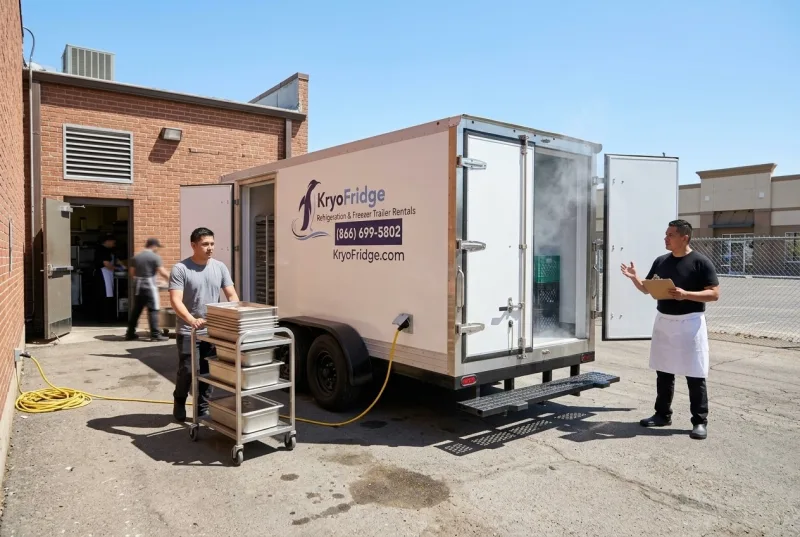
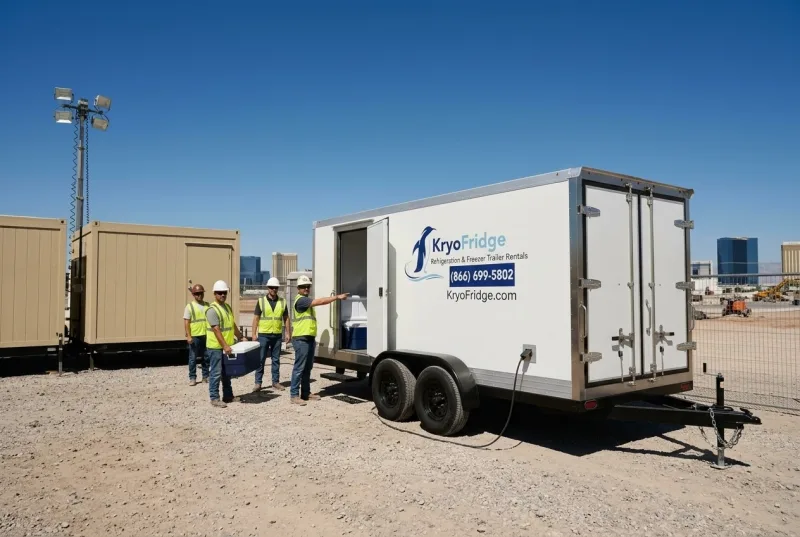
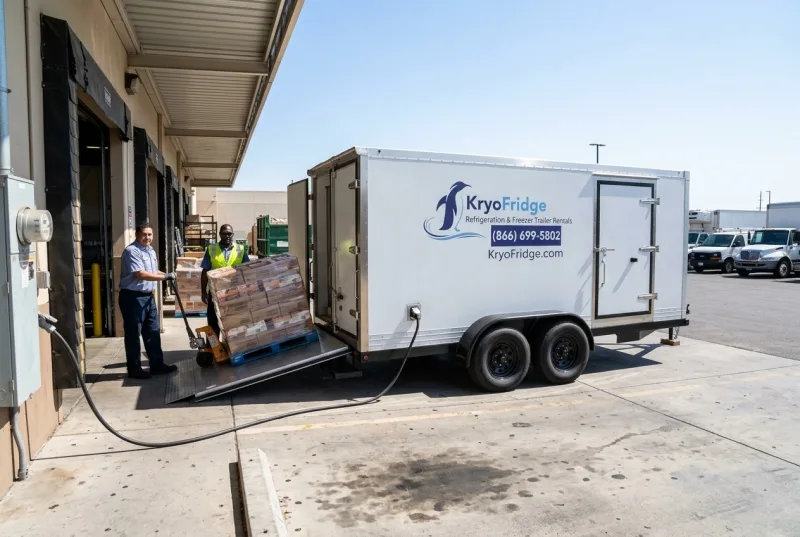
The stories behind that trust are the kind every restaurant owner recognizes. One Friday at 6:30 in the evening, a Chick-fil-A called in with a dead walk-in and a drive-through line already wrapped around the building. We prepped a trailer, dispatched it, and had it on their pad pulling temperature 34 minutes after the phone rang. The manager's first words when the driver pulled in were, "I cannot believe you are already here." That is the bar we hold ourselves to. Another year, an overnight outage shorted a cooler on the morning of a holiday rush, and our team staged three freezer trailers to hold every pie, every protein, and every prep tray so the kitchen served the rush without missing a ticket. The reason we hear some version of that line so often is the same every time: the equipment was already nearby, already cold, and owned by the people who answered the phone. That same standard travels to every Houston job, from a one-cook taqueria to a distribution floor.
"Our walk in quit at six on an August Friday with a full book, which is about the worst timing in this city. I called and a trailer was in the alley behind us that evening, cold before we finished pulling product. We lost nothing and Saturday went out like normal."
 Gordon M. · restaurant owner, the Heights
"We work the rodeo lots every spring and cold space out there is whatever you bring with you. Their trailer showed up on the Thursday with its own generator and stayed through all three weekends. Switching it from cooler to freezer between events took one phone call."
 Victor V. · catering director, NRG Park events
"Our rack replacement had the whole perishable set outside for eleven days while we stayed open. Two units on the side pad, one cold and one frozen, and my crew pulled from them all day without a complaint. Shrink at the end was basically zero."
 Breanna A. · store manager, southwest Houston grocery
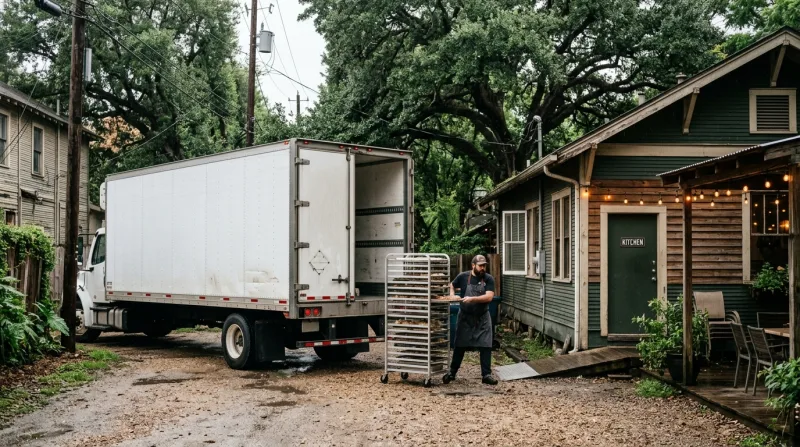
Our signature refrigerated trailer is the unit most Houston jobs land on, because it tucks into a strip center service drive off Bellaire Boulevard or a rear lot behind a converted bungalow in the Heights without swallowing the parking row, and it still holds a real week of restaurant product. Bigger and smaller units roll out of the same yard, so the full cold storage trailer specs and sizes are worth a look before you pick a delivery day.
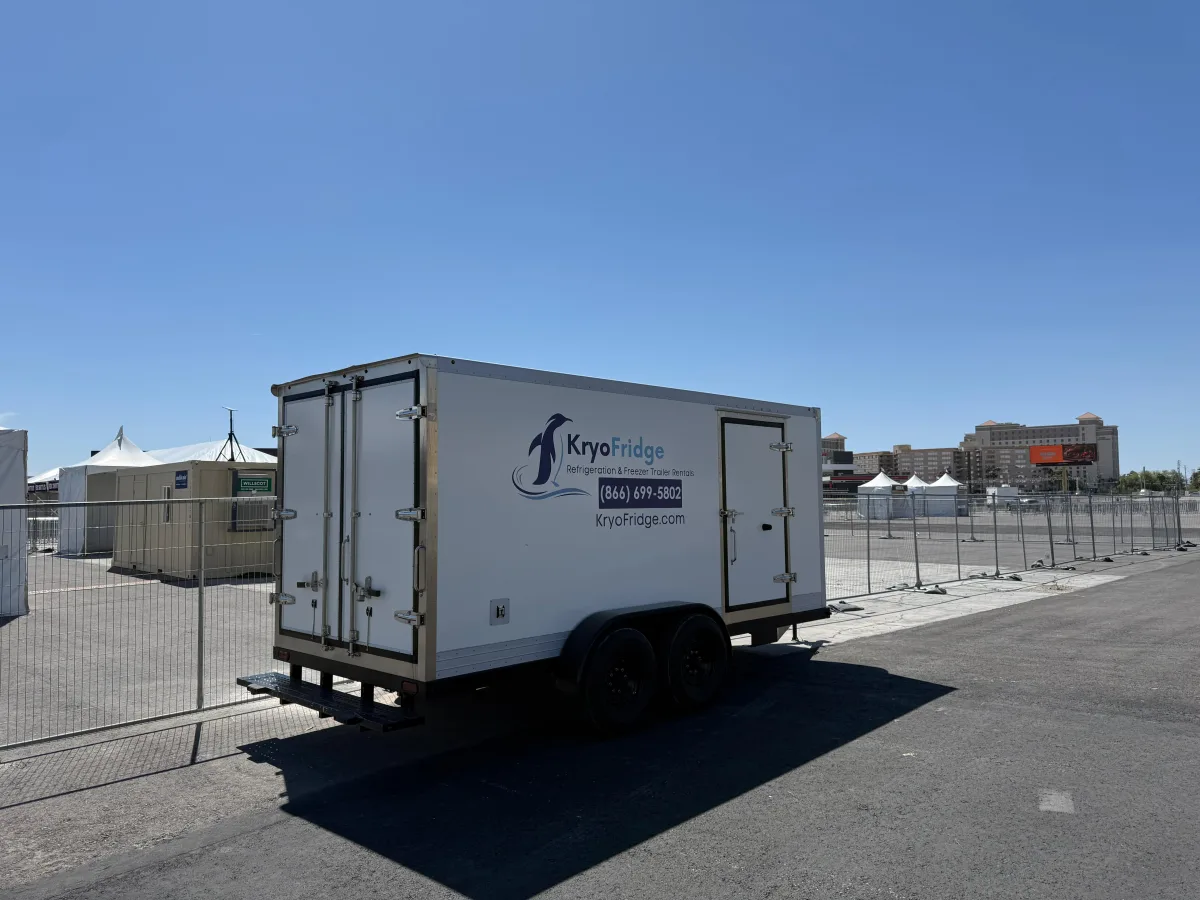
The 16' Utility earned its flagship spot the hard way, on jobs where a few degrees of drift would have cost somebody their inventory. The box is 16 feet long and fully insulated, riding on a tandem axle. The interior is NSF approved. One digital set point covers everything from -10°F frozen storage to a 50°F produce cooler. There are two ways in: rear double doors for pallets, and the side utility door for everyday grab-and-go.
Because we own and service the entire fleet, the trailer on your lot was prepped in our yard, not scrambled together after your call. It lives on a dedicated 120V, 20-amp circuit or a generator we supply, and it keeps its temperature whether the job runs a weekend or a full season.
| Spec | What you get |
|---|---|
| Temperature range | Roughly -10°F deep-freeze up to about 50°F fresh-cold |
| Mode | Dual-purpose: freezer or refrigerator on one precise digital set-point |
| Power | A dedicated 120V, 20-amp circuit within about 100 feet, or a generator we supply |
| Food safety | NSF-approved for direct food contact, food-safe surfaces, proper drainage |
| Footprints | 6x8, 6x12, and 6x16, from a tight retail lot to distribution scale |
| Backing | Owned in-house, fully licensed and insured, with 24/7 emergency dispatch |
Each unit holds a precise digital set-point and runs on a dedicated 120V/20A circuit or a generator. The trailers are not wired for 208 to 240V building service, so we confirm your hookup before the truck rolls.
We deliver anywhere in the city and out across the greater metro, and most of it happens on routes our drivers already cover every week. An order in Houston and a second unit for a sister store in Sugar Land or Baytown are usually one dispatch instead of two. Tell us the address, what you are holding and the date you need it, and we will confirm what fits the site, whether it takes a dedicated 120 volt 20 amp circuit within 100 feet or comes out with one of our generators. Nearby, we handle St George emergency freezer trailer rental and Mesquite cold storage trailers for rent.
Neighborhoods and towns we cover include Downtown, Midtown, Montrose, The Heights, EaDo, Third Ward, Museum District, Medical Center, Rice Village, Uptown, Galleria, Memorial, Energy Corridor, Spring Branch, Bellaire, Asiatown, Sharpstown, Westchase, Near Northside, Clear Lake, Pasadena, Sugar Land, Katy, The Woodlands.
From the busiest commercial corridors to the quietest side streets, these are the Houston area communities we serve every week.
One call sizes the trailer, sets the delivery window, and locks your quote for Houston. Call now, or send the quick quote request and we will call you.
Harris County holds roughly 12,915 restaurants and cafes, one of the busiest ports in the world, the largest medical complex on earth, and an event calendar that peaks in February and March instead of July. Those four things pull cold storage in four directions, and our fleet is sized and routed for all of them.
Older inner loop buildings run older equipment, and Gulf humidity is punishing on outdoor condenser coils. When a box quits mid service we get a unit moving the same night and set it as a cooler or a freezer depending on what you lost.
A walk in replacement takes days or weeks, and the product has to live somewhere the whole time. These are planned rentals with a known window, so we size the unit to the job instead of to the emergency.
A refrigeration rack swap pulls the entire perishable set outside while the store keeps its doors open. Multi week holds with more than one trailer are normal, and we stage them where your team can pull from them all day.
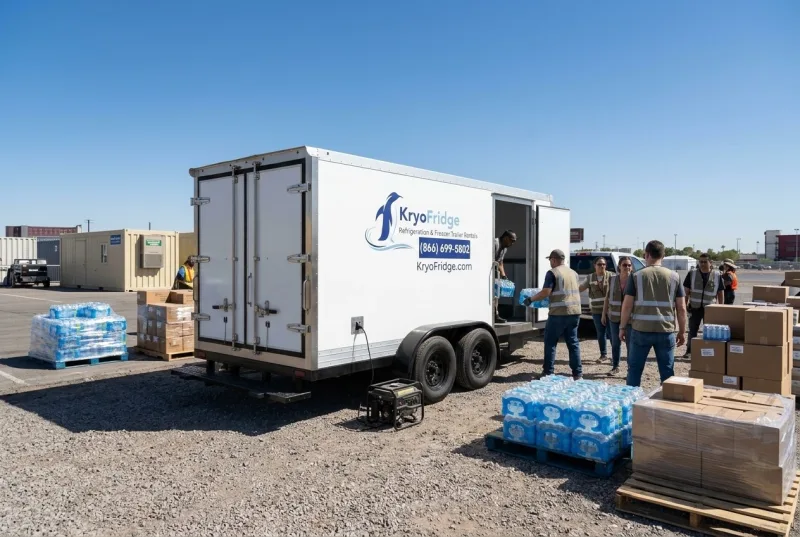
Atlantic hurricane season runs June 1 through November 30 and Houston has been on the wrong end of it repeatedly. We place generator ready units before landfall and keep dispatching after it, which is when this city needs cold space most.
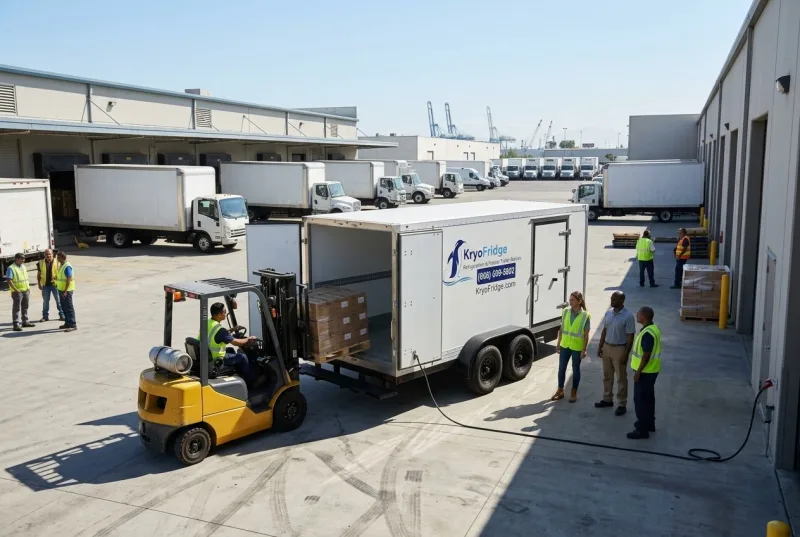
Spring and fall turnaround seasons along the Ship Channel put thousands of contract crews on plant property with temporary field kitchens. A trailer with its own generator holds the whole feeding program safely in August heat.
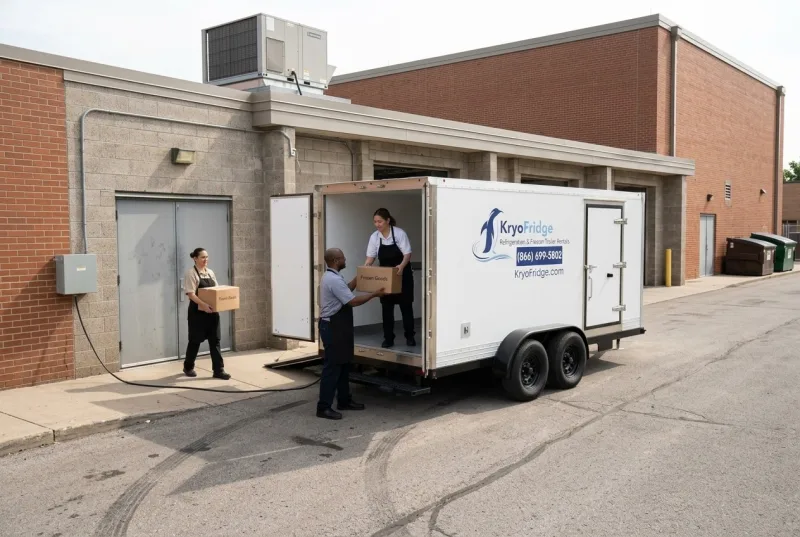
Thanksgiving protein programs, Lunar New Year in Asiatown, Restaurant Weeks in August and a distributor deal you could not pass up all create the same problem, which is more product than your box holds. If you have common portable refrigeration questions about timing or capacity, call us before the truck arrives.
What ties these together is the clock. Nobody budgets a freezer trailer into next quarter. They reach for one the hour a compressor quits, or the evening before a party when the stack of rented ice chests suddenly looks laughably undersized. Since our units sit staged around Houston instead of a couple counties down the freeway, "can I get it today" is an ordinary ask here, not a stretch.
Add it up the way an owner in Houston has to. One restaurant walk-in routinely sits on a small fortune in proteins, dairy, and prepped product. Scale that to a grocery rack or a warehouse freezer bay and the exposure balloons. Now knock the power or the compressor out on a triple-digit afternoon, and that whole inventory is in jeopardy inside a few hours. Then stack on the sales you lose while the line sits dark and the wages you burn paying staff to triage what can still be saved.
Hold a pre-staged trailer up against that risk and it reads like cheap insurance, a fixed, predictable expense parked in front of a loss with no ceiling. That is exactly why the businesses that got stung once tape our number by the phone. There is never a second scramble, because the next time they dial before the product has a chance to warm. Owning every trailer ourselves means we can scale the answer to fit. A single compact box suits a corner cafe. A clustered setup covers a warehouse floor. Either turns around the same day.
The numbers are not subtle. At Bush Intercontinental Airport the average July high is 94.5 degrees and the average August high is 94.9, making August the warmest month of the year. The all time record is 109 degrees, set on August 27, 2011 and matched on September 4, 2000. In 2023 the city recorded 45 days at or above 100 degrees, the second highest annual total in the record book, behind only the drought summer of 2011 at 46. August 20 of that year hit 108 degrees and broke a daily record that had stood for 114 years.
Humidity is the part that actually breaks equipment. Warm moist Gulf air means condensers reject heat against a high wet bulb for months without a break, and every door opening pulls moisture into a cold box that then has to be pulled back out. A unit that was adequate in April is working at the edge of its design by mid July. That is why walk in failures here cluster in August, and why our phone rings hardest on hot Friday evenings.
The calendar then stacks a second risk on the first. Atlantic hurricane season runs June 1 through November 30, and the region also takes hard freezes in January and February that outdoor equipment here was never built for. Houston averages 51.84 inches of rain a year, which fills the low spots and puts water into alley condensers. Any of those three can take a kitchen down, and a trailer with a generator does not care which one it was.
Houston does not concentrate its restaurants downtown the way most big cities do. The density sits in corridors, and each one has its own delivery personality. Bellaire Boulevard through Asiatown is the largest concentrated restaurant district in the city, roughly six square miles of Vietnamese, Chinese, Thai, Korean, Taiwanese and Malaysian kitchens rebuilt between Gessner Road and State Highway 6 starting in 1983. White Oak Drive in the Heights, Washington Avenue, Montrose, Midtown and EaDo add hundreds more, most in buildings never designed to carry today's refrigeration load.
That building stock is the reason we stay busy. A converted bungalow in Woodland Heights or a strip retail bay off Bellaire has one condenser working against 95 degree air at Gulf humidity for four straight months, and marginal equipment does not fail in February. It fails in August, usually on a Friday, usually during service. When it does, the walk in takes the whole kitchen with it: proteins, dairy, produce, prepped mise en place, everything the line pulls from. We answer that call at any hour and get a trailer moving while you are still breaking down the station.
The planned work matters just as much. A walk in replacement or a compressor rack changeout takes days to weeks, and the product has to live somewhere the entire time. Houston kitchens schedule around two fixed obstacles: the rodeo stretch in late February and March, and Houston Restaurant Weeks, which ran August 1 through September 7 in 2026 with nearly 400 participating restaurants from the Galleria and the Inner Loop out to Sugar Land, Galveston and The Woodlands. That five week spike lands in the hottest part of the year on set menus that need specific proteins held in quantity, so remodels get pushed to January or the fall shoulder and the trailer gets booked months ahead.
Multi unit groups are a different conversation. When a restaurant group sequences four stores through a remodel, that is a multi trailer, multi month schedule, and we plan it with you instead of taking it one panicked call at a time. Houston also has plenty of very small rooms. Sushi Horiuchi in Montrose seats six people for one service a night, which tells you how much cold storage a room like that keeps on site. Reach out early and we will hold your dates.
The Houston event calendar is front loaded in a way that catches out of town crews by surprise. The Houston Livestock Show and Rodeo at NRG Park drew more than 2.7 million people across its 2025 run from February 27 through March 23, and the 2026 edition drew 2.6 million. It opens with the World's Championship Bar-B-Que Contest, which put 250 competing teams on the NRG Stadium parking lots for three days in 2025, every one of them building a temporary service kitchen on bare asphalt with whatever arrives on wheels.
From there the year keeps going. The Art Car Parade brings more than 250 vehicles and roughly 250,000 spectators downtown in April. The Bayou City Art Festival stages twice a year, spring in Memorial Park and fall downtown, with about 300 exhibiting artists. Comicpalooza fills the George R. Brown Convention Center, all 1.8 million square feet of it, over Memorial Day weekend. And in 2026, NRG Stadium hosts seven FIFA World Cup matches between June 14 and July 4, five group stage games plus a round of 32 and a round of 16.
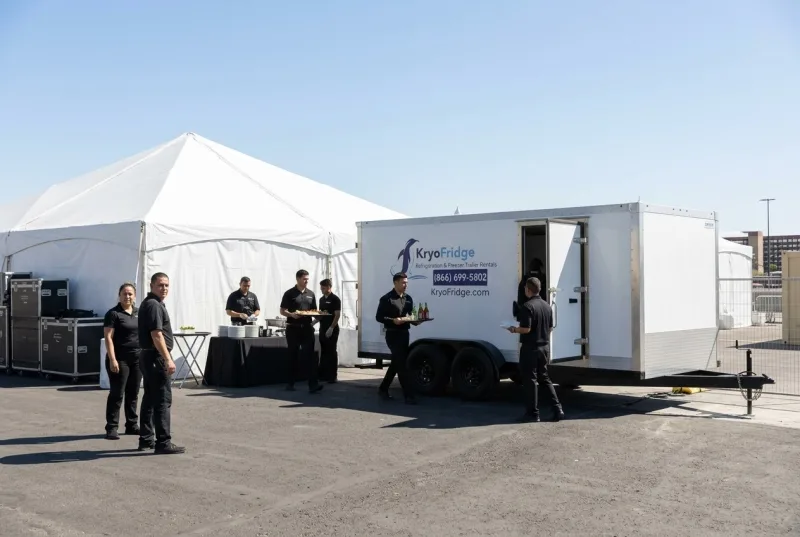
Every one of those sites has the same problem. The NRG lots, Discovery Green, Eleanor Tinsley Park and the Memorial Park golf lawns are bare ground with committed power and no spare refrigeration. A caterer working a March rodeo weekend, an April parade and a June match window is doing three different builds, and in all three the cold storage arrives on wheels or it does not arrive. We stage the unit where your service line needs it, power it with our own generator when event power is spoken for, and pull it when your load out opens.
Off premise catering across a metro this size is its own discipline. A crew loading in the Heights at eight in the morning for a six o'clock service in Sugar Land or The Woodlands is holding product all day in a climate where the back of a box truck is not a cold box. Our trailer becomes the working cold room at the venue, set as a cooler for produce and dairy or as a freezer for held proteins. Book it when you sign the venue contract.
Houston is a cold chain city before it is anything else. Port Houston finished 2025 at 4,303,345 TEUs and 54.5 million short tons, the best year in its history, after a 2024 that set records of its own at 4,139,991 TEUs and 53.07 million tons. Barbours Cut and Bayport handle about two thirds of the containerized cargo moving through the US Gulf, and the port has reported a sustained increase in refrigerated cargo that is driving new cold storage construction and added reefer capacity at both terminals. Purpose built cold facilities take 18 to 24 months to deliver, which is exactly why temporary capacity gets rented instead of built.
Grocery work here is steady and it is planned. Refrigeration rack replacements and case changeouts take a store's entire perishable set offline for days while the doors stay open, so the trailer has to sit where staff can pull from it a dozen times a day. Add the seasonal peaks: Thanksgiving and Christmas protein programs, the Lunar New Year surge through Asiatown, crawfish season from January into May, and the produce still moving through the Airline Drive corridor around the Houston Farmers Market, an 18 acre site trading since 1941.
The industrial side of this market is genuinely underserved. The eastern Ship Channel corridor through Pasadena, Deer Park and Baytown holds some of the largest refining and chemical complexes anywhere, including the ExxonMobil Baytown refinery at roughly 588,000 barrels per day, the 1,500 acre Shell Deer Park complex, and Phillips 66 Pasadena at about 247,000 barrels per day. Turnaround seasons fall roughly March through May and September through November, mobilizing thousands of contract craft workers who get fed on site from temporary field kitchens. Feeding 2,000 people in August on a paved plant lot is a serious food safety exposure, and a trailer with its own generator is the cleanest answer to it.
Institutional kitchens round it out. The Texas Medical Center covers more than 1,345 acres with 61 institutions, 21 hospitals and about 106,000 employees, and those hospital kitchens produce meals through a refrigeration failure or a renovation without pausing service. School districts across the metro do their walk in projects during summer break, which here means July and August with summer feeding sites still running. The Houston Food Bank moves more food than any other single organization in the Feeding America network out of a 308,000 square foot building on Portwall Street.
"Cold" is not one number. Different product stays safe inside different temperature windows, which is the entire reason a precise digital set-point matters, and in the middle of a heat wave in Houston, a load that slips out of its window is a load you write off. Use the chart below as the reference our customers lean on when they size a rental.
| Product | Target holding band | Trailer mode |
|---|---|---|
| Ice cream and frozen desserts | -10°F to 0°F | Deep freeze |
| Frozen proteins, seafood, prepared meals | 0°F or below | Freezer |
| Fresh meat and poultry (short hold) | 28°F to 32°F | Refrigerated |
| Dairy, deli, packaged produce | 34°F to 38°F | Refrigerated |
| Beverages, florals, catering trays | 38°F to 45°F | Refrigerated |
One figure outranks everything in that chart, and it is not listed there: 40°F. Food-safety guidance treats the band between 40°F and 140°F as the zone where bacteria thrive, and the clock on perishable product starts ticking the moment it crosses 40 on the way up. Roughly four cumulative hours above that line and most refrigerated inventory is no longer safe to serve. Picture that countdown running on a 100-degree afternoon in Houston with the walk-in dark, and the urgency of a quick trailer drop stops being abstract.
Tell us the single coldest item you are holding when you call, and we dial the trailer to that. One unit carries a straight freezer load with no fuss. But when your list mixes deep-freeze desserts with fresh-cold produce for the same remodel or event, we will usually point you toward a split setup or a second box so neither side of the load has to settle for the wrong temperature.
Powering one of our trailers is refreshingly simple, and there are precisely two ways to do it. Either you have a dedicated 120-volt, 20-amp circuit reachable within roughly 100 feet of the parking spot, or we bring a generator. What the units will not accept is standard 208 to 240V building service, so a quick question about your outlet before dispatch heads off any surprise on delivery day.
On placement, all the unit really asks for is a fairly flat patch with enough room for the delivery truck to maneuver it in and set it straight, plus either a power source in reach or space for a generator. We lock down the exact drop point before dispatch, and our drivers know the Houston layout cold, so the delivery is one clean trip instead of a guessing game on the property.
The call came in just after six on an August evening with a full book and the walk in already climbing. We had a unit prepped and rolling before the first table was seated, and it was cold in the rear lot that night. Nothing was lost, and Saturday service went out as if nothing had happened.
Three weekends of service on asphalt with power already committed to the tents and no cold space on the site. We staged a generator ready trailer at the edge of their build on the Thursday and left it through the run, resetting it from cooler to freezer between events. One unit, one delivery, three weekends.
The refrigeration contractor needed the whole perishable set out of the building for eleven days while the store stayed open. We put two trailers on the side pad, one set cold and one set frozen, where staff could pull from them all day. The store never closed and shrink at the end was effectively nothing.
We plan the crossing before we plan the drop. Houston is three concentric rings and a shipping channel, and the right route is a question of hour rather than mileage. Our drivers know when the 610 Loop beats Beltway 8, which Bellaire Boulevard service drives a trailer can actually turn into, that the Fred Hartman Bridge is the practical way to Baytown from a Pasadena yard, and which Uptown and Medical Center garages have clearance that rules out a rear placement. Look over our freezer trailer rental fleet and then tell us your address, because that is the conversation that makes a delivery window hold.
On a bad day, booking should be the part that does not add stress. Four steps, an upfront number, and a single person who owns the whole thing.
Tell us whether it is freezer or fridge product, a ballpark volume, and your rough window. That is enough for us to call the right size.
We pair you with a unit, confirm whether you have a dedicated circuit or need a generator, and pin the exact drop point so the truck makes one trip.
We arrive on your schedule, about 45 minutes for a true emergency, set the trailer, energize it, and let it drive down to your number.
It holds the set-point for your entire term while our line stays live the whole way through. Wrap up, and we swing back for the pickup.
The governing rules are the Texas Food Establishment Rules at 25 Texas Administrative Code Chapter 228, adopted from the FDA Food Code and administered by the Texas Department of State Health Services. Cold held potentially hazardous food must be maintained at 41 degrees Fahrenheit or below, with raw shell eggs in open display allowed at 45 degrees, and the danger zone is defined as 41 degrees to 135 degrees. Section 228.75(a) states plainly that stored frozen foods shall be maintained frozen. Our trailers hold a set point from about 50 degrees down to negative 10 degrees, so one unit covers either side of that line.
Inside the city, the Houston Health Department is the permitting authority. Houston Code of Ordinances Chapter 20, Article II, Division 2, Section 20-36 provides that no person may operate a food establishment without a valid current food dealer's permit. Temporary food permits are issued only where the operation is part of an event or celebration as defined in FDA Food Code 1-201.10(B) and runs no more than 14 days for that single event, which covers most festival, rodeo and stadium work. Mobile food units operate from a Central Preparation Facility, and under Texas House Bill 2844 and 25 TAC Chapter 226 that permitting authority transfers to Texas DSHS effective July 1, 2026. The department's specialized food inspection section covers warehouses, processors, bakeries and commissaries. Their main line is 832-393-5100.
On the worker safety side, OSHA published a proposed rule, Heat Injury and Illness Prevention in Outdoor and Indoor Work Settings, in the Federal Register on August 30, 2024. As proposed it would set an initial heat trigger at a heat index of 80 degrees and a high heat trigger at 90 degrees, and would require written prevention plans, heat monitoring, rest breaks, acclimatization and training. It remains a proposed rule. Experienced Gulf Coast crews already build the practice into the job anyway: shade in the site plan, cold water through the whole shift, heavy work scheduled early, and cold product staged where nobody is holding a door open in direct sun.
One caveat we always state plainly: we supply the food-safe, temperature-holding hardware itself, but we are not a temperature-logging or alarm-monitoring service. If your program requires continuous written records, line that vendor up on your own.
Our signature 16 foot Utility series leads the fleet. It is the trailer we send on most jobs, and crews like it for the side utility access door. We build three footprints in all, so a single kitchen holding overflow stock has a fit and so does a distribution floor in a disaster. Every unit is dual purpose by design: one adjustable system swings between freezer and refrigerator on a digital set point. Each trailer runs on a dedicated circuit or on a generator.
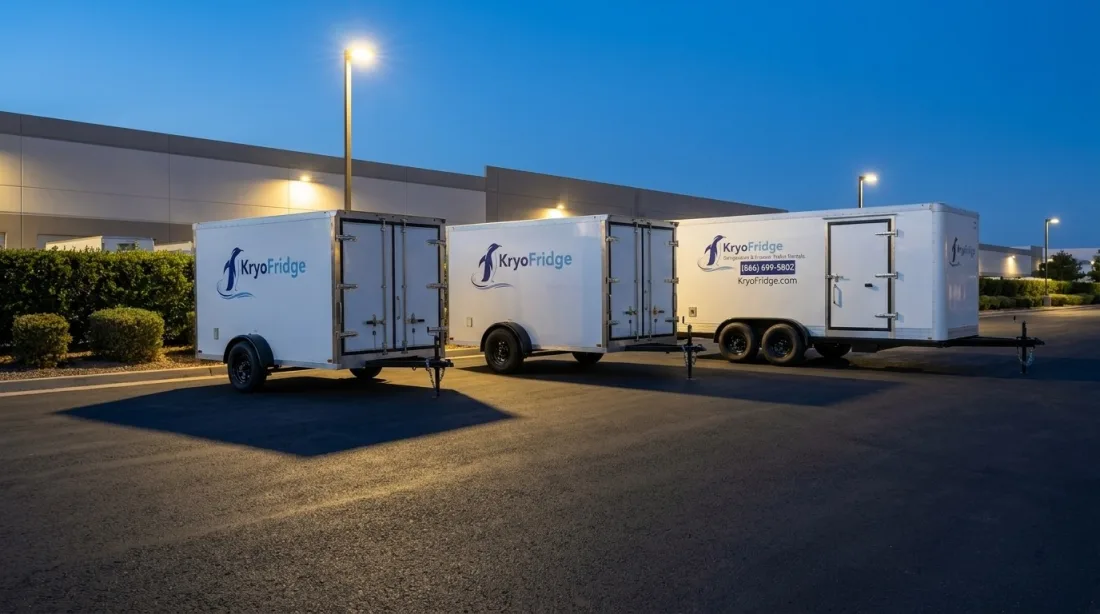
| Trailer | Best for | Temp range |
|---|---|---|
| 6x16 Utility ⭐ | Our signature series: distribution, large events, disaster response, side utility door | Heavy-duty reefer |
| 6x12 | Grocers, caterers, mid-size events | Deep-freeze capable |
| 6x8 | Tight lots, small kitchens, short overflow | -10°F to 50°F |
Each unit holds a precise digital set-point and runs on a dedicated 120V/20A circuit or a generator.
Think eight or so pallet spots, and the unit to grab when square footage is the whole problem. It slips into the pinched service yards and cramped back-of-house corners that a larger box cannot even swing into. One cafe or small-market walk-in goes down, and this is almost always enough cold to cover it, plus the simplest unit to set in a small space.
Call it fourteen pallet spots, deep-freeze rated, and far and away the size people ask for most. It lands right in the middle: roomy enough for a multi-day catering job or a restaurant that needs true walk-in-equivalent room while the kitchen is torn up. Roomy enough that nobody is playing Tetris with shelves, yet still small enough to set in most commercial back lots without a site survey.
Roughly twenty pallet spots paired with a heavy-duty reefer plant engineered to keep deep-freeze locked in even when the ambient air is merciless. Reach for it when a warehouse bay drops, when a large festival needs an anchor, or when a relief operation is carrying its own cold chain.
Not sure which size fits? Most customers land on the 16 foot Utility, and we will tell you honestly if a smaller footprint covers your job. Tell us roughly what you are storing and for how long, and we will spec it for you.
The questions that surface once the basics are settled. Tap any topic to open it.
The pop-up walk-in cooler. Cheap to rent and easy to set up, but it chills, it does not freeze, and it draws every watt it needs from your building while depending on a calm ambient temperature around it. The second your building loses power, your cooler loses it too.
The refrigerated box truck. Designed to haul product on the interstate, not to sit in a lot and babysit it. Parked, it idles fuel all day, broadcasts compressor noise across a storefront or an event lawn, and pins down a tractor plus a driver you probably do not need.
The freezer trailer we deliver. Built from the ground up to be dropped on a pad and to defend a temperature for as long as the job runs. It freezes deep, carries NSF approval, locks, stays quiet near guests, and lives on nothing more than one dedicated circuit or a generator.
Even a rented box has to satisfy the county environmental health office that licenses and inspects every food facility. Show an inspector a unit that cannot document its temperature or was not built for food contact, and they have the authority to halt service immediately.
That is a bar each of our trailers clears: NSF-approved throughout, food-safe interior surfaces, proper drainage, and a digital controller that puts the set-point in plain view. We supply the food-safe, temperature-holding hardware itself, but we are not a temperature-logging or alarm-monitoring service.
For a typical kitchen or market, one box does the job. Distribution floors, big fairs, and full-scale disaster response routinely need more, and because the fleet is ours, we can cluster several units and bring them online in waves as the work expands. Match the cold capacity to the operation rather than make the operation squeeze itself into one box.
The clock is yours to set. Some jobs are a handful of days for an emergency or a single event. Others stretch across weeks or months for a remodel or a seasonal swell, and a few become standing contracts for businesses that want capacity parked on standby. Name your window and you will get a clean quote, no penalty for an honest "not sure yet."
Building permanent cold storage is a capital project in every sense: you hire a refrigeration contractor, schedule the electrical, pull a building permit, and wait weeks before a single pallet goes inside. A rental turns that equation on its head. You bring in precisely the cold you need, for precisely the stretch you need it, and the trailer is holding temperature that same week, frequently that same day, with the commitment ending the moment your need is over.
Three engineered elements carry the load. Thick insulated panels and tightly gasketed doors lock the sun outside and the cold inside. A self-contained reefer condensing system specified with surplus capacity keeps stripping heat out of the box even when the air outside is brutal. And a digital thermostat locks onto your chosen number and cycles the compressor to hold the line. Run those three together and a trailer baking on open asphalt behaves like one tucked in a cool warehouse. That is also why power is the first thing we ask about: the design delivers its safety margin only on steady, uninterrupted power.
"Garage clearance meant nothing could go where the contractor wanted it. Their driver walked the property with us and found a surface spot my banquet team could actually reach with a cambro. That kind of attention is not what I expected from an equipment rental."
 Daniel H. · executive chef, Uptown hotel
"Turnaround feeding for a couple thousand people in September and nowhere to hold anything. They dropped a generator ready unit inside our gate and we never had a temperature question for the whole outage window. Pickup was on the day they said."
 Jeffrey W. · plant services coordinator, Deer Park
"Getting a trailer into our service drive without blocking four neighbors is the hard part on Bellaire. They came at five in the morning, worked it out with the property manager, and had it set before anyone opened. Our second location got one the same week."
 sara g. · owner, Bellaire Boulevard restaurant group
"We sequenced four stores through remodels last winter and they scheduled all of it with us up front. Same driver, same unit type, no surprises at any of the four. That is the whole reason we stopped shopping this around."
 Michael V. · operations manager, Katy restaurant group
"Our central kitchen walk in project landed in July while summer feeding sites were still running. They put a unit at the kitchen and another at the distribution dock so nothing stopped. Both were cold and ready the morning the contractor started."
 Karen M. · food service director, Pasadena school district
"We load out of our kitchen at eight in the morning for six o'clock services all over Fort Bend. Having the trailer waiting at the venue changed how we plan every job, because product is exactly where we left it. Delivery has been on time on every order."
 Amy F. · owner, Sugar Land catering company
"After the last storm we had product and no power and everyone else told us three days. They had a generator unit at our loading dock the next morning. That is not something I will forget the next time we plan for hurricane season."
 Lisanne M. · regional manager, Baytown market
Sample reviews written to mirror genuine Houston situations, to be replaced with verified Google reviews ahead of launch.
Same day is the standard we work to, and our dispatch is staffed around the clock every day of the year. We own the fleet, so when you call we are looking at our own yard instead of trying to find somebody else's trailer. Our fastest documented emergency arrival was 34 minutes from the phone call for a Chick-fil-A with the walk in down in the middle of dinner rush. Call us and we will tell you honestly what your window looks like.
There are exactly two ways to power one of our trailers. The first is a dedicated 120 volt, 20 amp circuit within 100 feet of where the trailer sits. The second is a generator that we provide and deliver with the unit. If your building cannot give up a dedicated circuit, which is common in older inner loop buildings and on plant yards and event grounds, the generator solves it. Tell us about the site when you call and we will settle it before the truck leaves.
Yes, and this is one of the real advantages of our equipment. Every trailer is dual purpose with an adjustable set point from roughly 50 degrees down to negative 10 degrees, so one unit covers refrigerated holding or hard frozen storage. Caterers use that constantly, running a cooler for produce and dairy one day and a freezer for held proteins the next. Tell us what you are holding and we will set it before delivery.
Under the Texas Food Establishment Rules at 25 TAC Chapter 228, cold held potentially hazardous food must be maintained at 41 degrees Fahrenheit or below, with raw shell eggs in open display allowed at 45 degrees. The temperature danger zone is defined as 41 to 135 degrees. Section 228.75(a) also requires that stored frozen foods be maintained frozen. Our set point range covers both requirements comfortably, and your Houston Health Department inspector will want to see the product held there, not just the equipment present.
If you are serving the public at a temporary event, you need a temporary food permit from the Houston Health Department, and those are issued only where the operation is part of an event or celebration and runs no more than 14 days for that single event. The cold holding requirements from the state rules apply the same way they would in a permanent kitchen. We supply the equipment and set it at the temperature you need. The permit is yours to pull, and the health department main line is 832-393-5100.
Yes, and a fair number of Houston grocers, restaurant groups and institutional kitchens do exactly that. Atlantic hurricane season runs June 1 through November 30, and the argument for standby capacity is simple arithmetic from the last one. After Hurricane Beryl in July 2024, more than 860,000 CenterPoint customers were still without power four days after landfall. A generator ready unit already parked on your property is worth more than a phone number when the whole region is calling at once.
The general federal guidance is that refrigerated food held above 40 degrees for more than two hours should be discarded, and USDA publishes specific direction on food safety during a power outage. A full freezer holds its temperature longer than a half empty one, and keeping the doors closed matters more than anything else in that window. Start the clock the moment you notice the failure and call us in the same minute, because the sooner we are moving, the more of that two hours you keep.
No. Our units have a digital set point control on board that you can read and adjust, but we do not offer a remote monitoring, logging or alarm service. If your program requires documented temperature records, plan on your own monitoring device inside the box, which many kitchens and distribution sites already use. We will tell you that up front rather than let you find out later.
No. Houston and the Gulf Coast are a core market for us, but our network delivers refrigerated and freezer trailers in all 50 states, with particular strength on emergency response, disaster work and long term rentals. If you have locations spread across several states, one conversation with us covers all of them. Call or request a quote and we will map the whole footprint at once.
Deeper reading for local businesses, from the failure-hour playbook to compliance and seasonal planning. Tap any guide to open it.
Walk in failures in Houston follow a pattern, and the pattern is the reason this article exists. They cluster in July and August, they happen at the end of the week far more often than at the start of it, and they announce themselves in the middle of service rather than politely at eight in the morning. If you manage a kitchen in this city long enough, you will live through one.
The first thing to do is confirm what actually failed, because the answer changes everything that follows. A tripped breaker or a shorted fuse on the condenser is a service call. So is a blocked coil. A compressor that has given up is a replacement conversation with a lead time attached. Either way, do not open the door again while you are figuring it out. A closed walk in with the compressor off holds temperature for a surprisingly long time, and every door opening costs you part of the runway you have left.
USDA Food Safety and Inspection Service guidance on power outages
Atlantic hurricane season runs June 1 through November 30, and Houston has spent the last decade proving what that means for anyone holding perishable inventory. Four separate region wide cold chain failures in seven years is not bad luck. It is the planning assumption every food business in this city should be working from.
Start with the numbers, because they set the scale of the problem. Hurricane Beryl came ashore on July 8, 2024 and knocked out power to 2.26 million CenterPoint customers. The utility restored more than a million of them in the first 55 hours, which sounds fast until you look at what came after: more than 860,000 customers still dark four days later, 680,000 beginning a sixth day without power, and roughly 226,000 projected to still be out eight days after landfall. In July heat.
Houston hosts one of the busiest temporary food calendars in the country, and almost all of it happens on ground with no permanent refrigeration. The rodeo and the World's Championship Bar-B-Que Contest fill the NRG Park lots for weeks in late winter. The Art Car Parade brings a quarter million people downtown in April. Comicpalooza fills the George R. Brown Convention Center in May. Park festivals cycle through Discovery Green and Eleanor Tinsley Park all year. If you are feeding people at any of them, two sets of rules apply at once.
The first is the state rule set. The Texas Food Establishment Rules at 25 TAC Chapter 228 govern retail food service statewide, adopted from the FDA Food Code. Cold held potentially hazardous food must be maintained at 41 degrees Fahrenheit or below, the danger zone is defined as 41 to 135 degrees, and stored frozen food must be maintained frozen under section 228.75(a). Section 228.222 covers temporary food establishments specifically, and requires them to meet the food temperature requirements in Food Code subparts 3-202, 3-401 through 3-403 and 3-501, plus the receiving specifications in section 228.62.
Refrigeration equipment is specified against a design condition, and Houston spends four months a year outside the one most equipment was sized for. That single sentence explains most of the emergency calls we take in this city between June and September.
Look at the climate record at Bush Intercontinental Airport. The average July high is 94.5 degrees and the average August high is 94.9, which makes August the warmest month of the year here. The all time record is 109 degrees, set on August 27, 2011 and matched on September 4, 2000. In 2023 the city posted 45 days at or above 100 degrees, second only to 2011 at 46, and on August 20 of that year it reached 108 degrees and broke a daily record that had stood for 114 years.
National Weather Service Houston IAH climate normals and extremes
Grab a quick, no-runaround quote, or ring our round-the-clock line for emergency cold storage anywhere across Houston and the surrounding area.