
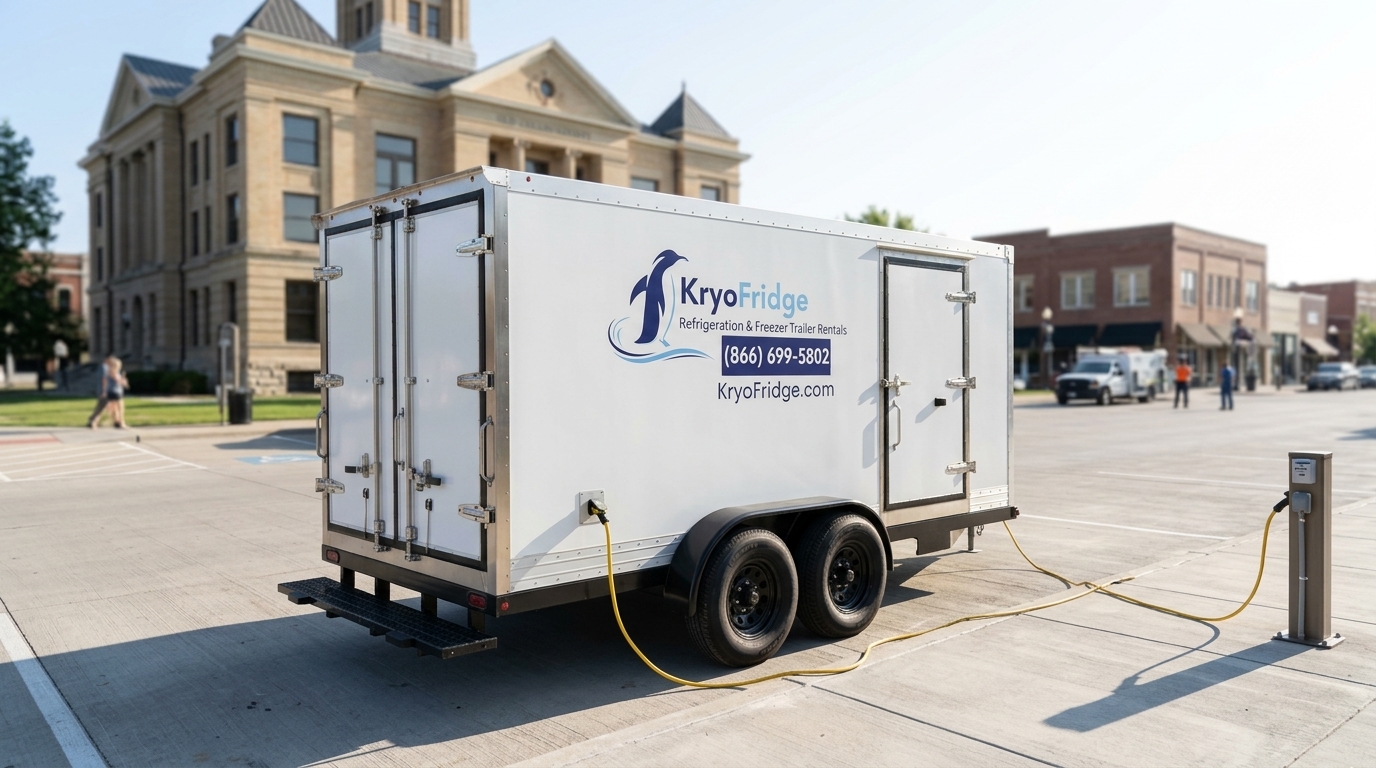
KryoFridge is the team McKinney kitchens and event crews call when the cold cannot wait. We bring mobile refrigeration rentals clean, fueled and already holding your number, whether the drop is a vendor lot beside the Historic Downtown Square or a loading door off Industrial Boulevard. Same day when we have a unit close by. Call us now or request a free quote and we will lock a delivery window today.
Cold trouble never books a date. A feeder drops on an August afternoon and the walk-in you counted on becomes the problem, or a supplier pulls a lot code and doubles what you have to hold overnight. We stage trailers close to the US 75 grid for exactly that, we own every one of them, and this family has been renting equipment for more than 30 years. Licensed, insured and SAM.gov registered, so a hospital kitchen or a school district can cut a purchase order the same week. Call now or request a free quote and we will put your site details on file before you need them.
You are not stuck with a fixed-temperature crate. One unit runs cooler or freezer, so a booking that starts as produce overflow can flip hard frozen without a second delivery and a second setup.
We bought these trailers and we service them ourselves. That is why we can tell you the real condition of the unit that is coming instead of reading you a spec sheet somebody else wrote.
Long enough to know which parts quit in a Texas July and to carry the spares before anybody asks for them. Experience mostly shows up as fewer surprises on your lot.
Licensed, insured and SAM.gov registered. Hospital systems and school districts around Collin County need certificates in hand before a purchase order clears, and ours go back in the first email.
Our North Texas units sit near the US 75 and SH 121 grid, not in another state waiting on a dispatcher. That is the only reason a same-day drop in this city is possible at all.
Refrigeration does not fail during office hours. Dispatch runs around the clock and a second unit is close enough to swap in, which is a different answer than a voicemail box and a callback on Monday.
National brands do not take chances with refrigeration. They put our trailers behind their busiest locations because the equipment holds temperature and the company behind it answers the phone.
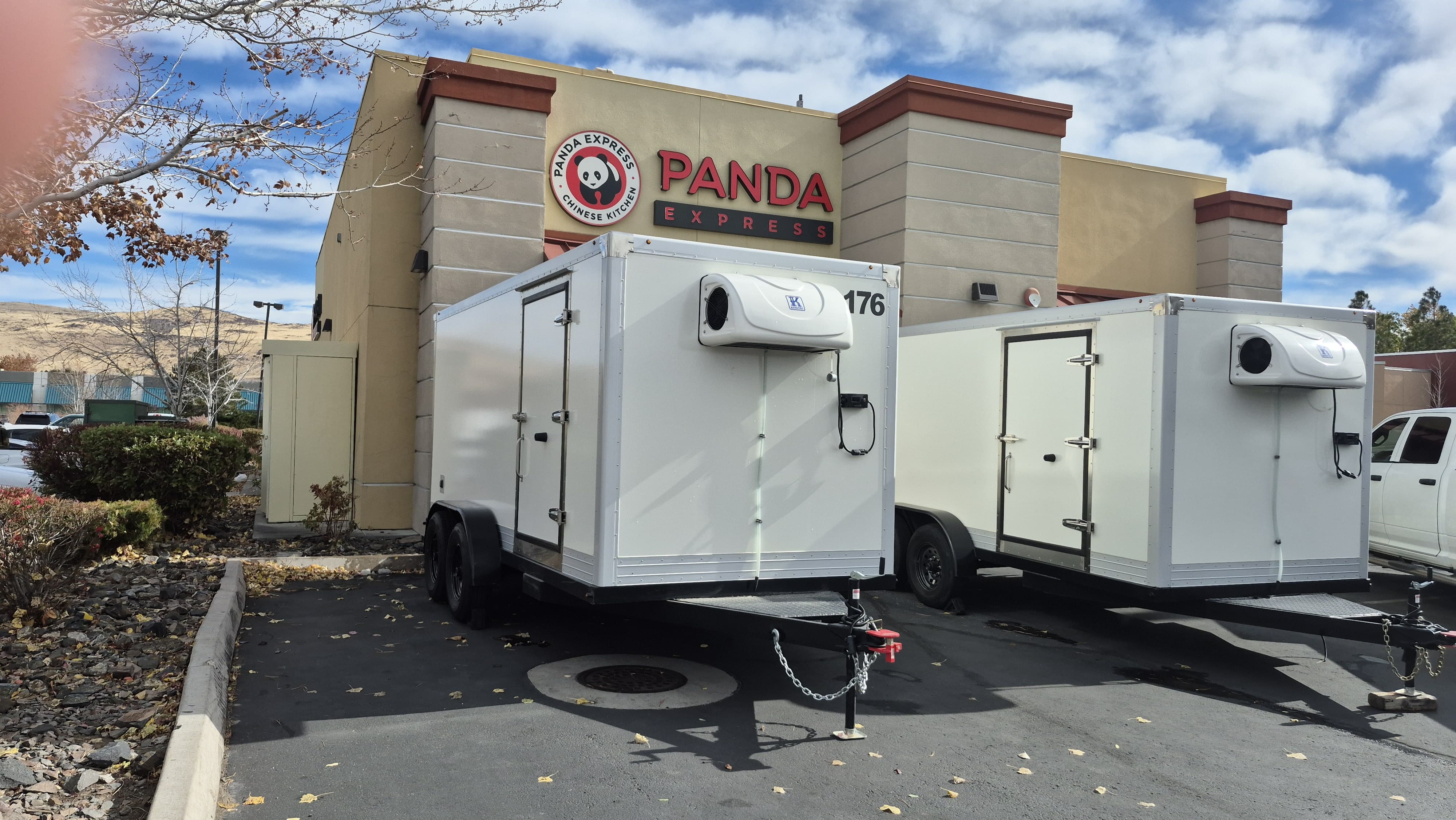 Panda Express
Overflow freezer space behind high-volume locations, holding bulk frozen product between distributor drops.
bulk overflow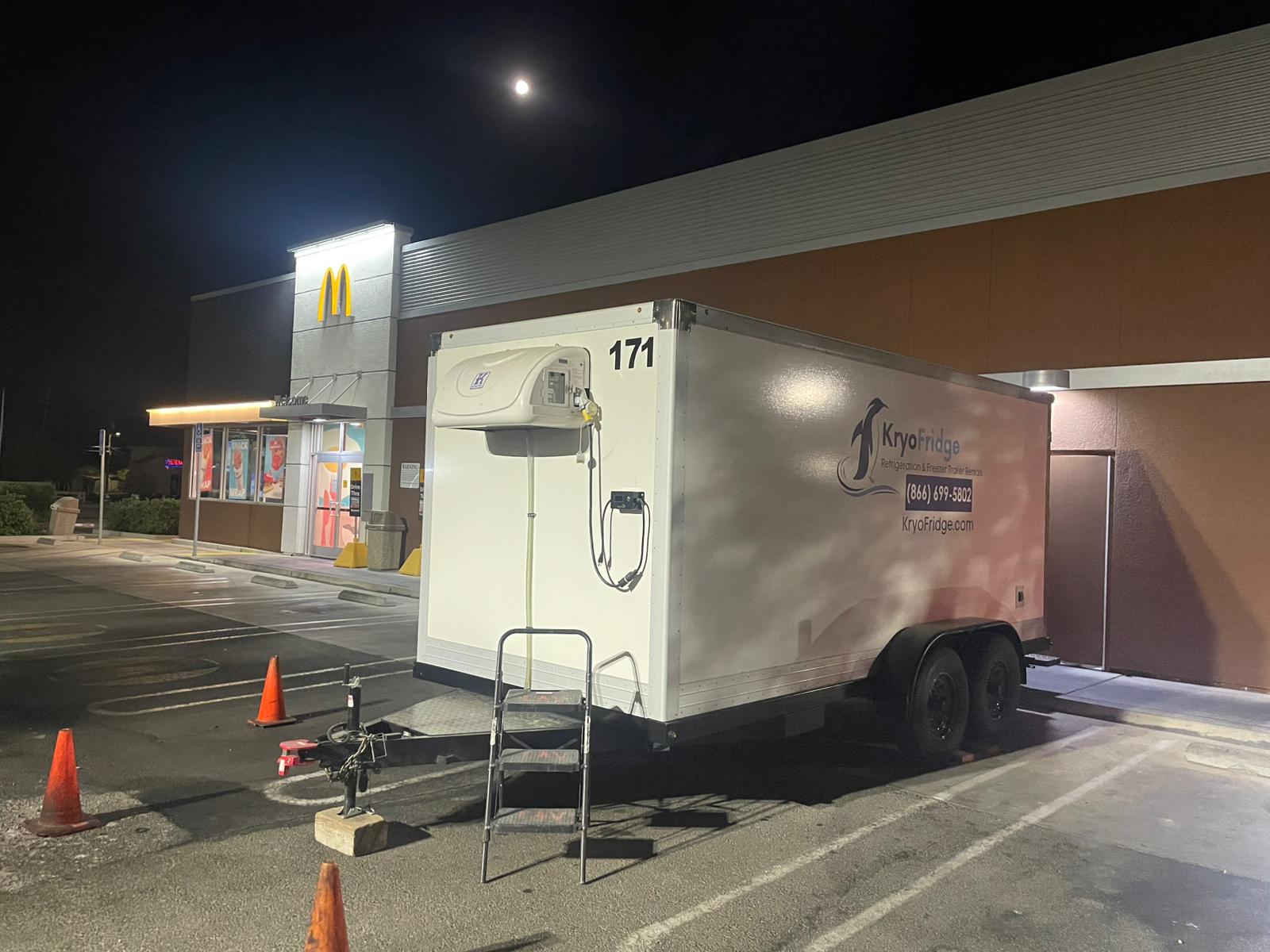 McDonald's
Freezer capacity staged on site through kitchen refits, keeping frozen stock at spec while the walk-in was down.
national account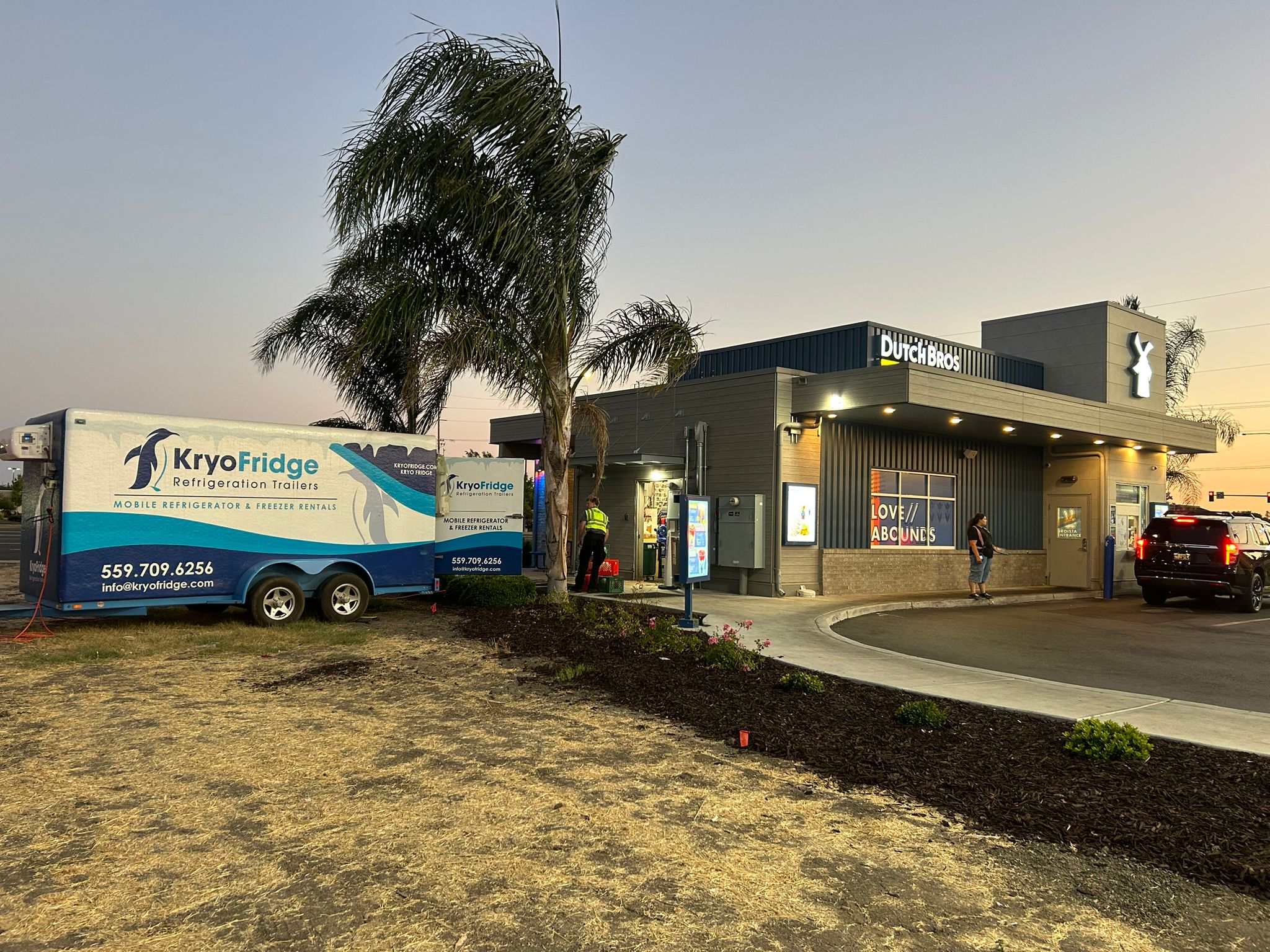 Dutch Bros
Overflow cold storage for dairy and blend stock behind high-volume drive-thru stands.
multi-site account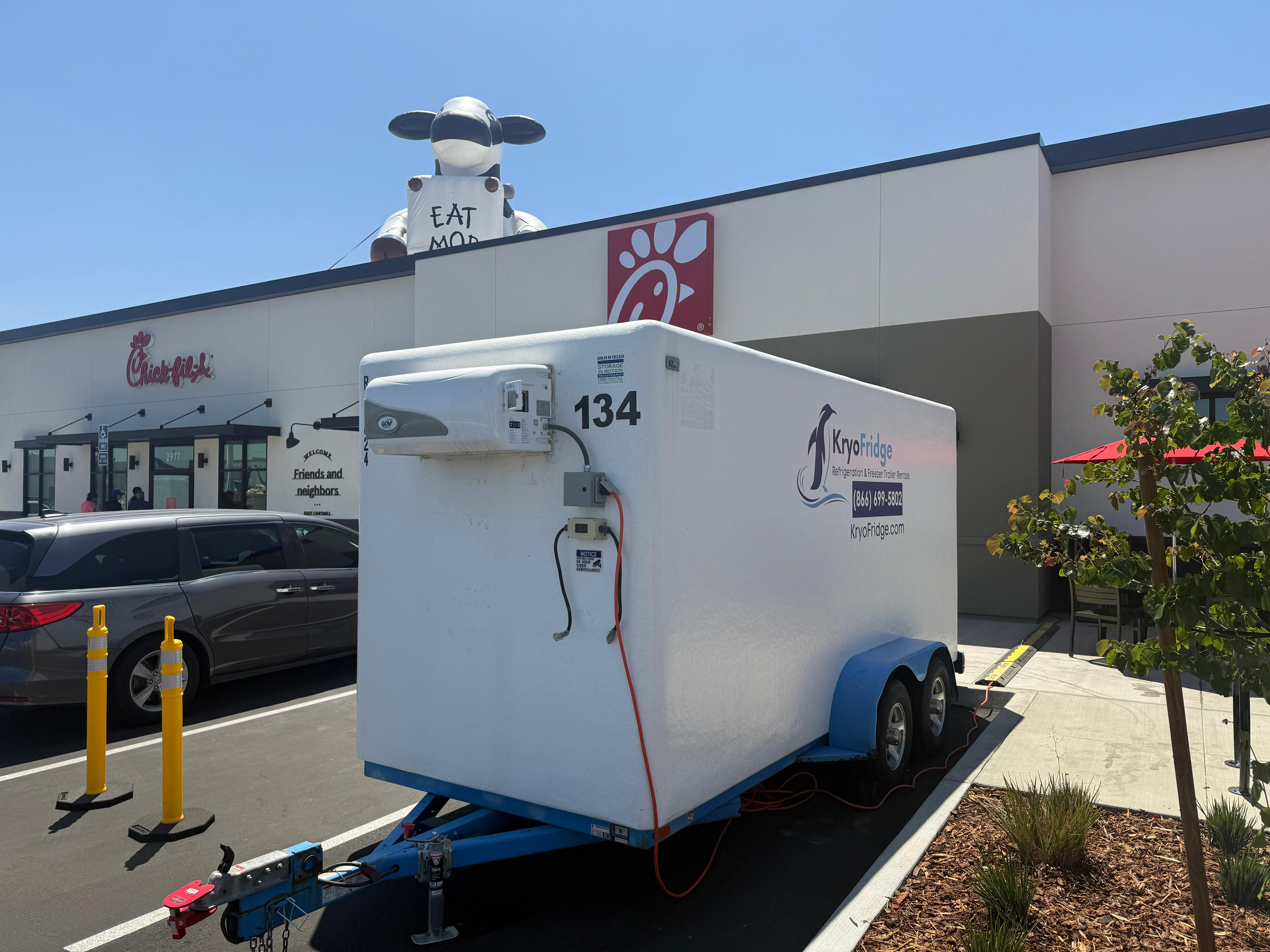 Chick-fil-A
On-site frozen holding during equipment changeouts, with staff pulling stock straight from the trailer between rushes.
zero thaw loss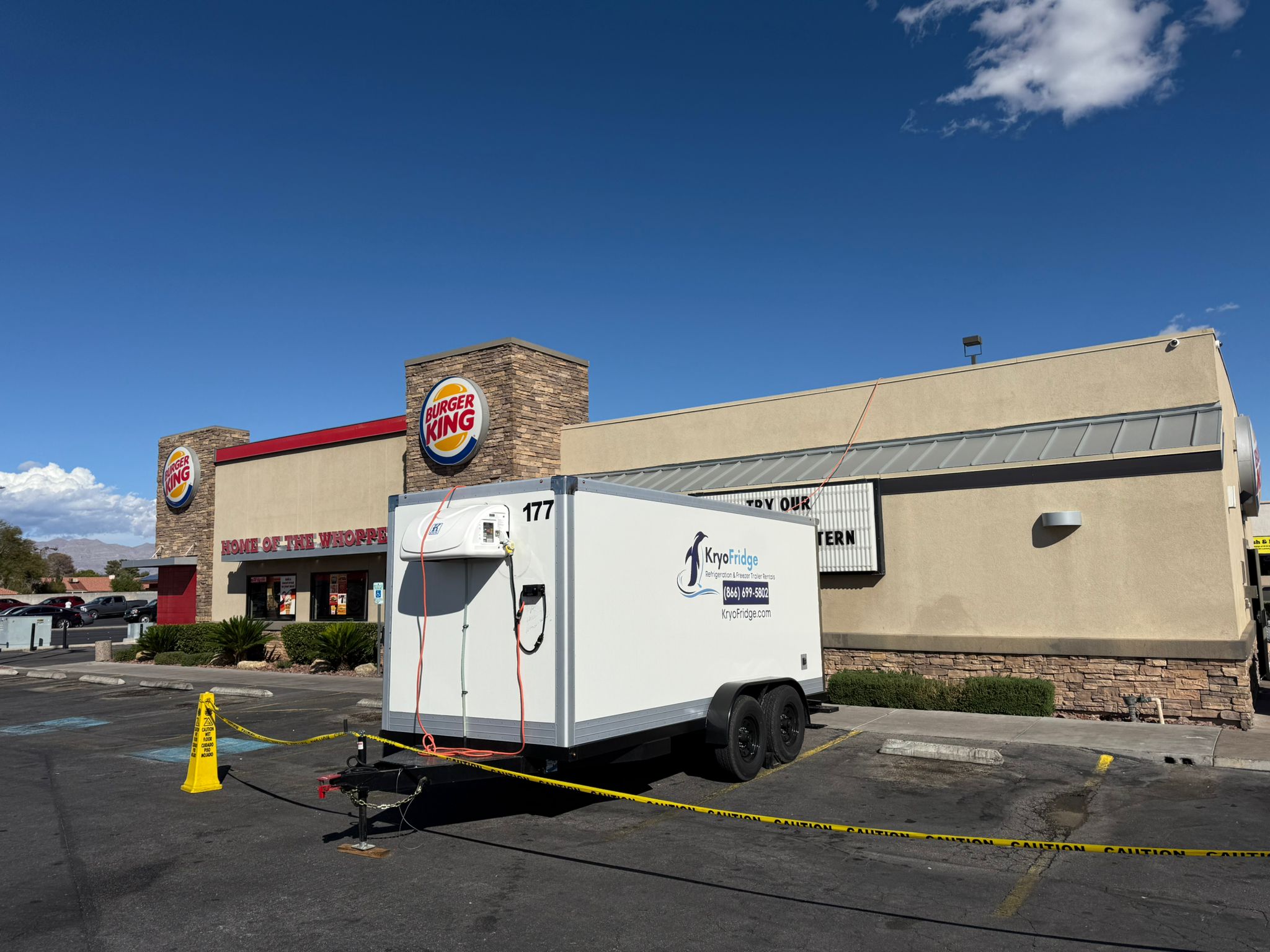 Burger King
Backup freezer capacity during walk-in repairs, holding frozen inventory on site instead of trucking it away.
same-day swap"We had two events on the same Saturday and a kitchen sized for one. Their trailer went in Thursday night and the whole weekend ran off it. The driver knew the block better than my own crew did."
"Squash and melons came in together after the rain and I had nowhere to put half of it. They had a unit on my pad the next morning."
"Valentine's week is the whole year for us. I book a unit every January now and stop worrying about it. They set it at 36 before it ever got here, which nobody else offered to do."
Most of our McKinney work sits between a produce hold at 38 degrees and a hard frozen load at zero, and the same box does both. We set your number before the trailer leaves the yard, then check it again once it is spotted on your lot.
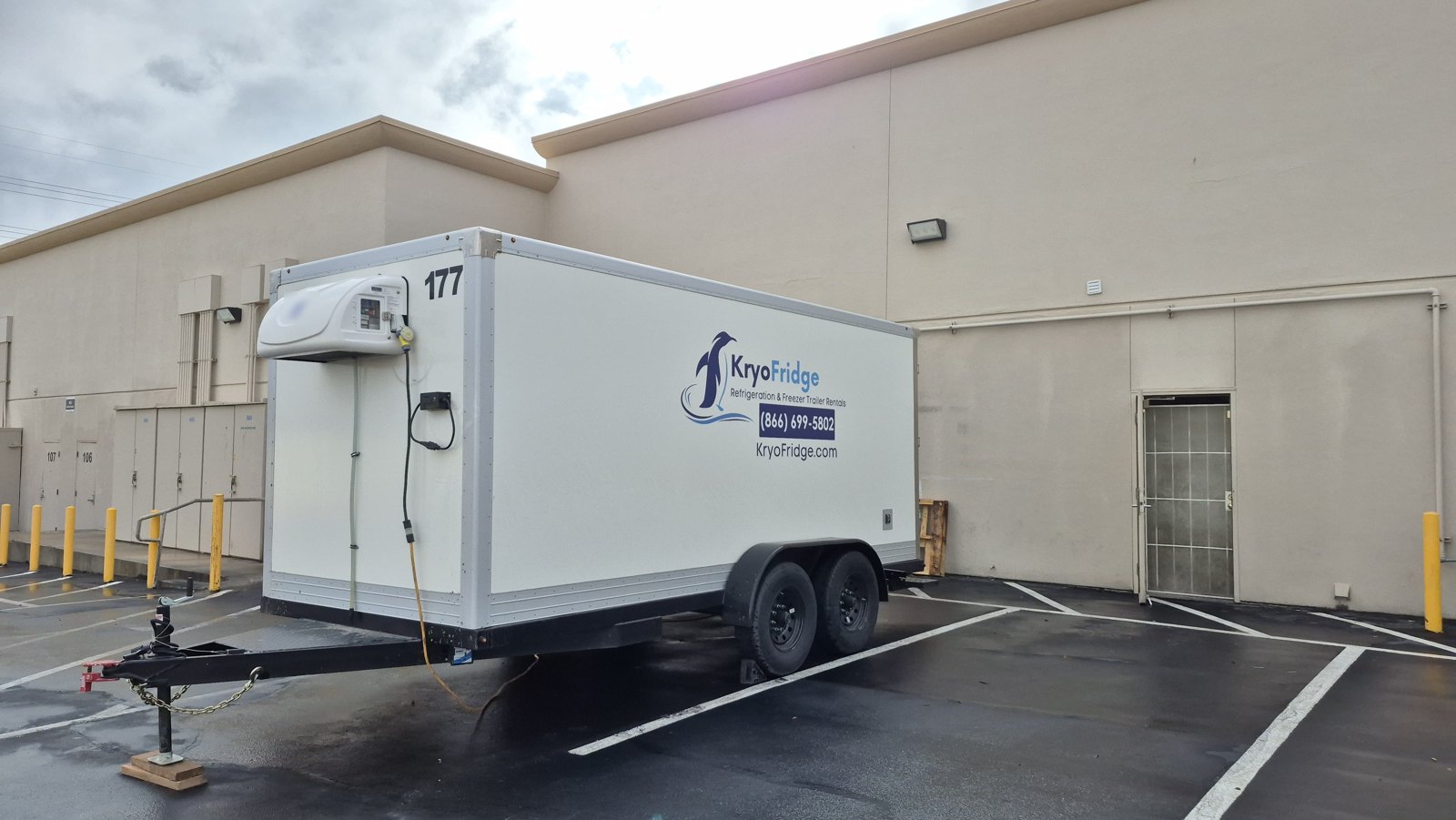
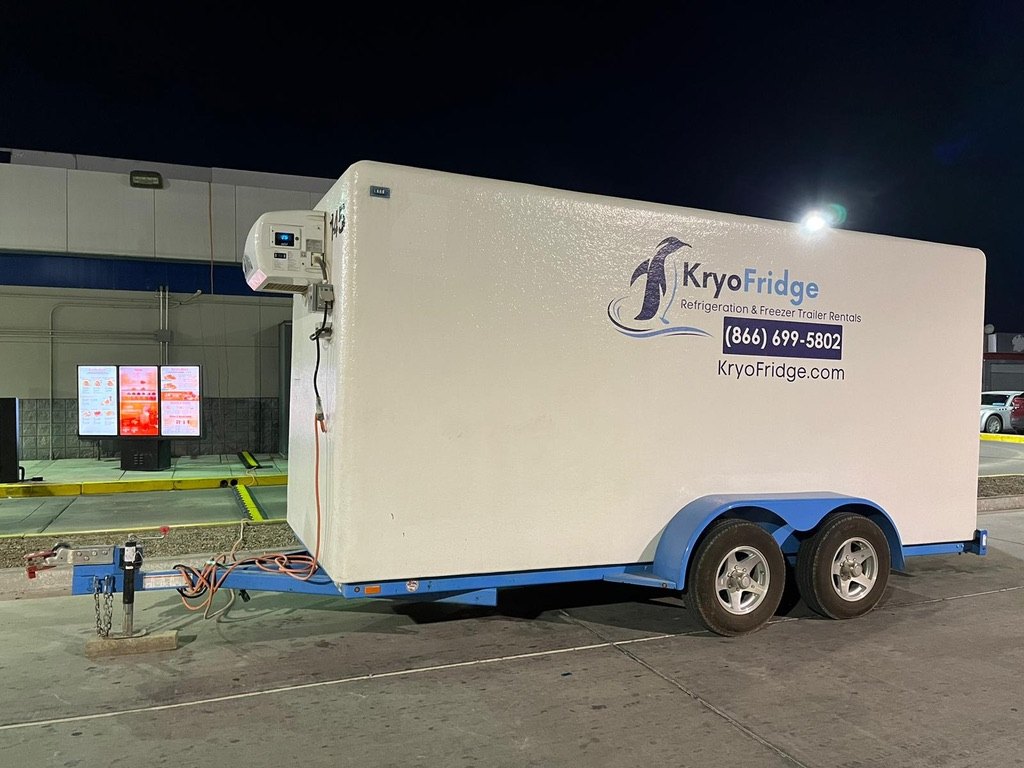
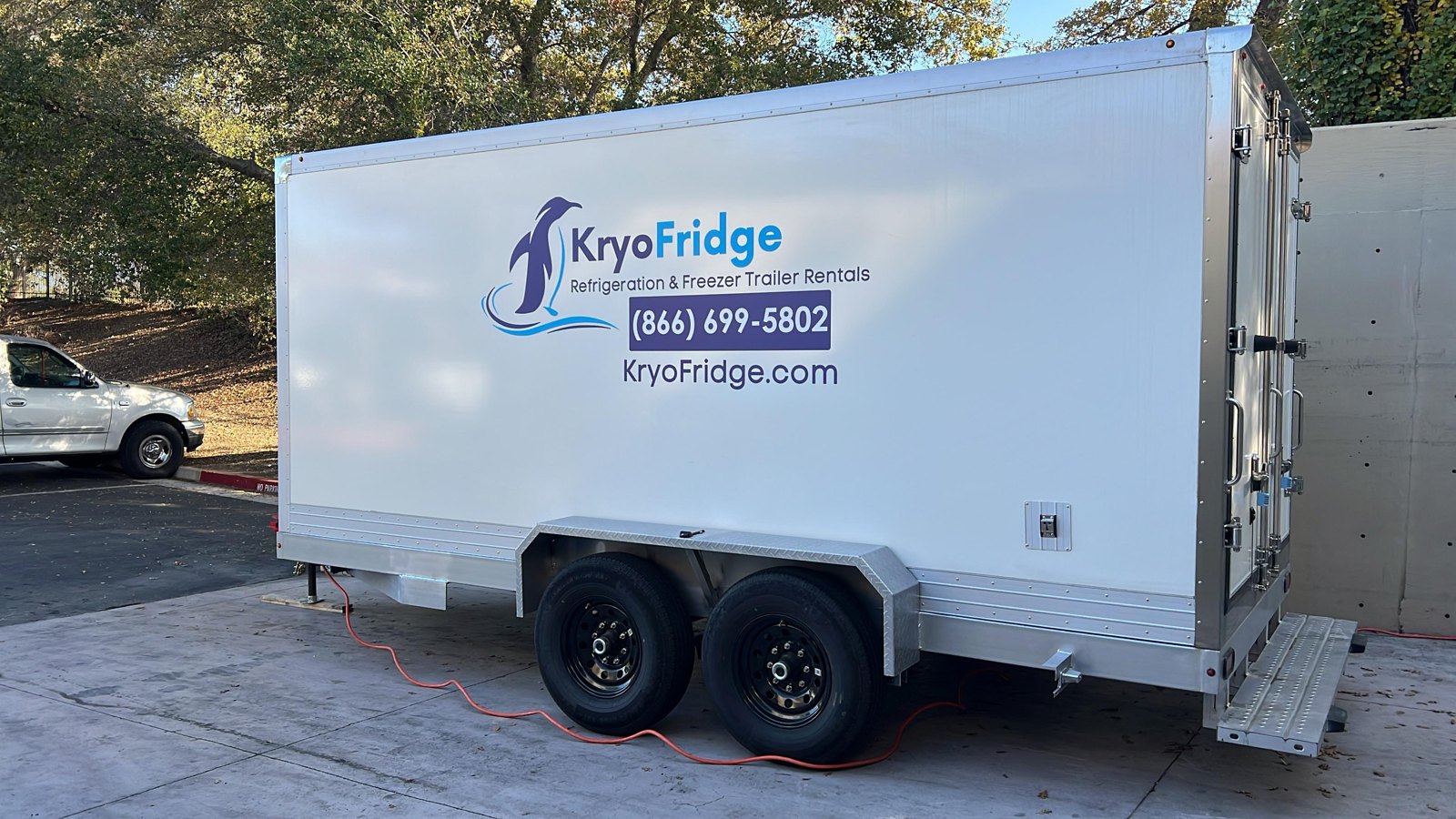
Ask any of our drivers which trailer they would send to a job that cannot fail, and they will point at the 16' Utility. Sixteen feet of insulated box rides on a tandem axle and swings from deep-freeze to fresh-cold on one digital set-point, every interior surface NSF approved. The rear doors swallow pallets off a loading dock while the side utility door gives your staff a quick in and out without dumping the cold air.
Every one of these is ours, not a unit we sourced from somebody else after you called. That means it arrives fueled, already pulled down to temperature, and serviced by our own shop. Plug it into a dedicated 120V, 20-amp circuit or run it on a generator we bring, and it will hold its number through the hottest week of the year.
| Spec | What you get |
|---|---|
| Temperature range | Roughly -10°F deep-freeze up to about 50°F fresh-cold |
| Mode | Dual-purpose: freezer or refrigerator on one precise digital set-point |
| Power | A dedicated 120V, 20-amp circuit within about 100 feet, or a generator we supply |
| Food safety | NSF-approved for direct food contact, food-safe surfaces, proper drainage |
| Footprints | 6x8, 6x12, and 6x16, from a tight retail lot to distribution scale |
| Backing | Owned in-house, fully licensed and insured, with 24/7 emergency dispatch |
Each unit holds a precise digital set-point and runs on a dedicated 120V/20A circuit or a generator. The trailers are not wired for 208 to 240V building service, so we confirm your hookup before the truck rolls.
McKinney is the Collin County seat, up to roughly 236,001 residents in 2025 from 195,308 at the 2020 count. Four highways carry our deliveries: US 75 north and south, US 380 east and west, SH 5 through the older core, and SH 121, the Sam Rayburn Tollway. We stage close to that grid, which is why a downtown drop and an airport drop get the same delivery window instead of one of them waiting a day.
Neighborhoods and towns we cover include Historic Downtown McKinney, Craig Ranch, Stonebridge Ranch, Trinity Falls, Adriatica Village, Towne Lake, Erwin Park, Eldorado Parkway, Virginia Parkway, Custer Road corridor, Hardin Boulevard, Bloomdale Road, Industrial Boulevard, McKinney National Airport, East McKinney, Allen, Frisco, Prosper, Melissa, Anna, Princeton, Fairview, Lucas, Celina.
From the busiest commercial corridors to the quietest side streets, these are the McKinney area communities we serve every week.
The civic and festival core of the city, built around the 1870s courthouse that now houses the McKinney Performing Arts Center. Streets are narrow and the historic district was never laid out for a tractor swing. We confirm the block and the barricade plan before the truck rolls, and we prefer a night-before drop here.
A master-planned community built out since 2004, with TPC Craig Ranch and its Tom Weiskopf course at the center of it. Event staging here means long walks from the nearest outlet and soft turf on either side of the cart path. We plan generator placement on every job in this part of town.
Street, drainage and utility reconstruction is active through here, including the Virginia and Throckmorton work that closed East Virginia between SH 5 and Main and pushed traffic onto East Louisiana. Access changes by phase. We coordinate with the site contractor rather than guessing at a gate.
McKinney National Airport has its own Airport Drive access, and Industrial Boulevard is scheduled for water and sewer reconstruction from late 2026 into late 2027. Firm pads and easy truck swings out here. The only thing to watch is which lane is open the week of your delivery.
Both roads are getting concrete panel and curb rehabilitation between Ridge Road and US 75, running into late 2026. This is the retail spine of the city, which means tight rear lots behind restaurant pads. We back in rather than asking a tenant to give up half their parking.
New subdivisions keep pushing north toward the county line, with the Bloomdale Road realignment and its roundabout at Spur 195 in design through late 2026. Landscape yards and new grocery anchors are the regular calls out here. Ground is often fresh fill, so we bring plates.
One call sizes the trailer, sets the delivery window, and locks your quote for McKinney. Call now, or send the quick quote request and we will call you.
A trailer lands here for plenty of reasons. But three jobs fill most of our Collin County calendar, and each one has its own local shape. Call us or request a quote and we will tell you which setup fits yours.
The commercial terminal is going into service with a new food and beverage space of about 1,660 square feet, timed close to Avelo's November 2026 launch. A new kitchen's first weeks are exactly when a backup cold box earns its keep.
The city's largest private employer runs a single site with roughly 4,200 workers and a cafeteria to match. Any planned equipment swap at that scale needs cold space that does not come out of the building.
Baylor Scott & White Medical Center at McKinney and the Medical Center of McKinney cook every day of the year. A dead compressor there is not a next-week problem, and those calls go to the front of our line.
The district serves 23,306 students across 32 campuses. That is 32 separate places a compressor can quit in any given month. We cover swaps and new-kitchen openings on the district's schedule, not ours.
A 13.7-acre retail hub at Eldorado Parkway and Stonebridge Drive already has Chipotle and Mountain Mike's Pizza signed. A new pad needs cold storage through the stock-up and training weeks before its own equipment is signed off.
The independent restaurants around the square work out of old buildings with small back rooms. When one replaces a walk-in there is nowhere on site to put the product, so it goes in a unit out back for the length of the job.
What ties these together is the clock. Nobody budgets a freezer trailer into next quarter. They reach for one the hour a compressor quits, or the evening before a party when the stack of rented ice chests suddenly looks laughably undersized. Since our units sit staged around McKinney instead of a couple counties down the freeway, "can I get it today" is an ordinary ask here, not a stretch.
Add it up the way an owner in McKinney has to. One restaurant walk-in routinely sits on a small fortune in proteins, dairy, and prepped product. Scale that to a grocery rack or a warehouse freezer bay and the exposure balloons. Now knock the power or the compressor out on a triple-digit afternoon, and that whole inventory is in jeopardy inside a few hours. Then stack on the sales you lose while the line sits dark and the wages you burn paying staff to triage what can still be saved.
Hold a pre-staged trailer up against that risk and it reads like cheap insurance, a fixed, predictable expense parked in front of a loss with no ceiling. That is exactly why the businesses that got stung once tape our number by the phone. There is never a second scramble, because the next time they dial before the product has a chance to warm. Owning every trailer ourselves means we can scale the answer to fit. A single compact box suits a corner cafe. A clustered setup covers a warehouse floor. Either turns around the same day.
The record book here runs from 118 degrees in 1936 down to 7 below zero in 1930. That is a 125 degree spread in one city, and both ends are hard on refrigeration. Long triple-digit stretches are the quiet killer, because a walk-in that was marginal in April gives up in August, right when a kitchen is moving the most perishable product it will handle all year.
February 2021 is still the reference point everybody in this state uses. Winter Storm Uri put more than 12 million Texans under boil-water warnings and triggered more than 1,200 boil-water notices statewide. Power and water went down together across whole neighborhoods. Plenty of businesses here rebuilt their emergency plan around that week, and a rented unit that can take a generator is a big part of what those plans now say.
Summer is the other version of the same failure. The ERCOT grid carries its own peak-demand risk during triple-digit runs, and a single substation or feeder going out during a heat wave does the same thing to a walk-in that an ice storm does. The product inside starts warming the minute the compressor stops. So we hold units back during severe weather weeks instead of booking every trailer out, because a regional event means several businesses on one corridor are dialing at the same time.
Nearly every festival in this city lands on the same few blocks around the Historic Downtown Square, in front of the old Collin County courthouse that now holds the McKinney Performing Arts Center and its 427 seats. Great for a crowd. Tight for a tractor trailer. So we work those drops the night before, while the streets are still open and the vendor vans have not stacked up at the barricades.
McKinney ISD Stadium is the other big one. Three high schools share that 12,000-seat building, and it has hosted NCAA Division II championship games and UIL playoff rounds on top of the district's own fall schedule. A fixed concession kitchen sized for a normal night does not stretch for a playoff crowd. We park a unit on the service side and let the stands pull from it all evening.
Then there is tournament week. TPC Craig Ranch has hosted the Byron Nelson in early May every year since 2021, and a golf course is not a building with a walk-in. Everything a hospitality tent serves across four days has to be held somewhere that did not exist in April. We stage on firm ground near the service road and settle the generator run before anybody drives a tent stake.
Two things go wrong at events and both are avoidable. Power is the first. The nearest usable outlet at a park can be a long walk from where your booth actually sits, and a shared circuit that trips at two in the morning takes the whole weekend with it. Load-in timing is the second. A trailer dropped the morning of an event fights every vendor van and tent crew for the same gate, which is why we push customers toward a night-before drop every time.
Every unit we send out adjusts from about 50 degrees down to negative 10. The same box holding a produce order at 38 this week can run hard frozen for a caterer next month. You set the number on a digital control and the unit holds it. The trailer is self-contained, with the refrigeration and the flooring built into the same unit, so it does not lean on your building for anything. The inside is built for food contact. The floor takes a pallet jack. And every trailer gets washed out and staged before it ever leaves for your site.
We are the same company in every market we work. The crews behind our Tempe cold storage trailer rentals in Arizona and our St. George freezer trailer rentals in Utah run off the same checklist we use here in Collin County. We bought this fleet. Nobody hands your booking to a broker who has never laid eyes on the unit, and nobody trucks a trailer in from two states away after you call, because we keep ours staged near the work.
Power stays simple on purpose. Either a generator we bring and fuel, or a dedicated 120 volt, 20 amp circuit within 100 feet of the trailer. Not 208 to 240 volt service. If your lot only has that, plan on the generator and we will size it before delivery day. We walk the spot with you first. Nobody should be dragging a cord across a parking aisle at six in the morning.
Collin County is blackland prairie, and there is still real farm ground east and north of the city even as subdivisions push toward the county line. Wheat and grain sorghum come off in the heat of summer here. Produce growers work a shorter, sharper window than that, and most of them are hauling to a market rather than to a loading dock, which changes what cold storage has to do for them.
The McKinney Farmers Market runs at Chestnut Square on the edge of downtown, and the sellers there are small operations without a cooler big enough for a bad week. A wet spring that stacks two crops into the same ten days is the call we get. So is a Saturday that hits 99 degrees with a van full of greens and no shade on the lot.
Field heat is the part growers underestimate. Produce picked at two in the afternoon carries the whole day's heat into whatever you put it in, and a cooler already full of yesterday's pick cannot pull that down fast. We tell crews to load the hot product with space around it and keep the return vent clear, then let the unit work overnight before anything gets stacked tight. Small thing. It is the difference between a steady box and one fighting itself for three days.
We do the same work behind our Tulare refrigerated trailer rentals out in California's San Joaquin Valley, where a packing shed can lose a day to one failed fan. Different crops, same clock. And the rule does not change: pull the field heat out fast, keep the door shut, and do not ask one box to hold frozen and fresh at the same time.
Cut flowers want it colder than most people think and a long way warmer than a freezer. Roses and most standard stems hold around 34 to 38 degrees. Tropicals sulk down there and want the high 40s. Our dial covers both ends, but one trailer holds one number, so we ask what is going inside before we set it.
Two weekends decide a florist's year and both are cold storage problems. Valentine's week drops a year's worth of roses into a shop built for a normal Tuesday. Mother's Day does the same thing with mixed bouquets and potted stock. Shops along Virginia Parkway and around the square book a unit for those weeks now instead of stuffing a walk-in and hoping the back corner holds.
Nursery work is the other half of it. Bare root stock and bulbs need a cold hold before they go in the ground, and landscape crews planting the new subdivisions off Bloomdale Road and up at Trinity Falls are working to a schedule somebody else set. A pallet of stock sitting behind a job trailer in the sun for two days is a write-off. We drop a unit at the yard instead and the crew pulls from it as the phases open.
Weddings pull both worlds together. A downtown venue booking means the flowers and the catering both want cold space at once, and that venue kitchen was sized for one of them. We spot a unit behind the building on Thursday and pull it Monday morning. The part florists tell us they like is that nobody has to rent a box truck and leave it idling all weekend just to keep stems cold.
"Cold" is not one number. Different product stays safe inside different temperature windows, which is the entire reason a precise digital set-point matters, and in the middle of a heat wave in McKinney, a load that slips out of its window is a load you write off. Use the chart below as the reference our customers lean on when they size a rental.
| Product | Target holding band | Trailer mode |
|---|---|---|
| Ice cream and frozen desserts | -10°F to 0°F | Deep freeze |
| Frozen proteins, seafood, prepared meals | 0°F or below | Freezer |
| Fresh meat and poultry (short hold) | 28°F to 32°F | Refrigerated |
| Dairy, deli, packaged produce | 34°F to 38°F | Refrigerated |
| Beverages, florals, catering trays | 38°F to 45°F | Refrigerated |
One figure matters more than everything in that chart, and it is not listed there: 40°F. Food-safety guidance treats the band between 40°F and 140°F as the zone where bacteria thrive, and the clock on perishable product starts ticking the moment it crosses 40 on the way up. Roughly four cumulative hours above that line and most refrigerated inventory is no longer safe to serve. Picture that countdown running on a 100-degree afternoon in McKinney with the walk-in dark, and the urgency of a quick trailer drop stops being abstract.
Tell us the single coldest item you are holding when you call, and we dial the trailer to that. One unit carries a straight freezer load with no fuss. But when your list mixes deep-freeze desserts with fresh-cold produce for the same remodel or event, we will usually point you toward a split setup or a second box so neither side of the load has to settle for the wrong temperature.
Powering one of our trailers is refreshingly simple, and there are precisely two ways to do it. Either you have a dedicated 120-volt, 20-amp circuit reachable within roughly 100 feet of the parking spot, or we bring a generator. What the units will not accept is standard 208 to 240V building service, so a quick question about your outlet before dispatch heads off any surprise on delivery day.
On placement, all the unit really asks for is a fairly flat patch with enough room for the delivery truck to maneuver it in and set it straight, plus either a power source in reach or space for a generator. We lock down the exact drop point before dispatch, and our drivers know the McKinney layout cold, so the delivery is one clean trip instead of a guessing game on the property.
A vendor booked three booths for a fall weekend and found out on the Monday before that a van cooler was the entire plan. We dropped a unit Thursday night on the closed block behind the square and ran it off our generator. His crew loaded at seven the next morning without blocking a single vendor van.
A wet spring pushed squash and melons into the same ten days. The barn cooler held about a third of it. We set a trailer on the gravel pad by the scale, and the grower worked through three market weekends instead of dumping product at a discount on whoever showed up first.
Two weddings and a funeral in one weekend, with a cooler built for about half that. We spotted a small unit behind the shop on Wednesday holding 38 degrees and picked it up Monday. Nothing wilted.
Bought ahead of the growth curve. Collin County went from 1,064,465 residents at the 2020 count to about 1,297,179 in 2025, and McKinney itself is up near 236,001. We added North Texas stock ahead of that instead of chasing it, so a same-day drop here does not depend on a trailer coming back from Dallas first.
On a bad day, booking should be the part that does not add stress. Four steps, an upfront number, and a single person who owns the whole thing.
Tell us whether it is freezer or fridge product, a ballpark volume, and your rough window. That is enough for us to call the right size.
We pair you with a unit, confirm whether you have a dedicated circuit or need a generator, and pin the exact drop point so the truck makes one trip.
We arrive on your schedule, about 45 minutes for a true emergency, set the trailer, energize it, and let it drive down to your number.
It holds the set-point for your entire term while our line stays live the whole way through. Wrap up, and we swing back for the pickup.
Collin County works under the Texas Food Establishment Rules, 25 TAC Chapter 228. Cold food that needs time and temperature control has to be held at or below 41 degrees. Product sitting above that line for more than four hours is a critical violation, and even under four hours an inspector can ask you to destroy it. The rules also call for a metal-stem dial thermometer accurate to within two degrees in every unit that holds food. We set our trailers to make 41 with room to spare, because a box that only just makes the line on a mild morning will not make it at three in the afternoon in July.
Temporary events carry their own permit layer. Collin County Development Services issues a short-term event food permit good for no more than 14 days at one location, and the application and payment have to be in at least five business days before your first day of operation, through the county's Citizen Self-Service Portal. That is the permit that covers a booth on the downtown square during Oktoberfest, and it covers tournament-week food service too whenever that operation is set up as a temporary event rather than a fixed concession contract. First-time vendors are the ones who get caught by the five-day clock, so start it early.
Power and fire are the third layer. A temporary commercial generator setup in Texas generally needs an electrical permit, which is one more reason we ask about your circuit before anything else. Give us a dedicated 120 volt, 20 amp outlet and that question usually goes away. Anything sitting on a street, in a park or on a public lot also has to clear the venue or event coordinator's placement process first. We hold the same setup discipline behind our Santa Clarita portable cold storage rentals in California, where the agencies are different and the physics are not.
One caveat we always state plainly: we supply the food-safe, temperature-holding hardware itself, but we are not a temperature-logging or alarm-monitoring service. If your program requires continuous written records, line that vendor up on your own.
Our signature 16 foot Utility series leads the fleet. It is the trailer we send on most jobs, and crews like it for the side utility access door. We build three footprints in all, so a single kitchen holding overflow stock has a fit and so does a distribution floor in a disaster. Every unit is dual purpose by design: one adjustable system swings between freezer and refrigerator on a digital set point. Each trailer runs on a dedicated circuit or on a generator.
| Trailer | Best for | Temp range |
|---|---|---|
| 6x16 Utility ⭐ | Our signature series: distribution, large events, disaster response, side utility door | Heavy-duty reefer |
| 6x12 | Grocers, caterers, mid-size events | Deep-freeze capable |
| 6x8 | Tight lots, small kitchens, short overflow | -10°F to 50°F |
Each unit holds a precise digital set-point and runs on a dedicated 120V/20A circuit or a generator.
Think eight or so pallet spots, and the unit to grab when square footage is the whole problem. It slips into the pinched service yards and cramped back-of-house corners that a larger box cannot even swing into. One cafe or small-market walk-in goes down, and this is almost always enough cold to cover it, plus the simplest unit to set in a small space.
Call it fourteen pallet spots, deep-freeze rated, and far and away the size people ask for most. It lands right in the middle: roomy enough for a multi-day catering job or a restaurant that needs true walk-in-equivalent room while the kitchen is torn up. Roomy enough that nobody is playing Tetris with shelves, yet still small enough to set in most commercial back lots without a site survey.
Roughly twenty pallet spots paired with a heavy-duty reefer plant engineered to keep deep-freeze locked in even when the ambient air is merciless. Reach for it when a warehouse bay drops, when a large festival needs an anchor, or when a relief operation is carrying its own cold chain.
Not sure which size fits? Most customers land on the 16 foot Utility, and we will tell you honestly if a smaller footprint covers your job. Tell us roughly what you are storing and for how long, and we will spec it for you.
The questions that surface once the basics are settled. Tap any topic to open it.
The pop-up walk-in cooler. Cheap to rent and easy to set up, but it chills, it does not freeze, and it draws every watt it needs from your building while depending on a calm ambient temperature around it. The second your building loses power, your cooler loses it too.
The refrigerated box truck. Designed to haul product on the interstate, not to sit in a lot and babysit it. Parked, it burns fuel all day, broadcasts compressor noise across a storefront or an event lawn, and pins down a tractor plus a driver you probably do not need.
The freezer trailer we deliver. Built from the ground up to be dropped on a pad and to defend a temperature for as long as the job runs. It freezes deep, carries NSF approval, locks, stays quiet near guests, and lives on nothing more than one dedicated circuit or a generator.
Even a rented box has to satisfy the county environmental health office that licenses and inspects every food facility. Show an inspector a unit that cannot document its temperature or was not built for food contact, and they have the authority to halt service immediately.
That is a bar each of our trailers clears: NSF-approved throughout, food-safe interior surfaces, proper drainage, and a digital controller that puts the set-point in plain view. We supply the food-safe, temperature-holding hardware itself, but we are not a temperature-logging or alarm-monitoring service.
For a typical kitchen or market, one box does the job. Distribution floors, big fairs, and full-scale disaster response routinely need more, and because the fleet is ours, we can cluster several units and bring them online in waves as the work expands. Match the cold capacity to the operation rather than make the operation squeeze itself into one box.
The clock is yours to set. Some jobs are a handful of days for an emergency or a single event. Others stretch across weeks or months for a remodel or a seasonal swell, and a few become standing contracts for businesses that want capacity parked on standby. Name your window and you will get a clean quote, no penalty for an honest "not sure yet."
Building permanent cold storage is a capital project in every sense: you hire a refrigeration contractor, schedule the electrical, pull a building permit, and wait weeks before a single pallet goes inside. A rental turns that equation on its head. You bring in precisely the cold you need, for precisely the stretch you need it, and the trailer is holding temperature that same week, frequently that same day, with the commitment ending the moment your need is over.
Three engineered elements carry the load. Thick insulated panels and tightly gasketed doors lock the sun outside and the cold inside. A self-contained reefer condensing system specified with surplus capacity keeps stripping heat out of the box even when the air outside is brutal. And a digital thermostat locks onto your chosen number and cycles the compressor to hold the line. Run those three together and a trailer baking on open asphalt behaves like one tucked in a cool warehouse. That is also why power is the first thing we ask about: the design delivers its safety margin only on steady, uninterrupted power.
"Our freezer went out over a long weekend. They had certificates and the SAM registration back to purchasing in one email, so we had a unit on site Monday instead of Thursday. That never happens with vendors."
"Remodel week. The trailer out back was the only reason we did not close."
"We hold bare root stock for two builders and the schedule moves every week. Having a cold box at the yard turned that from a daily headache into something I stopped thinking about. Service visits showed up when they said they would."
"Our vendors used to show up with coolers and a prayer on a 99 degree morning. We share one of their units on the lot now and I have not had a single vendor lose product since."
"Playoff nights are double a regular Friday and the stand does not get any bigger. Their unit absorbed all of it."
"The power went out on our block during a storm and we had product that could not sit. They came with the generator already on the trailer instead of making a second trip for it. That one decision saved the whole hold."
"We ran one of their units by the job trailer all summer for crew food. It took the heat without complaining, and the driver could actually spot a trailer on a tight pad without three tries."
"They walked the site with me two weeks before load-in and sorted out the power question early. On event day the unit was already in place when my vendors rolled up, which is the opposite of how these usually go."
"Thanksgiving week fills our back room by Tuesday. A second cold box out back is just part of the plan now. Clean unit, easy pickup, no drama either time."
On private property with the owner's permission, a temporary cold unit generally sits without a special permit. That is a big part of why this works for a fast swap. What draws permitting is usually the generator, since a temporary commercial generator setup normally needs an electrical permit. Give us a dedicated outlet and that step usually disappears. For anything sitting on a street, in a park or on a public lot, the venue or event coordinator has a placement process you clear first.
Yes, and that is most of why people rent one here. Our trailers are self-contained, so the refrigeration does not depend on your building staying up. In a heat run the thing that matters is headroom, which is why we set below your target instead of right at it. In a freeze the thing that matters is power, and a generator comes with the booking rather than on a second trip. Tell us which season you are planning for and we will set it up for that.
Both, and in that order. Count what is in your cooler on your busiest day and convert it to pallet positions, because most people guess high on volume and low on floor space. Then look at traffic. A box loaded once and left shut can be packed to the walls, while one somebody pulls from every twenty minutes needs an aisle and clear floor near the door. Leave about a quarter of the floor open if the door swings all day.
Past about a month we move you to a month-to-month agreement, which is what remodels, permit delays and equipment backorders usually need. There is no hard cutoff between short and long. We have left units on Collin County sites for the better part of a year. Tell us the realistic timeline at booking, not the optimistic one, and we will write it so an extension is not a new negotiation in week five.
Every unit gets washed out and staged before it leaves our yard, so the answer is always the same: right before it came to you. Interior surfaces are built for food contact rather than raw wood or bare metal. You should still do your own wipe-down before you load, the same as any equipment coming onto your site, and your own sanitation schedule still applies while you have it. If something is not right when it lands, tell the driver before he pulls out and we handle it there.
About 50 degrees down to negative 10 on one dial. Recovery depends more on how you loaded it than on the machine. A box packed wall to wall has nowhere for air to move, so the far corner lags. Keep the return vent clear, leave a gap under the pallets, and put the fast-moving product near the door. Done that way a unit pulls back down in minutes rather than most of an hour.
Yes on both, but tell us at booking so the right ramp comes on the truck. The floor is built to take a pallet jack. What it needs underneath is a firm, reasonably level surface, which is easy on the asphalt behind a store on Eldorado Parkway and harder on grass at a park. We do not supply racking or shelving, so if you need product off the floor, plan pallets or your own shelving before delivery day.
Treat it like they will, because they do. An inspector wants the cold holding line met and a working thermometer they can read, and they want the trailer handled as part of your food operation rather than as storage in a parking lot. Keep raw below ready-to-eat, keep everything off the floor, and keep your own temperature log the way you would for any cooler in the building. We do not provide a monitoring or logging service, so that log belongs to your staff.
That is normal downtown and it is why we schedule around it. Most festival blocks around the square close the evening before, so a night-before drop goes in clean while a morning drop fights every vendor van at the barricade. Send us your booth location and the organizer's load-in window when you book. If the block is already shut, we work with the event coordinator for an access time rather than showing up and hoping.
Both, every week. Those towns border us, so neither one means crossing a third city to reach from our staging point. Timing is the only thing we ask about on the longer drops, since a mid-afternoon run down US 75 takes noticeably longer than the same trip at ten in the morning. We build the window around real traffic instead of a map estimate.
A flat, firm spot with room for a tractor to swing in and back out, plus about four feet of clearance behind the rear door so it opens all the way. Know whether your outlet is truly dedicated or whether you want our generator. Have somebody on site who can sign and take the key. And send a photo of the spot when you book, because a photo settles the clearance question faster than any phone call.
We run more than one kind of trailer out of North Texas, so have a look at the rest of the fleet if this one is not the right fit for your job.
Two numbers decide the size you need, and trailer length is not either one. How much do you have to hold at once, and how often will somebody open the door. Get those right and the rest of the decision makes itself.
Start with pallet positions instead of cases. Walk your cooler on the busiest day you had last month and count what is actually in there. Most kitchens guess high on volume and low on space. A back room that feels packed often holds four or five pallets, while a grocery working a holiday week can push past a dozen. If you are covering a failed walk-in one for one, measure the inside of the old box and work from that number rather than from memory.
Further reading: the Texas food establishment rules.
The event year here has a shape, and cold storage books up in the same order every time. Most of it sits on the city's own calendar a year out, which means almost nobody has a genuine excuse to call the week of.
January is quiet, with the bridal show on the second weekend. Caterers running tastings are the only real cold storage draw, and a unit is easy to get. February brings Krewe of Barkus on the Sunday before Mardi Gras, plus the biggest floral week of the year for every shop in town.
Further reading: the city's events and festivals calendar.
We do not publish rates, because a rental that fits your job is built out of a handful of variables and any number on a web page would be a guess. But you should know what moves the figure, so you can control the parts that are yours to control.
Duration is the biggest lever and it does not move in a straight line. A three-day emergency and a three-month construction booking are built on different logic. If there is any chance your timeline slips, say so when you book. Extending an existing agreement beats tacking a fresh short-term rental onto the end of one, every time.
Your walk-in just quit. You have two calls to make and only one of them fixes today. The order matters more than people think.
Call the refrigeration tech first, always. But ask one specific question while you have him: is the part on your truck. In this region a common compressor or a control board might be same day, while anything specialty can sit on backorder for weeks. That single answer tells you whether you have a repair problem or a storage problem.
Most people think of a cold trailer as an emergency item. A good share of our Collin County work is the opposite: units that sit on one site for months while something else gets built or replaced.
Past about a month, the agreement changes shape. Short rentals are written around a date. Month-to-month is written around a condition, which is usually the day your own equipment comes back online. That difference matters because construction schedules move and nobody wants to renegotiate in week five.
Call now or send a quote request and we will confirm size, temperature and power before a truck leaves the yard. Tell us what you are holding and it shows up already sitting at your number.