
KryoFridge is the freezer trailer team Costa Mesa kitchens, caterers and event crews call first. We bring the unit to your lot, set it level, pull it down to temperature and hand it over ready to load the same day, whether you are working a service dock in South Coast Metro, a rear yard off 17th Street or a vendor row at the OC Fair and Event Center. Call our dispatch line or line up a reefer trailer rental quote and we will lock in a delivery window for your site.
We have spent more than 30 years in the event and equipment rental business, and KryoFridge is the refrigeration side of that family. We own the fleet and we answer our own phones, so you are talking to the company that owns the trailer instead of a broker who still has to go find one. We run one of the largest refrigerated and freezer trailer fleets in the West, we are licensed, insured and NSF ready, and our dispatch line is staffed around the clock for emergency swaps. Some of the biggest names in food trust us with their product, including McDonald's, Chick-fil-A and Dutch Bros Coffee. Costa Mesa sits well inside our California mobile cold storage rentals coverage, so there is usually a unit close by when you call.
Our trailers sit staged around Costa Mesa, fueled, pre-cooled, and maintained in-house, parked and waiting for the call rather than being sourced after it. That is why an emergency call usually puts a unit on your lot and pulling temperature in about 45 minutes.
The voice on the phone belongs to the same outfit that owns the trailer and sends the driver. No reseller in the middle quietly marking up somebody else's equipment while your inventory creeps past 40°F on the shelf.
Every unit is ours to own, service, and deliver, and each one swings between deep-freeze and fresh-cold on a precise digital set-point. So we can size the answer to your Costa Mesa job and turn it around the same day rather than putting you on next week's list.
National chains do not gamble on refrigeration. A drifting set-point during dinner rush can cost a brand a day of sales and a health-code headache, so the chains that scale fast vet a cold-storage partner the same careful way they vet a protein supplier. KryoFridge has held temperature for names like McDonald's, Chick-fil-A, and Dutch Bros, and earned the repeat call.
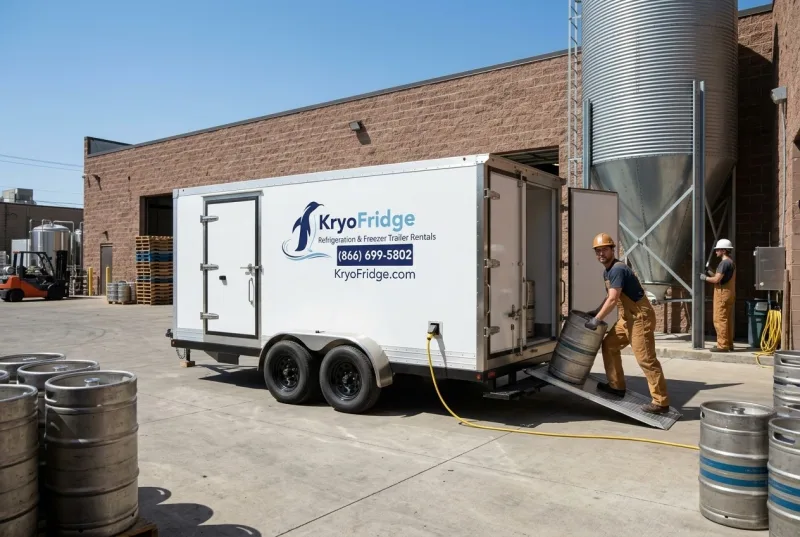
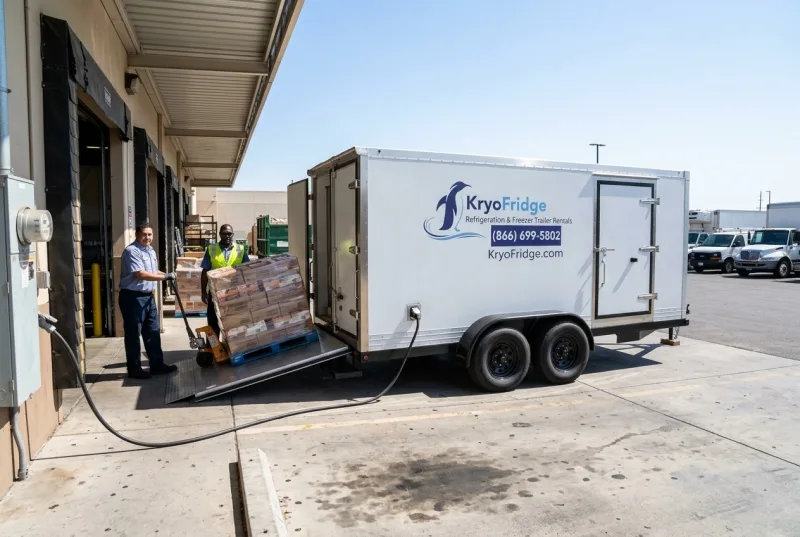
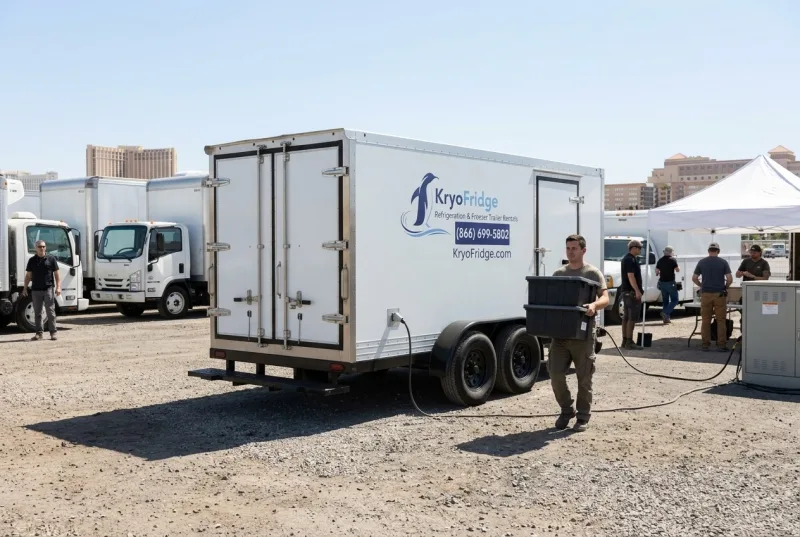
The stories behind that trust are the kind every restaurant owner recognizes. One Friday at 6:30 in the evening, a Chick-fil-A called in with a dead walk-in and a drive-through line already wrapped around the building. We prepped a trailer, dispatched it, and had it on their pad pulling temperature 34 minutes after the phone rang. The manager's first words when the driver pulled in were, "I cannot believe you are already here." That is the bar we hold ourselves to. Another year, an overnight outage shorted a cooler on the morning of a holiday rush, and our team staged three freezer trailers to hold every pie, every protein, and every prep tray so the kitchen served the rush without missing a ticket. The reason we hear some version of that line so often is the same every time: the equipment was already nearby, already cold, and owned by the people who answered the phone. That same standard travels to every Costa Mesa job, from a one-cook taqueria to a distribution floor.
"We had a wedding and a corporate dinner on the same weekend and our banquet cooler was never going to hold both. KryoFridge dropped two trailers at the dock on Thursday, one refrigerated and one frozen, and picked them up Monday."
 Harper D. · catering director, South Coast Metro
"Our walk in died on a Friday night and I was already doing math on what we were going to lose. They answered on the first call and had a refrigerated trailer in our alley that same evening. We moved everything across in one pass and opened Saturday like nothing happened."
 Vanessa L. · restaurant owner, Eastside Costa Mesa
"Our vendors were fighting chest freezers in August heat and losing temperature every time a lid came up. The trailer ran off its own generator, so it did not touch our power distribution at all."
 Maricela C. · event coordinator, OC Fair and Event Center vendor row
Our signature unit for Costa Mesa is the enclosed utility trailer with a side man door and a roof mounted condenser, which fits a tight restaurant back lot off 17th Street as easily as a warehouse apron on the Westside. We run more than one size, so look over the refrigerated trailer sizes and specs, tell us your pallet count and your gate width, and we will match the unit to the space you actually have.
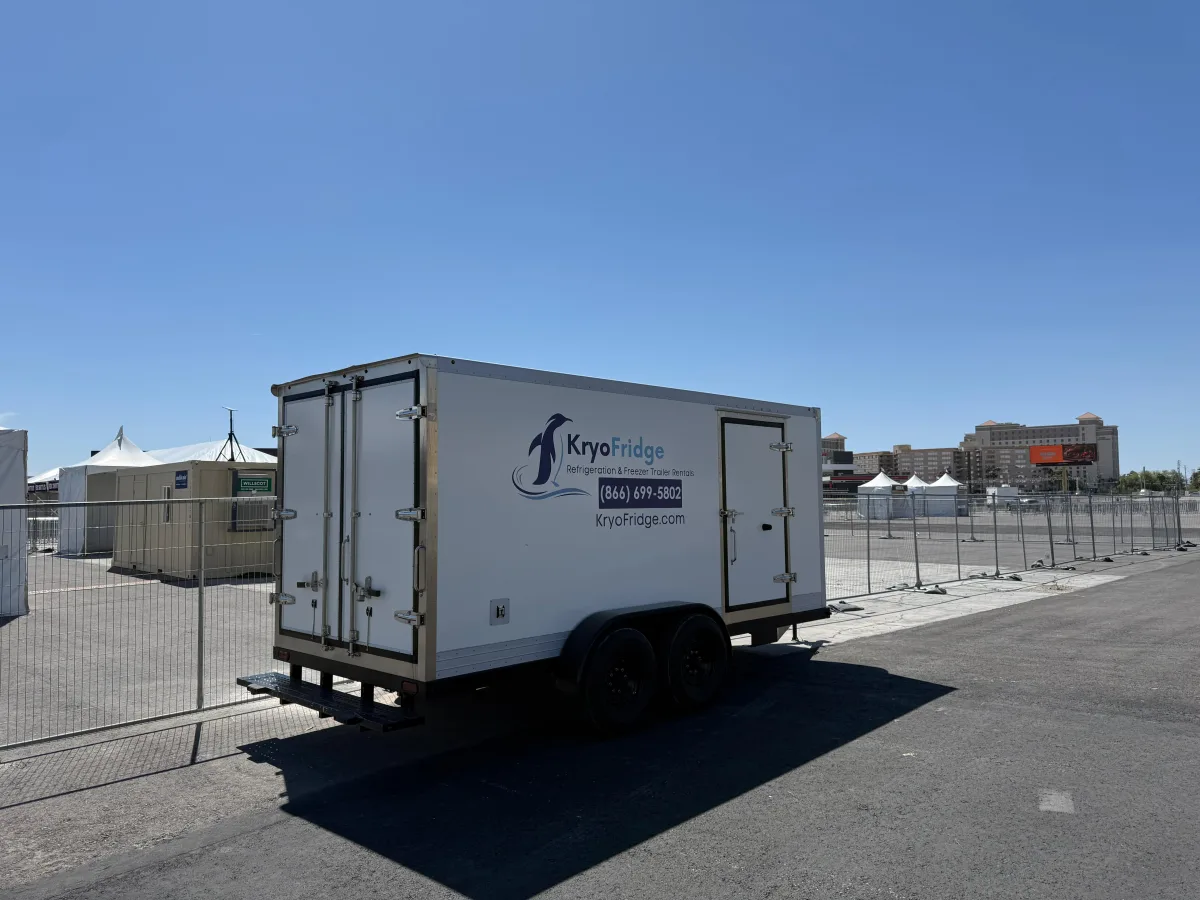
Ask any of our drivers which trailer they would send to a job that cannot fail, and they will point at the 16' Utility. Sixteen feet of insulated box rides on a tandem axle and swings from deep-freeze to fresh-cold on one digital set-point, every interior surface NSF approved. The rear doors swallow pallets off a loading dock while the side utility door gives your staff a quick in and out without dumping the cold air.
Every one of these is ours, not a unit we sourced from somebody else after you called. That means it arrives fueled, already pulled down to temperature, and serviced by our own shop. Plug it into a dedicated 120V, 20-amp circuit or run it on a generator we bring, and it will hold its number through the hottest week of the year.
| Spec | What you get |
|---|---|
| Temperature range | Roughly -10°F deep-freeze up to about 50°F fresh-cold |
| Mode | Dual-purpose: freezer or refrigerator on one precise digital set-point |
| Power | A dedicated 120V, 20-amp circuit within about 100 feet, or a generator we supply |
| Food safety | NSF-approved for direct food contact, food-safe surfaces, proper drainage |
| Footprints | 6x8, 6x12, and 6x16, from a tight retail lot to distribution scale |
| Backing | Owned in-house, fully licensed and insured, with 24/7 emergency dispatch |
Each unit holds a precise digital set-point and runs on a dedicated 120V/20A circuit or a generator. The trailers are not wired for 208 to 240V building service, so we confirm your hookup before the truck rolls.
We deliver across Costa Mesa and out through coastal Orange County every week, and we serve all 50 states through the wider network. Tell us the address, the gate you want us to use and the dates, and we will confirm the delivery window on the call. Close by, the routes include refrigerated trailer rentals in Orange, Norwalk ice box and freezer trailer rentals and Downey freezer trailers for rent.
Neighborhoods and towns we cover include Eastside Costa Mesa, 17th Street, Mesa Verde, Westside Costa Mesa, South Coast Metro, SoBECA District, College Park, Mesa del Mar, Halecrest, Freedom Homes, Fairview Park, Newport Beach, Newport Heights, Corona del Mar, Balboa Peninsula, Huntington Beach, Fountain Valley, Irvine, Tustin, Santa Ana, Garden Grove, Westminster, Seal Beach, Laguna Beach.
From the busiest commercial corridors to the quietest side streets, these are the Costa Mesa area communities we serve every week.
One call sizes the trailer, sets the delivery window, and locks your quote for Costa Mesa. Call now, or send the quick quote request and we will call you.
Three kinds of jobs fill most of our Costa Mesa calendar. Caterers and banquet teams staging service in South Coast Metro. Restaurant crews who lost a walk in and need the day back. Event vendors working the fairgrounds and the parks. Each one needs the trailer in a different spot, at a different set point, for a different length of time, and we plan all three the same way, on the phone, before the truck rolls.
The Westside warehouse belt along Randolph, Placentia and Monrovia has been the craft production corner of Costa Mesa for years. Cold crashing, conditioning and packaged inventory all compete for the same cold room. A trailer adds pallet positions for a seasonal release without anyone signing a warehouse lease.
Holiday build takes in more frozen and chilled product than most back rooms hold, and a case replacement project puts a whole aisle out of service for days. We park a unit at the receiving door so the store keeps taking deliveries on schedule instead of turning trucks away.
Production catering is cold storage by definition, because the crew is eating somewhere with no kitchen. Costa Mesa's warehouse stock and retail districts pull shoots year round, and food and beverage product shots need holding space too.
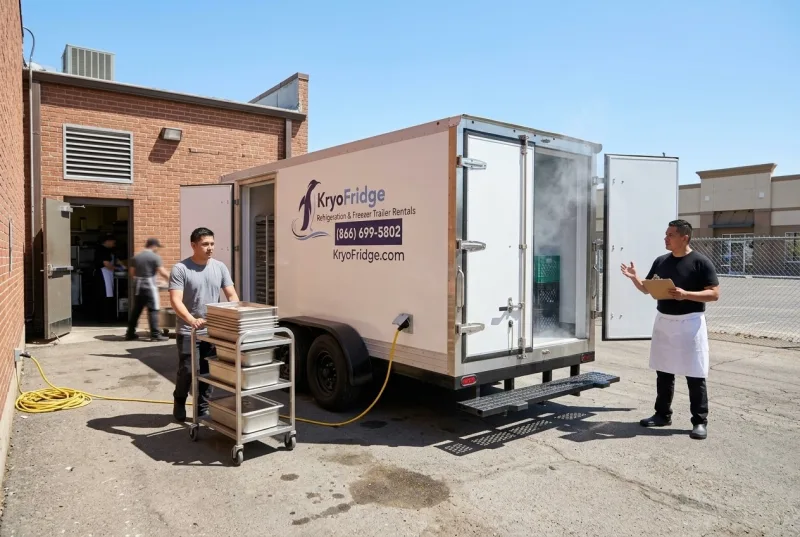
A banquet kitchen sized for normal covers has no slack for a convention overflow or a refrigeration repair during a booked weekend. Engineering teams generally like a self powered trailer at the service dock better than anything drawing on the kitchen panel.
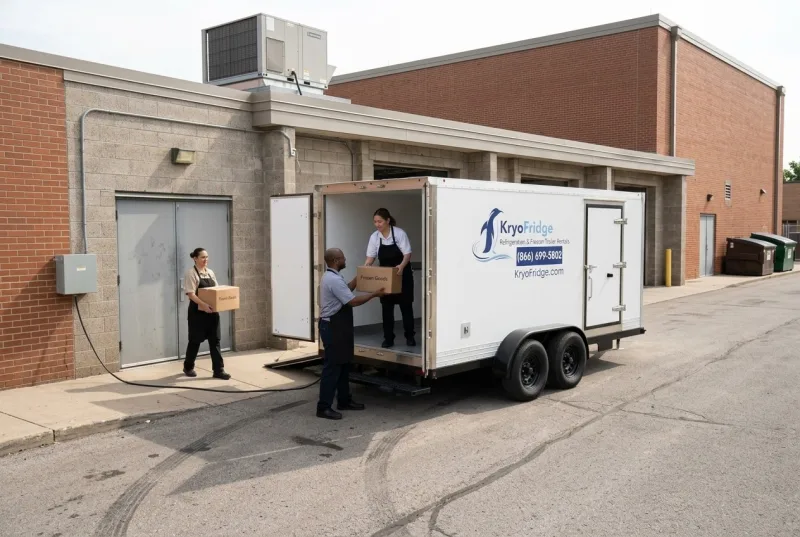
Orange Coast College and Vanguard University both run campus dining, athletics and large public events, and the district has its own kitchen network. Summer maintenance shutdowns, commencement catering and tournament concessions at TeWinkle Park and the Jack R. Hammett Sports Complex all take temporary cold space.
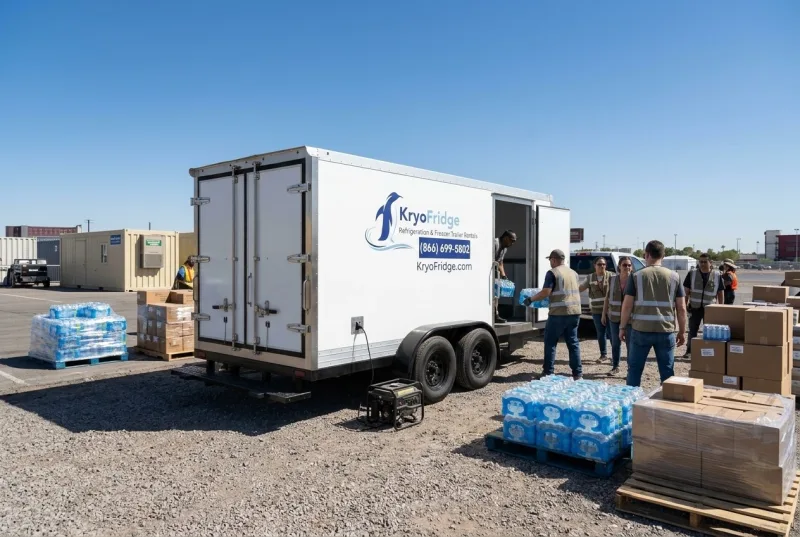
After a fire, a flood, a vehicle strike or a utility failure, product has to be held at temperature while the claim gets documented and the building gets repaired. Restoration contractors and adjusters call us direct, and we can be on site the same day with a unit running off its own generator.
What ties these together is the clock. Nobody budgets a freezer trailer into next quarter. They reach for one the hour a compressor quits, or the evening before a party when the stack of rented ice chests suddenly looks laughably undersized. Since our units sit staged around Costa Mesa instead of a couple counties down the freeway, "can I get it today" is an ordinary ask here, not a stretch.
Add it up the way an owner in Costa Mesa has to. One restaurant walk-in routinely sits on a small fortune in proteins, dairy, and prepped product. Scale that to a grocery rack or a warehouse freezer bay and the exposure balloons. Now knock the power or the compressor out on a triple-digit afternoon, and that whole inventory is in jeopardy inside a few hours. Then stack on the sales you lose while the line sits dark and the wages you burn paying staff to triage what can still be saved.
Hold a pre-staged trailer up against that risk and it reads like cheap insurance, a fixed, predictable expense parked in front of a loss with no ceiling. That is exactly why the businesses that got stung once tape our number by the phone. There is never a second scramble, because the next time they dial before the product has a chance to warm. Owning every trailer ourselves means we can scale the answer to fit. A single compact box suits a corner cafe. A clustered setup covers a warehouse floor. Either turns around the same day.
Costa Mesa reads mild on paper. Across a normal year the temperature runs from about 48 degrees to about 79 degrees, rain averages around 13 inches with February the wettest month, and summer rain is close to nothing. The hottest days here are not usually mid summer. They are the September and October days when the marine layer disappears and hot dry air pushes toward the coast from inland. The record high at John Wayne Airport, the reference station for this area, is 110 degrees, and it was set in September.
Those days arrive with the Santa Ana winds, and there are roughly 10 to 25 wind events in a typical year. They come out of the mountain passes warm and very dry, they regularly clear 40 miles an hour, and they raise fire danger across the region. Compressors that have been coasting all summer pick that week to fail, because ambient heat is exactly when a marginal condenser stops keeping up.
The other half is the grid. Southern California Edison runs the Public Safety Power Shutoff program, which turns off power in high fire risk areas ahead of Santa Ana conditions, and Orange County has seen thousands of customers affected during those events. A shutoff is announced in advance, which is the good news, because a business can stage cold storage before it happens instead of scrambling after. Either way the answer is the same: a trailer with its own generator does not care what the building's power is doing. Call us when the forecast turns and we will get a unit to you while there is still time to load it calmly.
South Coast Metro is the busiest catering corner of Orange County, and it is not because of the kitchens. It is because of the rooms. The Hilton Orange County in Costa Mesa is the largest hotel in the city with 486 rooms and suites, and it books large weddings and multi day events. The Westin South Coast Plaza runs indoor and outdoor ceremony and reception sites that seat anywhere from 20 to 650 guests, including the Waterfall Terrace and the palm lined pavilion. Every one of those rooms can outgrow the cold space attached to it on a busy weekend.
Then there is the Segerstrom Center for the Arts, where the Julianne and George Argyros Arts Plaza covers 56,100 square feet of open air event space. There is no cold room out on a plaza. A refrigerated trailer parked at the service side gives a banquet team a real staging cooler within a short cart run of the pass.
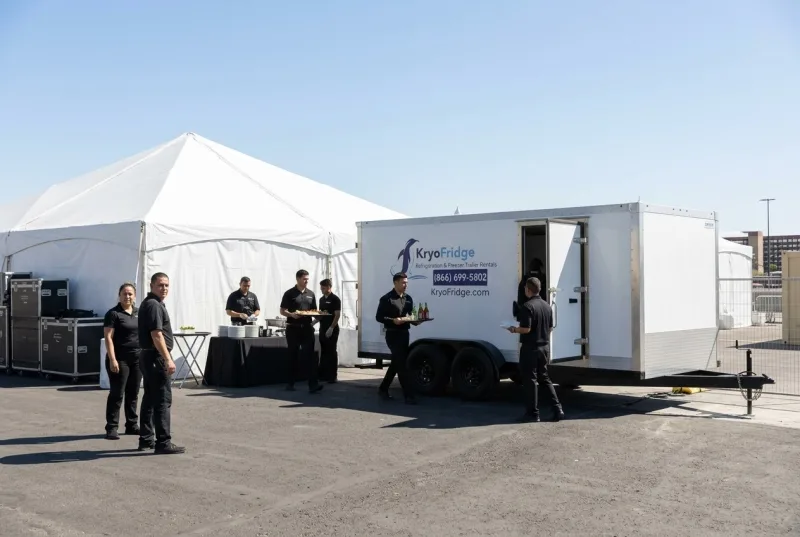
The formats these venues sell are the ones that eat cold space fastest. Stations, family style, passed hors d'oeuvres and full dessert service all mean more chilled components per guest than a single plated entree. Our trailers run as a refrigerator or a freezer on one adjustable set point, anywhere from about 50 degrees down to 10 below zero, so a catering team can run one unit cold for produce and dairy and a second one frozen for proteins and desserts.
We deliver, level and start the unit, and we walk your lead through the controls before we leave. Power is simple. Either we bring a generator, or you give us one dedicated 120 volt, 20 amp circuit within 100 feet of the trailer. Give us a call once your event dates are on the books and we will hold the trailer for the load in window you need.
The walk in is the whole back of house. Proteins, produce, dairy, dressings, prepped sauces, par stock, everything the line pulls from during service lives behind that one door. When the compressor quits, a kitchen is at a standstill inside the hour, because cold food has to stay at or below 41 degrees and there is nowhere else to put it. Costa Mesa is full of exactly the kitchens this hurts most: the shallow lots and shared alleys along 17th Street, the converted buildings around The LAB and The CAMP in the SoBECA District, the tenants at Triangle Square on Harbor Boulevard, and the food hall spaces at SOCO and The OC Mix.
Small footprint shops feel it first. A bakery or doughnut counter on 17th Street that makes everything from scratch every morning has one cooler and no second one. There is no yard to stage in and no spare reach in that can absorb a walk in's worth of product. The clock that matters is not the repair tech's arrival time. It is how long the product holds with the door shut.
That is the call we built the dispatch line for. One Friday evening at 6:30, in the middle of dinner rush, a Chick-fil-A called with its walk in cooler down and drive through lines around the block. We took the call, prepped a trailer and had it on site 34 minutes after the phone rang. On a Mother's Day weekend, an overnight outage shorted the fuse on a Denny's walk in cooler, and our dispatch team put three freezer trailers on site to hold pies, meats and the rest of the day's product so the restaurant could work its busiest shift of the year.
For a Costa Mesa kitchen the placement conversation is the important one, and it happens on the phone. Rear alleys off 17th Street are tight and sometimes have overhead limits. SoBECA properties share service yards between tenants, so the property manager needs to be in the loop. Tell us the address and the gate you want us to use, and we will tell you which unit fits before we dispatch it.
The OC Fair and Event Center is a 150 acre campus in the middle of Costa Mesa that hosts more than 150 events a year and draws about 4.3 million visitors. The 2026 OC Fair runs July 17 through August 16, which is 31 straight days of food service in the hottest stretch of the Orange County calendar, with gates open until 11 at night midweek and midnight on Friday and Saturday.
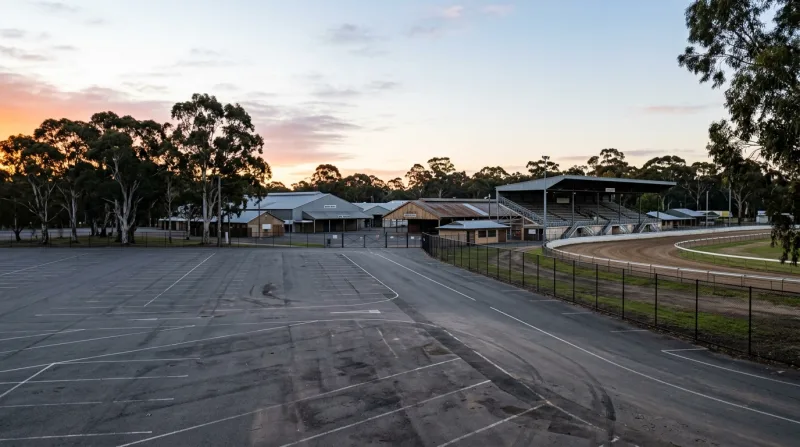
The rest of the year keeps going. A certified farmers market fills the lot every Thursday morning near gates 2 and 4, with growers selling produce, honey, flowers and fish. The 626 Night Market takes over the grounds on dates from May through September. Costa Mesa Speedway holds its race nights, the Pacific Amphitheatre books its shows, and the OC Marathon finishes right there at the fairgrounds after its course swings through the city past the Orange County Museum of Art, Segerstrom Center and South Coast Plaza. Off campus, the Costa Mesa Newport Harbor Lions Club Fish Fry and Carnival fills Fairview Park each summer, and The LAB and The CAMP run outdoor markets in SoBECA.
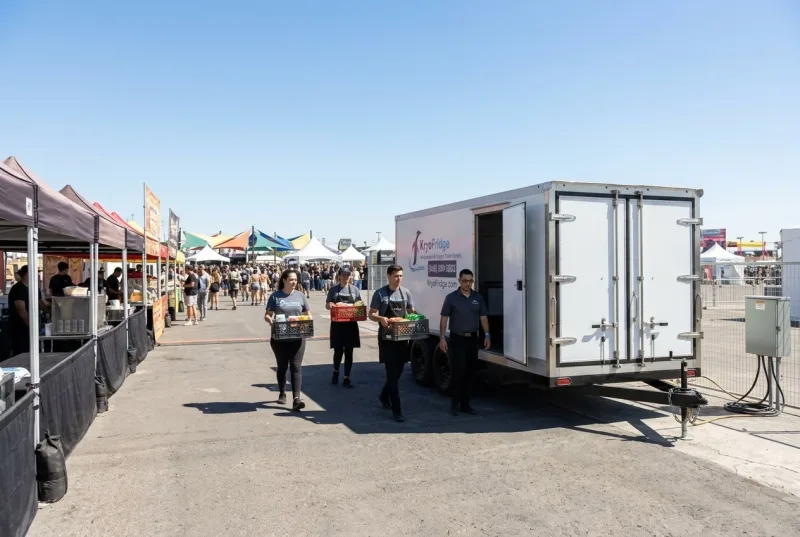
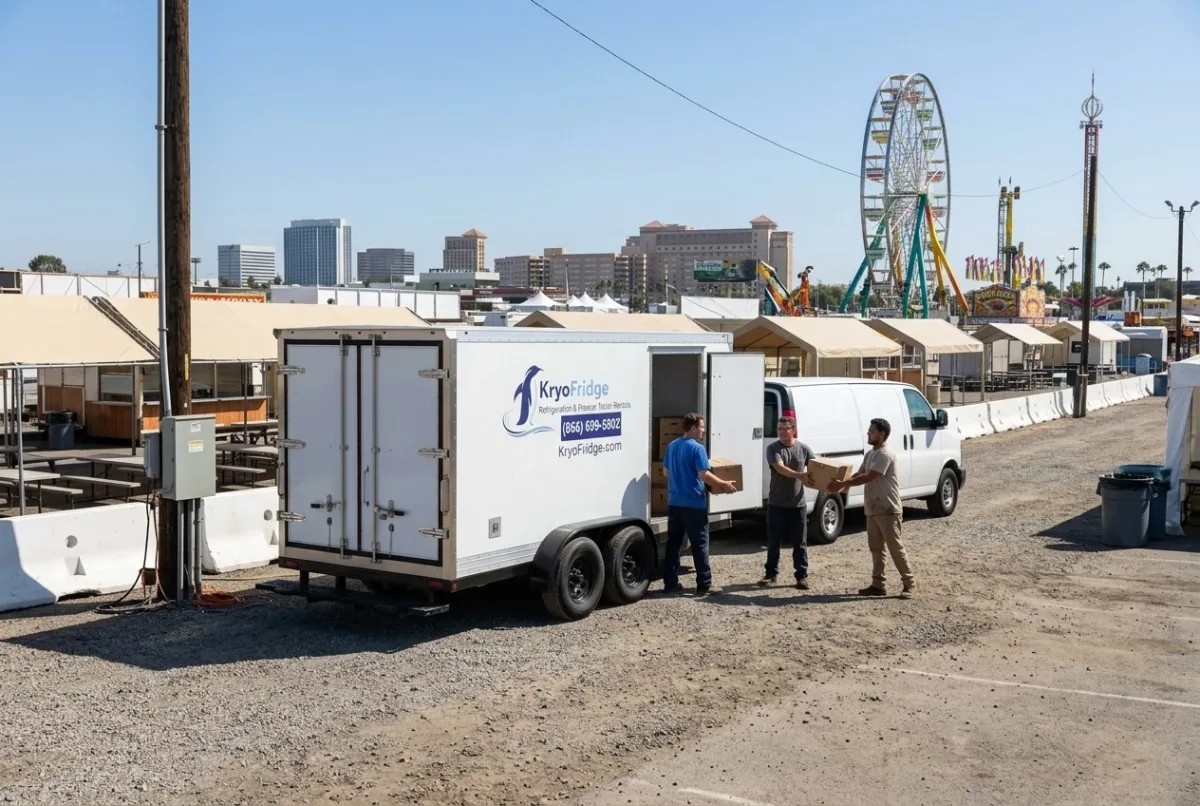
Vendor rows have two problems and a trailer solves both. The first is capacity. Chest freezers and ice chests do not hold a weekend of product for a row of vendors, and every lid lift in direct sun costs temperature. The second is power. Vendor row distribution is usually spoken for before the food trucks even arrive. Our unit either runs off a generator we bring or off one dedicated 120 volt, 20 amp circuit within 100 feet, so it does not fight the row for amperage.
Crews that tour a run of dates ask us to cover more than one stop, and the same fleet that serves this market also handles Los Angeles freezer trailer rentals, so one phone call can cover several cities on a tour. Give us your event dates early. Summer weekends on this campus book out.
"Cold" is not one number. Different product stays safe inside different temperature windows, which is the entire reason a precise digital set-point matters, and in the middle of a heat wave in Costa Mesa, a load that slips out of its window is a load you write off. Use the chart below as the reference our customers lean on when they size a rental.
| Product | Target holding band | Trailer mode |
|---|---|---|
| Ice cream and frozen desserts | -10°F to 0°F | Deep freeze |
| Frozen proteins, seafood, prepared meals | 0°F or below | Freezer |
| Fresh meat and poultry (short hold) | 28°F to 32°F | Refrigerated |
| Dairy, deli, packaged produce | 34°F to 38°F | Refrigerated |
| Beverages, florals, catering trays | 38°F to 45°F | Refrigerated |
One figure outranks everything in that chart, and it is not listed there: 40°F. Food-safety guidance treats the band between 40°F and 140°F as the zone where bacteria thrive, and the clock on perishable product starts ticking the moment it crosses 40 on the way up. Roughly four cumulative hours above that line and most refrigerated inventory is no longer safe to serve. Picture that countdown running on a 100-degree afternoon in Costa Mesa with the walk-in dark, and the urgency of a quick trailer drop stops being abstract.
Tell us the single coldest item you are holding when you call, and we dial the trailer to that. One unit carries a straight freezer load with no fuss. But when your list mixes deep-freeze desserts with fresh-cold produce for the same remodel or event, we will usually point you toward a split setup or a second box so neither side of the load has to settle for the wrong temperature.
Powering one of our trailers is refreshingly simple, and there are precisely two ways to do it. Either you have a dedicated 120-volt, 20-amp circuit reachable within roughly 100 feet of the parking spot, or we bring a generator. What the units will not accept is standard 208 to 240V building service, so a quick question about your outlet before dispatch heads off any surprise on delivery day.
On placement, all the unit really asks for is a fairly flat patch with enough room for the delivery truck to maneuver it in and set it straight, plus either a power source in reach or space for a generator. We lock down the exact drop point before dispatch, and our drivers know the Costa Mesa layout cold, so the delivery is one clean trip instead of a guessing game on the property.
The compressor quit at the top of a Friday dinner rush and the crew was already stacking product on prep tables. We answered, prepped a unit and had a refrigerated trailer in the rear alley that evening, set to holding temperature before the last table was seated. The kitchen moved everything across in one pass and opened on time Saturday morning with zero product written off.
A Friday corporate dinner, a Saturday wedding and a Sunday brunch landed on the same weekend, and the banquet cooler could hold about one of them. We delivered two trailers to the service dock on Thursday, one set for refrigeration and one set frozen, and picked them up Monday morning.
A vendor row was running on chest freezers in direct sun and losing temperature every time a lid opened. We staged a trailer behind the row on a generator so it did not draw a single amp from the event distribution, and the vendors used it as shared cold and frozen holding for the whole run.
One dispatch line for every location you run. Plenty of Costa Mesa businesses operate outside Costa Mesa too. A restaurant group has a second room in Newport Beach. A caterer works a Saturday here and a Sunday down the coast, and a market chain builds for the holidays across four cities at once. Because we own the fleet and run the same dispatch across our markets, a customer with stores here and San Diego cold storage trailer rentals down the coast gets one account, one phone number and one crew that already knows the sites.
On a bad day, booking should be the part that does not add stress. Four steps, an upfront number, and a single person who owns the whole thing.
Tell us whether it is freezer or fridge product, a ballpark volume, and your rough window. That is enough for us to call the right size.
We pair you with a unit, confirm whether you have a dedicated circuit or need a generator, and pin the exact drop point so the truck makes one trip.
We arrive on your schedule, about 45 minutes for a true emergency, set the trailer, energize it, and let it drive down to your number.
It holds the set-point for your entire term while our line stays live the whole way through. Wrap up, and we swing back for the pickup.
California runs one of the strictest retail food programs in the country, and it works in your favor when you rent cold space instead of improvising. The California Retail Food Code holds cold potentially hazardous food at or below 41 degrees, and it applies to a restaurant walk in the same way it applies to a festival booth. Our trailers hold a single adjustable set point from about 50 degrees down to 10 below zero, so a crew can run one unit in refrigeration range for produce and dairy and a second one frozen for proteins and desserts, and both sit inside the range an inspector expects.
Events add a second layer, and it is worth knowing before you book. The Orange County Health Care Agency issues Temporary Food Facility permits for food booths at community events, and an event organizer permit is required whenever two or more food vendors take part, under California Health and Safety Code section 114381.1. The organizer carries responsibility for shared facilities, including restrooms, refuse containers, potable water, waste water disposal and shared warewashing. Applications, a vendor list and a site map go in at least two weeks ahead under state law, and the county advises a month or more so there is time for review.
Worker heat rules matter too, because cold storage jobs happen in hot months. Cal/OSHA's indoor heat illness prevention standard took effect on July 23, 2024 and applies to indoor work areas at or above 82 degrees, requiring water, cool down areas, training and emergency response procedures, and it remains in force. At the federal level, OSHA published a proposed heat injury and illness prevention rule in August 2024 that has not been finalized, and experienced kitchen and event teams are already building their summer plans around what that proposed rule would ask for. On the city side, a trailer on private property may need a temporary use permit, anything in the public right of way needs an encroachment permit, and fire lane access has to stay clear at every site. We have placed units through all of it and we will tell you what your site needs before we dispatch.
One caveat we always state plainly: we supply the food-safe, temperature-holding hardware itself, but we are not a temperature-logging or alarm-monitoring service. If your program requires continuous written records, line that vendor up on your own.
Our signature 16 foot Utility series leads the fleet. It is the trailer we send on most jobs, and crews like it for the side utility access door. We build three footprints in all, so a single kitchen holding overflow stock has a fit and so does a distribution floor in a disaster. Every unit is dual purpose by design: one adjustable system swings between freezer and refrigerator on a digital set point. Each trailer runs on a dedicated circuit or on a generator.
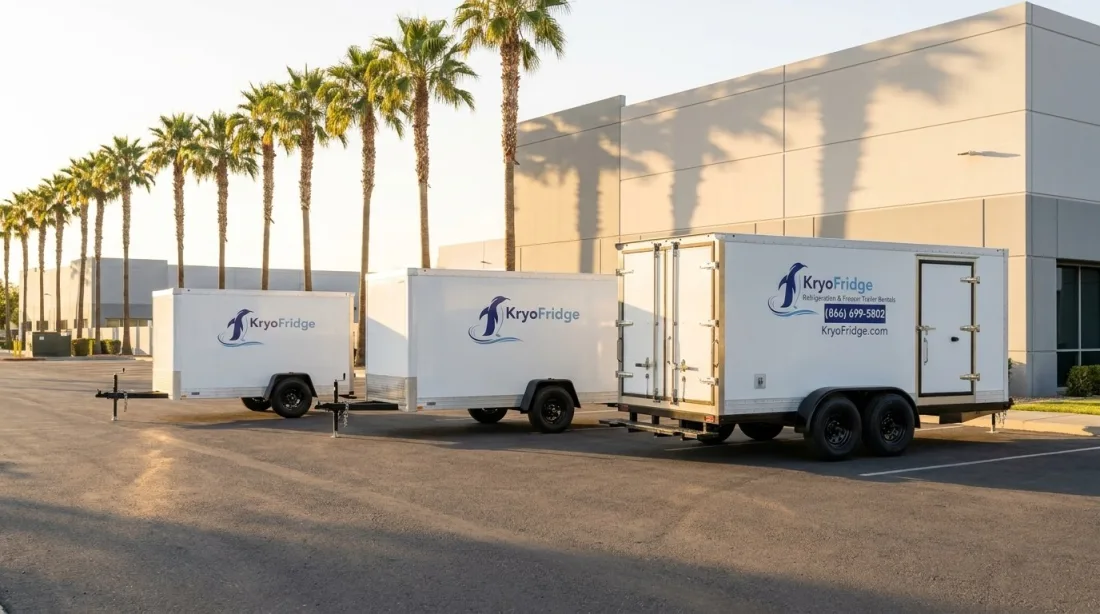
| Trailer | Best for | Temp range |
|---|---|---|
| 6x16 Utility ⭐ | Our signature series: distribution, large events, disaster response, side utility door | Heavy-duty reefer |
| 6x12 | Grocers, caterers, mid-size events | Deep-freeze capable |
| 6x8 | Tight lots, small kitchens, short overflow | -10°F to 50°F |
Each unit holds a precise digital set-point and runs on a dedicated 120V/20A circuit or a generator.
Think eight or so pallet spots, and the unit to grab when square footage is the whole problem. It slips into the pinched service yards and cramped back-of-house corners that a larger box cannot even swing into. One cafe or small-market walk-in goes down, and this is almost always enough cold to cover it, plus the simplest unit to set in a small space.
Call it fourteen pallet spots, deep-freeze rated, and far and away the size people ask for most. It lands right in the middle: roomy enough for a multi-day catering job or a restaurant that needs true walk-in-equivalent room while the kitchen is torn up. Roomy enough that nobody is playing Tetris with shelves, yet still small enough to set in most commercial back lots without a site survey.
Roughly twenty pallet spots paired with a heavy-duty reefer plant engineered to keep deep-freeze locked in even when the ambient air is merciless. Reach for it when a warehouse bay drops, when a large festival needs an anchor, or when a relief operation is carrying its own cold chain.
Not sure which size fits? Most customers land on the 16 foot Utility, and we will tell you honestly if a smaller footprint covers your job. Tell us roughly what you are storing and for how long, and we will spec it for you.
The questions that surface once the basics are settled. Tap any topic to open it.
The pop-up walk-in cooler. Cheap to rent and easy to set up, but it chills, it does not freeze, and it draws every watt it needs from your building while depending on a calm ambient temperature around it. The second your building loses power, your cooler loses it too.
The refrigerated box truck. Designed to haul product on the interstate, not to sit in a lot and babysit it. Parked, it idles fuel all day, broadcasts compressor noise across a storefront or an event lawn, and pins down a tractor plus a driver you probably do not need.
The freezer trailer we deliver. Built from the ground up to be dropped on a pad and to defend a temperature for as long as the job runs. It freezes deep, carries NSF approval, locks, stays quiet near guests, and lives on nothing more than one dedicated circuit or a generator.
Even a rented box has to satisfy the county environmental health office that licenses and inspects every food facility. Show an inspector a unit that cannot document its temperature or was not built for food contact, and they have the authority to halt service immediately.
That is a bar each of our trailers clears: NSF-approved throughout, food-safe interior surfaces, proper drainage, and a digital controller that puts the set-point in plain view. We supply the food-safe, temperature-holding hardware itself, but we are not a temperature-logging or alarm-monitoring service.
For a typical kitchen or market, one box does the job. Distribution floors, big fairs, and full-scale disaster response routinely need more, and because the fleet is ours, we can cluster several units and bring them online in waves as the work expands. Match the cold capacity to the operation rather than make the operation squeeze itself into one box.
The clock is yours to set. Some jobs are a handful of days for an emergency or a single event. Others stretch across weeks or months for a remodel or a seasonal swell, and a few become standing contracts for businesses that want capacity parked on standby. Name your window and you will get a clean quote, no penalty for an honest "not sure yet."
Building permanent cold storage is a capital project in every sense: you hire a refrigeration contractor, schedule the electrical, pull a building permit, and wait weeks before a single pallet goes inside. A rental turns that equation on its head. You bring in precisely the cold you need, for precisely the stretch you need it, and the trailer is holding temperature that same week, frequently that same day, with the commitment ending the moment your need is over.
Three engineered elements carry the load. Thick insulated panels and tightly gasketed doors lock the sun outside and the cold inside. A self-contained reefer condensing system specified with surplus capacity keeps stripping heat out of the box even when the air outside is brutal. And a digital thermostat locks onto your chosen number and cycles the compressor to hold the line. Run those three together and a trailer baking on open asphalt behaves like one tucked in a cool warehouse. That is also why power is the first thing we ask about: the design delivers its safety margin only on steady, uninterrupted power.
"I called three companies and KryoFridge was the only one who actually owned the trailer instead of trying to find one. They asked about my gate width before they quoted the unit, which nobody else did."
 Laura S. · general manager, Harbor Boulevard
"Our engineering team does not like anything extra on the kitchen panel, so the generator option sold it for us. The unit sat at the service dock for a full conference run and held temperature the whole time."
 Julia C. · operations manager, South Coast Metro hotel
"We needed pallet positions for a seasonal release and leasing cold warehouse space by the year made no sense. They backed a trailer right up to our roll up door on Randolph and we loaded it off the forklift."
 Autumn L. · production lead, Westside Costa Mesa
"Holiday build always gets too big for our back room and this year our cases were getting replaced on top of it. The trailer at the receiving door meant we never had to turn a truck away."
 Celia A. · store manager, Baker Street
"Plaza events sound great until you realize there is no cold room within a hundred yards. Having a staging cooler parked on the service side changed how we plan the whole menu."
 Miranda L. · banquet chef, Town Center Drive
"We are a small shop with one cooler and no yard, so a failure is basically a closed sign. They talked me through the alley clearance on the phone and picked the unit that would actually fit back there. It was running cold before my morning bake started."
 Jeffrey W. · bakery owner, 17th Street
"We had a shutoff warning ahead of a wind event and I did not want to gamble on the building's power. They got a trailer to us the day before with its own generator. Everything held and we did not lose a case of product."
 sara g. · facilities manager, Mesa Verde
"Summer maintenance takes our kitchen cold storage offline for weeks every year. KryoFridge has covered that gap for us more than once and the crew knows our loading area now."
 Adrianna G. · nutrition services director, College Park
"Location shoots never have a kitchen and craft service still has to keep everything cold all day. The trailer ran on the generator so we did not need anything from the building."
 Debbie O. · production coordinator, SoBECA District
Sample reviews written to mirror genuine Costa Mesa situations, to be replaced with verified Google reviews ahead of launch.
Our dispatch line is staffed around the clock and same day delivery is the normal outcome for a Costa Mesa address, not the exception. We have prepped and delivered a trailer to a restaurant 34 minutes after the phone call when a walk in cooler failed mid service. What speeds it up is knowing your address, your gate or alley, and roughly how much product you need to move, so have that ready when you call.
There are exactly two ways. We can bring a generator with the trailer, which is what most event and outdoor placements use, or you can provide one dedicated 120 volt, 20 amp circuit within 100 feet of where the unit sits. That is the full list, and nothing else is required. Vendor rows at the fairgrounds and plaza events at Segerstrom almost always go the generator route, because event power distribution is usually spoken for.
Every KryoFridge trailer runs as either a refrigerator or a freezer on one adjustable set point, from about 50 degrees down to 10 degrees below zero. That means the same unit can hold produce, dairy and prepped product in refrigeration range, or run hard frozen for proteins, ice cream and frozen dessert programs. Tell us what you are holding and we will set it before we hand it over.
Usually yes, and the way we make sure is by asking before we dispatch instead of finding out at the curb. Eastside lots are shallow, alleys are narrow and some have overhead limits, so we ask for the alley width, the approach and any overhead obstruction on the call. We run more than one size of trailer, so if the biggest unit will not swing in, a smaller one generally will.
Yes, and we work that campus regularly. The fairgrounds runs more than 150 events a year across 150 acres, with strict load in windows and gate assignments, so we plan the delivery around the event's schedule rather than our own. Tell us your gate, your load in window and where the venue wants the unit staged, and we will hit it.
As early as you can. The 2026 OC Fair runs July 17 through August 16, which is 31 straight days of demand on one campus, and that stretch overlaps the busiest wedding and event weekends of the Orange County year. Summer weekends book out first, then December corporate season, then the May and June graduation and marathon window. If your dates are on the books, call us and we will hold a unit.
Yes, and this is one of the busiest reasons Costa Mesa businesses call us in the fall. Southern California Edison announces Public Safety Power Shutoffs ahead of Santa Ana wind conditions, which gives you a window to stage cold storage before the power goes off rather than scrambling afterward. Because our trailers can run on a generator we provide, the unit keeps working no matter what the building's service is doing. When you see a shutoff notice for your area, call us that day.
That is one of our steadiest Costa Mesa uses. Walk in panel replacement, hood and suppression work, floor replacement and long lead refrigeration packages all take a cold room offline for days or weeks, and a trailer in the lot lets you keep trading instead of going dark. Rentals run short term or long term, so tell us your construction schedule and we will match the term to it.
No. Our trailers have digital set point control on the unit itself, so your team can see and adjust the temperature, but we do not offer a monitoring, logging or alarm service and we will not tell you otherwise. What we provide is the cold space, the set point control and a crew that answers when something changes.
We run coastal Orange County constantly, including Newport Beach, Corona del Mar and the Balboa Peninsula, Huntington Beach, Fountain Valley, Irvine, Tustin, Santa Ana, Garden Grove, Westminster, Seal Beach and Laguna Beach. Through the wider network we serve all 50 states, which matters if you run locations in more than one region and want one account and one dispatch line. If you are not sure whether your address is in the Costa Mesa run, call and ask. It usually is.
Deeper reading for local businesses, from the failure-hour playbook to compliance and seasonal planning. Tap any guide to open it.
A walk in cooler failure is not a maintenance problem. It is a countdown. Every protein, dairy item, prepped sauce and cut produce container in that room has a window before it crosses out of safe holding, and in a Costa Mesa kitchen on a warm September afternoon that window is shorter than most crews assume. The first hour decides whether you lose an evening of service or a week of inventory, so it is worth having the sequence written down before you need it.
Step one is to stop opening the door. Every time the door swings, warm room air replaces the cold air the box is still holding, and the internal temperature climbs faster than the thermometer shows. Assign one person to the walk in and keep everyone else out. Put a thermometer inside where you can read it without opening, if you have one, and note the time and the reading.
The OC Fair and Event Center is a 150 acre campus in the middle of Costa Mesa that hosts more than 150 events a year and draws about 4.3 million visitors. If you are producing food service there, whether it is a single weekend market or the full 31 day fair run from July 17 through August 16 in 2026, the cold storage plan is not an afterthought.
Start with the permit picture, because it sets your deadlines. The Orange County Health Care Agency issues Temporary Food Facility permits for food booths at community events. If two or more food vendors are taking part, an event organizer permit is required under California Health and Safety Code section 114381.1, and the organizer becomes responsible for the shared facilities: restrooms, refuse containers, potable water, waste water disposal and shared warewashing. Applications, a vendor list and a site map go in at least two weeks ahead under state law, and the county advises a month or more so there is time to review them.
Costa Mesa looks like an easy climate on paper. Temperatures across a normal year run from about 48 degrees to about 79 degrees, annual rain averages around 13 inches, and summer is dry and mild near the coast. That average is exactly what gives the wrong idea people. The hardest days on refrigeration equipment here are not in July. They are in September and October, when the marine layer disappears and hot dry air comes toward the coast from inland.
The record high at John Wayne Airport, the reference weather station for this part of Orange County, is 110 degrees, and it was set in September. What that tells a facilities manager is that the peak thermal load on a condenser is not distributed the way the calendar suggests. A rooftop condenser that has got by through a mild summer meets its hardest day in early fall, and that is when marginal equipment gives up.
California Public Utilities Commission, Public Safety Power Shutoffs
Costa Mesa has a deep stock of second and third generation restaurant space, especially along the Eastside and in the converted buildings on the Westside. Walk in panel replacement, floor replacement, hood and suppression upgrades and full kitchen remodels all take the cold room out of service, and the default plan is usually to close. It does not have to be.
The first question to settle is duration, and it is worth being pessimistic. Refrigeration packages carry long lead times, and a walk in that was promised in six weeks routinely lands in ten. Contractors sequence around the equipment they can actually see on site. If your cold storage plan only covers the optimistic schedule, you will be extending it under pressure, which is the expensive way to do it.
Grab a quick, no-runaround quote, or ring our round-the-clock line for emergency cold storage anywhere across Costa Mesa and the surrounding area.