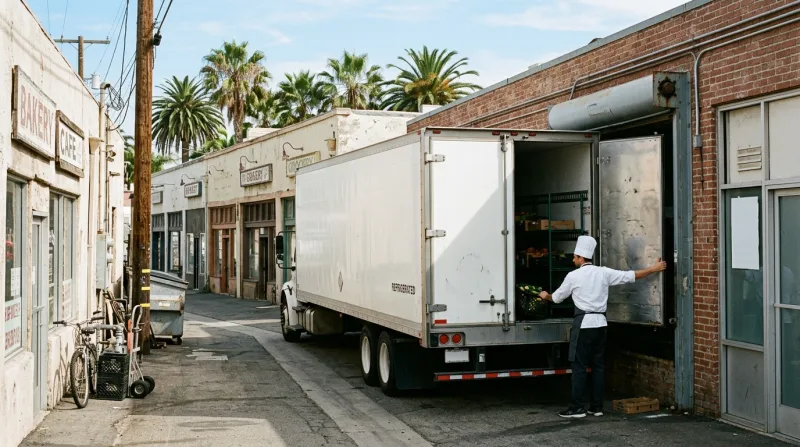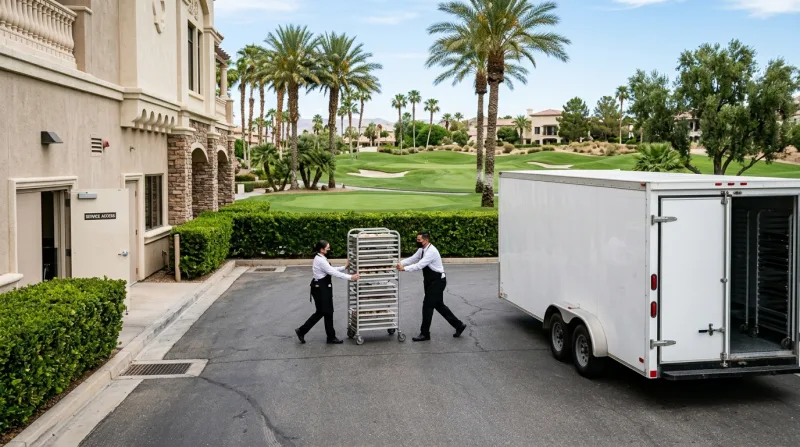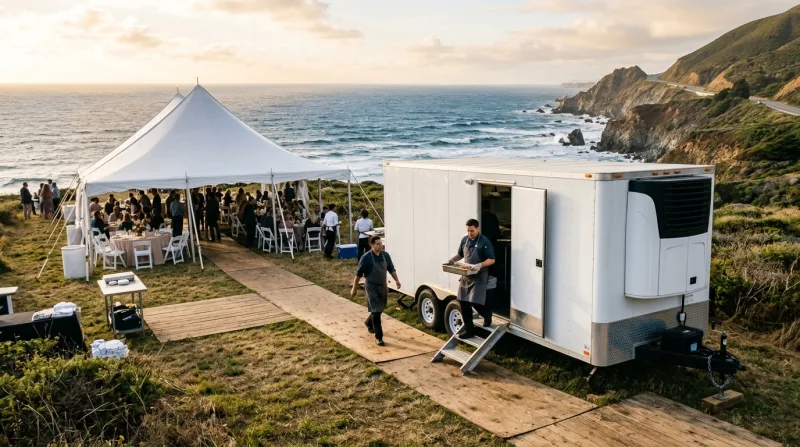

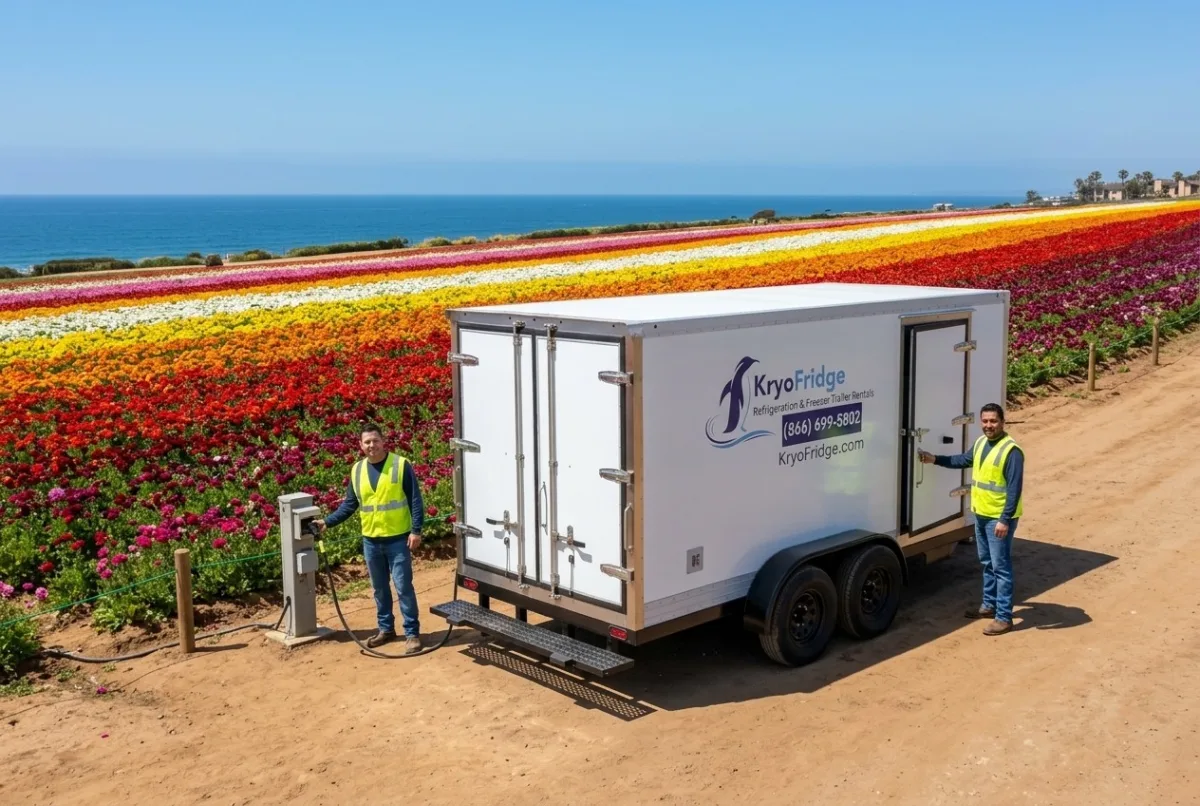
KryoFridge is the freezer trailer team Carlsbad kitchens, caterers, and event crews call first. We bring the unit out, set it where it needs to sit, and have it holding temperature before your first pallet goes in, whether that is a rear lot off State Street, a brewery pad on Yarrow Drive, or a bluff wedding site along Carlsbad Boulevard. Our fleet is the largest in the region and dispatch picks up at any hour, so a Friday night failure gets a truck moving the same night. Call 866-699-5802 or ask for a walk in freezer rental quote and we will hold your dates.
We have spent more than 30 years in the rental business as a family run company, and KryoFridge runs the largest freezer trailer fleet in the region. That depth matters in Carlsbad because a Village kitchen, a florist working the ranch fields, a seafood program on Roosevelt Street, and a grocery remodel on El Camino Real each hold product a different way, and we set the unit up for the product instead of handing you one setting and hoping. Our drivers already know the Village alleys, the business parks off Palomar Airport Road, and the service roads behind the La Costa and Aviara resorts, so nobody spends an hour figuring out where the trailer goes. We are fully insured, our trailers are NSF ready, and the same dispatch desk that covers California freezer trailer rentals from the Mexican border to the northern valleys answers the phone for a single Carlsbad restaurant. Call us before you commit to a date and we will walk the site with you first.
Our trailers sit staged around Carlsbad, fueled, pre-cooled, and maintained in-house, parked and waiting for the call rather than being sourced after it. That is why an emergency call usually puts a unit on your lot and pulling temperature in about 45 minutes.
The voice on the phone belongs to the same outfit that owns the trailer and sends the driver. No reseller in the middle quietly marking up somebody else's equipment while your inventory creeps past 40°F on the shelf.
Every unit is ours to own, service, and deliver, and each one swings between deep-freeze and fresh-cold on a precise digital set-point. So we can size the answer to your Carlsbad job and turn it around the same day rather than putting you on next week's list.
National chains do not gamble on refrigeration. A drifting set-point during dinner rush can cost a brand a day of sales and a health-code headache, so the chains that scale fast vet a cold-storage partner the same careful way they vet a protein supplier. KryoFridge has held temperature for names like McDonald's, Chick-fil-A, and Dutch Bros, and earned the repeat call.
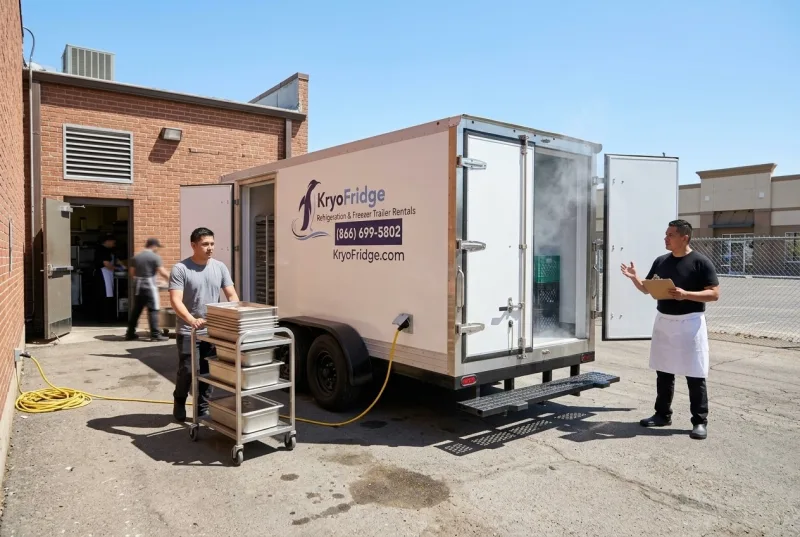
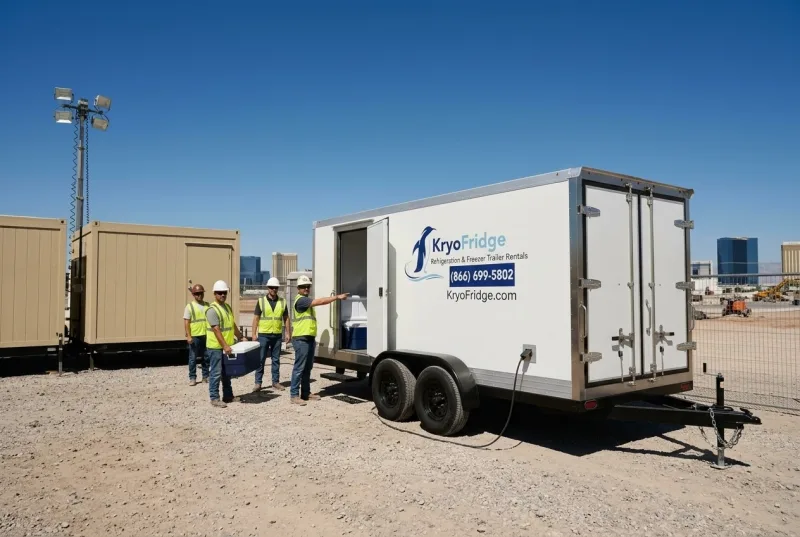
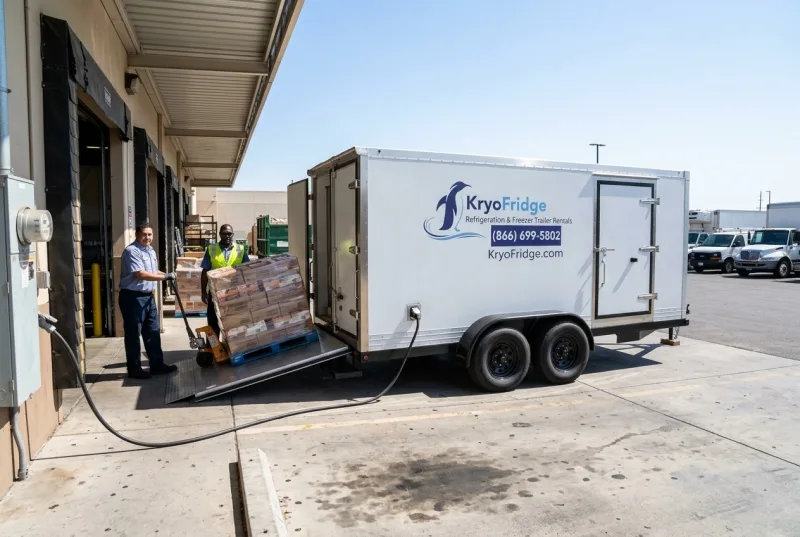
The stories behind that trust are the kind every restaurant owner recognizes. One Friday at 6:30 in the evening, a Chick-fil-A called in with a dead walk-in and a drive-through line already wrapped around the building. We prepped a trailer, dispatched it, and had it on their pad pulling temperature 34 minutes after the phone rang. The manager's first words when the driver pulled in were, "I cannot believe you are already here." That is the bar we hold ourselves to. Another year, an overnight outage shorted a cooler on the morning of a holiday rush, and our team staged three freezer trailers to hold every pie, every protein, and every prep tray so the kitchen served the rush without missing a ticket. The reason we hear some version of that line so often is the same every time: the equipment was already nearby, already cold, and owned by the people who answered the phone. That same standard travels to every Carlsbad job, from a one-cook taqueria to a distribution floor.
"Our walk in died on a Friday night in October, which is about the worst timing possible in this town. I called and a trailer was in our back lot that same evening, cold before I finished breaking down the line. We did not lose a single case and Saturday service ran like nothing happened."
 Maricela C. · restaurant owner, Carlsbad Village
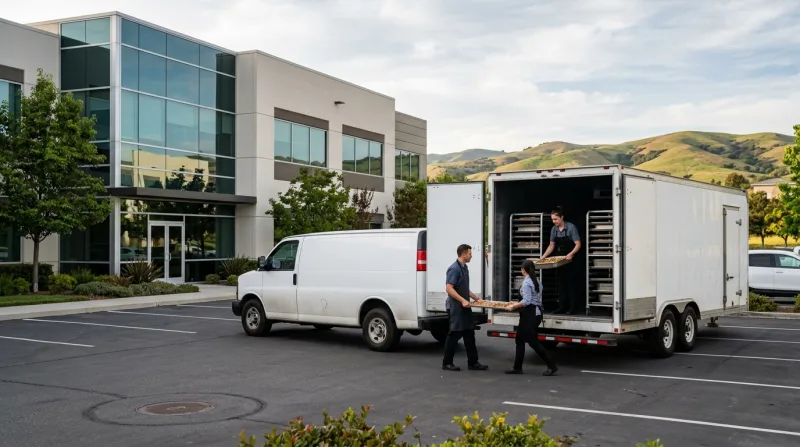
"We run events all over North County and the staging trailer has become part of how we plan every job. Load out of our kitchen in the morning, park it at the venue, and the product is exactly where we left it at four in the afternoon. Delivery has been on time every single order."
 Tyler B. · catering manager, Bressi Ranch
"Coordinating food vendors on a closed street is a headache and refrigeration used to be the biggest part of it. Having one central cold trailer at the edge of the closure solved it for everybody at once. The crew showed up the day before the barricades went in, exactly like they said they would."
 Julezza E. · event coordinator, Carlsbad Village
Our signature 16 foot freezer trailer is the unit most Carlsbad jobs land on, because it tucks into a Village rear lot or a shared retail pad without swallowing half the parking and still holds a real week of restaurant product. Larger and smaller units run out of the same yard, so the full freezer trailer sizes and specs are worth a look before you pick your delivery day.
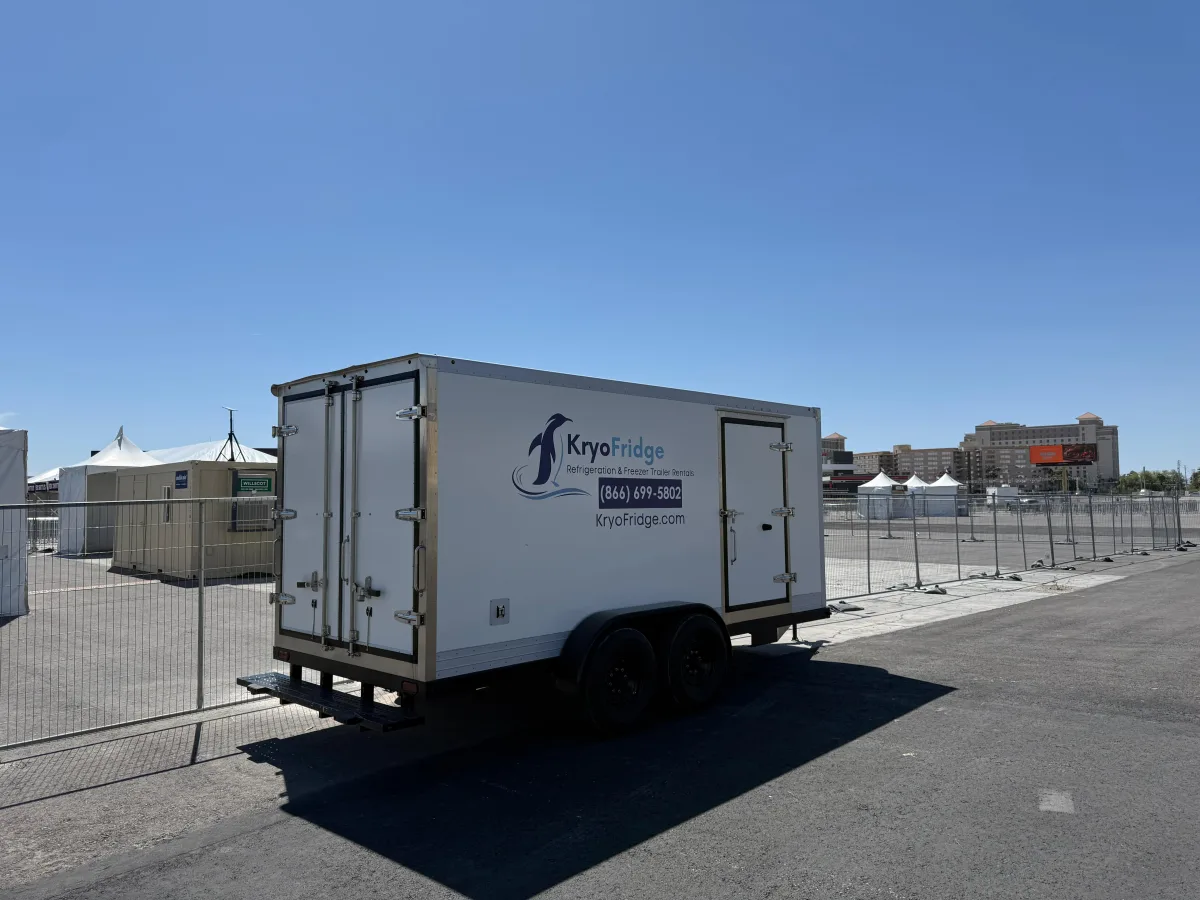
Ask any of our drivers which trailer they would send to a job that cannot fail, and they will point at the 16' Utility. Sixteen feet of insulated box rides on a tandem axle and swings from deep-freeze to fresh-cold on one digital set-point, every interior surface NSF approved. The rear doors swallow pallets off a loading dock while the side utility door gives your staff a quick in and out without dumping the cold air.
Every one of these is ours, not a unit we sourced from somebody else after you called. That means it arrives fueled, already pulled down to temperature, and serviced by our own shop. Plug it into a dedicated 120V, 20-amp circuit or run it on a generator we bring, and it will hold its number through the hottest week of the year.
| Spec | What you get |
|---|---|
| Temperature range | Roughly -10°F deep-freeze up to about 50°F fresh-cold |
| Mode | Dual-purpose: freezer or refrigerator on one precise digital set-point |
| Power | A dedicated 120V, 20-amp circuit within about 100 feet, or a generator we supply |
| Food safety | NSF-approved for direct food contact, food-safe surfaces, proper drainage |
| Footprints | 6x8, 6x12, and 6x16, from a tight retail lot to distribution scale |
| Backing | Owned in-house, fully licensed and insured, with 24/7 emergency dispatch |
Each unit holds a precise digital set-point and runs on a dedicated 120V/20A circuit or a generator. The trailers are not wired for 208 to 240V building service, so we confirm your hookup before the truck rolls.
We deliver anywhere in the city and across the surrounding North County markets, and most of it happens on routes our drivers already run. An order in Carlsbad plus a second unit for a sister location is usually one dispatch, not two, and the same trucks that cover San Diego freezer trailer rentals come up the Interstate 5 corridor every week. Tell us the address, the product, and the date, and we will confirm what fits the site. That coverage extends to Vista cold storage trailer rentals, cold storage trailer rentals in El Cajon and walk-in freezer rental in Costa Mesa.
Neighborhoods and towns we cover include Carlsbad Village, The Barrio, Olde Carlsbad, Carlsbad Ranch, Bressi Ranch, The Forum, La Costa, La Costa Greens, La Costa Valley, La Costa Oaks, Aviara, Terramar, Ponto, Poinsettia, Calavera Hills, Rancho Carlsbad, Carlsbad Oaks North, Oceanside, Encinitas, Leucadia, Vista, San Marcos, Rancho Santa Fe, Solana Beach.
Every part of the Carlsbad area rents cold storage for its own reasons. We know each one, and we deliver to all of them.
One call sizes the trailer, sets the delivery window, and locks your quote for Carlsbad. Call now, or send the quick quote request and we will call you.
Three kinds of jobs make up most of what we run in this city: event cold on closed streets and open turf, hard frozen holding for dessert and frozen product, and emergency cover when the power or the walk in quits. Each one asks something different from the trailer, and each one gets set up differently before it leaves the yard.
Older Village buildings run older equipment, and salt air is hard on outdoor condenser coils. When a box quits mid service we get a unit moving the same night and set it as a cooler or a freezer depending on what you lost.
A walk in replacement takes days or weeks, and the product has to live somewhere the whole time. These are planned rentals with a known window, and we size the unit to the job instead of the emergency.
Rack replacements and case swaps mean the whole perishable set moves outside while the store stays open. Multi week holds with more than one trailer are normal on these jobs.
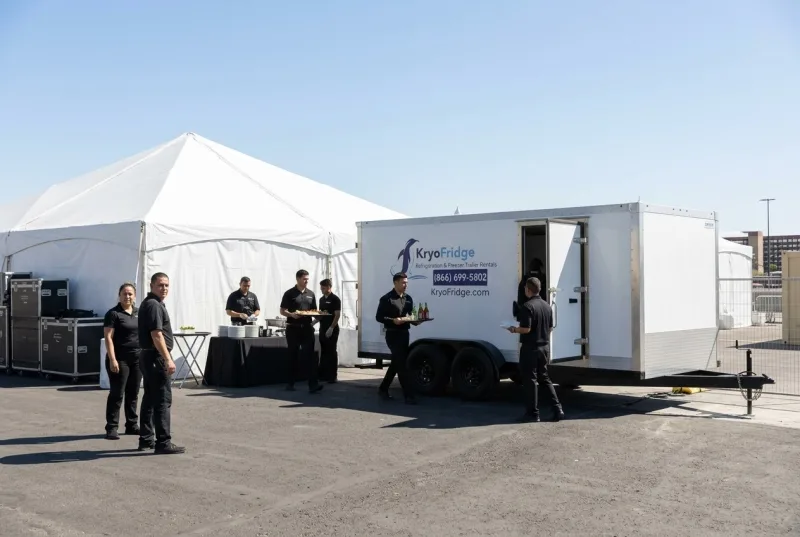
Bluff sites on Carlsbad Boulevard, lagoon overlooks, golf lawns at Aviara and La Costa, and estate properties have no back of house at all. A staged trailer becomes the working cold room for the day.
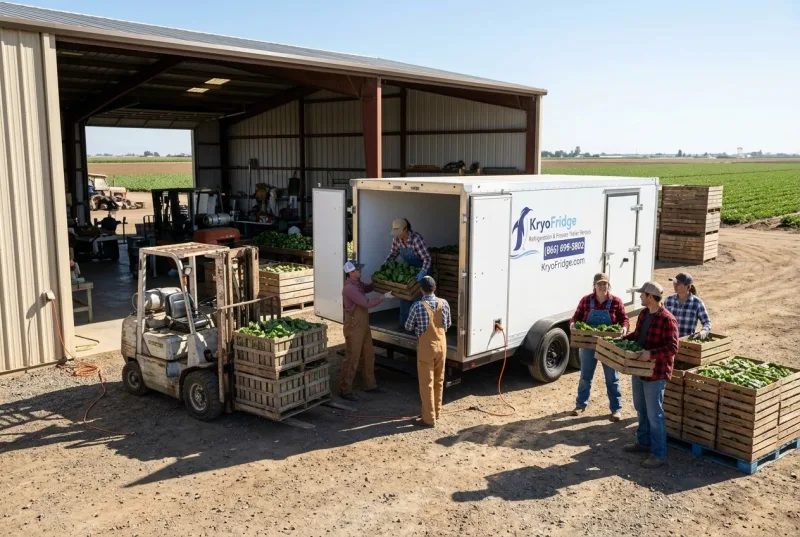
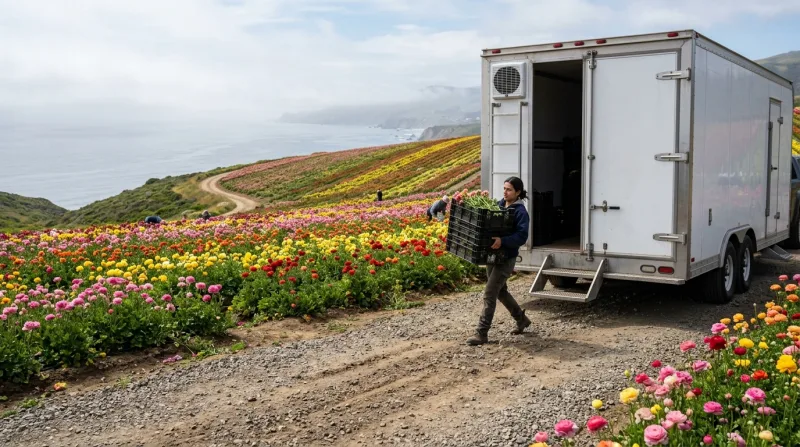
Cut stems from the ranch fields and berries picked at the peak of the season lose shelf life for every hour they sit warm. Putting the box at the field edge shortens the trip from harvest to cold to a few hundred feet.
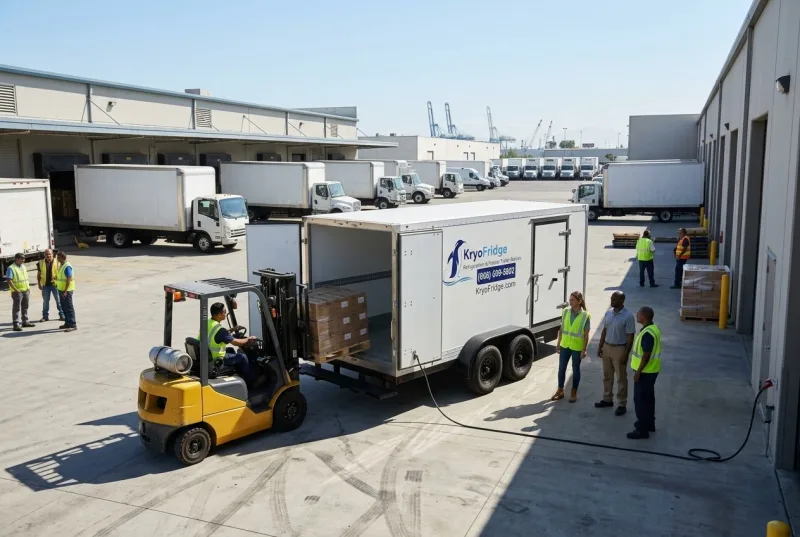
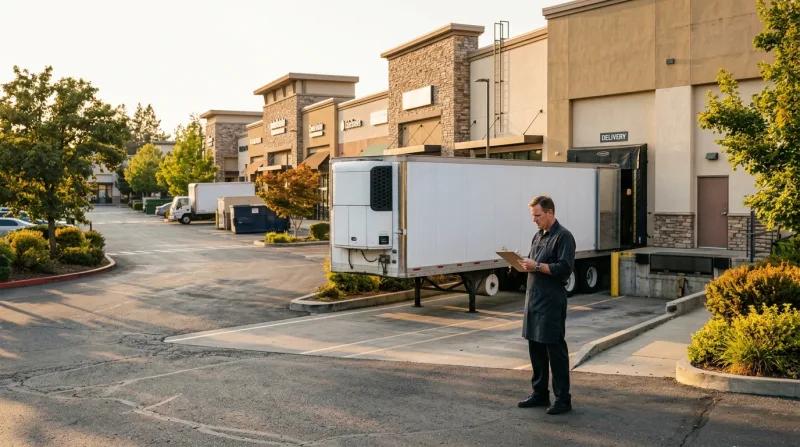
Permanent refrigeration often lands last in a construction sequence, and opening inventory does not wait. A temporary unit covers the gap and goes back when the built in box is signed off.
What ties these together is the clock. Nobody budgets a freezer trailer into next quarter. They reach for one the hour a compressor quits, or the evening before a party when the stack of rented ice chests suddenly looks laughably undersized. Since our units sit staged around Carlsbad instead of a couple counties down the freeway, "can I get it today" is an ordinary ask here, not a stretch.
Add it up the way an owner in Carlsbad has to. One restaurant walk-in routinely sits on a small fortune in proteins, dairy, and prepped product. Scale that to a grocery rack or a warehouse freezer bay and the exposure balloons. Now knock the power or the compressor out on a triple-digit afternoon, and that whole inventory is in jeopardy inside a few hours. Then stack on the sales you lose while the line sits dark and the wages you burn paying staff to triage what can still be saved.
Hold a pre-staged trailer up against that risk and it reads like cheap insurance, a fixed, predictable expense parked in front of a loss with no ceiling. That is exactly why the businesses that got stung once tape our number by the phone. There is never a second scramble, because the next time they dial before the product has a chance to warm. Owning every trailer ourselves means we can scale the answer to fit. A single compact box suits a corner cafe. A clustered setup covers a warehouse floor. Either turns around the same day.
Most of the year Carlsbad sits in a narrow band. The temperature usually runs between about 45 and 76 degrees and rarely climbs past 83, with roughly 263 sunny days a year measured at McClellan Palomar Airport. That mildness fools people into thinking refrigeration has an easy job here.
The tail is what gets kitchens. In September and October the wind turns around and blows offshore from the desert, the marine layer disappears, and coastal North County can run to 99 or 100 degrees. The station record is 107.5 degrees set in September 2010, and the October record is 104. Those are the days when a condenser that has been marginal all summer finally quits, and they land on the exact weekends when restaurants and event crews are busiest.
May and June have the opposite problem. The marine layer that locals call May Gray and June Gloom holds the coast overcast while Vista and San Marcos run 10 to 20 degrees warmer at the same hour. A caterer loading in the Village at 9 in the morning and serving inland at 4 in the afternoon is working two different climates in one day, and the trailer is what keeps the product from noticing.
The Carlsbad Village Street Faire is the biggest single day of food service in this city. It runs the first Sunday of May and the first Sunday of November along Carlsbad Village Drive, draws more than 100,000 visitors each time, and fields roughly 900 booths plus an international food court and a beer garden, with an entertainment stage as well. It has been running in the Village since 1975 and the Carlsbad Chamber of Commerce organizes it. Every food vendor on that closed street has to be at temperature by 8 in the morning and stay there until the last sale.
That is a cold storage problem before it is anything else. Booth space is small, power is limited, and there is no permanent refrigeration anywhere on the route. Producers who have done this a few times stage a central refrigerated trailer at the edge of the closure and let vendors pull from it through the day, which keeps ice chests from becoming the weak link at two in the afternoon. We deliver the day before the barricades go up, because once the street is closed nothing gets in.
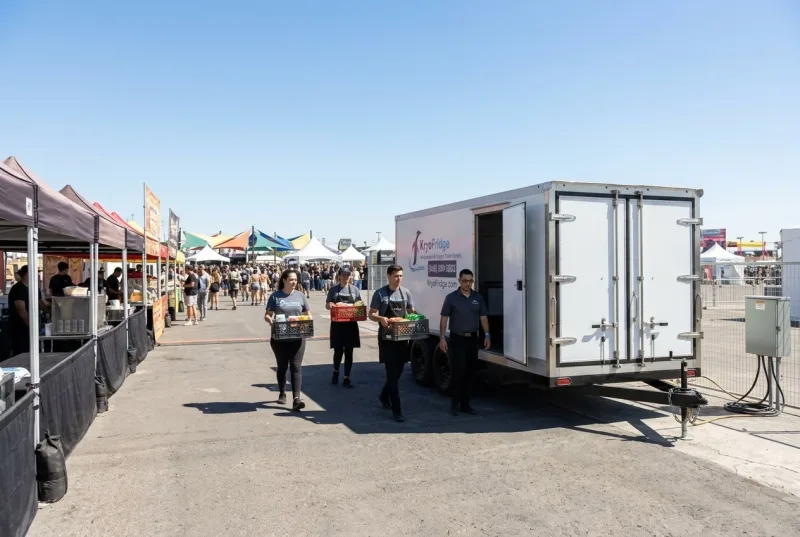
The rest of the Carlsbad event calendar works the same way. The Carlsbad 5000 runs each April with a start on Grand Avenue, a coastal stretch down Carlsbad Boulevard, and a downhill finish on Carlsbad Village Drive, and it has been held since 1986. The Carlsbad Marathon runs in January from Westfield Carlsbad on El Camino Real out along the Highway 101 beaches and lagoons. Add the Rotary Club Oktoberfest, the Fourth of July fireworks on the beaches, the weekly State Street Farmers' Market, and the NCAA Division I golf championships at Omni La Costa through 2028, and there is a food service crowd on the ground most months of the year.
Book event units early. Street Faire weekends and race weekends move a lot of equipment out of the yard at once, and the sites with the tightest access are the ones that need a delivery window planned rather than squeezed in. That means the beach bluffs and the Village alleys. Give us a call and we will put your date on the board before the season fills.
Carlsbad has a real frozen dessert trade. Handel's, Gelato.love, and Crispy Cones all work the Village district, and the beach corridor along Carlsbad Boulevard supports carts, kiosks, and event vendors from spring through October. That is a lot of product that has to stay hard in a city where the afternoon sun does not take a day off.
Ice cream is the least forgiving thing on this page. Product held warmer than about zero degrees starts to soften, and once it thaws and refreezes the texture is gone for good because of the ice crystals that form on the way back down. There is no fixing it after the fact and no serving it either. A dessert vendor either kept it hard the whole time or took the loss.
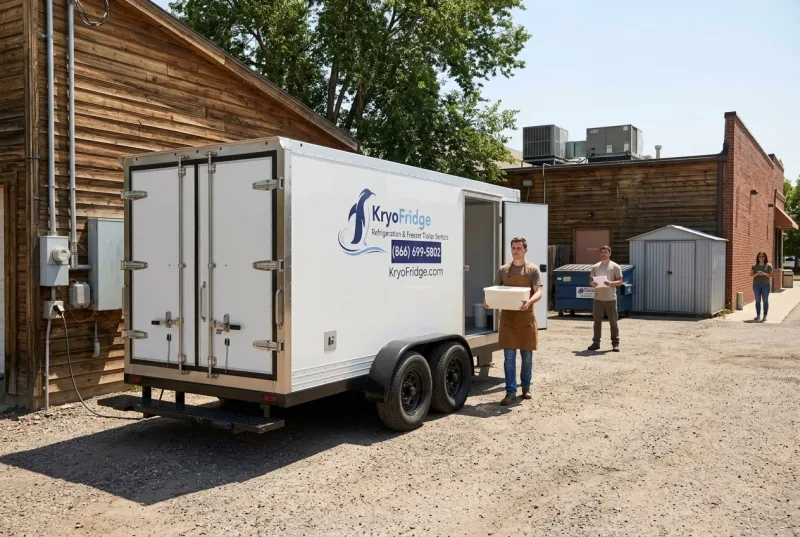
Our trailers hold set points from minus 10 degrees up to 50 degrees, so hard freeze is a setting rather than a special order. We pre chill the box before your product goes in, which means the first pallet never sits in a warm trailer waiting for the unit to catch up. On a hot delivery day that head start is the whole difference. The same unit can be turned back up to 34 degrees for dairy and mix the following week.
Placement matters as much as the set point. A trailer parked with its condenser against a west facing wall bakes all afternoon and works twice as hard. We put it where air moves, keep the coil clear, and think about where the door will face so your staff are not standing in full sun every time they load out. Ask us about your site and we will tell you where to put it.
SDG&E runs Public Safety Power Shutoffs across San Diego County during Santa Ana wind and red flag conditions. Recent events have peaked at just over 50,000 customers and have reached communities from Alpine, Julian, Ramona, Campo, Santee, and Poway to parts of Escondido and out toward Rancho Santa Fe. Restoration is not a switch. The utility has to record sustained lower wind speeds and then allow four to eight hours of daylight for crews to walk the lines looking for downed conductors, debris, and broken hardware before anything is re energized.
For a kitchen, that timeline is the entire problem. An outage that starts Tuesday night and clears Thursday afternoon is far longer than any walk in will coast, and the losses stack up while everyone waits for a phone call from the utility. A trailer running on a generator we provide does not care what the grid is doing. It gets dropped, plugged into its own power, and holds while the neighborhood sorts itself out.
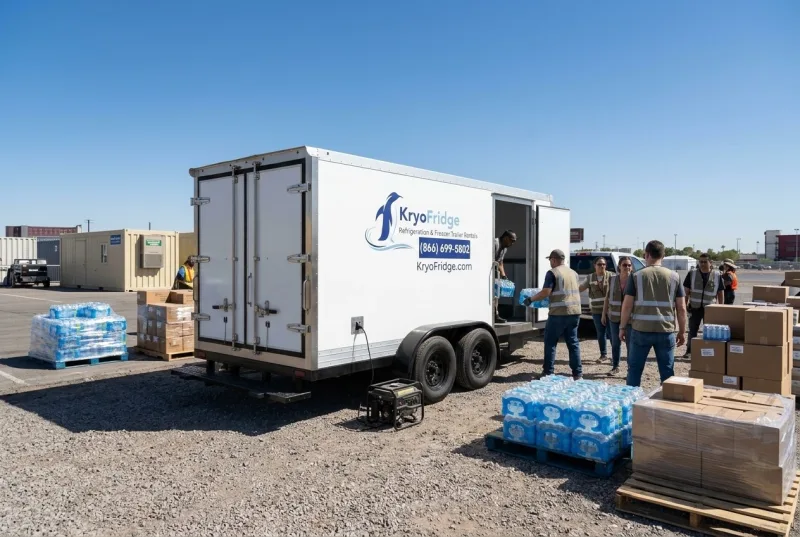
Quarantine and recall holds ride on the same equipment. When product has to come out of service and sit segregated until the disposition is documented, it cannot go back into the active box and it usually cannot be thrown out yet either. A lockable trailer parked on your property keeps that product at temperature, keeps it separate, and keeps it secure on an open lot overnight.
Wind events do not respect city lines, so when one runs down the coast the same dispatch desk that handles Los Angeles cold storage trailer rentals moves units toward whichever market took the hit. That is the practical benefit of a fleet this size. On the worst nights there are still trailers to send, and the Chick fil A crew that called us at 6:30 on a Friday with a dead walk in had one on site 34 minutes later.
"Cold" is not one number. Different product stays safe inside different temperature windows, which is the entire reason a precise digital set-point matters, and in the middle of a heat wave in Carlsbad, a load that slips out of its window is a load you write off. Use the chart below as the reference our customers lean on when they size a rental.
| Product | Target holding band | Trailer mode |
|---|---|---|
| Ice cream and frozen desserts | -10°F to 0°F | Deep freeze |
| Frozen proteins, seafood, prepared meals | 0°F or below | Freezer |
| Fresh meat and poultry (short hold) | 28°F to 32°F | Refrigerated |
| Dairy, deli, packaged produce | 34°F to 38°F | Refrigerated |
| Beverages, florals, catering trays | 38°F to 45°F | Refrigerated |
One figure outranks everything in that chart, and it is not listed there: 40°F. Food-safety guidance treats the band between 40°F and 140°F as the zone where bacteria thrive, and the clock on perishable product starts ticking the moment it crosses 40 on the way up. Roughly four cumulative hours above that line and most refrigerated inventory is no longer safe to serve. Picture that countdown running on a 100-degree afternoon in Carlsbad with the walk-in dark, and the urgency of a quick trailer drop stops being abstract.
Tell us the single coldest item you are holding when you call, and we dial the trailer to that. One unit carries a straight freezer load with no fuss. But when your list mixes deep-freeze desserts with fresh-cold produce for the same remodel or event, we will usually point you toward a split setup or a second box so neither side of the load has to settle for the wrong temperature.
Powering one of our trailers is refreshingly simple, and there are precisely two ways to do it. Either you have a dedicated 120-volt, 20-amp circuit reachable within roughly 100 feet of the parking spot, or we bring a generator. What the units will not accept is standard 208 to 240V building service, so a quick question about your outlet before dispatch heads off any surprise on delivery day.
On placement, all the unit really asks for is a fairly flat patch with enough room for the delivery truck to maneuver it in and set it straight, plus either a power source in reach or space for a generator. We lock down the exact drop point before dispatch, and our drivers know the Carlsbad layout cold, so the delivery is one clean trip instead of a guessing game on the property.
The call came in during dinner service with the cooler climbing and a full weekend of prep already in the box. We had a unit prepped and rolling that evening, dropped it in the rear lot off the alley, and had it pulled down before the kitchen finished cleaning. Saturday service ran on schedule and nothing went in the trash.
A Santa Ana pushed the afternoon into the 90s on a site with no shade, no kitchen, and a plated dinner for a few hundred people. We staged the trailer the day before so the crew could load straight from their Vista commissary in the cool of the morning. Every course went out at temperature and the client never knew how close the weather came to changing the menu.
The store stayed open through the project, which meant the whole perishable set had to move to the rear lot for several weeks. We set two units, one running as a cooler and one hard frozen, and swapped a unit mid project when the schedule stretched. Shrink for the period came in below what the store had budgeted for the job.
We plan the route around the lagoons before we plan the drop. Buena Vista, Agua Hedionda, and Batiquitos cut this city into bands, and there are only so many ways across them. Our drivers know which crossing to use at which hour, which Village alleys a trailer can actually turn into, and which shared retail lots need the property manager called first. That is why our delivery windows in Carlsbad hold up.
On a bad day, booking should be the part that does not add stress. Four steps, an upfront number, and a single person who owns the whole thing.
Tell us whether it is freezer or fridge product, a ballpark volume, and your rough window. That is enough for us to call the right size.
We pair you with a unit, confirm whether you have a dedicated circuit or need a generator, and pin the exact drop point so the truck makes one trip.
We arrive on your schedule, about 45 minutes for a true emergency, set the trailer, energize it, and let it drive down to your number.
It holds the set-point for your entire term while our line stays live the whole way through. Wrap up, and we swing back for the pickup.
Carlsbad food businesses are permitted and inspected by the San Diego County Department of Environmental Health and Quality, and the governing law is the California Retail Food Code. Under Health and Safety Code sections 113996 and 113998, potentially hazardous food must be held at or below 41 degrees or at or above 135 degrees. Section 114002 adds the cooling clock: from 135 degrees down to 41 degrees within six hours, with the drop from 135 to 70 happening inside the first two of those hours, and four hours to 41 degrees for items built from ambient ingredients. A trailer running at 34 degrees with real air movement pulls product through that window on schedule, which is exactly why kitchens use one during a big cook and chill.
At events the county rules get more specific and they work in your favor if you plan for them. Perishable food at a temporary food facility must be kept at 41 degrees or less, each booth needs a cold holding device capable of 45 degrees or less, and food may sit at 45 degrees for no more than 12 hours in any 24 during operating hours. Here is the part vendors feel: anything held between 42 and 45 degrees gets discarded at closing, while anything held at or below 41 degrees can go back to the commissary. Applications and fees are due at least 30 days before the event, with late fees inside 14 days. A central refrigerated trailer at 38 degrees is what turns a day of inventory into product you take home.
Heat rules cover your people at the same time. Cal/OSHA section 3395 requires one quart of drinking water per employee per hour for the whole shift and shade once the temperature passes 80 degrees, with high heat procedures kicking in at 95 degrees for construction, agriculture, landscaping, oil and gas, and heavy delivery work. Section 3396, operative since July 23, 2024, extends that indoors: it applies at 82 degrees, brings full requirements at 87 degrees or a heat index of 87, and requires cool down areas held under 82 degrees. Carlsbad kitchen lines clear 87 degrees on any Santa Ana afternoon. At the federal level, OSHA published a proposed heat injury and illness prevention rule in the Federal Register on August 30, 2024 covering general industry, construction, maritime, and agriculture, and the proposed rule would require every covered employer to build a plan for evaluating and controlling heat hazards. It is still a proposal, and planning around it now is cheaper than reacting to it later.
One caveat we always state plainly: we supply the food-safe, temperature-holding hardware itself, but we are not a temperature-logging or alarm-monitoring service. If your program requires continuous written records, line that vendor up on your own.
Our signature 16 foot Utility series leads the fleet. It is the trailer we send on most jobs, and crews like it for the side utility access door. We build three footprints in all, so a single kitchen holding overflow stock has a fit and so does a distribution floor in a disaster. Every unit is dual purpose by design: one adjustable system swings between freezer and refrigerator on a digital set point. Each trailer runs on a dedicated circuit or on a generator.
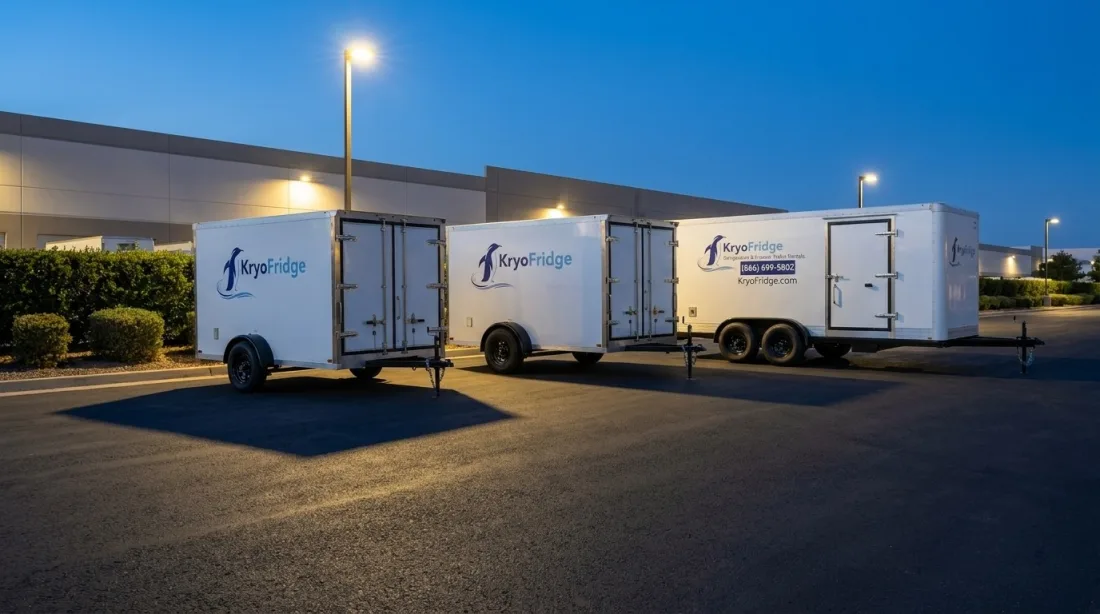
| Trailer | Best for | Temp range |
|---|---|---|
| 6x16 Utility ⭐ | Our signature series: distribution, large events, disaster response, side utility door | Heavy-duty reefer |
| 6x12 | Grocers, caterers, mid-size events | Deep-freeze capable |
| 6x8 | Tight lots, small kitchens, short overflow | -10°F to 50°F |
Each unit holds a precise digital set-point and runs on a dedicated 120V/20A circuit or a generator.
Think eight or so pallet spots, and the unit to grab when square footage is the whole problem. It slips into the pinched service yards and cramped back-of-house corners that a larger box cannot even swing into. One cafe or small-market walk-in goes down, and this is almost always enough cold to cover it, plus the simplest unit to set in a small space.
Call it fourteen pallet spots, deep-freeze rated, and far and away the size people ask for most. It lands right in the middle: roomy enough for a multi-day catering job or a restaurant that needs true walk-in-equivalent room while the kitchen is torn up. Roomy enough that nobody is playing Tetris with shelves, yet still small enough to set in most commercial back lots without a site survey.
Roughly twenty pallet spots paired with a heavy-duty reefer plant engineered to keep deep-freeze locked in even when the ambient air is merciless. Reach for it when a warehouse bay drops, when a large festival needs an anchor, or when a relief operation is carrying its own cold chain.
Not sure which size fits? Most customers land on the 16 foot Utility, and we will tell you honestly if a smaller footprint covers your job. Tell us roughly what you are storing and for how long, and we will spec it for you.
The questions that surface once the basics are settled. Tap any topic to open it.
The pop-up walk-in cooler. Cheap to rent and easy to set up, but it chills, it does not freeze, and it draws every watt it needs from your building while depending on a calm ambient temperature around it. The second your building loses power, your cooler loses it too.
The refrigerated box truck. Designed to haul product on the interstate, not to sit in a lot and babysit it. Parked, it idles fuel all day, broadcasts compressor noise across a storefront or an event lawn, and pins down a tractor plus a driver you probably do not need.
The freezer trailer we deliver. Built from the ground up to be dropped on a pad and to defend a temperature for as long as the job runs. It freezes deep, carries NSF approval, locks, stays quiet near guests, and lives on nothing more than one dedicated circuit or a generator.
Even a rented box has to satisfy the county environmental health office that licenses and inspects every food facility. Show an inspector a unit that cannot document its temperature or was not built for food contact, and they have the authority to halt service immediately.
That is a bar each of our trailers clears: NSF-approved throughout, food-safe interior surfaces, proper drainage, and a digital controller that puts the set-point in plain view. We supply the food-safe, temperature-holding hardware itself, but we are not a temperature-logging or alarm-monitoring service.
For a typical kitchen or market, one box does the job. Distribution floors, big fairs, and full-scale disaster response routinely need more, and because the fleet is ours, we can cluster several units and bring them online in waves as the work expands. Match the cold capacity to the operation rather than make the operation squeeze itself into one box.
The clock is yours to set. Some jobs are a handful of days for an emergency or a single event. Others stretch across weeks or months for a remodel or a seasonal swell, and a few become standing contracts for businesses that want capacity parked on standby. Name your window and you will get a clean quote, no penalty for an honest "not sure yet."
Building permanent cold storage is a capital project in every sense: you hire a refrigeration contractor, schedule the electrical, pull a building permit, and wait weeks before a single pallet goes inside. A rental turns that equation on its head. You bring in precisely the cold you need, for precisely the stretch you need it, and the trailer is holding temperature that same week, frequently that same day, with the commitment ending the moment your need is over.
Three engineered elements carry the load. Thick insulated panels and tightly gasketed doors lock the sun outside and the cold inside. A self-contained reefer condensing system specified with surplus capacity keeps stripping heat out of the box even when the air outside is brutal. And a digital thermostat locks onto your chosen number and cycles the compressor to hold the line. Run those three together and a trailer baking on open asphalt behaves like one tucked in a cool warehouse. That is also why power is the first thing we ask about: the design delivers its safety margin only on steady, uninterrupted power.
"Cut stems need steady cold and a little humidity, not a deep freeze, and this was the first rental company that actually understood that before I explained it. They set the unit to what my product needed and it held there all season. Vase life on our arrangements noticeably improved."
 Miranda L. · florist, Carlsbad Ranch
"Our anniversary weekend doubles the amount of keg and food product we have to hold and our cold room is not sized for it. One trailer in the back lot covered the whole thing. Easy setup, clean equipment, and they picked it up Monday morning right on schedule."
 Carol H. · taproom manager, Palomar Airport Road
"We stayed open through a refrigeration project that ran several weeks longer than planned. Two units in the rear lot carried the entire perishable set and they swapped one out mid project without any drama. Our shrink for the period came in under what we had budgeted."
 sara g. · store manager, El Camino Real
"A bluff site with no kitchen and a hot afternoon is exactly where catering goes wrong. The trailer went in the day before on matting so it did not sink into the turf, and the whole dinner service went out at temperature. My caterer now asks for them by name."
 Kj H. · wedding planner, Aviara
"Tournament weekends push us far past what the banquet kitchen was built to hold. They brought the unit in on the service road so no guest ever saw it, and it ran quietly all weekend. This is the third season we have used them and the equipment is always clean."
 JEANIQUA F. · banquet director, La Costa
"The county rules mean anything that drifts above 41 degrees gets thrown away at closing, and that used to cost us real money. Holding out of the trailer meant everything went back to our kitchen instead of the dumpster. Best decision we made all season."
 Greg R. · food vendor, Carlsbad Village Street Faire
"Our building is old and there was nowhere inside to add cold for the holidays. They squeezed a trailer into a rear space I honestly did not think a truck could reach. The driver knew the alley better than I did."
 Skip W. · bakery owner, the Barrio
"We replaced a freezer over summer break and had a full inventory that could not be allowed to thaw. The unit was delivered, plugged in, and down to temperature before we moved anything into it. Everything came through the project without a single case lost."
 Austin P. · school nutrition director, Carlsbad
"Berries picked at midday in June carry a lot of field heat and every hour they sit warm costs shelf life. Putting the box at the edge of the field cut that trip down to a few hundred feet. Our fruit held quality all the way to the weekend market."
 David O. · farm stand manager, Cannon Road
Sample reviews written to mirror genuine Carlsbad situations, to be replaced with verified Google reviews ahead of launch.
Set points run from minus 10 degrees up to 50 degrees on the same unit, so the trailer can be a hard freezer for ice cream and frozen protein or a cooler in the mid 30s for dairy, produce, and cut flowers. Recovery after the door has been open depends mostly on how long it stayed open and how much warm product went in, and a properly sized unit with a clear condenser pulls back down quickly. We pre chill the box before delivery so your first load goes into cold air rather than waiting on it, and we set the unit for your product before it leaves the yard.
There are exactly two ways to run one. Either a dedicated 120 volt, 20 amp circuit within 100 feet of the trailer, or a generator that we bring with the unit. It is not a 208 or 240 volt hookup, so you do not need an electrician to add service for a short rental. On beach sites, turf, and closed streets where there is no usable outlet at all, the generator is the normal answer and we plan for it when we quote the job.
Yes, and long term is a large share of what we do here. Grocery refrigeration projects, restaurant remodels, and resort kitchen renovations routinely run several weeks to several months, and the rate structure is built for that rather than treating it as a stretched day rental. We also handle schedule changes, because construction timelines move. If a project runs long, call us and we extend it rather than pulling the unit out from under you.
Yes. The usual setup is two units, one holding hard frozen and one in the mid 30s, because a single box cannot be two temperatures at once. That is common on grocery projects, large catering jobs, and any restaurant that lost both its walk in cooler and its freezer to the same failure. We have the fleet depth to send two or three units to one address, which is exactly what happened on a Mother's Day call where three trailers went out to hold pies, meats, and prepped product for one restaurant.
The units lock, and on open lots we position them so the door faces a wall, a fence, or your building rather than the street. In Carlsbad that usually means a rear lot off the alley in the Village, a back service area at a retail center, or inside the fence line on a business park property. Customers doing recall and quarantine holds rely on that, because the product has to stay separated and secured until the disposition is documented.
Dispatch is staffed 24 hours a day and swaps are part of the service, not an add on conversation. If a unit will not hold, we bring another one and move your product, which is the whole reason to rent from a company with the largest fleet in the region instead of a one-truck outfit. Carlsbad sits on routes we run daily, so keep our number by the phone in the office and use it.
Our trailers are NSF ready and hold well inside the county's requirements, which call for perishable food at 41 degrees or less and cold holding equipment capable of 45 degrees or less at each booth. The permit itself is yours to pull from the Department of Environmental Health and Quality, and applications are due at least 30 days before the event with late fees inside 14 days. What we provide is the equipment and the delivery timing that makes the temperature side straightforward. Bring your thermometer and log as usual, since we do not provide a temperature monitoring or record keeping service.
Size of unit, how long you need it, whether you need a generator, how far the drop is from our yard, and how difficult the site access is. A business park lot off Palomar Airport Road is a simple set. A bluff site on Carlsbad Boulevard with sand, a permit, and a tight turn takes more planning and more equipment. Call us with the address and the dates and we will put real numbers in front of you.
As early as you can. The first Sundays of May and November move a lot of equipment out of the yard at once, and April race weekend and January marathon weekend do the same. We also deliver event units the day before, because once the street closure goes up nothing gets in or out. If your date is on the calendar, get the trailer on the board now and adjust details later.
It needs a reasonably level spot, clearance for the truck to get in and back out, and either that dedicated 120 volt circuit within 100 feet or room for a generator. In the Village that is usually the rear lot or the alley, and the property owner rather than the tenant often has to sign off. At retail centers, keep it clear of fire lanes and trash enclosures. On turf we bring matting so the unit does not sink or scar the grass.
Deeper reading for local businesses, from the failure-hour playbook to compliance and seasonal planning. Tap any guide to open it.
Every food booth at a Carlsbad event, from the Village Street Faire to a race finish line to a school fundraiser, operates under a temporary food facility permit issued by the San Diego County Department of Environmental Health and Quality. The city does not run food inspections. The county does, and the rules are the same whether you are pouring beer at a brewery anniversary or plating tacos on a closed street.
The temperature core of those rules is short and worth memorizing. Perishable food has to be kept cold at 41 degrees or less, or hot at 135 degrees or more. Each booth needs a cold holding device, meaning a refrigerator, a freezer, or an ice chest, capable of holding food at 45 degrees or less. Food may sit at 45 degrees for up to 12 hours within any 24 hour period during the operating hours of the facility, which is the allowance that gets most vendors through a long day.
The most common mistake in temporary cold storage is treating a trailer as a single setting. It is not. The same unit that holds ice cream hard at minus 10 degrees will hold cut flowers at 34 degrees, and the difference between a good rental and a bad one is usually whether anyone asked what was going inside before the unit left the yard.
Start with the legal floor. The California Retail Food Code requires potentially hazardous food to be held at or below 41 degrees or at or above 135 degrees. That 41 degree line is a maximum, not a target. Setting a box at exactly 41 gives you nothing when the door opens, so working kitchens run their cold holding in the mid to upper 30s and treat 41 as the number they never want to see.
The two questions that decide whether a delivery goes smoothly in this city are where the unit will sit and how it will get power. Everything else is scheduling. Carlsbad has more site variety than a city its size usually does, from historic alleys to resort service roads to open bluffs, so it pays to work these out before the truck is on the road.
Power first, because it is the simplest. A KryoFridge trailer runs one of two ways: a dedicated 120 volt, 20 amp circuit within 100 feet of the unit, or a generator that we supply. It is not a 208 or 240 volt hookup and it does not require new electrical service for a short rental. If the nearest usable outlet is across a parking lot or shared with a compressor that is already loaded, the generator is the better answer and we plan for it up front.
Carlsbad has one of the mildest climates in the country and that is exactly why its refrigeration failures cluster. For most of the year the temperature runs between about 45 and 76 degrees and rarely passes 83, with roughly 263 sunny days measured at McClellan Palomar Airport. Equipment installed for those conditions is not tested hard, right up until it is.
In September and October the pattern flips. Offshore Santa Ana winds push down from the desert, the marine layer that normally caps coastal temperatures disappears, and North County can run to 99 or 100 degrees. The station record for Carlsbad is 107.5 degrees, set in September 2010, and the October record stands at 104. A condenser that has got by through August at 76 degrees suddenly has to reject heat into air 25 degrees warmer than it has seen all year.
Grab a quick, no-runaround quote, or ring our round-the-clock line for emergency cold storage anywhere across Carlsbad and the surrounding area.