
KryoFridge rents cold storage trailers to restaurants in the middle of a remodel, and we deliver them pre cooled, locked on your number, and ready to load. When the walk in comes out of the kitchen, your proteins, dairy, and prepped product do not have to come out with it. Our crews set units behind full service kitchens, on shared strip center pads, at second gen conversions, and at build outs still waiting on permanent refrigeration, in all 50 states. Call 866-699-5802 and we will size it with you on the phone, or send the quote request and we will call you back.
Licensed and insured | Largest Fleet in the West | 30+ Years in the rental business
KryoFridge is the refrigeration arm of a rental family that has been at this more than 30 years, and we run one of the largest dual purpose fleets of freezer and refrigeration trailers in the West. We own every unit in it. No broker sits in the middle, so the people who pick up the phone are the people who maintain the trailer, pre cool it, and put it on the truck. Kitchen renovation work is one of the handful of jobs we do most, and it shows in how short the call is. Tell us what is coming out, what day, and what is inside it, and we will name the trailer size that covers you. Licensed and insured, dispatch answers around the clock, and we deliver in all 50 states. Call 866-699-5802 and we will spec it right then, or send the quote request form and we will call you back.
Our trailers sit staged across our yards, fueled, pre-cooled, and maintained in-house, parked and waiting for the call rather than being hunted down after it. That is why an emergency call usually puts a unit on your lot and pulling temperature the same day.
The voice on the phone belongs to the same outfit that owns the trailer and sends the driver. No reseller in the middle quietly marking up somebody else's equipment while your inventory creeps past 40°F on the shelf.
Every unit is ours to own, service, and deliver, and each one swings between deep-freeze and fresh-cold on a precise digital set-point. So we size the answer to the job in front of us and turn it around fast rather than putting you on next week's list.
"Our walk in cooler came out on a Tuesday and the replacement was three weeks behind. The trailer was in the back lot that afternoon, already cold, and we never pulled an item off the menu."
"I run the job, so the food is not my department until it becomes my problem. One box in the corner of the lot meant the owner stopped asking me about his inventory every morning and let my crew work."
"We took over a second gen space and found out at walkthrough that the walk in compressor was finished. We had a rental on site before we opened and kept it five weeks while the new box was built."
References for Restaurant Remodels and Kitchen Renovations available on request.
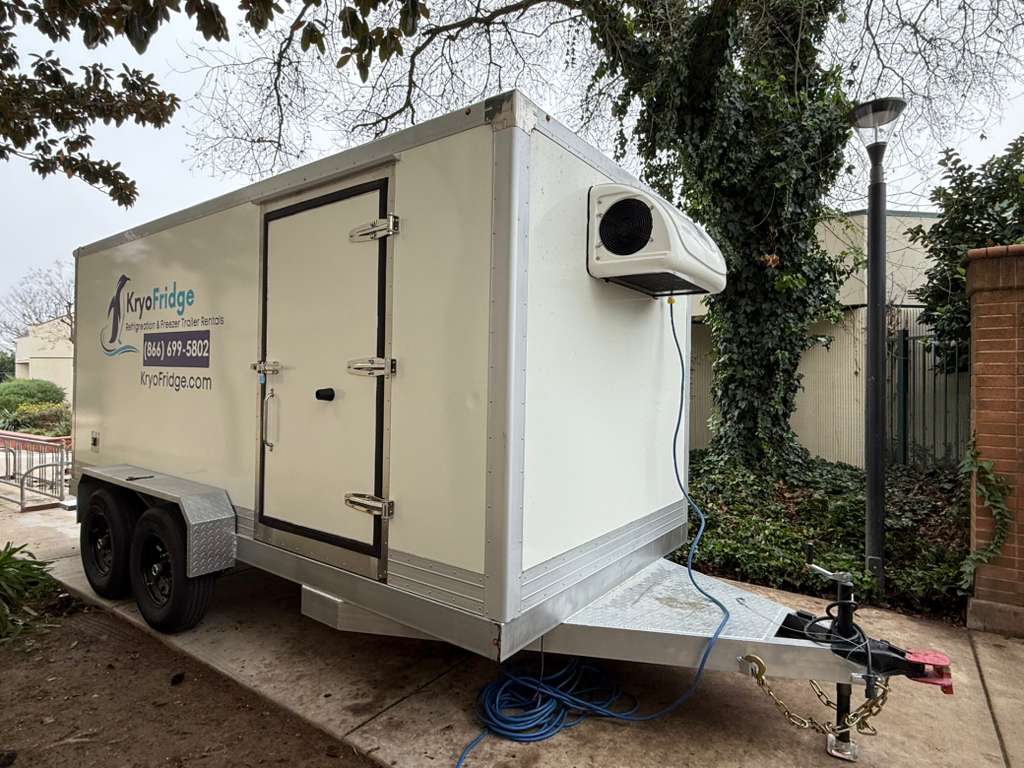
On a remodel the trailer is doing a walk in's job from a parking stall, which is why most restaurants end up on our 16 foot Utility. It is a self-contained refrigeration unit that carries real walk in volume and gives a cook a side door to grab one tray without opening the whole box to a hot lot.
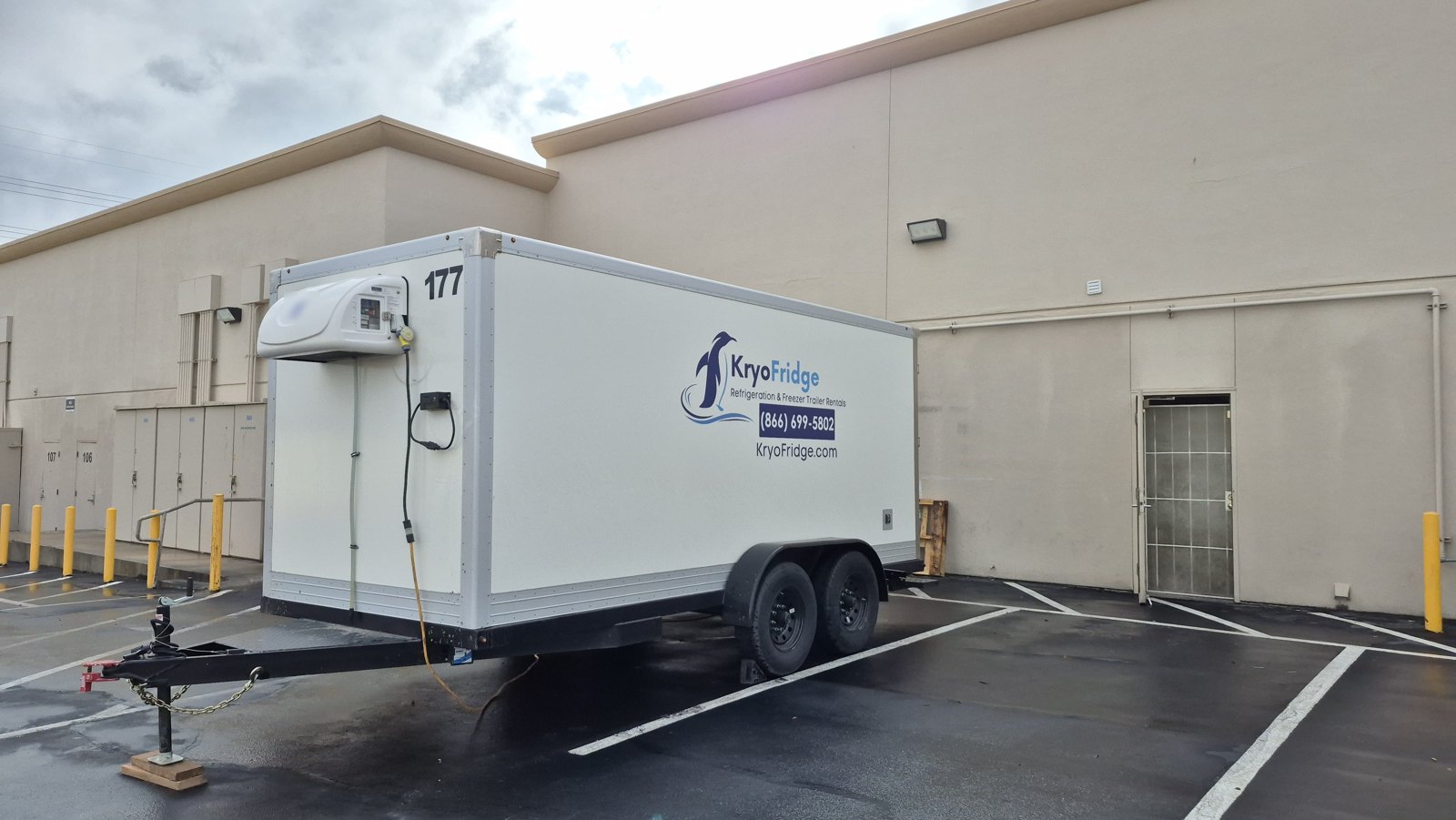
The 16 foot Utility holds anything from minus 10 degrees deep freeze up to about 50 degrees fresh cold on one digital set point, with NSF approved surfaces inside. That range matters more on a renovation than on almost any job we do, because a kitchen that loses its cooler and its freezer in the same week carries two loads at once. Rear double doors take pallet loads straight off a truck, and the third door on the side is the one cooks actually use, twenty times a shift, without dumping the cold air. We build three cold storage trailer sizes in all, and the 6x8 and 6x12 cover the smaller scopes.
Here is what it is like parked behind a working kitchen. The reefer plant cycles the way a rooftop condenser does, well under what a demo crew with a concrete saw is already putting into that lot. The box is white and clean. The floor drains properly. The interior is food safe for direct contact, the first thing an inspector looks at if one walks the site mid job. Staff learn the pattern in a day. Back door, twenty steps, side door, back in.
Getting it there is the part restaurants worry about and the part we have done most. Every unit is self-contained, with the refrigeration plant built into the trailer and nothing extra to stage on site. A tandem axle unit needs a flat patch and swing room for the truck, which on a strip center pad usually means giving up two or three stalls in a back corner instead of the front row. Power is either a dedicated 120 volt, 20 amp circuit within about 100 feet, or a generator we bring. These units are not wired for 208 to 240 volt building service, so we confirm your hookup before the truck rolls.
When the stakes are real, the 16' Utility is what we send. Sixteen feet of insulated, NSF-approved box on a tandem axle, running one precise digital set-point that covers deep freeze at -10°F all the way up to a 50°F cooler. The rear double doors handle pallet work off a dock, and the side utility door means a cook can pull one tray without letting the heat in.
The trailer that shows up is one of ours, prepped in our own shop, fueled and pre-cooled before it leaves the yard. It takes a dedicated 120V, 20-amp circuit or the generator we provide, and it will hold that set-point through a triple-digit stretch without drama.
| Spec | What you get |
|---|---|
| Temperature range | Roughly -10°F deep-freeze up to about 50°F fresh-cold |
| Mode | Dual-purpose: freezer or refrigerator on one precise digital set-point |
| Power | A dedicated 120V, 20-amp circuit within about 100 feet, or a generator we supply |
| Food safety | NSF-approved for direct food contact, food-safe surfaces, proper drainage |
| Footprints | 6x8, 6x12, and 6x16, from a tight retail lot to distribution scale |
| Backing | Owned in-house, fully licensed and insured, with 24/7 emergency dispatch |
Each unit holds a precise digital set-point and runs on a dedicated 120V/20A circuit or a generator. The trailers are not wired for 208 to 240V building service, so we confirm your hookup before the truck rolls.
One call sizes the trailer, sets the delivery window, and locks your quote. Call now, or send the quick quote request and we will call you.
A remodel is not one thing. A dining room refresh and a full kitchen gut share a word and almost nothing else. What actually separates them is how much cold storage walks out the door. These are the three scopes we get called on most.
Full service kitchens carry more refrigeration per square foot than any format we serve: a walk in cooler and a walk in freezer, a reach in at each prep station, a bar cold line, and banquet backstock. A gut job takes the two big boxes out first, because the floor drains and the hood work sit under and around them. That one morning removes more storage volume than everything else in the building combined.
The timeline is what gets restaurants. Nation's Restaurant News covered a renovation at a chain's original 1946 location in Hapeville, Georgia that ran nine months, with a dual lane drive thru, a rebuilt dining room, and sixteen historical artifacts preserved from the 1967 building. Nobody plans a nine month kitchen gap. But we see that shape at smaller scale constantly, where a job scoped at ten days turns into five weeks once equipment lead time and the permit queue stack up in sequence instead of side by side.
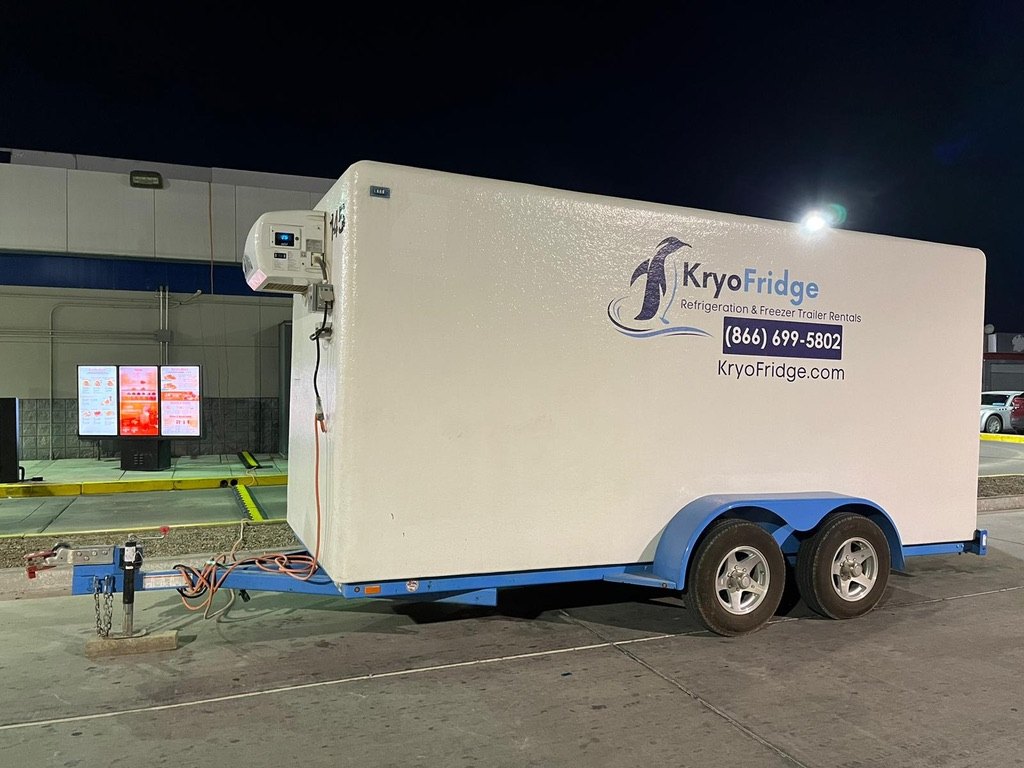
What we do differently is ask about the order of operations before quoting. If the cooler comes out Monday and the freezer comes out Thursday, that is one trailer on cooler temperatures for three days and then a second unit, not one box asked to do two jobs badly. If both go together, we point at a 6x16 and a 6x12 side by side so the deep freeze side never compromises for the produce. After enough of these, the first thing we ask about is not the volume. It is the sequence.
Placement at a full service building is the easiest of the three scopes. These are purpose built structures more often, with a rear alley or a loading dock, so the unit sits out of the customer's sightline. Alleys carry their own catch. An alley is frequently a public easement rather than private property, which turns placement into a city encroachment question instead of a landlord question. We raise it early, because that answer takes days.
Quick service kitchens concentrate their cold into fewer, denser boxes feeding a narrow, high velocity menu. That is the whole problem. Losing the one walk in at a QSR removes a much larger share of on site storage than losing one of four boxes at a full service concept, so there is no absorbing it internally. And the pressure to reopen is heavier, because same store sales comparisons do not pause while a unit sits dark.
Chains renovate for operational reasons now, not just cosmetic ones. Trade coverage of 2025 renovation trends reported dine in traffic up 1.2 percent in 2025 after 6.3 percent in 2024, takeout up 15.5 percent year over year, and remodel scopes widening to kitchen automation, digital menu boards, and higher efficiency HVAC. One national chain reported six percent growth in both sales and traffic at remodeled units, and another projected a two percentage point profitability lift from technology upgrades over two years. Those numbers get a remodel approved. They are also why the reopen date is not negotiable.
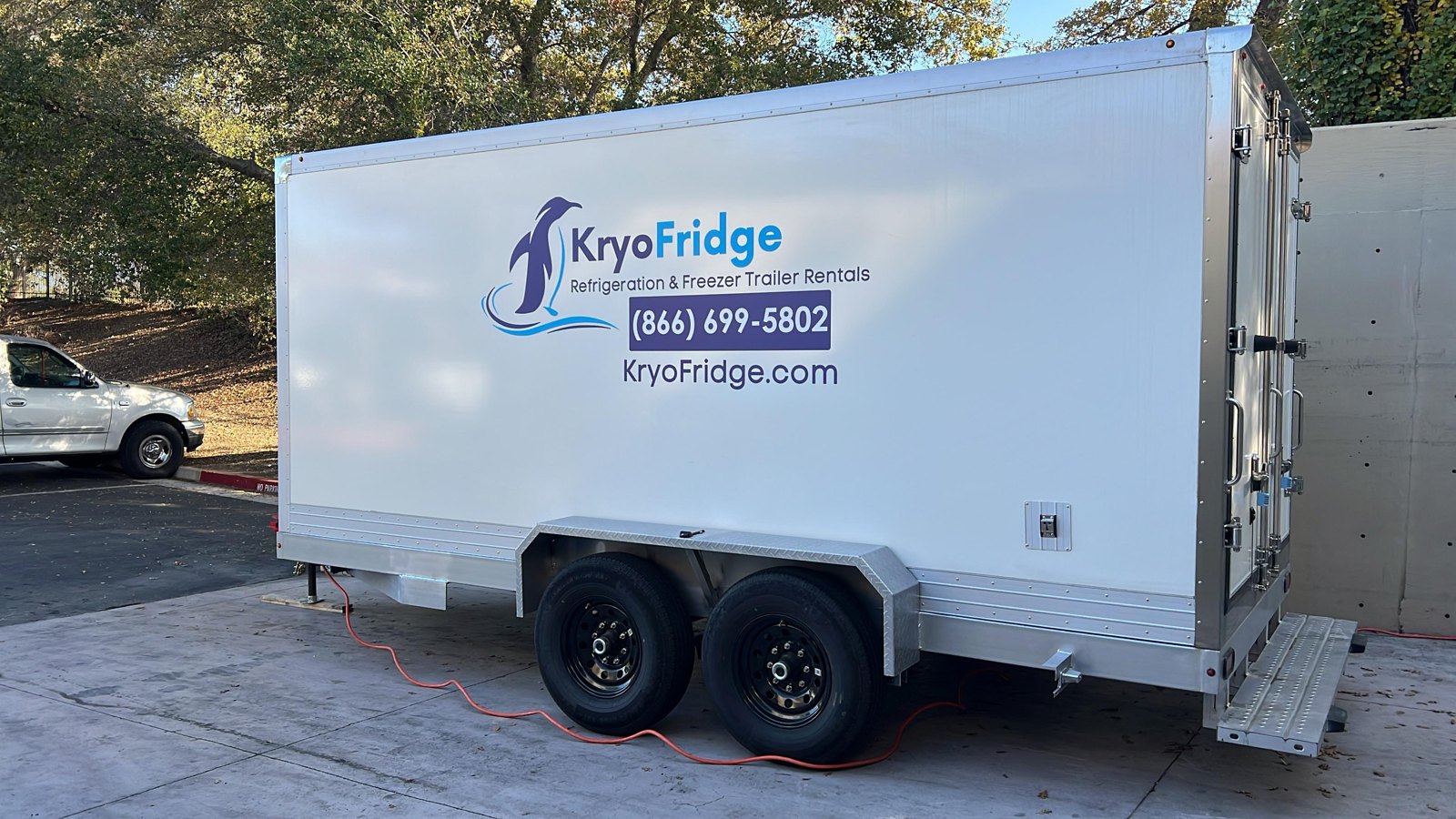
The lot is where quick service gets complicated. A strip center pad shares its parking with customers, a drive thru queue, and usually a property manager with an opinion about what parks there. We walk it before delivery and pick a corner that keeps the drive thru stack clear, leaves the accessible parking and its access aisle untouched, and lets a crew member reach the door without crossing the queue. That is the same discipline we bring to refrigerated trailer rentals for stadiums and concessions, where the crowd path and the service path cannot be the same path.
Power is the other quick service catch. A QSR panel already carries reach ins, point of sale, signage, and HVAC, and there is often no spare dedicated circuit idle. That is not a problem, it is a phone call. We bring a generator instead, and we tell the general contractor early so the fire prevention office hears about it before the unit shows up.
Converting an existing restaurant space costs roughly 1.5 to 2 times less than building from scratch, per a Restaurant Dive analysis of second generation space, because the expensive systems may already be there. The same piece is blunt about the catch. Unexpected reworking can eliminate the savings, and while stainless tables may be reusable, refrigeration and deep fryers require thorough evaluation. Both can look sound at walkthrough and need replacement after opening.
That line about refrigeration names the exact category that turns a fast reopen into a five week gap. An owner who thought they inherited a working walk in, and learns during due diligence that the compressor is at end of life, is in the same spot as somebody building from dirt. We get that call often enough that we now ask conversion customers one question up front. Has anyone put a gauge on the inherited refrigeration, or does it just feel cold?
New location build outs and ghost kitchen conversions are the same problem in different clothes. A brand standing up a delivery hub inside a shared commissary negotiates power panel capacity and dock access with a facility manager who has several other tenant kitchens, not with one landlord. Multi unit rollouts repeat that site by site. Permanent refrigeration lands last and opening day does not wait for it, so a rented box covers the overlap.
Equipment lead time is the quiet clock behind all of it. One walk in manufacturer runs an expedited program promising delivery in as little as 2 or 10 days, and trade coverage notes many customers still benefit more from standard custom built walk ins despite the longer wait. Read that backward and it tells you how long a standard build takes. Stack it against a plan check window measured in weeks and the slipped timelines stop being a mystery.
A remodel lot already holds a dumpster, a material stack, and six contractor trucks. Our job is to add a cold box without adding a problem.
We deliver before demolition whenever the customer lets us. A trailer dropped the day before the walk in comes out gets eight to twelve hours to pull down and stabilize, so product moves straight from one cold box into another with nothing warming on a prep table. The alternative is the call we get most, and it is not somebody planning ahead. It is somebody saying the walk in came out yesterday and the contractor just told them it is another two weeks.
Placement gets decided on the ground, and we walk it with the owner or the general contractor. Four things, in order. Can the truck swing the unit in and set it straight. Does the accessible route from the accessible parking spaces to the front door keep its full clear width for the whole rental, not just delivery day. Where does the condensate drain, and does it run near a storm drain or the grease interceptor the plumber is working on. And how many steps does a cook take from the back door at 11 at night. It is the same walk we do for San Antonio freezer trailer rentals and every other city we serve.
What goes wrong on these sites is almost never the refrigeration. It is access. A dumpster gets swapped and the new one lands in the trailer's approach. A property manager notices the unit in week two and asks for lease language nobody read in week zero. A generator ends up closer to a back door than the 20 foot clearance federal preparedness guidance calls for. Each is cheap to prevent on day one and expensive in week three.
Pickup is easy if the plan was made at the start. We want the new walk in commissioned and holding its temperature a full 24 hours before we haul the rental away, because a new unit that trips overnight leaves the kitchen where it started. Tell us the commissioning date and we hold the trailer through it. Extending two days is a phone call. Sending a second trailer back out after a failed startup is a much longer day.
Powering one of our trailers is refreshingly simple, and there are precisely two ways to do it. Either you have a dedicated 120-volt, 20-amp circuit reachable within roughly 100 feet of the parking spot, or we bring a generator. What the units will not accept is standard 208 to 240V building service, so a quick question about your outlet before dispatch heads off any surprise on delivery day.
On placement, the unit asks for a reasonably flat patch with enough room for the delivery truck to maneuver it in and set it straight, plus either a power source in reach or space for a generator. We lock down the exact drop point on the restaurant lot before dispatch, so delivery is one clean trip instead of a guessing game.
On a bad day, booking should be the part that does not add stress. Four steps, an upfront number, and a single person who owns the whole thing.
Tell us whether it is freezer or fridge product, a ballpark volume, and your rough window. That is enough for us to call the right size.
We pair you with a unit, confirm whether you have a dedicated circuit or need a generator, and pin the exact drop point so the truck makes one trip.
We arrive on your schedule, about 45 minutes for a true emergency, set the trailer, energize it, and let it drive down to your number.
It holds the set-point for your entire term while our line stays live the whole way through. Wrap up, and we swing back for the pickup.
Size it to what is coming out, not to the whole kitchen. The question we ask on every remodel call is which boxes go dark and for how many days.
| Scenario | Size of the job | Units |
|---|---|---|
| Single walk in cooler swap at a cafe or small market | one box out 3 to 10 days | 1 unit, 6x8 |
| Quick service refresh with the walk in out | one dense box, menu stays live | 1 unit, 6x12 |
| Full service kitchen gut, cooler and freezer both out | two walk ins, 4 to 8 weeks | 2 units, a 6x12 and a 6x16 |
| Second gen conversion, inherited refrigeration in doubt | no working walk in at handover | 1 unit, the 16 foot Utility |
| Multi unit rollout or ghost kitchen build out | capacity per site before permanent gear lands | 1 unit per site, usually the 16 foot Utility |
| Holiday overflow stacked on an active remodel | peak week volume, walk in already gone | 2 units, a 6x12 plus a 6x16 |
Start with pallet spots, because that is the unit every restaurant can estimate in thirty seconds. Our 6x8 holds roughly eight pallet spots, the 6x12 about fourteen, and the 16 foot Utility about twenty. Walk your existing box, count what is in it with speed racks included, and you will land close. Most single walk in swaps come out at one 6x12. Most full kitchen guts take two units, because the deep freeze load and the fresh cold load want different numbers and one box holds one.
What moves the count is rarely the volume. It is the split and the duration. A kitchen holding ice cream and frozen proteins alongside dairy, produce, and prepped dressings has two set points to satisfy, and California Health and Safety Code Section 113996 puts the refrigerated side at or below 41 degrees with no wiggle room worth gambling on. A three day gap can be absorbed with a tight box and disciplined staff. A five week gap needs room for deliveries to keep arriving on schedule.
Our honest default on a remodel is one size larger than the arithmetic says, because renovation timelines move in one direction. A box sized exactly to today's inventory has no room for the two produce deliveries that land in week three, and a kitchen that cannot accept a delivery starts ordering less, which shows up on the menu before the contractor is done.
Volumes above are working numbers our dispatchers use on the phone, not a guarantee. Tell us the coldest item on your list and roughly how much of it you are holding, and we will size the unit for you before anything is booked.
"Cold" is not one number. Different product stays safe inside different temperature windows, which is the entire reason a precise digital set-point matters. Use this chart the way our dispatchers do when they size a rental.
| Product | Target holding band | Trailer mode |
|---|---|---|
| Ice cream and frozen desserts | -10°F to 0°F | Deep freeze |
| Frozen proteins, seafood, prepared meals | 0°F or below | Freezer |
| Fresh meat and poultry (short hold) | 28°F to 32°F | Refrigerated |
| Dairy, deli, packaged produce | 34°F to 38°F | Refrigerated |
| Beverages, florals, catering trays | 38°F to 45°F | Refrigerated |
One figure matters more than everything in that chart, and it is not listed there: 40°F. Food-safety guidance treats the band between 40°F and 140°F as the zone where bacteria thrive, and the clock on perishable product starts ticking the moment it crosses 40 on the way up. Roughly four cumulative hours above that line and most refrigerated inventory is no longer safe to serve.
Tell us the single coldest item you are holding when you call, and we dial the trailer to that. One unit carries a straight freezer load with no fuss. When your list mixes deep-freeze product with fresh-cold product on the same job, we will usually point you toward a split setup or a second box so neither side of the load has to settle for the wrong temperature.
Our signature 16 foot Utility series leads the fleet. It is the trailer we send on most jobs, and crews like it for the side utility access door. We build three footprints in all, so a single kitchen holding overflow stock has a fit and so does a distribution floor in a disaster. Every unit is dual purpose by design: one adjustable system swings between freezer and refrigerator on a digital set point. Each trailer runs on a dedicated circuit or on a generator.
| Trailer | Best for | Temp range |
|---|---|---|
| 6x16 Utility ⭐ | Our signature series: distribution, large events, disaster response, side utility door | Heavy-duty reefer |
| 6x12 | Grocers, caterers, mid-size events | Deep-freeze capable |
| 6x8 | Tight lots, small kitchens, short overflow | -10°F to 50°F |
Each unit holds a precise digital set-point and runs on a dedicated 120V/20A circuit or a generator.
Think eight or so pallet spots, and the unit to grab when square footage is the whole problem. It slips into the pinched service yards and cramped back-of-house corners that a larger box cannot even swing into. One cafe or small-market walk-in goes down, and this is almost always enough cold to cover it, plus the simplest unit to set in a small space.
Call it fourteen pallet spots, deep-freeze rated, and far and away the size people ask for most. It lands right in the middle: roomy enough for a multi-day catering job or a restaurant that needs true walk-in-equivalent room while the kitchen is torn up. Roomy enough that nobody is playing Tetris with shelves, yet still small enough to set in most commercial back lots without a site survey.
Roughly twenty pallet spots paired with a heavy-duty reefer plant engineered to keep deep-freeze locked in even when the ambient air is merciless. Reach for it when a warehouse bay drops, when a large festival needs an anchor, or when a relief operation is carrying its own cold chain.
Not sure which size fits? Most customers land on the 16 foot Utility, and we will tell you honestly if a smaller footprint covers your job. Tell us roughly what you are storing and for how long, and we will spec it for you.
The number every restaurant knows is 41 degrees, and in California it is statute rather than a model code. Health and Safety Code Section 113996 requires potentially hazardous food held at or above 135 degrees or at or below 41 degrees, with a narrow 45 degree allowance for a short list: raw shell eggs, live shellfish, sealed pasteurized milk, vending machine food, farmers market samples, and food actively in transport. A remodel is not on that list. Temporary does not mean warmer. The state language mirrors the FDA Food Code 2022, which most states adopt in some form.
The phrase that confuses people is temporary food facility, and it is narrower than it sounds. Section 113930 defines it as a facility approved by the enforcement officer operating at a fixed location for the duration of an approved community event or swap meet. Section 114343 follows from that, allowing potentially hazardous food at such a facility to be held at up to 45 degrees for up to 12 hours, after which it must be destroyed in a manner the enforcement agency approves. Section 114341 adds that preparation happens inside the facility or another approved one. None of that describes a permitted restaurant storing its own inventory during a renovation.
In practice a restaurant using a rented box for its own product is usually treated as an extension of the permanent food facility permit it already holds. Section 113849 defines a permanent food facility around storing, preparing, serving, manufacturing, packaging, or otherwise handling food at retail, and storing is right there in it. A storage only refrigerated trailer with no sales also sits outside the mobile food facility definition in Section 113831, which is written around vehicles that sell food. That makes the conversation simpler than a food truck's. It does not make it disappear. Section 113709 preserves local authority to add requirements and enforcement, so the answer varies county to county. Call your environmental health division and get it in writing.
Two more rules decide where the unit can physically sit. The 2010 ADA Standards define a path of travel as a continuous, unobstructed way of pedestrian passage, including sidewalks, curb ramps, and parking access aisles, and the U.S. Access Board puts the minimum clear width on an accessible route at 36 inches. A trailer cannot narrow that route below 36 inches and cannot touch a marked accessible space or its access aisle at all. On generator power, keep the unit outdoors and at least 20 feet from windows, doors, and attached garages per federal preparedness guidance, then confirm with the local fire prevention office, which holds authority over a generator sitting on a lot for weeks rather than hours.
Potentially hazardous food held at or above 135 degrees or at or below 41 degrees, with a narrow 45 degree list that does not include remodels
Plan review within 20 working days, with a 20 business day timeline called out for restaurant tenant improvements
Defines a temporary food facility as a community event or swap meet operation, and caps its holding at 45 degrees for 12 hours before disposal
Puts food storage inside the permanent food facility definition and keeps a trailer used only for storage outside the mobile food facility category
An unobstructed accessible route of at least 36 inches clear width, with accessible spaces and their access aisles kept clear
Preserves local authority to add requirements and enforcement, which is why the permitting answer varies county by county
We confirm placement, power, and the accessible route with the site contact before the truck rolls.
One caveat we always state plainly: we supply the food-safe, temperature-holding hardware itself, but we are not a temperature-logging or alarm-monitoring service. If your program requires continuous written records, line that vendor up on your own.
Without a rental, restaurants fall back on four things, and we have watched customers try all four in one week. They rent portable coolers and reach ins piecemeal, which rarely reaches real walk in volume and multiplies the boxes somebody has to hold at 41 degrees. They buy ice and use chest coolers, which covers a two day gap and falls apart over a weekend when nobody is in the building. They shuttle product to a sister location, which only works if there is one nearby with spare room and adds a transport temperature question nobody wants to answer to an inspector. Or they throw it out.
That last one is the expensive option, and the margin math says so without a price appearing anywhere. Food cost runs roughly 28 to 32 percent of revenue at most concepts, and waste is a direct driver pushing real food cost above target. The National Restaurant Association's 2025 operations data puts median income before taxes at 2.8 percent of sales for full service and 4.0 percent for limited service, with prime cost at a median 65 percent of sales in limited service and payroll and benefits alone at a median 36.5 percent in full service. A loaded walk in represents something on the order of ten times a full service restaurant's median monthly margin, in one box nobody planned for.
There is a clock too, and it is shorter than people think. Federal preparedness guidance says a sealed refrigerator holds safe temperature about 4 hours without power, and a full freezer about 48 hours if the door stays shut. A walk in being physically removed offers none of that grace period, because the box is gone, not just unpowered. That is the difference between an outage and a remodel. It is also why St. George cold storage trailer rentals get booked before demolition instead of after it. With 42 percent of restaurants reporting they were not profitable last year, a preventable inventory loss is not a rounding error.
Bars compare the exposure, not the invoice. We never quote a number on a web page, because the right answer depends on the size of the unit and the length of the rental. Call and we will price your job in one conversation.
The scope was a hood replacement and new floor drains, which meant the cooler and the freezer both had to come out to reach the slab. The owner called the Thursday before demolition with a firm date from the contractor. We set a 6x16 on the deep freeze side and a 6x12 on cooler temperatures in the rear alley the day before, both pulled down overnight, and the kitchen moved product across in one morning. The job ran eleven days past estimate and we extended twice by phone. The restaurant never closed and never dropped a menu item.
The panel here was already committed, so there was no dedicated circuit to give us and we brought a generator. That turned placement into a three way call with the property manager and the local fire prevention office two weeks before delivery, which is exactly when that call should happen. We ended up in the back corner of the lot, clear of the drive thru stack, twenty plus feet off the building, accessible spaces and access aisle untouched. The general manager's only complaint was the walk to the box at midnight, so we moved it twelve feet in week two.
The group signed on a second gen space specifically because the refrigeration was supposed to convey, and a technician put a gauge on the walk in during the punch walk and gave it weeks, not years. That is the scenario the trade press warns about, where refrigeration looks sound and is not. They called on a Tuesday and we had a 16 foot Utility on the pad Wednesday afternoon, ahead of the health department's preopening inspection. They opened on schedule and kept it five weeks while the replacement box was built.
Often yes, and the deciding factor is usually cold storage rather than cooking equipment. A dining room refresh or a front of house rebuild can happen while the kitchen keeps working. The moment the walk in comes out, the question becomes where your product lives. A rented trailer in the lot is what lets most restaurants hold a full menu through a scope that would otherwise force a closure.
Longer than the demolition estimate, because two outside clocks run behind it. Plan check for a restaurant tenant improvement carries a 20 business day statutory review timeline under California Health and Safety Code Section 114380. Equipment lead time is the second clock, long enough that at least one manufacturer built an expedited program promising delivery in as little as 2 or 10 days to compete with its own standard build. Those two often run in sequence rather than side by side.
It depends on where it sits and which county you are in. Placement entirely inside a private parking lot is usually a lease question plus the ADA access rules. An alley, a curb lane, or any public right of way generally needs an encroachment or revocable permit from the city. Section 113709 preserves local authority to add requirements, so call your environmental health division and your city before the unit ships.
Usually not, and the distinction matters. Section 113930 defines a temporary food facility around approved community events and swap meets, and Section 114343 is what caps that category at 45 degrees for 12 hours. A permitted restaurant storing its own inventory is normally treated as an extension of its permanent food facility permit, and Section 113849 puts storing food inside that definition. Your local inspector makes the call, so ask first.
There are exactly two ways to power our units. One is a dedicated 120 volt, 20 amp circuit within about 100 feet. The other is a generator we supply. These trailers are not wired for 208 to 240 volt building service. At a quick service site with a committed panel a generator is the normal answer, and we flag it early so the fire prevention office and the property manager both know before delivery day.
Not if we place it correctly, and that is a decision we make on foot with you. The 2010 ADA Standards define the path of travel as a continuous, unobstructed way of pedestrian passage, and the minimum clear width on an accessible route is 36 inches. We hold that route at full width for the entire rental and never touch a marked accessible space or its access aisle.
A single walk in swap most often lands on the 6x12, about fourteen pallet spots. A full kitchen gut with cooler and freezer both out usually takes two units, commonly a 6x12 plus the 16 foot Utility at roughly twenty pallet spots. Tight lots and small cafes take the 6x8. On the line between two sizes, take the larger one.
Yes, and it is a common booking. Permanent refrigeration is typically the last thing commissioned at a new site, and the opening date rarely waits for it. A rented box covers the overlap, which on a multi unit rollout means one unit per site on a staggered schedule. Inside a shared commissary, dock access and power capacity get negotiated with the facility manager, so start early.
Deeper reading for local businesses, from the failure-hour playbook to compliance and seasonal planning. Tap any guide to open it.
Most restaurants build a remodel schedule backward from the reopen date. Build it forward from the equipment order instead, because the walk in is the only item on the job with two external clocks attached, and neither belongs to your contractor.
Clock one is the permit. California Health and Safety Code Section 114380 sets a 20 working day plan review timeline, with a 20 business day window called out for restaurant tenant improvements. Clock two is manufacturing. Standard custom built walk ins take long enough that at least one manufacturer sells an expedited program promising delivery in as little as 2 or 10 days. Run those two in sequence and you have two months of calendar before a box is on a truck.
So work in this order. Confirm the equipment order with a firm ship date. Submit for plan check the same week. Set the demolition date backing up from the ship date rather than forward from today. Book the rental to land the day before demolition so it has overnight to pull down.
Further reading: California Health and Safety Code Section 114380.
Restaurants schedule major kitchen work around their own slow season where they have the flexibility, and for a lot of concepts that is the weeks right after the winter holidays. January into February is soft for sales at most formats, and it also tends to be when lease renewals and franchise reinvestment obligations come due.
That timing is good for revenue and mixed for the lot. A January job in coastal Northern California, Oregon, or Washington means wet season placement, and wet season placement means footing. A gravel corner that holds a tandem axle unit fine in August can rut badly in February, and a trailer out of level is a trailer whose condensate does not drain right. We check the surface before we set.
Summer jobs trade that for a different problem. Desert work in Nevada and Arizona puts real heat load on the unit, which means more compressor run time and, on generator placements, more fuel. The equipment handles it. What changes is the planning. In a triple digit week the overnight pull down before a swap matters more.
Most of what goes wrong with a rental on a renovation site is decided in the ten minutes before the unit is booked, not during the weeks it sits there. This is the list we walk through with restaurants, and it is short on purpose.
Start with the product questions. What is the single coldest item you will hold, and does anything in the load need a different number? How many pallet spots, counting speed racks and sheet pan racks, are in the box coming out? Are deliveries continuing on their normal schedule, and is there a catering contract or a holiday week inside the rental window? Those four answers pick the size and the count.
Then the site questions, which matter more. Who owns the lot, and does the lease say anything about what parks there and for how long? Where are the marked accessible spaces, and what is the exact path from them to the front door? Is there a dedicated 120 volt, 20 amp circuit within about 100 feet, or are we bringing a generator?
The same trailers, dialed in for a different load. These are the operations we cold-store for most often.
We run the same trailers for temporary cold storage for Food banks and food recovery, cold storage trailer rentals for Hospitals and healthcare, refrigerated trailer rentals for Schools and universities, freezer trailer rentals for Meat processing and hunting season and mobile cold storage for Stadiums and concessions.
Cold storage trailers for distributions, recovery routes, and disaster feeding operations.
Freezer and refrigeration trailers for hospital kitchens, dietary departments, and facility projects.
Temporary cold storage for campus dining halls, central kitchens, and summer renovation windows.
Refrigerated trailer rentals for processors, lockers, and the seasonal volume that overruns them.
Cold storage for concession stands, event kitchens, and game day volume a venue cannot hold.
We deliver nationwide, and we keep crews and staged trailers in the markets below. If your site is somewhere else, call us anyway. We move units.
Our busiest service area markets include refrigerated trailer rentals in San Antonio, freezer trailer rentals in St. George, mobile cold storage in Spokane, portable refrigeration units in El Paso and temporary cold storage in Tacoma, each with its own staged trailers and its own drivers.
A dense independent restaurant scene with constant kitchen turnover and second gen conversions.
Fast growing dining corridors where summer heat makes an unplanned cold storage gap expensive.
Wet season placements where footing and drainage decide where the trailer can sit.
Desert heat load on generator powered units parked through a multi week kitchen job.
Older downtown buildings where alley placement turns into a city right of way question.
We also route trailers to these markets:
Coverage runs to all fifty states. Emergency work, disaster response, and long-term holds travel the furthest, and the metro markets above are simply where a trailer is closest to your gate on an ordinary Tuesday.
Grab a quick, no-runaround quote, or ring our round-the-clock line. We deliver nationwide, and an emergency call gets a person, not a queue.