
KryoFridge rents refrigerated and freezer trailers to stadium concessions teams and event food crews in all 50 states, and we own every one of them. The unit shows up pre cooled and already holding the set point you asked for, running on a generator we bring or on a dedicated 120V, 20 amp circuit within about 100 feet. Most game day work lands on the 16 foot Utility, our flagship, though plenty of single stand jobs are covered by a 6x8 or a 6x12 and we will tell you so. Call 866-699-5802 or send the quote request and we will size it with you today.
Licensed and insured | Largest Fleet in the West | 30+ Years in the rental business
We have been in the equipment rental business for more than thirty years, and the cold side of it grew up around kitchens that are not allowed to stop. Event food is the sharpest version of that. Gates open at a set time and the crowd arrives all at once. Nobody gets to tell sixty thousand people to come back Tuesday. We run one of the largest dual purpose fleets of freezer and refrigeration trailers in the West, and we own every unit on it. No broker sits in the middle marking up somebody else's equipment. The same trucks and the same drivers stand behind our freezer trailer rentals in Arlington and behind every other market we cover. Call 866-699-5802 and a dispatcher picks up, day or night, or send the quote request form and we will come back with a size and a delivery window.
Our trailers sit staged across our yards, fueled, pre-cooled, and maintained in-house, parked and waiting for the call rather than being hunted down after it. That is why an emergency call usually puts a unit on your lot and pulling temperature the same day.
The voice on the phone belongs to the same outfit that owns the trailer and sends the driver. No reseller in the middle quietly marking up somebody else's equipment while your inventory creeps past 40°F on the shelf.
Every unit is ours to own, service, and deliver, and each one swings between deep-freeze and fresh-cold on a precise digital set-point. So we size the answer to the job in front of us and turn it around fast rather than putting you on next week's list.
"Our walk in quit on a Thursday and we had a sellout Saturday. They had a trailer on our dock the next morning, already cold, and we loaded straight into it. Nobody in the stands knew anything had happened."
"Club level is the smallest cold storage in the whole building and the least forgiving. We park a trailer at the dock for every big night now. It changed how we plan a buyout."
"We had 24 food booths and not one of them had real cold storage. One shared trailer behind the row gave the health inspector a single place to check and gave me one less thing to worry about for three days."
References for Stadiums and Concessions available on request.
The 16 foot Utility is the trailer KryoFridge sends to most stadium and fairground work. Sixteen feet of insulated box carries a real surge, and the side door keeps a runner from walking around the back of the box on every trip.
Every unit we build is dual purpose. One adjustable system swings from about 50F fresh cold down to roughly -10F deep freeze on a digital set point, so the same box that held frozen novelties for a Saturday fair can hold cases of canned drinks and deli trays for a Tuesday concert. Tell us the coldest item on your list when you call and we set it to that number before it leaves the yard. It arrives at temperature, not on its way there.
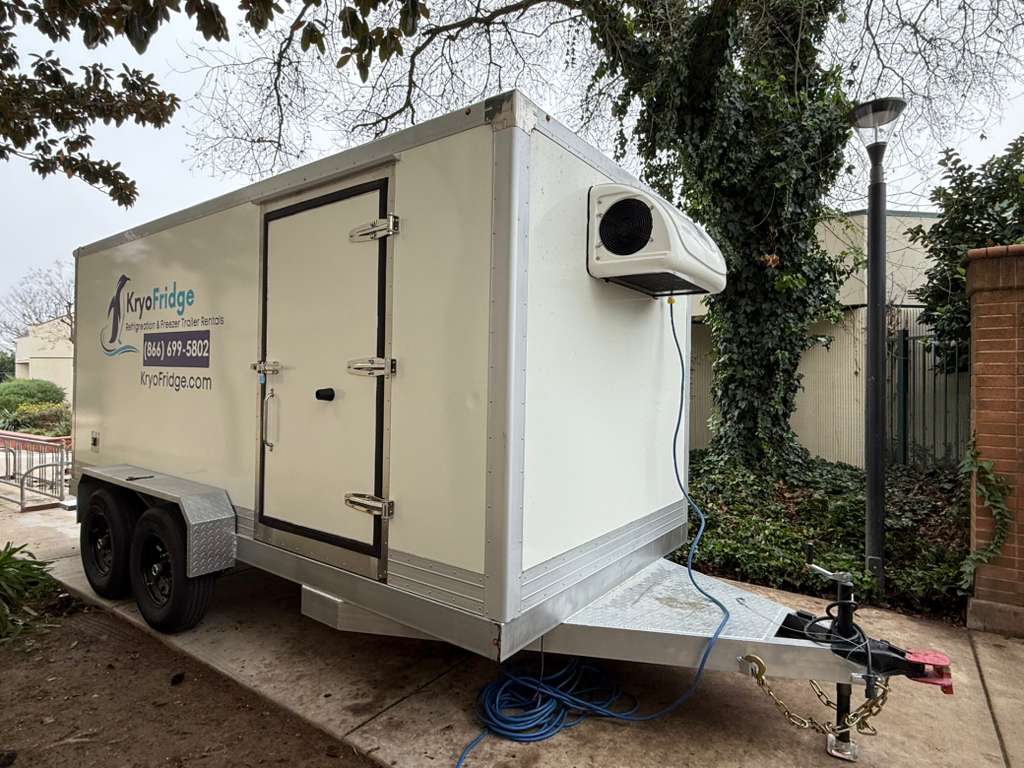
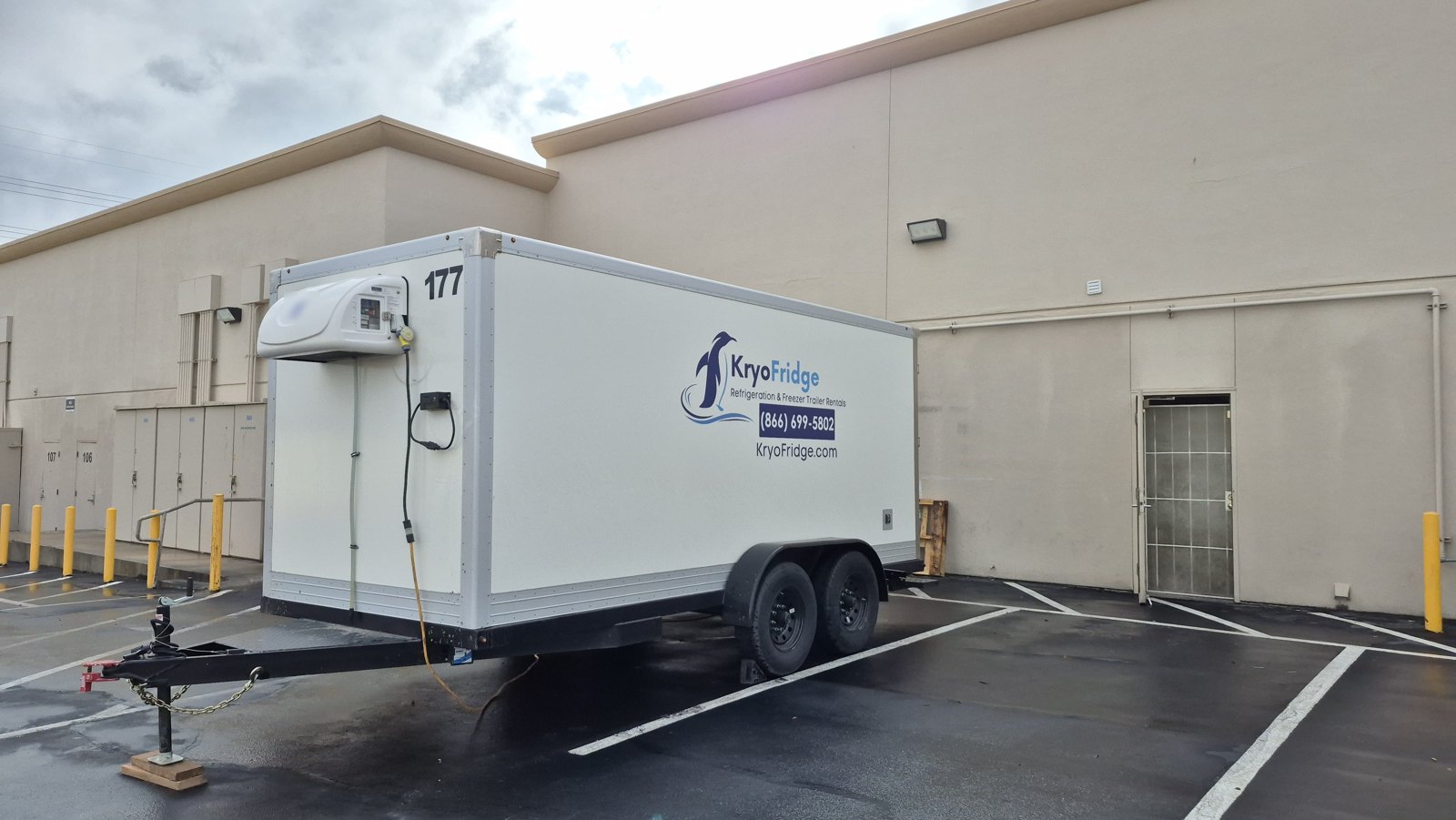
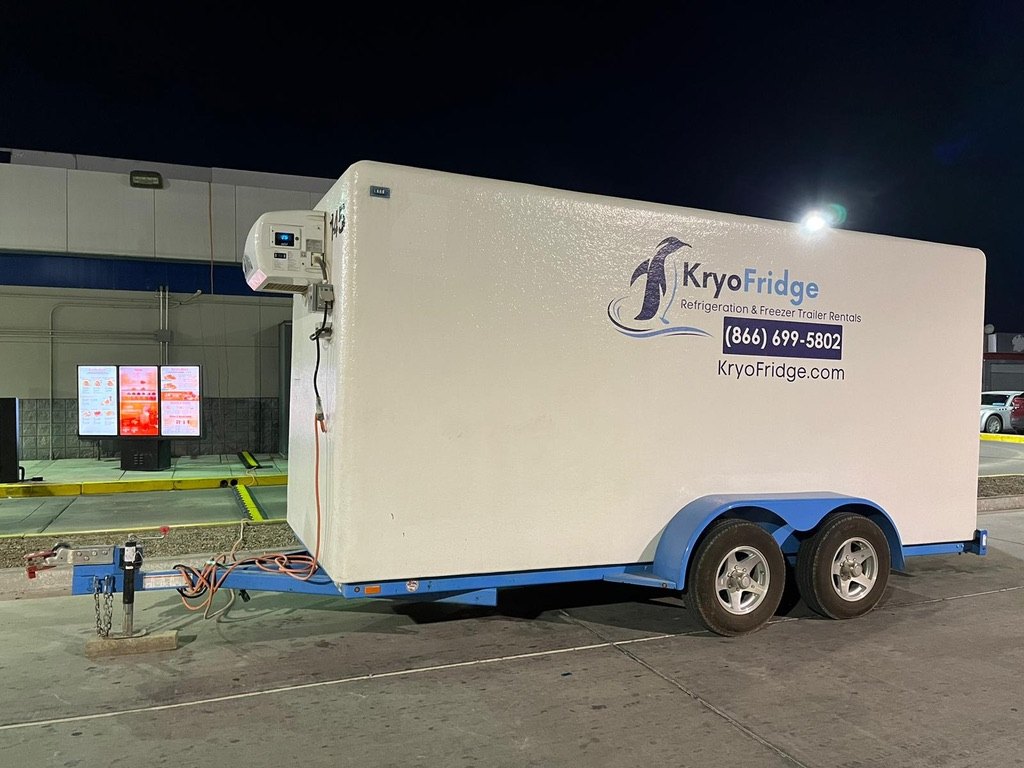
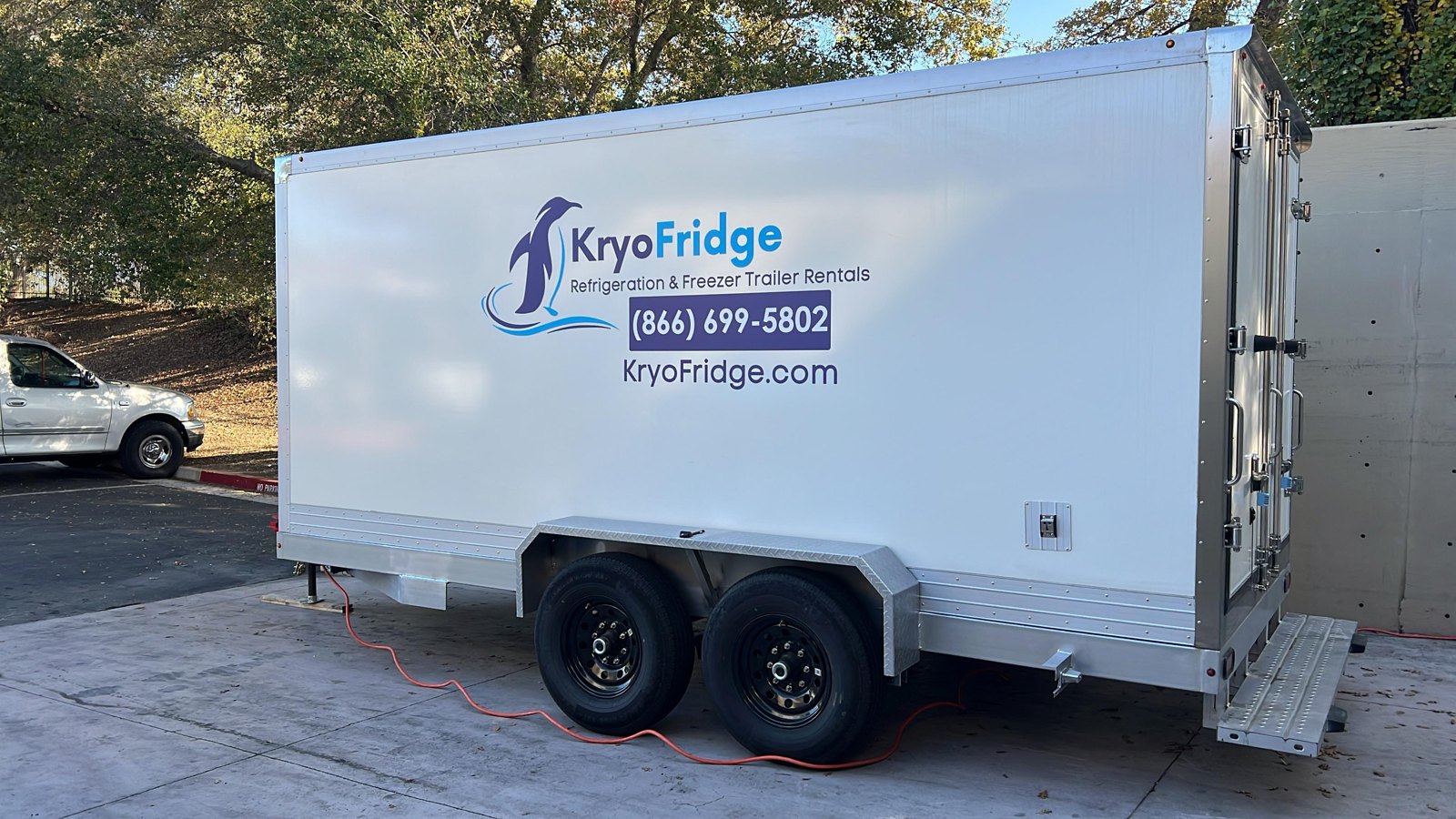
It is a plain white insulated box on a tandem axle, and that matters more than it sounds. Nothing about it reads as back of house clutter when it sits beside a hospitality tent or on a plaza inside public view. The box is sealed and food safe inside, with proper drainage and a floor that takes a hand truck. Interior lighting means a runner grabbing two cases at halftime is not working by phone flashlight.
Getting it to you is our truck and our driver, not a drop ship. We tow it in and back it to the dock, or set it curbside where you point. Then we level it and get it running on your circuit or on a generator we bring and fuel. Our crews have set trailers in loading docks with a fourteen foot ceiling and in gravel lots with no power for a quarter mile. We ask about the last hundred feet of the approach before we ask about anything else.
The 16' Utility earned its flagship spot the hard way, on jobs where a few degrees of drift would have cost somebody their inventory. The box is 16 feet long and fully insulated, riding on a tandem axle. The interior is NSF approved. One digital set point covers everything from -10°F frozen storage to a 50°F produce cooler. There are two ways in: rear double doors for pallets, and the side utility door for everyday grab-and-go.
Because we own and service the entire fleet, the trailer on your lot was prepped in our yard, not scrambled together after your call. It lives on a dedicated 120V, 20-amp circuit or a generator we supply, and it keeps its temperature whether the job runs a weekend or a full season.
| Spec | What you get |
|---|---|
| Temperature range | Roughly -10°F deep-freeze up to about 50°F fresh-cold |
| Mode | Dual-purpose: freezer or refrigerator on one precise digital set-point |
| Power | A dedicated 120V, 20-amp circuit within about 100 feet, or a generator we supply |
| Food safety | NSF-approved for direct food contact, food-safe surfaces, proper drainage |
| Footprints | 6x8, 6x12, and 6x16, from a tight retail lot to distribution scale |
| Backing | Owned in-house, fully licensed and insured, with 24/7 emergency dispatch |
Each unit holds a precise digital set-point and runs on a dedicated 120V/20A circuit or a generator. The trailers are not wired for 208 to 240V building service, so we confirm your hookup before the truck rolls.
One call sizes the trailer, sets the delivery window, and locks your quote. Call now, or send the quick quote request and we will call you.
Stadium food is not one job. Three of them cover almost everything we deliver into this work. Each one calls for a different size. Each one runs on its own power plan. Each one lands on its own arrival time.
A concourse walk in is built and permitted for an average night, not for the biggest date on the calendar. That is a structural fact about how buildings get designed, not a planning failure by the food team. Every season has a rivalry game or a playoff push or a one off booking that runs well past average, and the built in box is the same size it was in April. Cold storage sized to the season's biggest date is the actual fix, and it is the reason concessions teams stage one instead of trying to cram a sellout into a cooler sized for a Tuesday.
The volume is real. A mid range ballpark night moves somewhere around 10,000 cans of beer, and at 24 cans to a case that is close to 417 cases that have to be cold before first pitch. Nothing in that number counts the seltzer or the bottled water sold beside it. An NFL building day runs eight to ten hours once you count the lots filling before gates and the crowd clearing after, and the cold chain has to hold across the whole stretch, not just across the three hours of play.
The other call we take is the emergency one. A walk in motor quits on a Thursday and the weekend is a sellout. There is no other lever a food team can pull that fast. Same day dispatch is not a marketing line in this work, it is the whole product. Dispatch answers around the clock and we keep units staged across our markets so a unit can be pre cooled and rolling inside the same shift. Our freezer trailer rentals for schools and universities work runs on the same clock in August.
Placement is where a concourse job gets won or lost. One dock usually serves every stand on a level, and that same dock is handling trash and every other vendor's delivery. We plan the drop spot around the route a loaded cart takes from the door to the stand, because a spot fifty feet farther costs a runner an extra minute on every trip. Where the dock is full we set curbside on a service drive and run power from the nearest usable circuit or off a generator.
Club and suite catering is the smallest cold storage in the building and the least forgiving. The food cost per guest runs far above the concourse, and the guests paid for that difference. A complaint goes straight to the front office the same night. When a concourse stand runs short the result is a longer line. When a suite kitchen runs short, somebody is having a conversation about it on Monday morning.
Those kitchens were designed around the space left over after the seats and the bars were laid out, which usually means one small reach in and a prep counter. A corporate buyout or a larger than usual suite gathering can put a day's worth of extra cold product into a room with nowhere to put it. A unit at the nearest dock becomes the overflow room that the floor plan never had, and a runner can be at it and back inside a few minutes.
A large club space can seat well over a thousand people for a reception, which is a catering job on its own scale sitting on top of whatever the main bowl is doing the same night. We ask for the guest count and the menu split separately, because a reception heavy on chilled plates needs different capacity than one built around hot service. The honest planning question is how many hours the product has to hold at 41F, not how many people are coming.
When one unit is available for a building, this is the space we tell teams to cover first. The concourse can absorb a slow line. A premium kitchen cannot absorb a cold chain break without it showing up in a phone call. We formed that judgment after enough of these nights, and we will say it out loud on the sizing call even when it is not the answer somebody expected.
A vendor row is a line of independent food booths that almost never have cold storage of their own. One documented desert festival ran more than 20 booths behind three shared trailers, one freezer and two coolers, because no single booth's small reach in could carry a weekend of stock. That works out to roughly one trailer for every seven or eight booths, and it is the planning ratio we hand fair and festival organizers when they ask where to start.
Scale it and the numbers stay honest. A county fair or a multi stage music festival running 40 to 60 booths lands near six to nine trailers of mixed freezer and cooler capacity on that same ratio, before you account for a beverage sponsor tent that will want a dedicated unit. Organizers size this by booth count and by how many hours the event runs each day, because a two day heat wave weekend burns through cold holding far faster than a mild single day with the same attendance.
Shared cold storage solves a coordination problem as much as a capacity one. Instead of twenty booths each guessing at their own plan, there is one place a health inspector, an event lead and every vendor on the row can walk up to and confirm is at temperature. When a breaker feeding a whole row trips, every small reach in on that circuit starts climbing at once, and a unit on its own generator is the one piece of cold storage on the footprint still doing its job.
Lot and plaza work is generator work, full stop. A fan fest plaza or a fairground row has no dedicated 120V, 20 amp circuit waiting for you, and an outlet on a nearby wall is not proof of a dedicated 20 amp circuit. So we assume a generator for these sites and we bring it. The fuel visits get planned around the event day, so nobody is chasing a can of gas at nine at night with a row full of product to protect.
Venue rules, not the equipment, decide when a delivery can happen. We plan the whole job backward from the vehicle cutoff.
The first two questions we ask a new concessions customer are where the dock sits relative to the stand that needs the cold storage, and what time the building stops vehicle movement before gates. Most venues close the roads around the building roughly 15 minutes before gates open, and any delivery vehicle needs a movement pass and a scheduled arrival window ahead of that cutoff. Get those two answers wrong and a unit that arrived on time still cannot be set where it needs to go.
So we deliver early and we build slack into it. For a planned date that usually means the day before, which also gives the box hours to pull down hard with product already loaded. For an emergency call it means whatever window the building will give us, and we will work a pre dawn dock slot if that is what exists. Our cold storage trailer rentals in San Antonio run the same way, and so does every other market on the route sheet.
What goes wrong on these sites is almost always traffic, not equipment. A delivery truck stuck on a freeway misses the cutoff and product ends up sitting in the sun until a post event window opens. A dock backs up behind a trash pull. A kickoff gets flexed to primetime and the whole schedule shifts by six hours. We ask for a venue contact who can actually move a dock slot, because a phone number that goes to voicemail on game day is not a plan.
Pickup is the mirror image. Nothing rolls out while the crowd is still leaving, so we schedule the retrieval for the next dead window and leave the unit running until then rather than making your crew empty it under pressure. On a multi day fair we will swap or add a unit mid event if the row is running ahead of plan. Tell us the last load out time on your run of show and we will work back from it.
Powering one of our trailers is refreshingly simple, and there are precisely two ways to do it. Either you have a dedicated 120-volt, 20-amp circuit reachable within roughly 100 feet of the parking spot, or we bring a generator. What the units will not accept is standard 208 to 240V building service, so a quick question about your outlet before dispatch heads off any surprise on delivery day.
On placement, the unit asks for a reasonably flat patch with enough room for the delivery truck to maneuver it in and set it straight, plus either a power source in reach or space for a generator. We lock down the exact drop point on the venue before dispatch, so delivery is one clean trip instead of a guessing game.
On a bad day, booking should be the part that does not add stress. Four steps, an upfront number, and a single person who owns the whole thing.
Tell us whether it is freezer or fridge product, a ballpark volume, and your rough window. That is enough for us to call the right size.
We pair you with a unit, confirm whether you have a dedicated circuit or need a generator, and pin the exact drop point so the truck makes one trip.
We arrive on your schedule, about 45 minutes for a true emergency, set the trailer, energize it, and let it drive down to your number.
It holds the set-point for your entire term while our line stays live the whole way through. Wrap up, and we swing back for the pickup.
Capacity follows the hours a load has to hold and the number of stands drawing on it, not seat count on its own.
| Scenario | Size of the job | Units |
|---|---|---|
| One stand backing up a sellout | single stand, one date | 1 unit, 6x8 or 6x12 |
| Concourse level with a dead walk in | 8 to 12 stands | 1 to 2 units, 6x16 Utility |
| Ballpark homestand, several dates in a row | 3 to 7 game days | 1 unit, 6x16 Utility |
| Club reception plus a main bowl event | up to 1,200 reception guests | 1 unit, 6x12 |
| Fan fest or sponsor plaza outside the gates | 6 to 10 food vendors | 1 to 2 units on generators |
| Fair or festival vendor row | 20 to 60 booths | 3 to 9 units, freezer and cooler mix |
| Bowl game or neutral site one off | a crowd the building has not hosted | 2 units led by the 6x16 |
Start with the case math, because beverages are the biggest block of cold volume at almost every building. Ten thousand cans at 24 to the case is about 417 cases that have to be chilled before doors, and a case takes up shelf space plus the airflow clearance a unit needs to hold an even temperature. Our 6x16 Utility carries that kind of surge with room to work. A 6x12 fits a single large stand's overflow. A 6x8 suits a satellite stand holding prepped product for a few extra hours between deliveries.
Booth count drives the festival side. One unit for every seven or eight booths is the ratio that has held up across the vendor rows we have staged, which puts a 40 booth fairground near six units and a 60 booth footprint near nine. Add a unit on top for any single vendor with unusual volume. The same arithmetic shows up in our temporary cold storage for restaurant remodels work, where one kitchen replaces one walk in, just spread across a row instead of stacked in one building.
Heat moves the number more than anything else on the list. Where Cal/OSHA's Title 8 section 3395 applies, shade and cool drinking water are required once it passes 80F and high heat procedures kick in above 95F, and a West Coast day game in July sits at or above that first line for most of the working day. Hot outside air makes a unit work harder to hold 41F, so on a triple digit afternoon we size up rather than run a box at its limit. The honest default for a full event day is the 16 foot Utility.
Volumes above are working numbers our dispatchers use on the phone, not a guarantee. Tell us the coldest item on your list and roughly how much of it you are holding, and we will size the unit for you before anything is booked.
"Cold" is not one number. Different product stays safe inside different temperature windows, which is the entire reason a precise digital set-point matters. Use this chart the way our dispatchers do when they size a rental.
| Product | Target holding band | Trailer mode |
|---|---|---|
| Ice cream and frozen desserts | -10°F to 0°F | Deep freeze |
| Frozen proteins, seafood, prepared meals | 0°F or below | Freezer |
| Fresh meat and poultry (short hold) | 28°F to 32°F | Refrigerated |
| Dairy, deli, packaged produce | 34°F to 38°F | Refrigerated |
| Beverages, florals, catering trays | 38°F to 45°F | Refrigerated |
One figure matters more than everything in that chart, and it is not listed there: 40°F. Food-safety guidance treats the band between 40°F and 140°F as the zone where bacteria thrive, and the clock on perishable product starts ticking the moment it crosses 40 on the way up. Roughly four cumulative hours above that line and most refrigerated inventory is no longer safe to serve.
Tell us the single coldest item you are holding when you call, and we dial the trailer to that. One unit carries a straight freezer load with no fuss. When your list mixes deep-freeze product with fresh-cold product on the same job, we will usually point you toward a split setup or a second box so neither side of the load has to settle for the wrong temperature.
Our signature 16 foot Utility series leads the fleet. It is the trailer we send on most jobs, and crews like it for the side utility access door. We build three footprints in all, so a single kitchen holding overflow stock has a fit and so does a distribution floor in a disaster. Every unit is dual purpose by design: one adjustable system swings between freezer and refrigerator on a digital set point. Each trailer runs on a dedicated circuit or on a generator.
| Trailer | Best for | Temp range |
|---|---|---|
| 6x16 Utility ⭐ | Our signature series: distribution, large events, disaster response, side utility door | Heavy-duty reefer |
| 6x12 | Grocers, caterers, mid-size events | Deep-freeze capable |
| 6x8 | Tight lots, small kitchens, short overflow | -10°F to 50°F |
Each unit holds a precise digital set-point and runs on a dedicated 120V/20A circuit or a generator.
Think eight or so pallet spots, and the unit to grab when square footage is the whole problem. It slips into the pinched service yards and cramped back-of-house corners that a larger box cannot even swing into. One cafe or small-market walk-in goes down, and this is almost always enough cold to cover it, plus the simplest unit to set in a small space.
Call it fourteen pallet spots, deep-freeze rated, and far and away the size people ask for most. It lands right in the middle: roomy enough for a multi-day catering job or a restaurant that needs true walk-in-equivalent room while the kitchen is torn up. Roomy enough that nobody is playing Tetris with shelves, yet still small enough to set in most commercial back lots without a site survey.
Roughly twenty pallet spots paired with a heavy-duty reefer plant engineered to keep deep-freeze locked in even when the ambient air is merciless. Reach for it when a warehouse bay drops, when a large festival needs an anchor, or when a relief operation is carrying its own cold chain.
Not sure which size fits? Most customers land on the 16 foot Utility, and we will tell you honestly if a smaller footprint covers your job. Tell us roughly what you are storing and for how long, and we will spec it for you.
The number that governs this work is 41F. Under the FDA Food Code, foods that need time and temperature control for safety have to be held at 41F or below on the cold side and 135F or above on the hot side. The band between those two is where bacteria can double about every 20 minutes, which is why holding temperature is the first thing a health inspector checks at a stand or a booth. Most state and county health departments adopt that model code directly or with their own amendments, so the rule follows you from one market to the next.
Temporary booths carry a second layer. A temporary food establishment permit is issued against a named event and is generally capped at 14 consecutive days, and most jurisdictions want a certified food safety manager on site for the length of the event rather than just at setup. Violations get corrected on the spot, and an unpermitted booth can have its food pulled while the event is still running. A booth that keeps operating in a parking lot outside a tied event needs a standing mobile permit instead of a temporary one.
Inspectors expect food to be held in equipment built and maintained as commercial refrigeration, which is the expectation NSF certification represents. A rented trailer built for this work passes that look cleanly where a converted box truck or a household appliance invites questions. Where a local health department runs its own equipment approval checklist, that local list is the one that controls. We send whatever paperwork your jurisdiction asks for on the unit you booked.
Foods needing time and temperature control are held at 41F or below
A permit tied to one named event, generally capped at 14 consecutive days
A certified manager must be present for the length of the event. That coverage cannot stop after setup.
Shade and cool water above 80F, and high heat procedures above 95F, at California outdoor sites
Cold holding equipment built and maintained to commercial sanitation standards
Staged equipment keeps accessible routes and counters clear on public concourses
A rented trailer gives an inspector one place to check and one reading to write down.
One caveat we always state plainly: we supply the food-safe, temperature-holding hardware itself, but we are not a temperature-logging or alarm-monitoring service. If your program requires continuous written records, line that vendor up on your own.
Without a trailer the fallback is the same everywhere. Bagged ice and coolers cover the small booths and the tents, a second household style reach in gets wedged into whatever back of house corner exists, and for anything bigger the plan is to run short and hope the crowd does not outpace the built in walk in. None of that holds 41F in a way anybody can verify across a full event day.
The labor is the part nobody budgets. Somebody has to buy the ice, haul the ice, drain the melt and re ice every cooler on the footprint, over and over, for as long as the gates are open. On a hot afternoon a well packed cooler is realistically good for a few hours before product drifts up into the danger zone, and once it does there is no practical way for a tent or a booth to pull it back down. The teams running our cold storage trailer rentals for food banks hit the same wall for the same reason, just with donated product instead of concessions stock.
The bigger cost never shows on a receipt. Running out mid event means lost sales on the busiest day of the week, and a cold chain break at club level means a complaint that reaches the front office the same night. The unit holds its set point on its own for the whole booking, which turns a pile of hourly guesswork into one thing an event lead can walk up to and confirm.
Bars compare the exposure, not the invoice. We never quote a number on a web page, because the right answer depends on the size of the unit and the length of the rental. Call and we will price your job in one conversation.
A concessions manager at a minor league park called on a Thursday afternoon with the main cooler down and a sold out Saturday on the schedule. The building had no second box to shift product into, and the repair quote came with a part on back order. We pre cooled a 6x16 Utility that evening and set it at the dock Friday morning on a circuit the electrician confirmed for us. The crew loaded straight across and worked out of the trailer for eleven days. The Saturday crowd never knew.
A catering director booked a corporate reception in the club space on a night the building already had a full event downstairs. The club kitchen had one reach in and a prep counter, which covers a normal night and nothing more. We set a 6x12 on the service drive two days early so the chilled plates could be staged ahead instead of built in a rush. The run of show had a load out window at eleven, and we pulled the unit the next morning.
A vendor coordinator had 24 food booths on a fairground row and one shared cooler trailer behind it. On the second afternoon a breaker feeding half the row tripped, and every small reach in on that circuit started climbing. The trailer was on its own generator, so it kept holding while the electrician worked. Vendors moved their most sensitive product into it inside twenty minutes. The row lost no stock and the event finished on schedule.
Foods that need time and temperature control have to be held at 41F or below under the FDA Food Code, which nearly every state and county health department adopts. The band from 41F up to 135F is the danger zone, and bacteria can double roughly every 20 minutes inside it. Our trailers hold a precise digital set point, so you tell us the coldest item on your list and we dial the box to that number before it leaves the yard.
Yes, and for lot and plaza work a generator is the normal answer. There are exactly two ways to power one of our trailers. Either a dedicated 120V, 20 amp circuit sits within about 100 feet of where the unit is set, or we bring a generator and plan the fuel visits around your event day. The units are not wired for 208 to 240V building service, so we confirm the hookup before the truck rolls.
One stand backing up a busy night usually lands on a 6x8 or a 6x12. A concourse with a dead walk in, or a homestand running several dates in a row, is 16 foot Utility work. A vendor row is different arithmetic entirely, because you size it by booth count rather than by stand. Plan on roughly one unit for every seven or eight booths, and add another for any vendor with unusual volume.
We work backward from the vehicle cutoff. Most venues close the roads around the building about 15 minutes before gates open, and a delivery vehicle needs a movement pass and a scheduled arrival window ahead of that. For a planned date we deliver the day before wherever the venue allows it, which also gives the box hours to pull down hard with product inside. For an emergency we take whatever dock slot exists, including a pre dawn one.
For us it is one trailer, not two. Every unit is dual purpose and swings from about 50F fresh cold down to roughly -10F deep freeze on the same digital set point, so a box that held frozen novelties last weekend can hold deli trays and cases of cans this weekend. Where a booking mixes deep freeze product with fresh cold product, we will usually point you toward two units so neither side settles for the wrong number.
That is one of the most common ways this equipment gets used. Shared central cold storage behind a vendor row means twenty booths are not each guessing at their own plan, and a health inspector has one place to walk up to. One documented desert festival ran more than 20 booths behind three shared trailers. Roughly one trailer per seven or eight booths is a reliable starting point for a fair or festival footprint.
It is a sealed insulated box, so with the doors kept shut it holds for a meaningful stretch while power is restored. The honest answer depends on the outside air and on how often somebody opens the door. The better answer is to plan around it. A unit on its own generator keeps running when a breaker or a utility line takes the rest of the site down, which is why we default to generator power on lots and fairgrounds.
No. We do not run a remote monitoring service, we do not log temperature records for you, and we do not offer a high temperature alarm service. The box carries a digital set point control you can read right there, and the certified food safety manager your permit already requires on site is the person who checks and records it. We would rather tell you that plainly than have you plan around something we do not do.
Almost always, and it comes from the local or county health department rather than the venue. A temporary food establishment permit is issued against one named event and is generally capped at 14 consecutive days. Most jurisdictions also want a certified food safety manager present for the whole event. A booth that runs regularly in a lot without a tied event needs a standing mobile permit instead.
Three pieces we wrote because the same questions come up on the phone every summer. One lays out a planning timeline. One covers what heat does to an event day. The last is what to ask a rental company before you sign for a big date.
Work backward from the vehicle cutoff, not forward from the booking. The date you actually need is the last moment a truck can be inside the building's road closure, which is usually about 15 minutes before gates. Everything else on the timeline hangs off that one number, and it is the question most first time renters have not asked their venue yet.
Four to six weeks out is where a planned date belongs. That is enough runway to confirm the dock slot, pull the movement pass and get a health department temporary food establishment permit filed, since that permit is tied to one named event and capped at 14 consecutive days. The permit office is the slowest party in this chain and the least interested in your kickoff time.
One week out, walk the drop point with whoever owns the dock. Measure the cart route from the unit's door to the stand it feeds and confirm the dedicated 120V, 20 amp circuit is really within about 100 feet, because an outlet on a wall is not proof of a dedicated circuit. If the panel is spoken for, settle the generator plan then rather than on event morning.
July through October is the hardest stretch on this calendar. Baseball is at its hottest and most frequent while the touring season is at its peak. County and state fairs are running their own multi week vendor rows at the same time, all drawing on the same regional pool of mobile refrigeration rentals. Booking in that window is a different exercise than booking in February.
The worker side has real thresholds behind it. Cal/OSHA's Title 8 section 3395 requires shade and cool drinking water for outdoor crews once it passes 80F and adds high heat procedures above 95F, and a day game in an inland West Coast market sits above that first line for most of the working day. Federal OSHA has run a heat emphasis program nationwide alongside it.
The equipment side moves in the same direction. Hot outside air makes any unit work harder to hold 41F, and a cooler packed with ice is realistically good for a few hours on a 95F afternoon before product drifts up. Once it drifts, a booth has no practical way to pull it back down mid event. That is the gap a set point holds closed.
Further reading: Cal/OSHA heat illness prevention.
Ask who owns the trailer. A broker can quote you a unit it has never seen, and on the morning a walk in quits the difference between a company with its own yard and a company with a phone list is the difference between a delivery and an apology. We own every unit we send, which is also why we can tell you honestly when a smaller footprint covers your job.
Ask exactly how it gets power. The answer should be a specific circuit rating and a specific distance, or a generator the company brings and fuels. Ours is a dedicated 120V, 20 amp circuit within about 100 feet, or a generator. A vague answer here becomes a real problem at a dock at six in the morning.
Ask what happens on a Sunday night. Event food does not fail during business hours, and the reactive call is common enough in this work that same day dispatch is a genuine difference rather than a slogan. Find out whether a person picks up the phone and whether units are staged anywhere near your market.
The same trailers, dialed in for a different load. These are the operations we cold-store for most often.
We run the same trailers for refrigerated trailer rentals for Restaurant remodels, cold storage trailer rentals for Schools and universities, cold storage trailer rentals for Hospitals and healthcare, temporary cold storage for Food banks and mobile refrigeration rentals for Meat processing and hunting season.
Planned kitchen projects that need the walk in replaced without closing the doors.
Campus kitchens and athletics dates that stack onto a summer construction calendar.
Kitchens on a census clock that are not allowed to pause meal service.
Distribution teams moving donated perishables through tight receiving yards.
Deep freeze capacity that shows up for a few weeks and then leaves.
We deliver nationwide, and we keep crews and staged trailers in the markets below. If your site is somewhere else, call us anyway. We move units.
Our busiest service area markets include cold storage trailer rentals in Arlington, temporary cold storage in Austin, mobile refrigeration rentals in San Antonio, refrigerated trailer rentals in Frisco, freezer trailer rentals in Spokane and cold storage trailer rentals in Tacoma, each with its own staged trailers and its own drivers.
A stadium district where two big buildings share one event calendar and one set of lots.
A campus stadium and a heavy festival season landing in the same warm months.
Arena dates and fairground vendor rows running through a long hot stretch.
Newer venues with tight service drives and strict vehicle movement windows.
Summer arena and fairground work in a market that has seen the grid buckle in a heat wave.
Ballpark and arena concessions on urban lots with very little staging room.
Coverage runs to all fifty states. Emergency work, disaster response, and long-term holds travel the furthest, and the metro markets above are simply where a trailer is closest to your gate on an ordinary Tuesday.
Tell us your event date, your vehicle cutoff time and roughly what you are holding. We will confirm the size you need. We will confirm the power plan. We will confirm the delivery window. Dispatch answers 24 hours a day, and we deliver to all 50 states.