
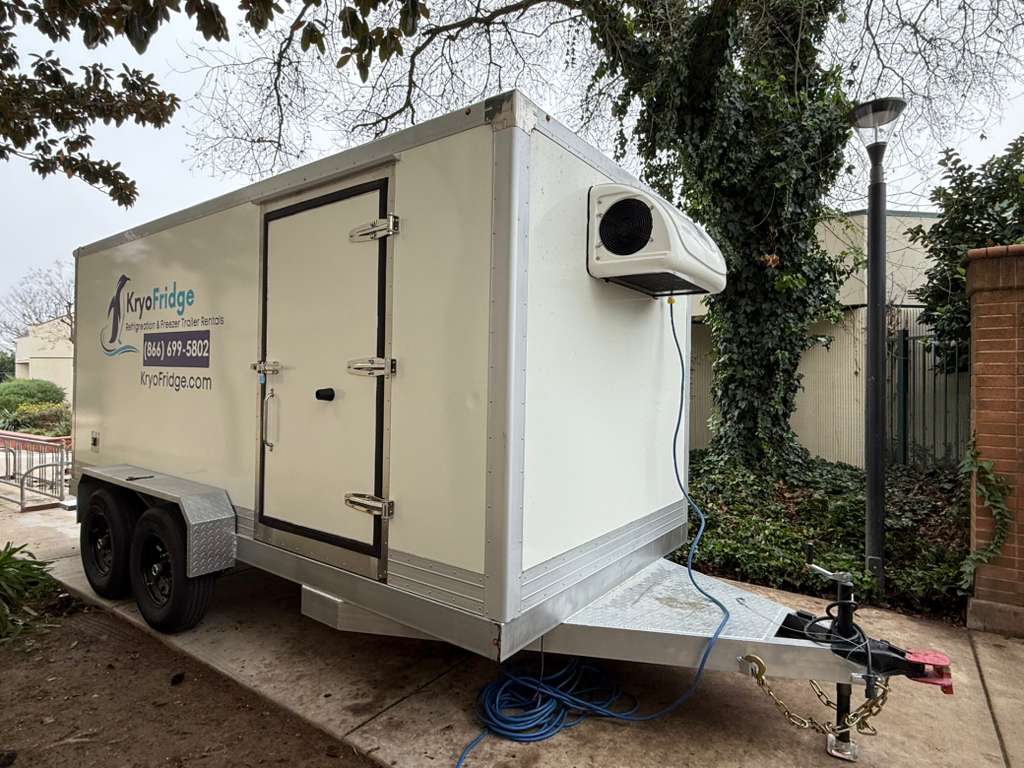
KryoFridge rents freezer and refrigeration trailers to school kitchens and campus dining halls in all 50 states, and we own every trailer we send. The unit arrives pre cooled, holding the temperature you asked for, on a dedicated 120V, 20 amp circuit within about 100 feet or on a generator we bring. Most school jobs land on the 16 foot Utility, and we say so honestly when a 6x8 or a 6x12 covers it instead. Call 866-699-5802 or send the quote request form and we will size it with you today.
Licensed and insured | Largest Fleet in the West | 30+ Years in the rental business
We have been in the equipment rental business for more than thirty years, and the freezer side of it grew up around kitchens that are not allowed to close. A school kitchen is the clearest version of that. The menu is posted, the bell schedule is fixed, and nobody gets to tell a lunch line to come back Tuesday. We run one of the largest dual purpose fleets of freezer and refrigeration trailers in the West, we own every unit on it, and no broker sits in the middle marking up somebody else's equipment. The same fleet and the same drivers stand behind our freezer trailer rentals in Austin. Call 866-699-5802 and a dispatcher picks up, day or night, or send the quote request form for a size and a delivery window.
One thing school work does that little else we serve does: the buyer is two offices. Nutrition services knows the meal counts and what is in the freezer. Facilities owns the project calendar and the circuit. Get both on one call and a quote takes ten minutes. Leave one out and the trailer lands on the asphalt the demolition crew needs in week three.
Our trailers sit staged across our yards, fueled, pre-cooled, and maintained in-house, parked and waiting for the call rather than being hunted down after it. That is why an emergency call usually puts a unit on your lot and pulling temperature the same day.
The voice on the phone belongs to the same outfit that owns the trailer and sends the driver. No reseller in the middle quietly marking up somebody else's equipment while your inventory creeps past 40°F on the shelf.
Every unit is ours to own, service, and deliver, and each one swings between deep-freeze and fresh-cold on a precise digital set-point. So we size the answer to the job in front of us and turn it around fast rather than putting you on next week's list.
"Our freezer came out on the first day of demolition and the new one did not land until the last week of July. The trailer sat by the kitchen door the whole time on its own circuit. Summer meal service never moved off its schedule."
"We put the unit in the bid documents instead of scrambling for one in June. When the project ran four weeks long the trailer just stayed, and nobody had to go to the board for an emergency purchase."
"We closed three dining halls for the summer and pushed everything into one building that was never sized to hold it. The 16 foot unit at the service drive took the overflow. Conference groups ate on time all summer."
References for Schools and Universities available on request.
The 16 foot Utility is the trailer we send on most school and campus jobs, because a summer project runs for weeks and the side door keeps the cart trips short.
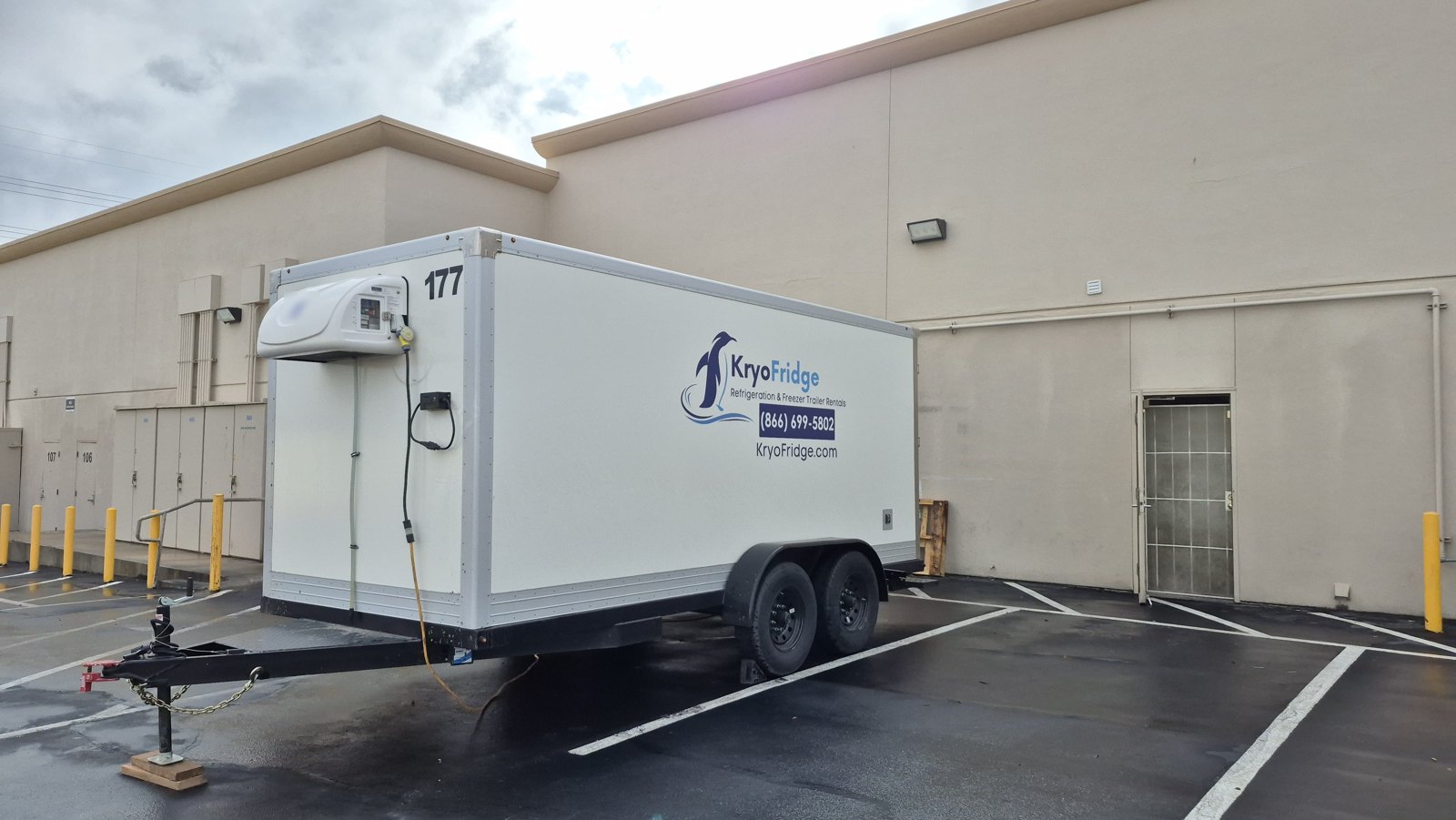
On a school job the unit is doing the work the built in walk in used to do, not backing it up. Staff are in and out of it twenty times a day pulling case packed entrees for the next service, so door swing and shelf layout decide whether the kitchen keeps its rhythm. One adjustable system swings from about 50 degrees F down to roughly 10 below on a digital set point, so the same box runs as a freezer for bulk stock one week and as a cooler for milk staging the next.
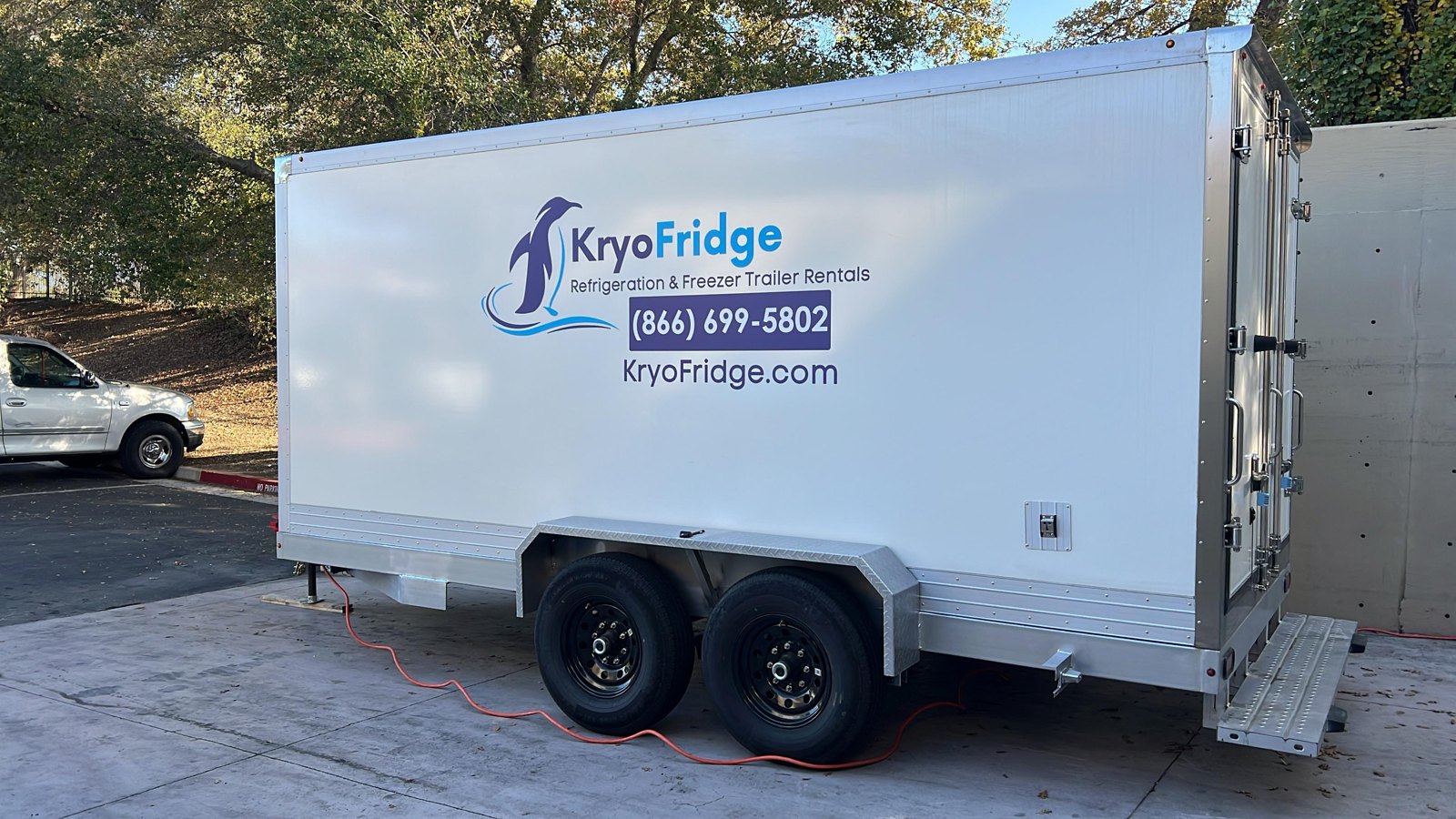
It looks and sounds like what it is, which matters more on a campus than people expect. The box is white and plain. It sits low on a tandem axle, and the condenser rides on the roof. Summer camps and open classroom windows are within earshot on a lot of these sites, so we point the condenser end away from the building. Your staff read the set point off the panel and write it in the same log they already keep.
Getting it there is mostly the last hundred feet. School service drives were striped for a box truck and a dumpster, and summer is when the sealcoat crew has half the lot roped off. We ask what the bus loop looks like and whether the posts by the kitchen door are fixed. The 6x8 goes where the 16 foot will not, and on a tight elementary site that is often the honest answer.
The 16' Utility is the trailer our crews reach for when the job is serious. A 16-foot insulated box on a tandem axle holds anything from -10°F deep-freeze to 50°F fresh-cold on one precise digital set-point, with NSF-approved surfaces throughout. Rear double doors take pallet loads straight off a dock, and the side utility door lets a cook grab one tray without opening the whole box to the heat.
We own every one of these units, so the trailer that shows up is fueled, pre-cooled, and maintained in-house. It runs on a dedicated 120V, 20-amp circuit or a generator we supply, and it holds its number through triple-digit afternoons. When a walk-in dies or a harvest runs long, this is the box that carries the load.
| Spec | What you get |
|---|---|
| Temperature range | Roughly -10°F deep-freeze up to about 50°F fresh-cold |
| Mode | Dual-purpose: freezer or refrigerator on one precise digital set-point |
| Power | A dedicated 120V, 20-amp circuit within about 100 feet, or a generator we supply |
| Food safety | NSF-approved for direct food contact, food-safe surfaces, proper drainage |
| Footprints | 6x8, 6x12, and 6x16, from a tight retail lot to distribution scale |
| Backing | Owned in-house, fully licensed and insured, with 24/7 emergency dispatch |
Each unit holds a precise digital set-point and runs on a dedicated 120V/20A circuit or a generator. The trailers are not wired for 208 to 240V building service, so we confirm your hookup before the truck rolls.
One call sizes the trailer, sets the delivery window, and locks your quote. Call now, or send the quick quote request and we will call you.
School work runs on a calendar, which makes most of it plannable months ahead. Three job types cover nearly everything we deliver to a district or a campus, and each needs a different size and a different delivery window.
A cafeteria kitchen cannot be torn up while students are in the building, so nearly every major kitchen project gets squeezed into the 10 to 12 week window between the last spring bell and the first fall one. The walk in is usually the first thing out, partly because it is load bearing to the room layout and partly because failing gaskets and an undersized box are what got the project funded. From demolition until the new box is installed and cleared by the health inspector, that kitchen has zero fixed cold storage.
Projects run long far more often than they run early. Permits and refrigeration lead times are the normal texture of institutional construction, which is why the sentence we hear most in August is that the new walk in slipped four weeks. Plan the rental in from day one and the trailer just stays. Skip it and you are calling the week before students return.
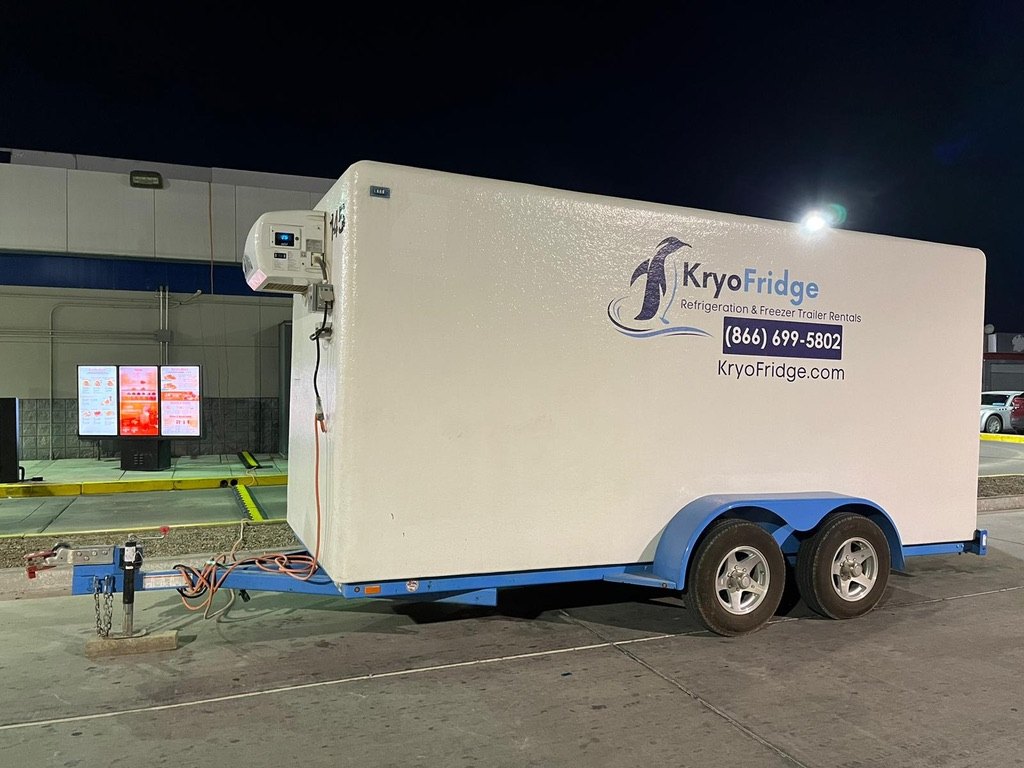
The right first call is facilities or construction management. The nutrition office alone is not enough, because facilities owns the change order risk that turns six weeks into ten. We ask for the demolition date and the commissioning date separately, since the gap between them is the real rental window and it is almost never what the first email says. Written into the bid documents the way portable restrooms already are, it stops being an emergency purchase. Our temporary cold storage for restaurant remodels work runs on the same logic.
Placement on a construction site takes more care than a working campus. The contractor has a laydown area and a route the concrete truck needs, and none of that shows on the site plan the nutrition office has. We walk it, pick a spot that stays usable through the whole job, and confirm the dedicated 120V, 20 amp circuit is within about 100 feet before the truck rolls. Where the panel is tied up, we bring a generator instead.
Residential campus dining falls off a cliff between commencement and fall welcome week. A university that runs a dozen named venues during the term, the way the University of Oregon lists Carson Dining and Fresh Marketcafe among others, collapses into a separately branded summer operation once students leave. Halls close and food service compresses into one or two buildings. That is the moment a campus finds out the building still open has no room for the frozen stock coming out of the three that closed.
Summer is not quiet, it is different. Conference groups and athletic camps keep eating, and catering picks up work the residence halls used to absorb. A catering kitchen that runs at a steady pace in February becomes the only cold storage on that side of campus in July. Then move in weekend arrives and volume jumps back to full semester levels in about seventy two hours. We see two rental windows on a lot of campuses for that reason.
This is the most plannable work we do and the least often planned. A dining office knows every May what it is about to close and every August what it has to reopen, so the rental period can be set against the academic calendar the same way catering staffing is. Campuses that book in April get the size they want and a window that fits around commencement traffic.
Where the unit goes is its own problem. Dining halls sit inside pedestrian cores with brick paths and a service drive that was a carriage road in 1930. We ask for a photo of the approach before committing to the 16 foot Utility, because a 6x12 that fits beats a bigger box parked two buildings away costing staff an hour a day in cart trips. Summer road closures change the answer, so we confirm the route again on delivery morning.
Feeding a six figure crowd is an industrial job, not a hot dog stand. Ohio Stadium seats 102,780 and has held 110,045 for a single game. Kyle Field seats 102,733 and drew 110,905 for a 2024 concert described as the largest ticketed concert in the country. Concession cold storage in those venues is sized for routine operations, so one football Saturday can require more pre staged product than an ordinary week, and the building gets booked again days later.
The K through 12 version is smaller and just as real. District stadiums host playoff rounds and graduation ceremonies on the football field, both needing cold product past what one high school cafeteria walk in holds. Those events cluster in May and early June, frequently the same weeks the cafeteria kitchen is already mid demolition. Our refrigerated trailer rentals for stadiums and concessions page covers the venue side in more detail.
Commencement is the university mismatch in its purest form. A campus the scale UT Austin reports, 53,864 students as of fall 2024, graduates across a compressed multi day ceremony schedule, and every ceremony trails receptions and department lunches drawing on one catering kitchen. Homecoming stacks the same spike onto a football weekend. A catering team can hit its highest volume week of the year while its fixed cold storage is already shared with athletics.
Event work rewards being booked ahead, not called during. Athletics and events offices already budget temporary infrastructure for a stadium date, so a cold storage trailer joins an order that exists. We stage these deliveries against the gate schedule rather than the kitchen schedule, because once parking opens a tandem axle trailer is not getting through the concourse apron. Thursday drop for a Saturday event, Monday pickup.
Most of what decides whether a campus delivery goes cleanly happens before the truck leaves our yard, in the questions we ask about the last hundred feet.
Timing gets set by your calendar, not ours. On a planned job we want the unit on site and pulled down to temperature a day before the walk in comes out, so the kitchen transfers into a cold box rather than a warm one. On a true failure we are moving inside about 45 minutes of the call.
Placement is where school jobs get won or lost, and the surprise is almost never power. It is clearance. Bus loops and the low awning over the kitchen door were built for a box truck, and half those approaches stop working once you add a 16 foot insulated box on a tandem axle. We also keep the cart push short on purpose. A unit at the far end of the staff lot quietly costs a two person kitchen team an hour a day for the length of the project. Same discipline behind our cold storage trailer rentals in Spokane.
Power gets confirmed before dispatch, every time. There are exactly two ways to run these units: a dedicated 120 volt, 20 amp circuit within about 100 feet, or a generator we supply. A school having a big electrical room does not mean there is a free dedicated circuit at the kitchen door, and during a remodel the contractor has often claimed whatever was spare. So we ask for a photo of the panel, and we plan a generator when the answer is unclear.
Pickup is a scheduling problem more than a physical one. Everyone wants the unit gone before students return, and the new walk in has to pass its own inspection first. So we hold the trailer until the kitchen has actually moved product back into the fixed box, not until the contractor says it is finished.
Powering one of our trailers is refreshingly simple, and there are precisely two ways to do it. Either you have a dedicated 120-volt, 20-amp circuit reachable within roughly 100 feet of the parking spot, or we bring a generator. What the units will not accept is standard 208 to 240V building service, so a quick question about your outlet before dispatch heads off any surprise on delivery day.
On placement, the unit asks for a reasonably flat patch with enough room for the delivery truck to maneuver it in and set it straight, plus either a power source in reach or space for a generator. We lock down the exact drop point on the campus before dispatch, so delivery is one clean trip instead of a guessing game.
On a bad day, booking should be the part that does not add stress. Four steps, an upfront number, and a single person who owns the whole thing.
Tell us whether it is freezer or fridge product, a ballpark volume, and your rough window. That is enough for us to call the right size.
We pair you with a unit, confirm whether you have a dedicated circuit or need a generator, and pin the exact drop point so the truck makes one trip.
We arrive on your schedule, about 45 minutes for a true emergency, set the trailer, energize it, and let it drive down to your number.
It holds the set-point for your entire term while our line stays live the whole way through. Wrap up, and we swing back for the pickup.
Capacity tracks meal counts and menu mix, not enrollment on its own. Two schools with the same head count can need very different units depending on how much of the menu arrives frozen.
| Scenario | Typical load | Units |
|---|---|---|
| Elementary kitchen, about 500 students | Frozen entrees and vegetables, 2 to 8 weeks | 1 unit, 6x12 |
| Middle school, 900 to 1,200 students | Frozen bulk plus chilled milk staging | 1 unit, 6x12 or the 6x16 Utility |
| Comprehensive high school, 2,000 or more | Full summer project window | 6x16 Utility, often a second unit |
| District central kitchen feeding several sites | Bulk frozen stock for the whole district | 2 to 3 units led by the 6x16 |
| Campus dining hall closed for phased work | Stock redirected from halls that shut for summer | 1 unit, 6x16 Utility |
| Graduation weekend or a home football Saturday | Pre staged cold product for one to three days | 1 to 2 units, 6x12 or 6x16 |
| Summer feeding site with no fixed kitchen | Daily chilled meals and milk | 1 unit, 6x8 |
Here is the arithmetic we use, and it is worth checking against your own numbers. Plan on roughly 0.08 cubic feet of shelf packed frozen storage per meal that depends on a frozen component, applied only to that share of the day. A 500 student elementary serving about 450 lunches and 250 breakfasts, with roughly 60 percent of meals built on frozen items, comes to about 420 frozen meal equivalents and a daily draw near 34 cubic feet. Usable trailer volume runs 15 to 20 percent under the raw box dimensions once shelving and aisle space come out.
Run that through the fleet and the sizes separate fast. The 6x12 holds roughly 420 usable cubic feet, about twelve days of frozen stock for that elementary kitchen. Scale to a 2,000 student high school at about 2,700 meals a day and the same 60 percent share gives 1,620 frozen meal equivalents and a draw near 130 cubic feet, so the 6x16 Utility at roughly 560 usable cubic feet covers a little over four days. A university hall running 6,000 meals with about a quarter frozen lands near 120 cubic feet a day.
Four days is not a failure of the trailer, and this is the part people misread. Over a ten week project nothing holds ten weeks of stock, so the number that matters is how often the district truck has to come. A 6x12 at an elementary means a normal delivery rhythm. A 6x16 at a big high school means a truck twice a week instead of daily, which is why comprehensive high schools usually take two units.
Volumes above are working numbers our dispatchers use on the phone, not a guarantee. Tell us the coldest item on your list and roughly how much of it you are holding, and we will size the unit for you before anything is booked.
"Cold" is not one number. Different product stays safe inside different temperature windows, which is the entire reason a precise digital set-point matters. Use this chart the way our dispatchers do when they size a rental.
| Product | Target holding band | Trailer mode |
|---|---|---|
| Ice cream and frozen desserts | -10°F to 0°F | Deep freeze |
| Frozen proteins, seafood, prepared meals | 0°F or below | Freezer |
| Fresh meat and poultry (short hold) | 28°F to 32°F | Refrigerated |
| Dairy, deli, packaged produce | 34°F to 38°F | Refrigerated |
| Beverages, florals, catering trays | 38°F to 45°F | Refrigerated |
One figure matters more than everything in that chart, and it is not listed there: 40°F. Food-safety guidance treats the band between 40°F and 140°F as the zone where bacteria thrive, and the clock on perishable product starts ticking the moment it crosses 40 on the way up. Roughly four cumulative hours above that line and most refrigerated inventory is no longer safe to serve.
Tell us the single coldest item you are holding when you call, and we dial the trailer to that. One unit carries a straight freezer load with no fuss. When your list mixes deep-freeze product with fresh-cold product on the same job, we will usually point you toward a split setup or a second box so neither side of the load has to settle for the wrong temperature.
Our signature 16 foot Utility series leads the fleet. It is the trailer we send on most jobs, and crews like it for the side utility access door. We build three footprints in all, so a single kitchen holding overflow stock has a fit and so does a distribution floor in a disaster. Every unit is dual purpose by design: one adjustable system swings between freezer and refrigerator on a digital set point. Each trailer runs on a dedicated circuit or on a generator.
| Trailer | Best for | Temp range |
|---|---|---|
| 6x16 Utility ⭐ | Our signature series: distribution, large events, disaster response, side utility door | Heavy-duty reefer |
| 6x12 | Grocers, caterers, mid-size events | Deep-freeze capable |
| 6x8 | Tight lots, small kitchens, short overflow | -10°F to 50°F |
Each unit holds a precise digital set-point and runs on a dedicated 120V/20A circuit or a generator.
Think eight or so pallet spots, and the unit to grab when square footage is the whole problem. It slips into the pinched service yards and cramped back-of-house corners that a larger box cannot even swing into. One cafe or small-market walk-in goes down, and this is almost always enough cold to cover it, plus the simplest unit to set in a small space.
Call it fourteen pallet spots, deep-freeze rated, and far and away the size people ask for most. It lands right in the middle: roomy enough for a multi-day catering job or a restaurant that needs true walk-in-equivalent room while the kitchen is torn up. Roomy enough that nobody is playing Tetris with shelves, yet still small enough to set in most commercial back lots without a site survey.
Roughly twenty pallet spots paired with a heavy-duty reefer plant engineered to keep deep-freeze locked in even when the ambient air is merciless. Reach for it when a warehouse bay drops, when a large festival needs an anchor, or when a relief operation is carrying its own cold chain.
Not sure which size fits? Most customers land on the 16 foot Utility, and we will tell you honestly if a smaller footprint covers your job. Tell us roughly what you are storing and for how long, and we will spec it for you.
The federal cold chain duty for school food service is regulatory text, not a talking point. 7 CFR 210.13, the food safety section of the National School Lunch Program rules, requires that food storage and service follow the sanitation and health standards set under state and local law. It also requires a written food safety program built on HACCP principles, plus a minimum of two food safety inspections each school year from a state or local health agency, with the results posted publicly. That duty traces back through the school lunch statute at 42 U.S.C. 1758.
The same section requires facilities to be maintained so purchased and donated commodities are safeguarded against spoiled food and other loss. Short phrase, and it does a lot of work. It gives a business office standing to treat a failed compressor as a compliance problem rather than a maintenance ticket, and a nutrition director never has to argue that cold chain records matter.
HACCP is seven specific steps, and a cold storage unit sits inside four of them. The critical limit is a maximum holding temperature. The monitoring procedure is the temperature check your staff already run. The corrective action is what the kitchen does the moment a reading drifts, and the record keeping is the log an inspector asks to see. The FDA Food Code, which state and local health departments adopt to make these principles enforceable, sets the actual numbers your jurisdiction holds you to.
So the honest way to position a rental is inside your food safety plan, not beside it. A district that loses fixed cold storage mid project still carries every one of these duties on whatever storage it is using that week. Our trailers hold a precise digital set point your staff read and record on their own schedule. We do not run a monitoring or alarm service, because the log an inspector reviews has to be yours.
A written food safety program on HACCP principles, plus two health inspections per school year with results posted.
The school lunch statute that carries the food safety program duty into program participation.
The model your state and local health department adopts, setting cold holding and frozen storage numbers.
Hazard analysis through record keeping, with your storage unit inside the critical limit and monitoring steps.
7 CFR 210.13 points back to state and local standards, so your health agency sets the enforceable figures.
A rented unit slots into the same food safety plan the fixed walk in already lives inside.
One caveat we always state plainly: we supply the food-safe, temperature-holding hardware itself, but we are not a temperature-logging or alarm-monitoring service. If your program requires continuous written records, line that vendor up on your own.
With no rental in the plan, a district makes do, and the improvisation is expensive in labor even though it never shows up as a line item. The common pattern is borrowing space at another building, with frozen stock carried between sites in whatever staff vehicles and ice chests are at hand. Each transfer adds handling and ambient exposure, exactly the kind of event a hazard analysis is supposed to flag. It also builds a single point of failure, since the one building holding everything has nothing behind it.
The second habit is quietly shifting the menu toward shelf stable substitutes to lean less on the compromised freezer. Service stays technically continuous. What actually happens is weeks of less varied food, which works against the same program goals the cold chain rules protect, and student participation is the number that drops. A nutrition director sees it in the meal counts first. Food bank teams hit the same wall, which is why our cold storage trailer rentals for food banks work looks familiar to school staff.
The least visible cost is the hours. Kitchen managers spend real time every day of a gap moving product and documenting the workaround for their own food safety file, and none of it appears on a budget sheet. Across a ten week summer project that adds up to weeks of somebody's job.
Bars compare the exposure, not the invoice. We never quote a number on a web page, because the right answer depends on the size of the unit and the length of the rental. Call and we will price your job in one conversation.
The call came from facilities, not nutrition, which is usually the sign a project is already moving. Demolition started on a Monday and the replacement box was eight weeks out on a lead time nobody had checked at bid. We set a 6x12 by the kitchen service door on a dedicated circuit the district electrician confirmed that afternoon, pulled down to 0 degrees F overnight, and the summer feeding program loaded into it the next morning. It stayed nine weeks. Nothing was discarded.
This one was planned well, which is the point of telling it. The unit went into the project documents in February with a demolition date and a commissioning date, and we held a 16 foot Utility against both. When the new walk in slipped four weeks there was no emergency purchase and no board agenda item. A second unit came in for the last three weeks as deliveries went daily.
Three residence hall dining rooms closed for the summer and everything landed in one building sized for its own traffic. Catering was also running camp meals out of the same kitchen. We put a 16 foot Utility on the service drive behind the open hall, away from the windows over the camp dorms, and it held the frozen bulk all summer. A second unit came in for move in weekend.
The federal duty follows you through the project. 7 CFR 210.13 still requires a written food safety program and two health inspections a school year while your walk in is in a dumpster. A rented trailer closes that gap with a box your staff log on the schedule they already use. Set it before demolition so product transfers cold.
7 CFR 210.13 sends you back to the sanitation and health standards set under state and local law, so the enforceable numbers come from your own health department. Most jurisdictions adopt the FDA Food Code, so cold holding and frozen storage figures track that model. Our units hold a digital set point from about 50 degrees F down to roughly 10 below, so whatever number your inspector holds you to, the box can sit on it.
Talk to us early and we will work with your purchasing office on the paperwork path it prefers. Most districts and public universities lean on cooperative vehicles like Sourcewell or OMNIA Partners to skip running their own solicitation, and most purchasing codes carry an emergency exception for a genuine failure. We turn around a certificate of insurance naming you as additional insured and a quote your office can attach to a purchase order.
There are exactly two ways to power these units. One is a dedicated 120 volt, 20 amp circuit within about 100 feet of where the trailer sits. The other is a generator we supply. They are not wired for 208 to 240 volt building service. Send a photo of the panel and we will tell you which way it goes before the truck rolls.
Give us your meal counts and how much of the menu arrives frozen and we will run the numbers with you. As a starting point, a 500 student elementary is usually well covered by a 6x12, a comprehensive high school generally needs the 16 foot Utility and often a second unit, and a summer feeding site can do fine on a 6x8. All three sizes are available, and we will tell you when the smaller one is enough.
Dispatch answers around the clock and a person picks up, not a queue. On an emergency we are prepping and moving inside about 45 minutes of the call in our core markets. What speeds it up on your end is knowing where the trailer can sit and whether a dedicated 120V, 20 amp circuit is within about 100 feet of it.
Both are documented failure modes. During the June 2021 heat wave Portland hit 116 degrees F and Seattle hit 108, and grocers shut down aisles because refrigeration failed under the load while rolling blackouts hit around Spokane. February 2021 in Texas was the mirror image, with multi day outages emptying shelves of staples. A trailer on its own generator is not on the same strained building circuit your rooftop units are.
No, and anyone who says otherwise is selling you something. Each unit runs one set point at a time and swings from about 50 degrees F down to roughly 10 below. Frozen proteins at 0 degrees F and prepped produce that wants 34 to 38 cannot share a box. When your list is mixed the answer is a second unit set to the warmer number, quoted up front rather than discovered on delivery day.
We deliver to all 50 states. Our heaviest route coverage and fastest emergency response sit in our core Western markets, where same day dispatch is the norm. Farther out, a planned summer project books well with lead time, and we will tell you plainly what the delivery window looks like rather than promising a number we cannot hit.
Four things move fastest. A photo of the drop point and the route a truck takes to it. Whether a dedicated 120V, 20 amp circuit sits within about 100 feet. Your meal counts or roughly what you are storing. And the two dates that bracket the job, meaning when the fixed box goes away and when it comes back. With that we usually come back same day.
Three pieces we wrote because the same questions come up every spring. One walks a summer project from bid to pickup. One maps what the academic calendar does to cold storage. The last is what a purchasing office should ask before it signs.
The cheapest version of this rental is the one that was in the project documents from the start. The most expensive is the one somebody calls for in the third week of August. Price is not what separates them. A planned unit gets the size you wanted and a purchase order that moved through normal channels instead of an emergency exception.
Start with two dates, not one. The demolition date is when your fixed cold storage disappears. The commissioning date is when the new box has been installed and cleared by the health inspector, which is not the day the contractor calls it done. The gap between them is the actual rental window, and the first email always plays it down.
Then size it off meal counts rather than square footage. Pull the frozen dependent share of your daily meals, multiply by roughly 0.08 cubic feet, and compare that to the usable volume of a unit rather than its outside dimensions. Do the same for any summer feeding program running while the kitchen is down. Those meals are easy to forget.
Further reading: Texas Square Meals equipment grant and capital expenditure requests.
Campus cold storage demand is not a smooth line, and planning against an average leaves you wrong in both directions. April is when dining offices should book, because the closure list for summer is settled and the capital projects calendar is final. May is commencement, the highest volume catering week of the year on most campuses, landing right as the residence hall kitchens wind down.
June and July are the consolidation months. Halls close, food service compresses into one or two buildings, and the building still open inherits frozen stock it was never sized to hold. This is also when the capital work happens, so a dining hall can be closed for consolidation and torn up for construction at the same time.
Late August is the whiplash. Move in weekend takes a campus from summer volume back to full semester volume in about seventy two hours, at the point summer capacity has not ramped back up and anything that slipped is still slipping. We take more late August emergency calls from campuses than from any other customer type, and nearly every one was predictable in April. Book the August window in the spring.
Public purchasing offices are good at asking about price and paperwork and less practiced at asking the questions that decide whether a rental works on a school site. These are the ones worth adding to your list.
Do you own the equipment or are you brokering someone else's? This determines who answers when something goes wrong at 10 p.m. A company that owns its fleet can commit to a size and a window. A broker is relaying your problem to whoever has a unit free that week.
How exactly does the unit get power, and what happens if our circuit is not available? The only acceptable answers are specific. Ours are a dedicated 120 volt, 20 amp circuit within about 100 feet, or a generator we supply. Anything less clear means somebody solves an electrical problem in your bus loop on delivery day.
The same trailers, dialed in for a different load. These are the operations we cold-store for most often.
We run the same trailers for freezer trailer rentals for Restaurant remodels, refrigerated trailer rentals for Hospitals and healthcare, cold storage trailer rentals for Stadiums and concessions, mobile walk in freezer rentals for Food banks and refrigeration trailer rentals for Meat processing and hunting season.
Planned kitchen projects that need the walk in replaced without closing the doors.
Kitchens on a census clock that are not allowed to pause meal service.
Event day cold storage where the volume arrives all at once.
Distribution teams moving perishable donations through tight receiving yards.
Seasonal deep freeze capacity that appears for a few weeks and then leaves.
We deliver nationwide, and we keep crews and staged trailers in the markets below. If your site is somewhere else, call us anyway. We move units.
Our busiest service area markets include cold storage trailer rentals in Austin, mobile walk in freezer rentals in Fresno, refrigeration trailer rentals in Spokane, freezer trailer rentals in San Antonio, refrigerated trailer rentals in Tacoma and cold storage trailer rentals in El Paso, each with its own staged trailers and its own drivers.
Fast growing districts and a flagship campus that both build through the summer.
Large district kitchens working summer projects through triple digit heat.
The market that saw rolling blackouts during the June 2021 heat wave.
Dense district campuses with service drives striped decades before trailer deliveries.
School kitchens and college dining halls on tight urban lots.
Summer feeding programs running while cafeteria kitchens are mid project.
Coverage runs to all fifty states. Emergency work, disaster response, and long-term holds travel the furthest, and the metro markets above are simply where a trailer is closest to your gate on an ordinary Tuesday.
Send a photo of your drop point and the route to it, then tell us your meal counts and your two project dates. We will come back with a size and a delivery window. Dispatch answers 24 hours a day.