

KryoFridge rents refrigerated and freezer trailers to custom meat processors and to the hunting camps that feed them, and we own every unit we send. The trailer shows up pre cooled and already sitting on your number, parked close enough to the door that nobody is walking a deer across a gravel lot. One dual purpose box runs from about 50 degrees F down to minus 10 degrees F on a digital set point, in three sizes. Call 866-699-5802 and a dispatcher picks up, or send the quote request and we will size your whole season in one conversation.
Licensed and insured | Largest Fleet in the West | 30+ Years in the rental business
We have been in the equipment rental business for more than thirty years, and the cold side of it grew up serving kitchens that are not allowed to close. Meat processing is the same problem with a shorter fuse. A shop can run all year on one walk in and still meet the Saturday after a rifle opener with more animals in the lot than it has rail to hang them on. We run one of the largest dual purpose fleets of freezer and refrigeration trailers in the West and we own every unit on it. No broker sits in the middle marking up somebody else's equipment while a deer warms up in a truck bed. Call 866-699-5802 and a person answers, day or night, or send the quote request form and we will come back with a size and a delivery window. The same drivers back our freezer trailer rentals in Fort Collins and every other market we run.
Two very different customers call us inside the same eight weeks and they want the exact same thing. One is a cut shop that just took in eleven animals it has no rail for. The other is a guide with a camp a long way up a dirt road from the nearest cooler. Both are watching a clock that speeds up every afternoon the sun comes out. After enough of these falls, the first question we ask is not how many animals you expect. It is how many feet of rail you already have, and what day your zone opens.
Shops that have done this before book in September for a November drop, and they give us the opener date rather than a delivery date, because the opener is the number that drives the job. We keep units staged and we will take a short notice call at nine at night in the middle of rifle season, because that is when a shop finds out it is short. Either way the conversation runs about ten minutes.
Our trailers sit staged across our yards, fueled, pre-cooled, and maintained in-house, parked and waiting for the call rather than being hunted down after it. That is why an emergency call usually puts a unit on your lot and pulling temperature the same day.
The voice on the phone belongs to the same outfit that owns the trailer and sends the driver. No reseller in the middle quietly marking up somebody else's equipment while your inventory creeps past 40°F on the shelf.
Every unit is ours to own, service, and deliver, and each one swings between deep-freeze and fresh-cold on a precise digital set-point. So we size the answer to the job in front of us and turn it around fast rather than putting you on next week's list.
"Our rail filled up by noon on the Saturday after the opener and we still had eleven animals sitting in the parking lot. The trailer was behind the cut room the next morning. We hung overflow in it for three straight weeks."
"We book one every fall now instead of hoping we get through. It sits by the back door from the third week of October until the last elk goes out, and the walk in finally has room for wrapped orders."
"Camp is two and a half hours of dirt road from the nearest cooler. We ran a box off a generator at the ranch gate and quit losing meat to warm afternoons. That was the whole fix."
References for Meat Processing and Hunting Season available on request.
Every job on this page runs on the same box. One dual purpose trailer, dialed to whatever the load needs, whether that is a steady 35 degrees F for hanging animals or a hard freeze for wrapped orders nobody has picked up yet.
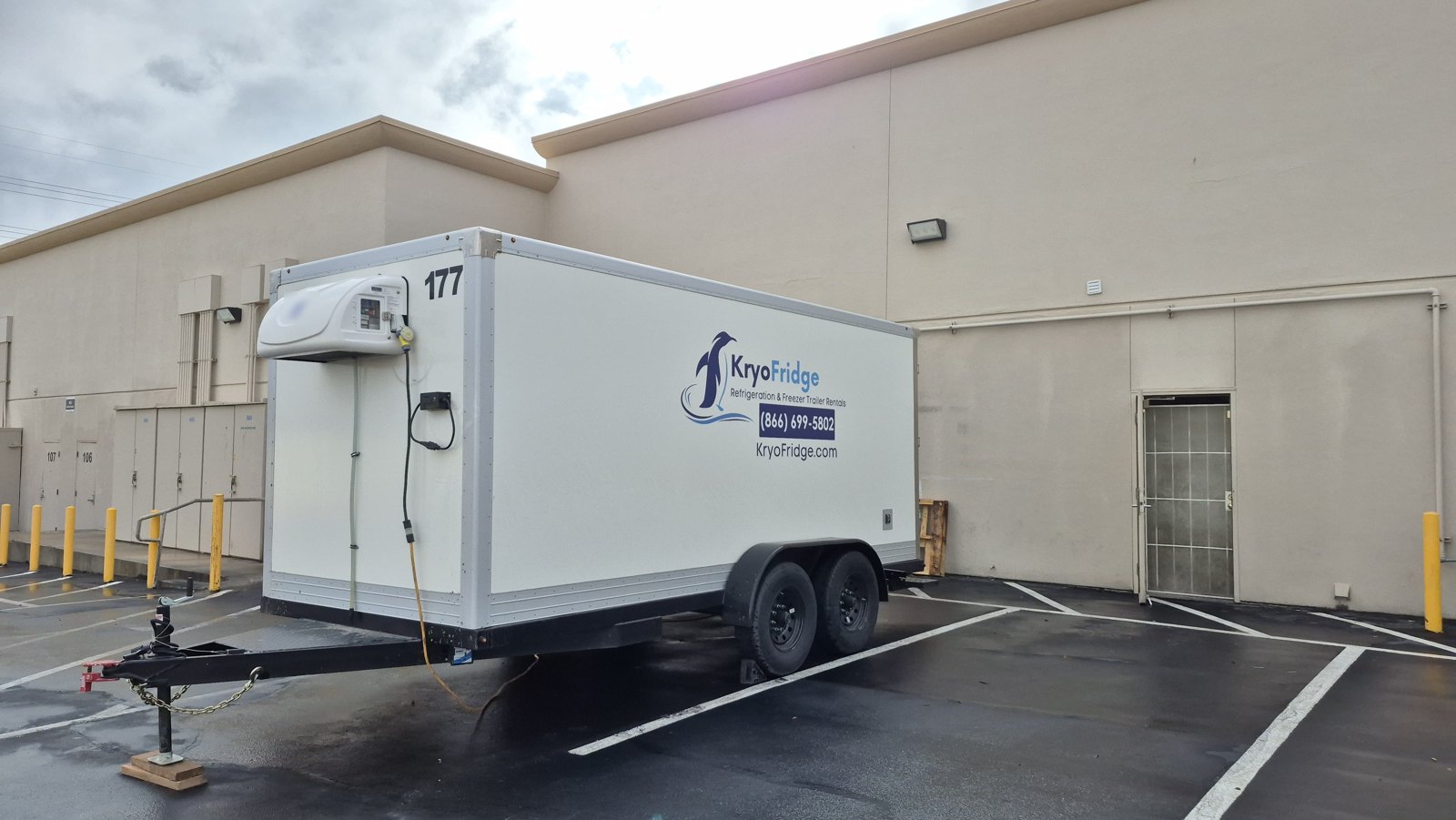
The box holds one number and keeps holding it through the door swings. Set it at 35 degrees F and it stays there while a cutter walks in and out forty times a shift, which is the band the California Department of Fish and Wildlife points hunters toward when it says a promptly chilled deer can be aged at 34 to 37 degrees F for about seven days before it is cut and wrapped. Push the same box the other way and it runs to about minus 10 degrees F.
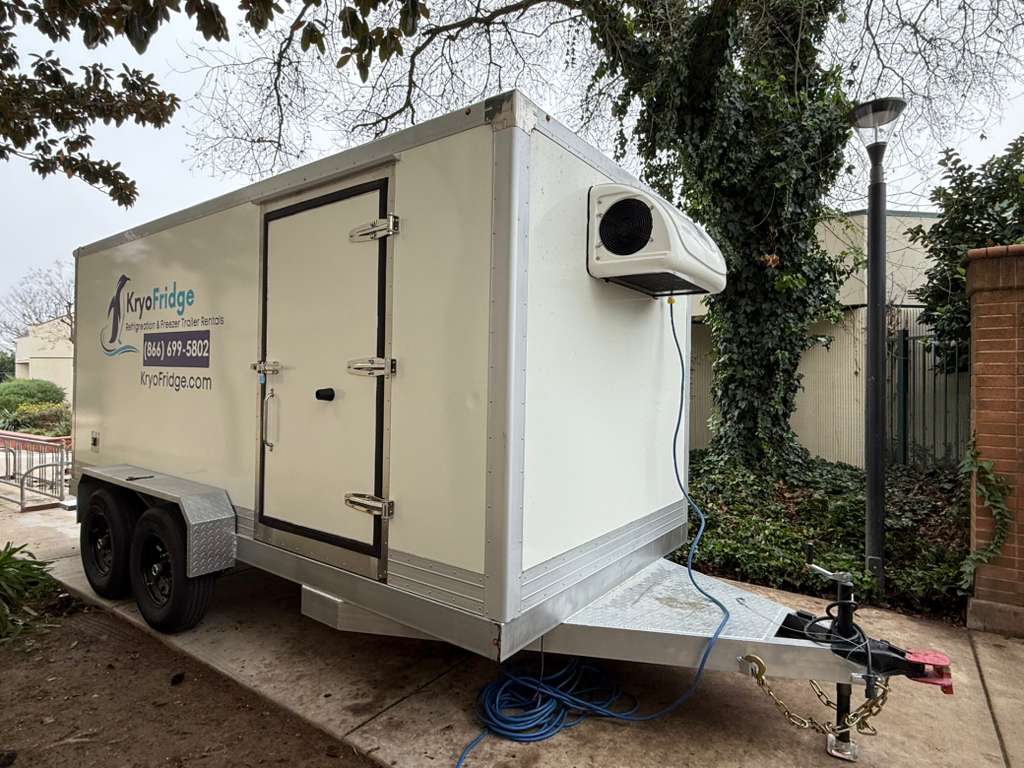
It looks like what it is. An insulated cargo box on a tandem axle with the condenser up on the roof and a man door in the side wall. That side door matters more than people expect during game season, because a cutter can duck in for one shoulder without opening the rear doors and dumping the whole box of cold air onto the yard. Inside, the surfaces are NSF approved for direct food contact and sealed, with real drainage, so the unit hoses out when the season ends.
Getting it to you comes down to a flat patch and a plug. The trailer sets down fine on gravel or a packed dirt apron. Power is either a dedicated 120V, 20 amp circuit within about 100 feet of where it parks, or a generator we bring with it. These boxes are not wired for 208 to 240 volt building service, so we confirm your hookup before the truck rolls. At a camp with no power at all, the generator is the entire answer.
The 16' Utility earned its flagship spot the hard way, on jobs where a few degrees of drift would have cost somebody their inventory. The box is 16 feet long and fully insulated, riding on a tandem axle. The interior is NSF approved. One digital set point covers everything from -10°F frozen storage to a 50°F produce cooler. There are two ways in: rear double doors for pallets, and the side utility door for everyday grab-and-go.
Because we own and service the entire fleet, the trailer on your lot was prepped in our yard, not scrambled together after your call. It lives on a dedicated 120V, 20-amp circuit or a generator we supply, and it keeps its temperature whether the job runs a weekend or a full season.
| Spec | What you get |
|---|---|
| Temperature range | Roughly -10°F deep-freeze up to about 50°F fresh-cold |
| Mode | Dual-purpose: freezer or refrigerator on one precise digital set-point |
| Power | A dedicated 120V, 20-amp circuit within about 100 feet, or a generator we supply |
| Food safety | NSF-approved for direct food contact, food-safe surfaces, proper drainage |
| Footprints | 6x8, 6x12, and 6x16, from a tight retail lot to distribution scale |
| Backing | Owned in-house, fully licensed and insured, with 24/7 emergency dispatch |
Each unit holds a precise digital set-point and runs on a dedicated 120V/20A circuit or a generator. The trailers are not wired for 208 to 240V building service, so we confirm your hookup before the truck rolls.
One call sizes the trailer, sets the delivery window, and locks your quote. Call now, or send the quick quote request and we will call you.
Three different jobs, one box. A shop needs rail it does not own. A camp needs cold it cannot drive to. A ranch needs somewhere to hang beef on a day it already committed to.
The bottleneck in a game processing shop is almost never floor space and almost never staff. It is linear feet of hanging rail at a controlled temperature. A shop that hangs forty animals comfortably all year runs out of rail on the Saturday after a rifle opener, because the hunters who filled tags that morning all want their animal handled inside the same 48 to 72 hours. Past that the choices get ugly. Product goes on the floor, which is a sanitation problem. Or the shop turns people away, which in a small town costs it years.
So we park rail outside the building. A 6x16 Utility set behind the cut room adds roughly thirteen usable feet of rail per side wall, and at about twenty inches per hanging deer size animal that is another fourteen or fifteen head holding at 35 degrees F instead of sitting in a pickup bed. Shops that run this every fall tell us the trailer stops being overflow by the second week and becomes the intake cooler, with the walk in holding only what is already cut and wrapped.
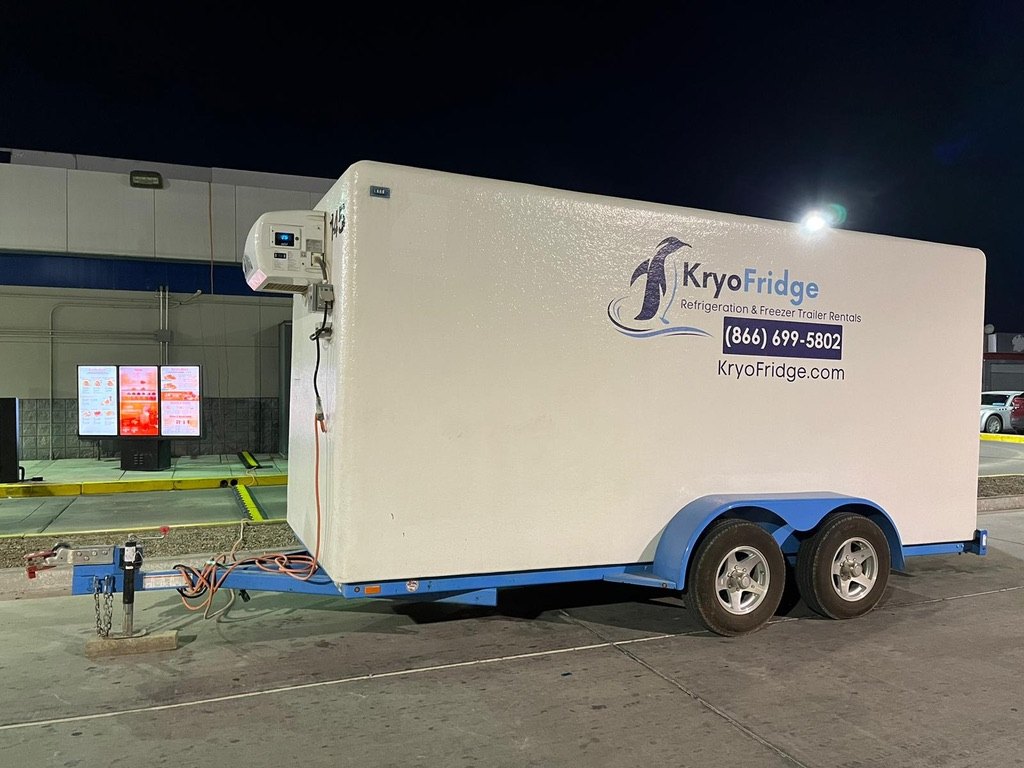
Most shops in a hunting town run two product streams under one roof. Retail meat moves through the front counter under full inspection. Privately owned deer and elk move through the back under the federal custom exempt rule at 9 CFR 303.1, marked Not for Sale and returned to the person who owned the animal. Federal rules require the two to stay apart while the custom work is in the shop's hands. A rented box is clean on that point because it is dedicated.
The other pressure nobody plans for is donation. A shop that agreed in July to take deer for a hunger relief program still has to find room for them in November, on top of everything paying customers dropped off. We have sent the same trucks that run our refrigerated trailer rentals in Spokane into shops in the middle of a donation push. The ask never changes. Cold rail, this week, gone by December.
Camp is where the clock is hardest. The California Department of Fish and Wildlife puts it plainly in its hunter guide: aging is fast above 40 degrees F, and a deer held at 65 degrees F for one day has already aged as long as it should. Sixty five degrees is not a heat wave. That is an ordinary September afternoon across most of the archery country out West, and archery seasons in Oregon and Washington both open in late August or the first days of September.
The traditional answer is a meat pole in the shade at night and a scramble during the day, and that same guide says as much. Hang it at night, get it somewhere cool once the sun is up, and if the nights stay warm, quarter the animal and take it to a locker plant right away. That last instruction is the expensive one, because the nearest shop with open rail might be two hours out. A trailer at camp deletes the drive.
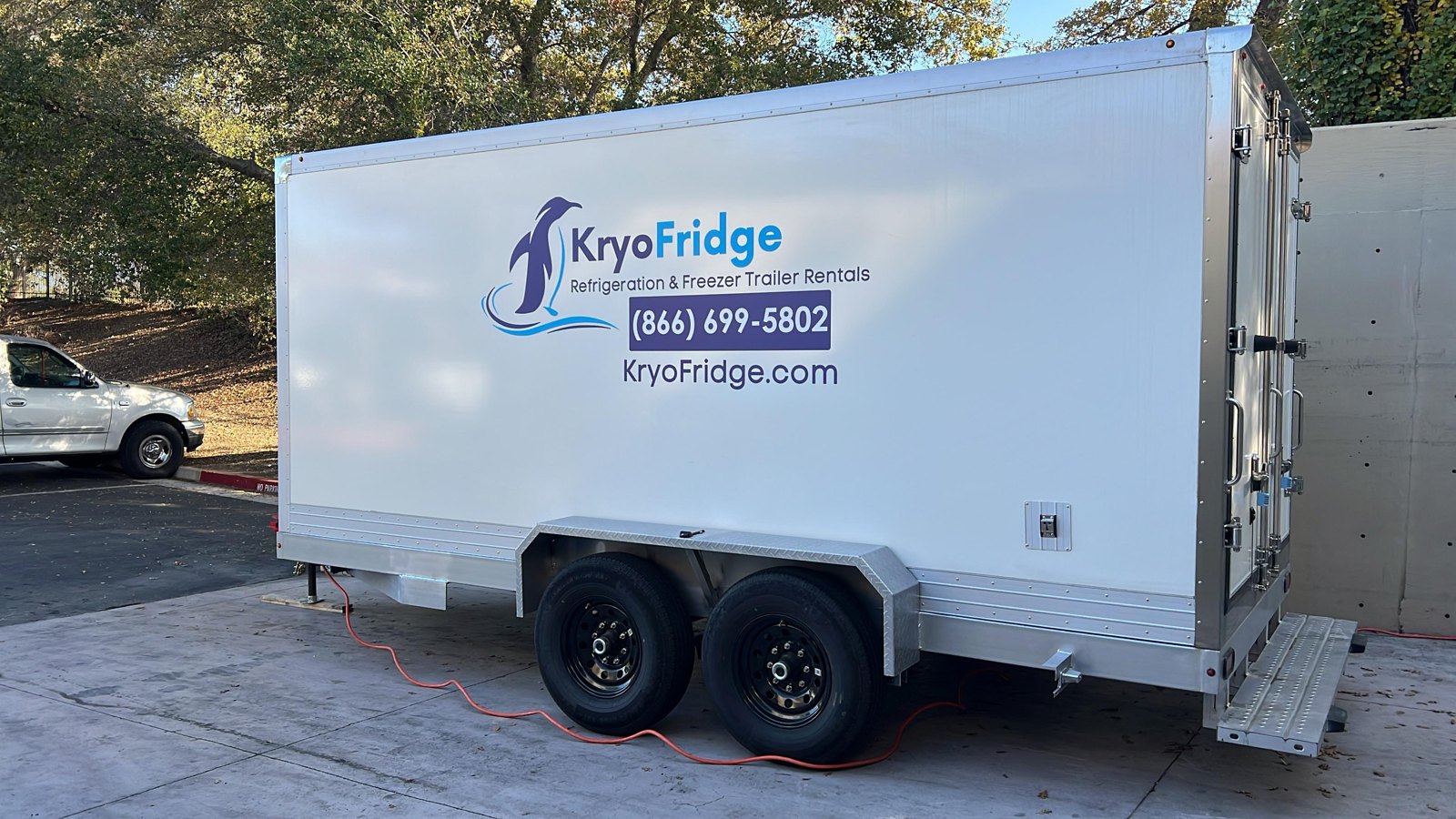
We run these off generators constantly, because a ranch gate or a two track turnaround has no outlet anywhere near it. The generator comes from us, it runs the box through the night, and the temperature holds whether anybody in camp is awake or not. Guides working week long camps usually take a 6x8 or a 6x12, hang whole animals for the first few days, then switch to boxed quarters as the count climbs.
One thing we ask every camp before we quote it. What does the last hundred feet of the approach look like. A loaded trailer needs a truck to get in and then back out, and a road a side by side handles fine is not automatically a road a one ton handles in the dark. Send a photo of the turnaround.
A beef animal is not a big deer. It is a different unit of measure. A hanging beef quarter wants three to four linear feet of rail against roughly one and a half for a deer, so a ranch that harvests three or four head in a day puts a load on a cooler that behaves like twenty deer arriving at once. The 6x16 Utility takes about six to eight quarters, and two of them cover a small harvest day whole.
Harvest days cluster in the fall after calves are weaned and before real winter, which is the same stretch when the deer and elk work peaks. A shop serving both sides gets squeezed from two directions in the same six weeks. The ranches that handle it well pick the harvest date first and reserve cold storage second, instead of learning on the morning the truck arrives that the cooler is full of somebody else's elk.
County and state fair junior livestock auctions create the same spike in a single evening. At the National Western Stock Show in Denver, only 96 animals out of thousands qualify for the Auction of Junior Livestock Champions, and a winning bidder can either pay the full bid or pay the difference between that bid and a buy back price the meat packer pays. Those animals move into processing channels right after the sale, not next month.
Fairgrounds essentially never have permanent refrigerated space sized for the one night of the year that needs it. A trailer parked behind the show barn for auction week covers the sale and the two days after, then goes home. We deliver into fairgrounds the way we deliver our cold storage trailer rentals in Eugene, on a set window, with the drop point agreed first.
We set the delivery around your opener, not around our route sheet. Here is what actually happens on the ground.
We like to drop three to five days ahead of the date you are worried about. The box gets set, plugged in and pulled down to temperature with the doors shut, so it is already holding 35 degrees F before the first animal comes through the gate. Dropping the morning of an opener works and we do it, but a trailer pulling down while people load it in warm air fights you all day.
Placement is a five minute conversation that saves a month of annoyance. The doors want to face the way your animals actually travel, which usually means squaring the rear doors toward the rail door rather than toward the street. We need truck swing to get it in and back out, and somewhere for meltwater to go that is not the doorway people walk through.
The failures we see are boring and they repeat. Somebody runs the trailer off an extension cord instead of the dedicated circuit and the unit trips at two in the morning. Somebody shares the circuit with a shop compressor and the same thing happens on a longer timeline. Somebody props the rear doors open during a busy intake and wonders why the box climbed six degrees. A walk around with our driver on delivery day prevents all of it.
Pickup is scheduled, not negotiated. Tell us your season end date when you book, because a shop finishing in early December and a camp folding in late September want very different windows. Hose the interior down before we take it. The same crews handle this when we pull a unit off a job doing temporary cold storage for restaurant remodels, and the drill does not change for a processing yard.
Powering one of our trailers is refreshingly simple, and there are precisely two ways to do it. Either you have a dedicated 120-volt, 20-amp circuit reachable within roughly 100 feet of the parking spot, or we bring a generator. What the units will not accept is standard 208 to 240V building service, so a quick question about your outlet before dispatch heads off any surprise on delivery day.
On placement, the unit asks for a reasonably flat patch with enough room for the delivery truck to maneuver it in and set it straight, plus either a power source in reach or space for a generator. We lock down the exact drop point on the processing yard before dispatch, so delivery is one clean trip instead of a guessing game.
On a bad day, booking should be the part that does not add stress. Four steps, an upfront number, and a single person who owns the whole thing.
Tell us whether it is freezer or fridge product, a ballpark volume, and your rough window. That is enough for us to call the right size.
We pair you with a unit, confirm whether you have a dedicated circuit or need a generator, and pin the exact drop point so the truck makes one trip.
We arrive on your schedule, about 45 minutes for a true emergency, set the trailer, energize it, and let it drive down to your number.
It holds the set-point for your entire term while our line stays live the whole way through. Wrap up, and we swing back for the pickup.
Rail feet, not cubic feet. This is the table our dispatchers actually use when a shop calls short.
| Unit | What it holds | Typical fit |
|---|---|---|
| 6x8 | About 5 to 6 deer size carcasses on side rail | A camp, or a shop that needs a few nights of relief |
| 6x12 | About 9 to 10 deer size carcasses | A locker plant covering one opening weekend spike |
| 6x16 Utility | About 14 to 15 deer size carcasses, or 6 to 8 beef quarters | A busy shop running the full six to ten week season |
| Two 6x16 units | Roughly 28 to 30 deer size carcasses | A shop taking donated animals on top of paying work |
| 6x16 held at 34 to 37 F | A full hang aging for about a week | Whole carcass aging before cut and wrap |
| 6x12 held below 0 F | Boxed and wrapped cuts waiting on pickup | Finished orders customers have not collected yet |
Here is the arithmetic. We plan on about twenty inches of rail per hanging deer size carcass, center to center, which leaves room for it to swing and for a cutter to work around it. Take two feet off each end of a rail run for door clearance and airflow, and a 6x8 gives roughly five usable feet per side while a 6x12 gives about nine. The 6x16 Utility gives about thirteen. Rail on both walls roughly doubles those counts.
What moves the number is the animal and the way you hang it. A mule deer and a mature bull elk are not the same thing on a hook. Whole carcasses eat rail. Split sides eat less per animal but take more hooks. Quarter and box the product and it stops being a rail question and becomes a shelf question, at which point the same 6x16 holds far more than the carcass count suggests.
If you are guessing, guess the 6x16. It is the size most shops keep for the season and the one our dispatchers reach for the moment somebody describes a rail that is already full. The figures above are planning numbers our crews use on the phone, not a promise, and they are worth checking against your own animals. Call with your rail length and a typical intake day and we will do the math with you.
Volumes above are working numbers our dispatchers use on the phone, not a guarantee. Tell us the coldest item on your list and roughly how much of it you are holding, and we will size the unit for you before anything is booked.
"Cold" is not one number. Different product stays safe inside different temperature windows, which is the entire reason a precise digital set-point matters. Use this chart the way our dispatchers do when they size a rental.
| Product | Target holding band | Trailer mode |
|---|---|---|
| Ice cream and frozen desserts | -10°F to 0°F | Deep freeze |
| Frozen proteins, seafood, prepared meals | 0°F or below | Freezer |
| Fresh meat and poultry (short hold) | 28°F to 32°F | Refrigerated |
| Dairy, deli, packaged produce | 34°F to 38°F | Refrigerated |
| Beverages, florals, catering trays | 38°F to 45°F | Refrigerated |
One figure matters more than everything in that chart, and it is not listed there: 40°F. Food-safety guidance treats the band between 40°F and 140°F as the zone where bacteria thrive, and the clock on perishable product starts ticking the moment it crosses 40 on the way up. Roughly four cumulative hours above that line and most refrigerated inventory is no longer safe to serve.
Tell us the single coldest item you are holding when you call, and we dial the trailer to that. One unit carries a straight freezer load with no fuss. When your list mixes deep-freeze product with fresh-cold product on the same job, we will usually point you toward a split setup or a second box so neither side of the load has to settle for the wrong temperature.
Our signature 16 foot Utility series leads the fleet. It is the trailer we send on most jobs, and crews like it for the side utility access door. We build three footprints in all, so a single kitchen holding overflow stock has a fit and so does a distribution floor in a disaster. Every unit is dual purpose by design: one adjustable system swings between freezer and refrigerator on a digital set point. Each trailer runs on a dedicated circuit or on a generator.
| Trailer | Best for | Temp range |
|---|---|---|
| 6x16 Utility ⭐ | Our signature series: distribution, large events, disaster response, side utility door | Heavy-duty reefer |
| 6x12 | Grocers, caterers, mid-size events | Deep-freeze capable |
| 6x8 | Tight lots, small kitchens, short overflow | -10°F to 50°F |
Each unit holds a precise digital set-point and runs on a dedicated 120V/20A circuit or a generator.
Think eight or so pallet spots, and the unit to grab when square footage is the whole problem. It slips into the pinched service yards and cramped back-of-house corners that a larger box cannot even swing into. One cafe or small-market walk-in goes down, and this is almost always enough cold to cover it, plus the simplest unit to set in a small space.
Call it fourteen pallet spots, deep-freeze rated, and far and away the size people ask for most. It lands right in the middle: roomy enough for a multi-day catering job or a restaurant that needs true walk-in-equivalent room while the kitchen is torn up. Roomy enough that nobody is playing Tetris with shelves, yet still small enough to set in most commercial back lots without a site survey.
Roughly twenty pallet spots paired with a heavy-duty reefer plant engineered to keep deep-freeze locked in even when the ambient air is merciless. Reach for it when a warehouse bay drops, when a large festival needs an anchor, or when a relief operation is carrying its own cold chain.
Not sure which size fits? Most customers land on the 16 foot Utility, and we will tell you honestly if a smaller footprint covers your job. Tell us roughly what you are storing and for how long, and we will spec it for you.
The rule that structures this business is federal and it is short. 9 CFR 303.1 exempts custom slaughter of cattle, sheep, swine and goats delivered by the owner, and separately exempts custom preparation of meat from game animals delivered by their owner. The phrase doing the work is delivered by the owner thereof. Custom exempt processing serves the person who already owns the animal, whether that came from raising livestock or from taking a deer in the field.
What comes with the exemption is housekeeping, and the housekeeping is what touches cold storage. Custom prepared product has to be plainly marked Not for Sale immediately after it is prepared and stay marked until it goes home with the owner. Anything being prepared for sale has to be kept separate from custom prepared product the whole time the custom work is in the shop's custody. The shop also keeps records with the name and address of each owner.
Read those together and the reason a rented box works becomes obvious. A shop cannot solve overflow by stuffing custom exempt deer into the same cooler holding product bound for the retail case, because that is the mixing the federal rule is written against. A trailer parked outside is a dedicated space living entirely on the custom exempt side. One box, one product stream. The paper trail stays simple when somebody asks how the two were kept apart.
Every state wildlife agency layers its own requirements on top. A hunter fills out the tag and attaches it to the animal before it changes hands, then returns the report card portion to the agency, which is why careful shops check the tag before they check the cooler. Wyoming Game and Fish asks hunters to submit samples for chronic wasting disease surveillance and to follow carcass transport rules for the hunt area. An animal waiting on a result belongs in its own box.
Custom slaughter and preparation for the owner of the animal is exempt from federal inspection, and game animals delivered by their owner fall under the same section.
Custom prepared product is plainly marked Not for Sale immediately after preparation and stays marked until it is handed back to the owner.
Product being prepared for sale is kept apart from custom prepared product the entire time the custom work is in the shop's custody.
The shop keeps records of the livestock and product handled on a custom basis, with the name and address of each owner.
A hunter fills out the tag and attaches it to the animal, then returns the report card portion to the wildlife agency, before the animal changes hands at a shop.
Hunters are asked to submit samples for statewide surveillance, may be required to sample in focus areas, and follow carcass transport and disposal rules for the hunt area.
A dedicated rental box keeps custom exempt work on its own side of the shop, with nothing bound for sale in it.
One caveat we always state plainly: we supply the food-safe, temperature-holding hardware itself, but we are not a temperature-logging or alarm-monitoring service. If your program requires continuous written records, line that vendor up on your own.
Everybody in this trade has a workaround and every one has a bill attached, just not one that shows up on an invoice. A dry box truck gets pressed into service as a cooler, which only works if somebody also runs a portable cooling unit inside it around the clock. A neighbor's walk in gets borrowed, which depends on that neighbor having room in the exact week every cold box in a hunting town is full. Window air conditioners make a hot room less hot without ever reaching the band that matters.
The workaround that actually happens most often is driving further. The close shop is full, so the animal goes another two hours to the shop that is not, and the meat warms the entire way. That is the part worth sitting with, because the state agency guidance is unambiguous about what warm hours do. A carcass held at 65 degrees F for a single day has already used the whole aging window it was going to get. The fix people reach for recreates the exact risk cold storage exists to prevent.
There is one more cost that only shows up when it goes wrong. A fixed walk in is a compressor with a duty cycle, and one already running near its rated capacity to hold a normal year round load has nothing in reserve when the thermal load doubles for six weeks. The season that fills the cooler leans hardest on the one machine holding it. A second, separate box takes that bet off the table. We deliver the same way for our cold storage trailer rentals in Eugene and in every market we run.
Bars compare the exposure, not the invoice. We never quote a number on a web page, because the right answer depends on the size of the unit and the length of the rental. Call and we will price your job in one conversation.
The shop hangs forty animals on a normal week and had sixty two through the door by the Tuesday after the opener. The cooler was full by Saturday noon. We set a 6x16 Utility behind the cut room on Sunday morning, plugged into a dedicated circuit the shop had run for a chest freezer years earlier, and the box was holding 35 degrees F within the hour. It carried intake the rest of the season.
Archery had been open since the end of August and afternoons were still hitting the seventies. The camp had been hanging animals at night and racing them into coolers by mid morning, which cost a guide half of every day. We delivered a 6x12 on a generator to the ranch gate, the closest point a one ton could turn around. The camp hung whole animals for four days, then switched to boxed quarters. Nothing left camp warm after that.
The ranch committed to an October harvest date before anyone thought about where four beef would hang, and the shop it usually leans on was already carrying auction animals from the county fair. Four head is sixteen quarters, more rail than most small shops have free in October. We delivered two 6x16 units the day before, both pre cooled, and the quarters went from the kill floor straight into the boxes. The ranch kept one an extra ten days.
It depends on temperature far more than on days. The California Department of Fish and Wildlife says a deer killed and chilled promptly can be aged at 34 to 37 degrees F for about seven days before it is cut and wrapped, ideally with the hide on so it does not dry out. Above 40 degrees F that window shrinks fast, and a carcass held at 65 degrees F for one day has already aged as long as it should.
For hanging and aging, 34 to 37 degrees F is the band the CDFW guide names, and it is what our trailers are set to when a shop calls about game season. For wrapped and boxed product, the same unit runs down to about minus 10 degrees F. The number that matters most is the one you do not want to cross going up, because perishable meat starts losing ground past 40.
Yes, and that is precisely what the federal custom exempt rule at 9 CFR 303.1 is for. A shop can prepare a game animal delivered by its owner without federal inspection, as long as the product is plainly marked Not for Sale and goes back to the person who owned the animal. That is also why the shop keeps a record with your name and address on it.
Because a whole season's worth of hunters fill tags on the same morning, and they all want the animal handled inside the next 48 to 72 hours. Western states compress most of their harvest into a window somewhere between late August and early December, and a rifle opener concentrates it further into one weekend. The shop runs out of hanging rail long before it runs out of floor space.
Planning on about twenty inches of rail per hanging deer size carcass, a 6x8 holds roughly five or six and a 6x12 holds nine or ten. The 6x16 Utility holds about fourteen or fifteen with rail on both side walls. Elk run larger and beef quarters larger still, closer to three or four feet of rail apiece. Call with your animal mix and we will size it properly.
Yes. A generator is one of the two ways these units run, and we supply it. The other is a dedicated 120V, 20 amp circuit within about 100 feet of where the trailer parks. The trailers are not wired for 208 to 240 volt building service, so we confirm which of the two you have before dispatch. At camp it is almost always the generator, and it holds overnight without anybody tending it.
Check the rules for the specific hunt area you hunted, because states with affected areas publish their own sampling and carcass transport requirements. Wyoming Game and Fish asks hunters to submit samples for surveillance and points them to approved disposal locations. An animal waiting on a result is a good reason to have a separate box rather than a spot on a shared rail.
That is the most common booking we take for this work. Shops usually take the unit a few days before the date they are worried about and keep it until intake tapers, which for most is somewhere between three weeks and the full season. Give us the opener date and your season end date when you book, and the delivery and the pickup both go on the calendar at once.
Three things worth reading before you book, written from what we see every fall on processing yards and in camps.
Season dates are the planning calendar for this industry, and they are not the same shape in any two states. California staggers its zones so hard that deer season is really a rolling wave. Zone A runs general season from early August into late September, while several D zones push general season into early November and D-12 alone runs November 7 through November 29. A shop near a zone boundary can see three separate opening week waves in one fall.
Oregon compresses the pressure instead of spreading it. Western Oregon general buck season runs early October into the first week of November, with statewide archery from late August through late September and elk rifle seasons stacking through November. Washington spreads wider, with modern firearm deer in the second half of October and late archery running into December and past New Year in some units.
The Mountain West and Texas add their own shapes. Montana runs archery from early September through mid October and general rifle from late October to the end of November. Wyoming stretches some deer areas across the entire fall. Texas runs statewide archery from late September into October, then a general season opening the first of November that runs into January in the South Zone. Book against your opener, not against a month.
Further reading: California Department of Fish and Wildlife deer hunting.
Start with rail, because that is what actually runs out. Ask how many linear feet of hanging rail the unit gives you and on how many walls, then compare it against the rail you already have rather than against a cubic foot number. A box that sounds enormous and has rail on one wall can be worse for a shop than a smaller unit rigged on both sides. Ask whether the interior surfaces are approved for direct food contact.
Then ask about power in plain terms. What exactly does it need, how far can it sit from the panel, and what happens if the answer at your site is nothing at all. With our trailers it is a dedicated 120V, 20 amp circuit within about 100 feet or a generator we supply, and they are not built for 208 to 240 volt building service, which is worth knowing before a driver is standing in your yard.
Finally, ask who you are actually renting from. Plenty of listings online belong to brokers who will go find somebody else's trailer and add a markup, which becomes a real problem on the night you need a person rather than a callback. We own every unit we send and we answer the phone around the clock, the same standard we hold on our freezer trailer rentals for hospitals and healthcare. Ask for a delivery window and a named pickup date.
Aging is a temperature process disguised as a time process. The window everybody quotes, about a week of hanging, assumes a steady 34 to 37 degrees F and a humid space, and the CDFW guide is explicit that it also assumes the animal was chilled promptly after the kill. Move any one of those assumptions and the week is gone. Warm weather country is where this bites hardest.
The field decisions matter as much as the cooler does. Field dressing exists to let the carcass start cooling, not for any other reason, and the guidance for a warm camp is straightforward. Hang at night, move it somewhere cool during the day, and if the nights are warm too, quarter it and get it into real refrigeration right away. Some animals should not be aged at all, including one shot in warm weather and never chilled quickly.
Where a rented box changes the outcome is that it removes the guessing. A trailer holding a steady 35 degrees F at camp or behind a shop turns an aging plan from a weather bet into a decision. It also lets a shop age the animals that should be aged and move the rest straight to the cut table.
The same trailers, dialed in for a different load. These are the operations we cold-store for most often.
We run the same trailers for refrigerated trailer rentals for Hospitals and healthcare, freezer trailer rentals for Restaurant remodels, cold storage trailer rentals for Food banks, refrigeration trailer rentals for Schools and universities and mobile cooler trailer rentals for Stadiums and concessions.
Kitchens that cannot pause meal service when a walk in quits.
Planned projects that replace the walk in without closing the doors.
Distribution sites moving perishable donations through tight receiving yards.
Campus dining kitchens feeding a fixed count on a fixed schedule.
Event day cold storage where the volume arrives inside a few hours.
We deliver nationwide, and we keep crews and staged trailers in the markets below. If your site is somewhere else, call us anyway. We move units.
Our busiest service area markets include refrigeration trailer rentals in Eugene, refrigeration trailer rentals in Salem, mobile cooler trailer rentals in Spokane, refrigerated trailer rentals in Cedar City, freezer trailer rentals in Amarillo and cold storage trailer rentals in Santa Fe, each with its own staged trailers and its own drivers.
General buck season stacking on elk rifle weeks in November.
Valley cut shops taking archery animals in warm September weather.
Modern firearm deer in late October with elk right behind.
High country deer camps hours from the nearest locker plant.
Panhandle mule deer weeks landing in the middle of cattle country.
Mountain shops and ranch harvest days in one narrow window.
We also route trailers to these markets:
Coverage runs to all fifty states. Emergency work, disaster response, and long-term holds travel the furthest, and the metro markets above are simply where a trailer is closest to your gate on an ordinary Tuesday.
Give us the date the pressure starts and the date it stops. We will size the box, set the delivery window and have it holding temperature before the first animal comes through the gate. Call 866-699-5802 or send the quote request.