
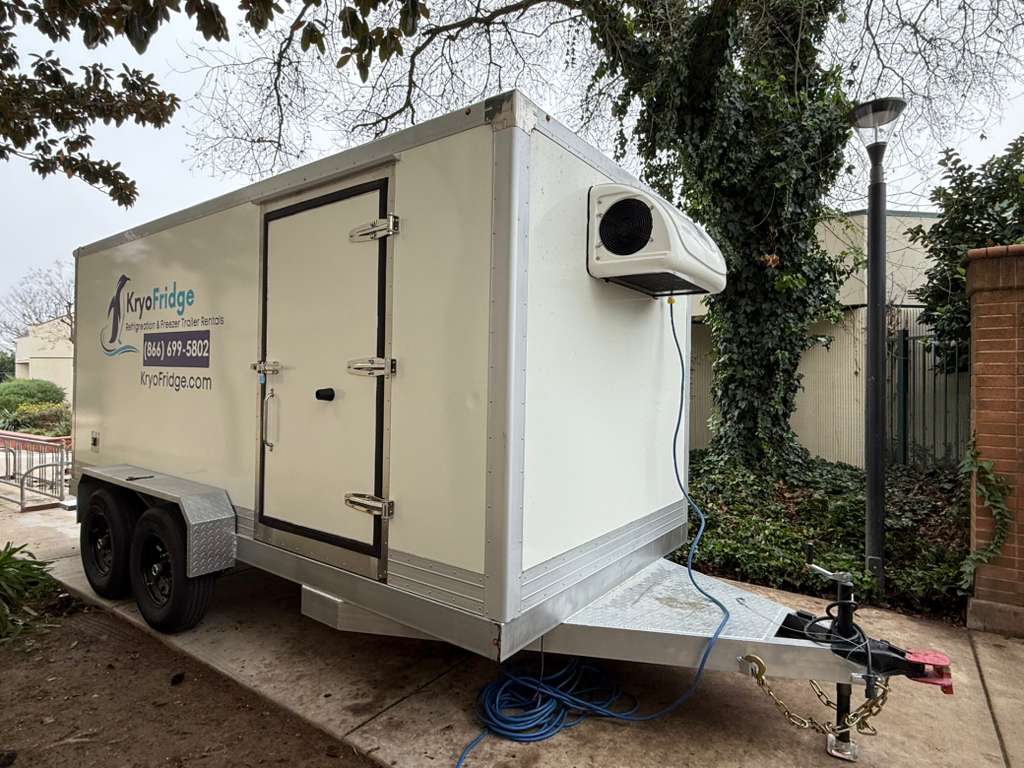
KryoFridge rents freezer and refrigerated trailers to hospitals, skilled nursing communities and health system campuses, and we own every unit we send. The box arrives fueled, pre cooled and already on your number, set close enough to the kitchen door that nobody is pushing carts across a parking lot at 5 a.m. One dual purpose unit runs from minus 10 degrees F up to about 50 degrees F on a digital set point, in three footprints. Call 866-699-5802 and a dispatcher picks up, or send the quote request and we will size the job in one conversation.
Licensed and insured | Largest Fleet in the West | 30+ Years in the rental business
We have been in the equipment rental business for more than thirty years, and the freezer side of it grew up serving kitchens that are not allowed to close. That is the whole job at a hospital. Census does not pause because a compressor quit, and nutrition services still has to plate three meals for every occupied bed while the walk in sits dark. We run one of the largest dual purpose fleets of freezer and refrigeration trailers in the West, we own every unit on it, and there is no broker in the middle marking up somebody else's equipment while your product creeps past 41 degrees F. Call 866-699-5802 and a dispatcher picks up, day or night, or send the quote request form and we will come back with a size, a window and a number. The same fleet and the same drivers back our freezer trailer rentals in Fresno and every other market we run.
One thing healthcare does that almost nothing else we serve does: a single rental conversation touches three people. Nutrition services asks about cubic footage, dock height and the concrete pad. Pharmacy and lab ask about temperature range and how fast the box gets cold. Facilities asks about amperage, noise and permits. That is why we want photos of the spot and the access route before we quote a hospital.
Our trailers sit staged across our yards, fueled, pre-cooled, and maintained in-house, parked and waiting for the call rather than being hunted down after it. That is why an emergency call usually puts a unit on your lot and pulling temperature the same day.
The voice on the phone belongs to the same outfit that owns the trailer and sends the driver. No reseller in the middle quietly marking up somebody else's equipment while your inventory creeps past 40°F on the shelf.
Every unit is ours to own, service, and deliver, and each one swings between deep-freeze and fresh-cold on a precise digital set-point. So we size the answer to the job in front of us and turn it around fast rather than putting you on next week's list.
"Our walk in cooler quit on a Friday evening with a full census and a weekend ahead of us. The unit was on our dock and pulling temperature before the night shift finished report. We moved every protein and dairy case straight across and never missed a tray line."
"Our kitchen remodel ran nine days and the walk in freezer came out on day one. We kept the 16 foot unit on a dedicated circuit by the loading dock the whole time. Residents got three meals a day on the same schedule they always have, which is the only measure that matters here."
"We plan for a multi day utility shutoff every fall now. Having the trailer and the generator pre scouted, with the amperage already confirmed and a drop point already picked, turned a scramble into a phone call. Our plant ops team knew exactly where it was going."
References for Hospitals and Healthcare available on request.
One box does both jobs on a healthcare site. Deep freeze for bulk proteins and frozen prepared meals, fresh cold for dairy, produce and tray line stock, on a single digital set point you can read at a glance.
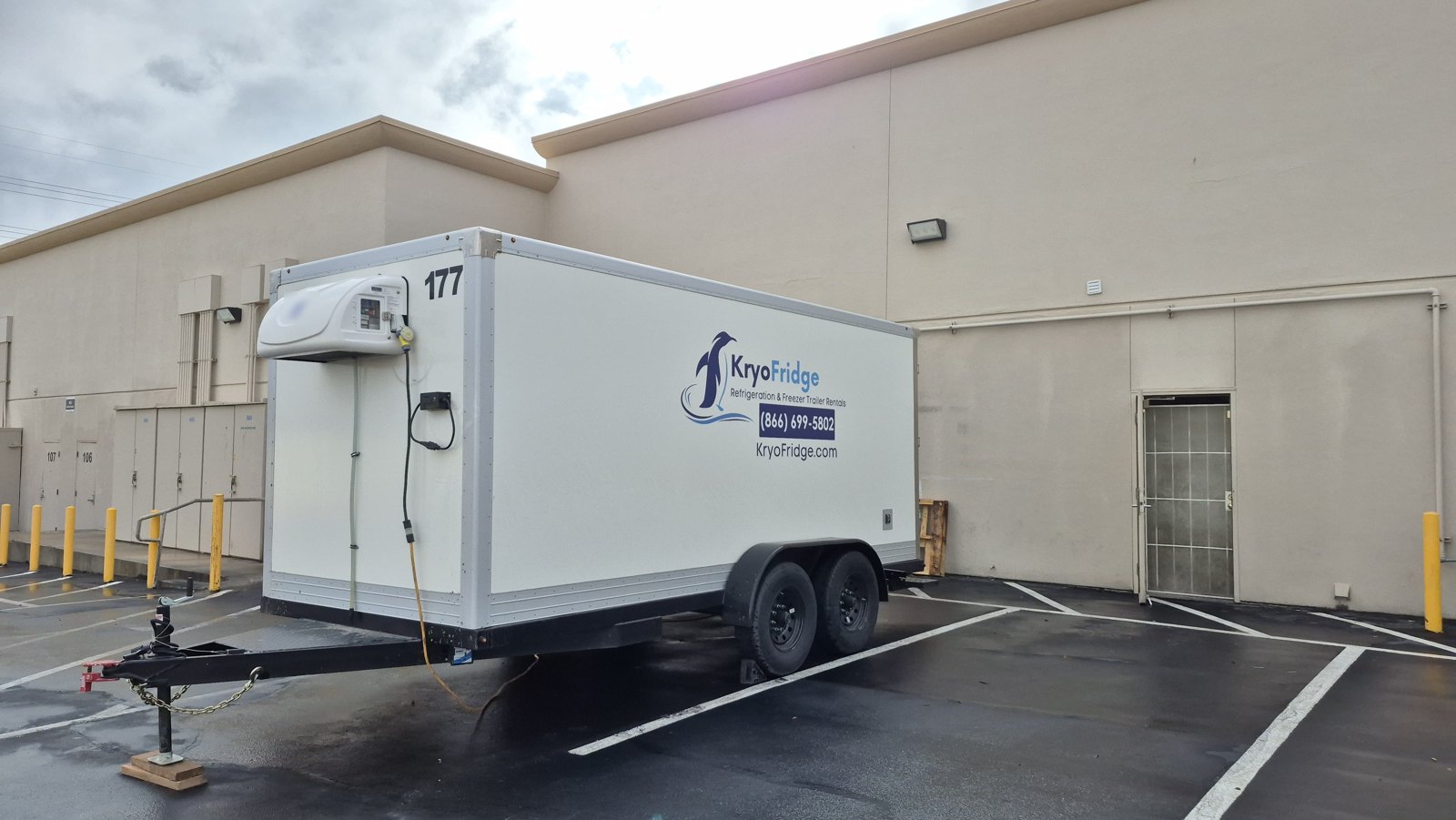
The 16 foot Utility is the unit our dispatchers reach for first on hospital work, and the reason is the third door. Rear double doors take a pallet straight off a standard dock. The side utility door lets a cook pull one case of chicken without opening the whole box to a 98 degree afternoon. On a kitchen running tray line three times a day, that door is the difference between a set point that holds and one that climbs every time somebody needs a tub of dressing.
Inside, the surfaces are NSF approved for direct food contact. The box is sealed and insulated. The floor drains properly. That matters in a hospital, because your state adopted food code inspector looks at a rented unit exactly the way they look at your built in walk in. The digital controller puts the set point in plain view, which is the first thing an inspector asks to see and the first thing your kitchen lead writes on the log sheet.
Getting there is the part facilities teams underestimate. A 16 foot insulated box on a tandem axle needs a flat pad and room for the tow vehicle to swing, and hospital loading zones built in the 1960s were designed for a box truck. Low canopies, tight radii and a dock ramp nobody has measured since the building opened are what actually stop a delivery. We measure before we roll, and we will say honestly if the 6x12 or the 6x8 fits your yard.
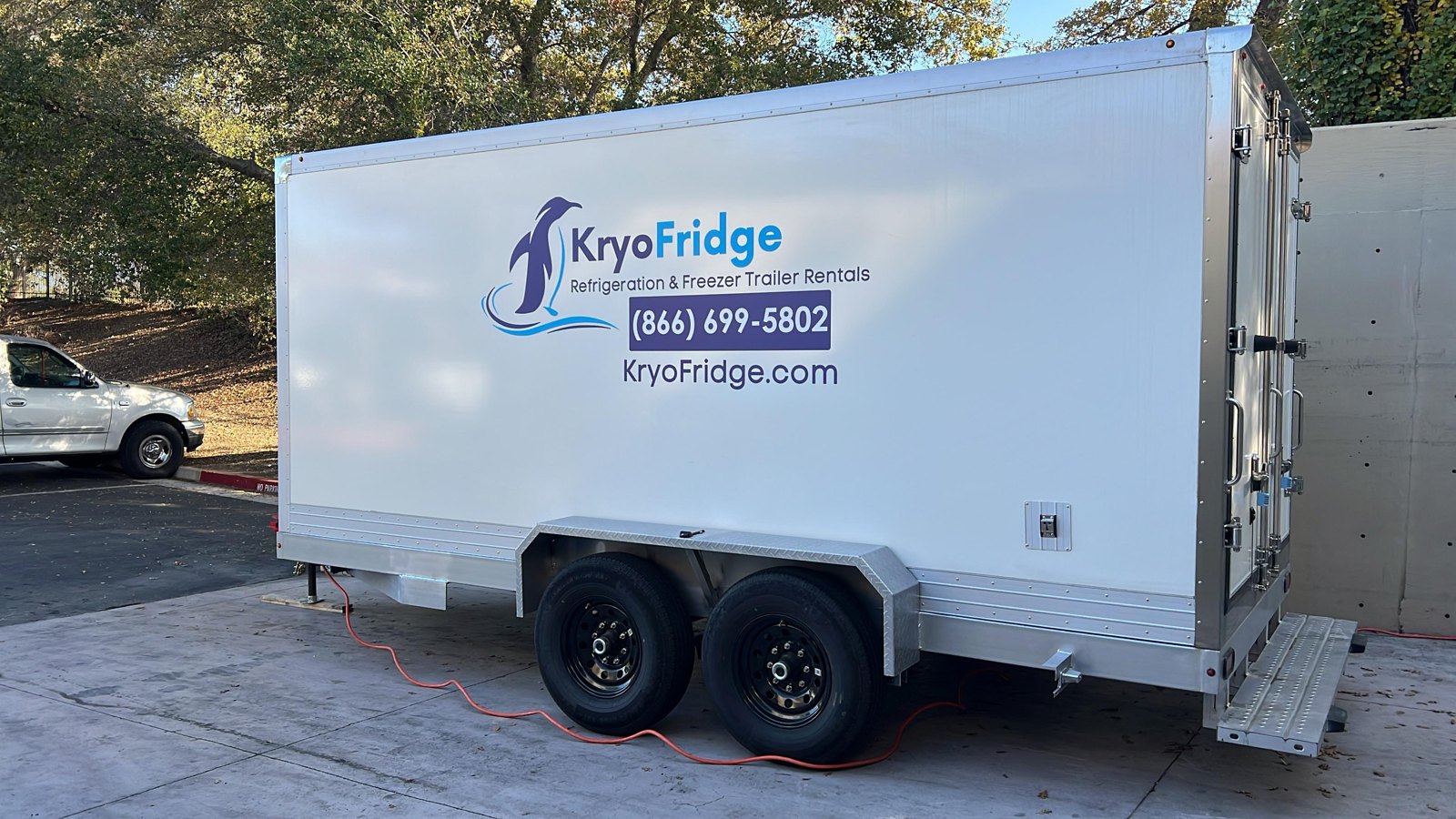
Ask any of our drivers which trailer they would send to a job that cannot fail, and they will point at the 16' Utility. Sixteen feet of insulated box rides on a tandem axle and swings from deep-freeze to fresh-cold on one digital set-point, every interior surface NSF approved. The rear doors swallow pallets off a loading dock while the side utility door gives your staff a quick in and out without dumping the cold air.
Every one of these is ours, not a unit we sourced from somebody else after you called. That means it arrives fueled, already pulled down to temperature, and serviced by our own shop. Plug it into a dedicated 120V, 20-amp circuit or run it on a generator we bring, and it will hold its number through the hottest week of the year.
| Spec | What you get |
|---|---|
| Temperature range | Roughly -10°F deep-freeze up to about 50°F fresh-cold |
| Mode | Dual-purpose: freezer or refrigerator on one precise digital set-point |
| Power | A dedicated 120V, 20-amp circuit within about 100 feet, or a generator we supply |
| Food safety | NSF-approved for direct food contact, food-safe surfaces, proper drainage |
| Footprints | 6x8, 6x12, and 6x16, from a tight retail lot to distribution scale |
| Backing | Owned in-house, fully licensed and insured, with 24/7 emergency dispatch |
Each unit holds a precise digital set-point and runs on a dedicated 120V/20A circuit or a generator. The trailers are not wired for 208 to 240V building service, so we confirm your hookup before the truck rolls.
One call sizes the trailer, sets the delivery window, and locks your quote. Call now, or send the quick quote request and we will call you.
Healthcare calls us for three distinct reasons, and they arrive on completely different clocks. One is a planned capital project somebody scheduled six months ago. One is a compressor that failed ninety minutes ago. One is a forecast. Each one is sized and staged differently.
A built in walk in is sized for a licensed bed count on an ordinary day. It is not sized for its own replacement, and there is almost no redundancy behind it. When a compressor quits in a hospital kitchen, the space next door is clinical space, so there is frequently nowhere in the building rated to put the product. The clock is short. Food safety guidance treats 40 degrees F to 140 degrees F as the zone where bacteria multiply, and roughly four cumulative hours above 41 degrees F writes off most refrigerated inventory.
Diagnosing an aging walk in is not a same day exercise either. Your team has to find the fault, source a part that is rarely on the truck for older refrigeration equipment, and get a qualified technician on site. Hours to days is normal. That gap is the window a rental unit covers.
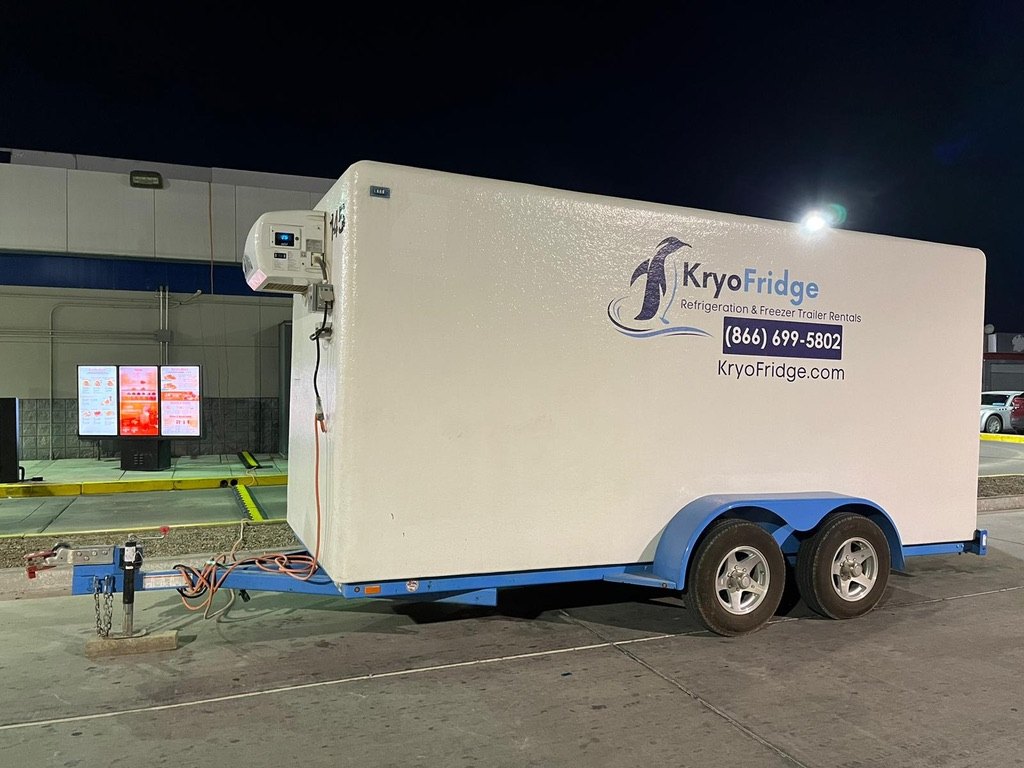
Remodels are the quieter half, and far more common than the emergencies. A full walk in replacement is a planned capital project with a demolition date on a contractor's schedule. What surprises people is how late temporary cold storage enters the conversation. The contract is signed, the date is set, and only then does somebody ask where eight weeks of frozen bulk stock will live. The same pattern drives our temporary cold storage for restaurant remodels work.
What we do differently on a remodel is plan for the doors, not just the cubic feet. A construction zone closes the normal kitchen path, so we walk the route staff will take with a cart, confirm the dedicated 120 volt, 20 amp circuit is within about 100 feet or plan a generator instead, and pick a drop point the demolition crew will not need on week three.
What a hospital generator is wired to carry is narrower than most people outside facilities engineering assume. Under 42 CFR 482.41 the required emergency power scope is the operating, recovery, intensive care and emergency rooms and the stairwells, with battery lamps for other areas. It does not follow that every walk in cooler and nutrition services freezer sits on that branch at full capacity for the full duration of a long outage. Confirming what is and is not on backup, at what fuel burn, is work that happens before the outage.
Two events made that concrete. During the February 2021 Texas grid failure, hospitals ran on their own generators while grid and water supply were cut, facilities without adequate storage were told to transfer inventory elsewhere, and roughly 1,000 vaccine doses were lost. Grocery shelves emptied of bread, milk and eggs because retail refrigeration could not hold through a multi day outage.
The West Coast version repeats on a schedule. During the 2019 California public safety power shutoffs, roughly 800,000 customer accounts, about 2.5 million people, lost power initially, expanding past 3 million by late October. Refrigerators holding insulin and other drugs were named specifically among the equipment people could not run, and one oxygen dependent man died 12 minutes after the outage reached his area on October 11. The utility had more than 30,000 customers in its medical baseline program and, per the public record, used the list only as a contact file.
So we keep units staged and we bring the generator. A dedicated 120 volt, 20 amp circuit within about 100 feet is the simplest hookup and most hospital docks have one, but a supplied generator makes the unit independent of whatever the grid is doing, which is the entire point during a shutoff. These units are not wired for 208 to 240 volt building service, so we confirm your hookup before the truck leaves the yard. Emergency and disaster work travels the furthest of anything we do, and coverage runs to all 50 states.
Long term care kitchens carry a federal meal cadence a hospital kitchen does not. Under 42 CFR 483.60 residents get at least three meals daily at times comparable to when people normally eat, with no more than 14 hours between the evening meal and breakfast, extendable to 16 when a bedtime snack is offered and the resident group agrees. Menus are reviewed by a qualified dietitian. The same section even requires policies for the safe storage and handling of food a visitor brings in. None of that pauses for a failed compressor.
The infrastructure behind those meals is usually thinner than a hospital's. Skilled nursing and assisted living kitchens tend to be smaller and older, with less spare electrical capacity and often no facilities engineer on site around the clock. Many communities contract that role out, which adds hours to an emergency response. About 1.4 million Americans lived in a nursing home as of 2017, and certified communities are surveyed on site about every 12 months.
That survey cadence is why a cold storage failure here is never only an operations problem. 42 CFR 483.25 requires the facility to help residents maintain acceptable parameters of nutritional status and sufficient fluid intake. 42 CFR 483.90 requires an emergency electrical power system adequate for exits, fire systems and life support, and an on premises generator as defined in NFPA 99 wherever life support systems are used. The kitchen sits inside all of that.
Practically, this is where the 6x8 and the 6x12 earn their place. A 96 resident community holding three meals a day plus snacks does not need distribution scale cold storage. It needs the right box set where an aide can reach it without a long outdoor push in the rain. We check the amperage before delivery, because a 1970s community kitchen panel is a real constraint, and we bring a generator when it is not there. The same thinking drives our freezer trailer rentals for schools and universities.
A hospital dock is the busiest hundred feet on the property. Getting a rental unit onto it cleanly is mostly a question of what we ask before the truck rolls.
Delivery timing is driven by your dock schedule, not ours. A hospital loading dock is usually the only truck accessible route into the building, shared with linen, medical waste, pharmacy and general supply in narrow windows. We would rather take a 6 a.m. slot than fight a 10 a.m. supply truck for the same apron. On a true emergency we are moving inside about 45 minutes instead.
Placement is where jobs get won or lost, and the surprise is almost never power. It is clearance and pad. Hospital loading zones carry overhead canopies, low awnings and turning radii built for delivery vans. Add a 16 foot insulated box on a tandem axle and half those approaches stop working. We ask for photos of the intended spot and the access route before every hospital and senior living quote. We also pick a spot that keeps the cart push short, because a unit at the far end of the visitor lot quietly costs your staff an hour a day.
Power gets confirmed before dispatch. There are exactly two ways to run these units: a dedicated 120 volt, 20 amp circuit within about 100 feet, or a generator we supply. A hospital having licensed emergency power on the premises does not mean a spare generator rated outlet sits near the dock, because emergency power is allocated to specific branches by design. The same pre check runs on our cold storage trailer rentals for food banks, where the receiving yard is just as tight and the electrical is usually older.
Pickup is scheduled the way delivery was. Tell us the date the built in walk in comes back online or the remodel clears inspection, and we swing back. If the project slips, and remodels slip, the unit stays.
Powering one of our trailers is refreshingly simple, and there are precisely two ways to do it. Either you have a dedicated 120-volt, 20-amp circuit reachable within roughly 100 feet of the parking spot, or we bring a generator. What the units will not accept is standard 208 to 240V building service, so a quick question about your outlet before dispatch heads off any surprise on delivery day.
On placement, the unit asks for a reasonably flat patch with enough room for the delivery truck to maneuver it in and set it straight, plus either a power source in reach or space for a generator. We lock down the exact drop point on the hospital campus before dispatch, so delivery is one clean trip instead of a guessing game.
On a bad day, booking should be the part that does not add stress. Four steps, an upfront number, and a single person who owns the whole thing.
Tell us whether it is freezer or fridge product, a ballpark volume, and your rough window. That is enough for us to call the right size.
We pair you with a unit, confirm whether you have a dedicated circuit or need a generator, and pin the exact drop point so the truck makes one trip.
We arrive on your schedule, about 45 minutes for a true emergency, set the trailer, energize it, and let it drive down to your number.
It holds the set-point for your entire term while our line stays live the whole way through. Wrap up, and we swing back for the pickup.
Capacity here tracks census and menu, not licensed bed count. Two hospitals with identical bed counts can need very different units depending on how centralized their food production is.
| Scenario | Typical load | Units |
|---|---|---|
| Single walk in cooler down, community hospital | One kitchen's refrigerated stock, 1 to 3 days | 1 unit, 6x12 |
| Walk in freezer replaced during a kitchen remodel | Bulk frozen stock for a 6 to 12 week project | 1 unit, 6x16 Utility |
| Cooler and freezer both out at once | Mixed fresh cold and deep freeze | 2 units, one at 0 degrees F and one near 36 degrees F |
| Skilled nursing community, 80 to 120 residents | Three meals a day plus snacks, 1 to 2 weeks | 1 unit, 6x8 or 6x12 |
| Multi day outage on a health system campus | Kitchen stock plus retail foodservice | 6x16 Utility on a supplied generator |
| Central production kitchen feeding several campuses | Bulk frozen and chilled production stock | 2 to 3 units, led by the 6x16 |
Start with occupied beds, not licensed beds. Meal production tracks census, then add staff and visitor retail foodservice, then add any outside meal program the kitchen produces for, because some systems plate meals for an affiliated senior community out of the same central kitchen. That last item is the one people forget, and it is often the largest block of frozen stock in the building.
Then check what is actually in the box. A straight freezer load at 0 degrees F or below is simple and one unit covers it. A mixed list is the complication. Frozen proteins at 0 degrees F and prepped produce that wants 34 to 38 degrees F cannot share one set point, and the honest answer is a split setup or a second box. Tell us the single coldest item on your list and we dial the unit to that.
The honest default for an unplanned failure is the 6x12. It holds roughly a mid size walk in worth of product and fits most commercial back lots without a site survey. For a remodel running weeks, go up to the 16 foot Utility and use the side door. For a small community kitchen or a pinched service yard, the 6x8 is usually enough cold and far easier to place. Size your emergency plan around your own worst documented outage, not a national average.
Volumes above are working numbers our dispatchers use on the phone, not a guarantee. Tell us the coldest item on your list and roughly how much of it you are holding, and we will size the unit for you before anything is booked.
"Cold" is not one number. Different product stays safe inside different temperature windows, which is the entire reason a precise digital set-point matters. Use this chart the way our dispatchers do when they size a rental.
| Product | Target holding band | Trailer mode |
|---|---|---|
| Ice cream and frozen desserts | -10°F to 0°F | Deep freeze |
| Frozen proteins, seafood, prepared meals | 0°F or below | Freezer |
| Fresh meat and poultry (short hold) | 28°F to 32°F | Refrigerated |
| Dairy, deli, packaged produce | 34°F to 38°F | Refrigerated |
| Beverages, florals, catering trays | 38°F to 45°F | Refrigerated |
One figure matters more than everything in that chart, and it is not listed there: 40°F. Food-safety guidance treats the band between 40°F and 140°F as the zone where bacteria thrive, and the clock on perishable product starts ticking the moment it crosses 40 on the way up. Roughly four cumulative hours above that line and most refrigerated inventory is no longer safe to serve.
Tell us the single coldest item you are holding when you call, and we dial the trailer to that. One unit carries a straight freezer load with no fuss. When your list mixes deep-freeze product with fresh-cold product on the same job, we will usually point you toward a split setup or a second box so neither side of the load has to settle for the wrong temperature.
Our signature 16 foot Utility series leads the fleet. It is the trailer we send on most jobs, and crews like it for the side utility access door. We build three footprints in all, so a single kitchen holding overflow stock has a fit and so does a distribution floor in a disaster. Every unit is dual purpose by design: one adjustable system swings between freezer and refrigerator on a digital set point. Each trailer runs on a dedicated circuit or on a generator.
| Trailer | Best for | Temp range |
|---|---|---|
| 6x16 Utility ⭐ | Our signature series: distribution, large events, disaster response, side utility door | Heavy-duty reefer |
| 6x12 | Grocers, caterers, mid-size events | Deep-freeze capable |
| 6x8 | Tight lots, small kitchens, short overflow | -10°F to 50°F |
Each unit holds a precise digital set-point and runs on a dedicated 120V/20A circuit or a generator.
Think eight or so pallet spots, and the unit to grab when square footage is the whole problem. It slips into the pinched service yards and cramped back-of-house corners that a larger box cannot even swing into. One cafe or small-market walk-in goes down, and this is almost always enough cold to cover it, plus the simplest unit to set in a small space.
Call it fourteen pallet spots, deep-freeze rated, and far and away the size people ask for most. It lands right in the middle: roomy enough for a multi-day catering job or a restaurant that needs true walk-in-equivalent room while the kitchen is torn up. Roomy enough that nobody is playing Tetris with shelves, yet still small enough to set in most commercial back lots without a site survey.
Roughly twenty pallet spots paired with a heavy-duty reefer plant engineered to keep deep-freeze locked in even when the ambient air is merciless. Reach for it when a warehouse bay drops, when a large festival needs an anchor, or when a relief operation is carrying its own cold chain.
Not sure which size fits? Most customers land on the 16 foot Utility, and we will tell you honestly if a smaller footprint covers your job. Tell us roughly what you are storing and for how long, and we will spec it for you.
The licensed facility is always the accountable party. Our job is to deliver equipment that holds the range reliably and to be straight with you about what we do and do not provide.
The most direct federal language sits in 42 CFR 482.41, which requires hospitals to maintain proper ventilation, light and temperature controls in pharmaceutical, food preparation and other appropriate areas. That is about as plain a citation as exists for why a hospital cannot run either area without working cold storage. The same section sets the emergency power scope described earlier and requires Life Safety Code compliance under NFPA 101.
On the planning side, 42 CFR 482.15 for hospitals and 42 CFR 483.73 for long term care use nearly identical language. Both require written policies covering subsistence needs for staff and patients or residents whether everyone leaves the building or stays and shelters in place, naming food, water, medical and pharmaceutical supplies. Both require alternate sources of energy to maintain temperatures that protect the safe storage of provisions, point generator siting and testing at NFPA 99, NFPA 101 and NFPA 110, and require a documented fuel management plan where fuel is kept on site.
For accredited hospitals, The Joint Commission layers utility risk management on top. EC.02.05.01 requires that the hospital manages risks related to its utility systems, and refrigeration is named inside that scope alongside electrical distribution and emergency power. It is reported as one of the most frequently cited standards in surveys, appearing in roughly 58 percent of reviewed surveys. EC.02.05.03 requires an inventory of utility systems, and EC.02.05.07 covers emergency power testing: life safety branch power starts within 10 seconds, monthly generator tests run at least 30 minutes under actual building load, and a 72 hour on site fuel supply is expected.
Two things sit outside the trailer, and we say them up front. Pharmacy cold chain is a different regime than food. Most refrigerated vaccines and biologics run 2 to 8 degrees C, select frozen chain vaccines such as chicken pox and shingles vaccines run near minus 20 degrees C, and a small number need ultra cold storage near minus 70 degrees C, a tier only an estimated 25 to 30 countries could support at scale when it mattered. No rental reefer unit reaches that, ours included. And we supply the food safe, temperature holding hardware, not a logging or alarm monitoring service. Under HACCP monitoring and record keeping principles your food program already keeps dated, signed records, so fold the rental unit into that cadence.
Hospitals maintain proper ventilation, light and temperature controls in pharmaceutical and food preparation areas.
Hospital emergency plans must name alternate energy sources that keep provisions at safe temperatures.
Long term care carries the same subsistence needs and alternate energy duty, citing NFPA 99, 101 and 110.
Three meals daily at comparable times, no more than 14 hours between dinner and breakfast, 16 with a bedtime snack.
The hospital manages risks related to its utility systems, with refrigeration named in scope.
Cold holding at 41 degrees F or below, frozen storage at 0 degrees F or below, as adopted by your state.
NSF approved interior surfaces, a digital set point in plain view, and proper drainage, on every unit we deliver.
One caveat we always state plainly: we supply the food-safe, temperature-holding hardware itself, but we are not a temperature-logging or alarm-monitoring service. If your program requires continuous written records, line that vendor up on your own.
The first reach is almost always coolers and bagged ice, staged in whatever non clinical space is open. It works, briefly. It buys hours, not days, and it converts a facilities problem into a labor problem, because somebody now owns the ice runs and a manual temperature check every 30 to 60 minutes. That is staff attention pulled off patient care during exactly the hours the building is already absorbing whatever caused the failure.
The second reach is shuttling inventory to a sister building in the same system. That works only if the other site has spare capacity, and only if the transport does not break the cold chain on the way. It also pulls a vehicle and a person off their normal assignment for the length of the crisis.
The third outcome is the one every nutrition services and pharmacy manager is trying to avoid, which is discarding product rather than risking it. Thrown out food is a budget line. Thrown out biologic inventory is a supply and patient access problem that can take weeks to replace. And it all runs against a short clock, because four cumulative hours above 41 degrees F is where most refrigerated inventory stops being safe to serve. A pre scouted rental removes all three branches, which is why our refrigerated trailer rentals for stadiums and concessions customers book the same way.
Bars compare the exposure, not the invoice. We never quote a number on a web page, because the right answer depends on the size of the unit and the length of the rental. Call and we will price your job in one conversation.
The call came in after dinner service, which is the worst hour for it, because the fault gets found right as the maintenance bench goes home for the weekend. Nutrition services had a full census and a cooler climbing through the 40s. We staged a 6x12 already pulled toward 36 degrees F, set it at the dock apron on a dedicated circuit the facilities lead had confirmed by phone, and the kitchen moved dairy, proteins and prepped product across in one push. Nothing was discarded.
The built in freezer came out on day one of demolition, which the administrator had planned around, so this was the calm version of the job. We set a 16 foot Utility at the service entrance with the side door facing the kitchen path and ran it on a generator, because the 1970s panel had no spare dedicated circuit. It stayed through a two day schedule slip at the end. Three meals a day ran on the normal clock the whole time.
This one was pre planned, which is the point of telling it. The facilities and plant operations manager scouted a drop point in spring, confirmed there was no spare generator rated outlet near the dock, and pre agreed that we would bring the generator. When the shutoff notice landed, the booking was a four minute phone call. We delivered ahead of the shutoff window, and the hospital's own emergency power stayed dedicated to the branches it is designed to carry.
Yes, and it is one of the most common reasons healthcare calls us. A rental unit sits at the dock and holds your refrigerated or frozen stock for the length of the project. Tell us the demolition date and the expected duration and we will spec the size. Plan it when the construction contract is signed, because that is when the good drop points are still open.
Under the FDA Food Code framework that state and local health departments adopt, frozen storage is 0 degrees F or below, which is minus 18 degrees C, and refrigerated time and temperature control for safety food is held at 41 degrees F or below. Our units carry a digital set point from roughly minus 10 degrees F up to about 50 degrees F, so one box covers either band.
They run on a different temperature regime, and the two should never be treated as interchangeable. Most refrigerated vaccines and biologics sit at 2 to 8 degrees C, roughly 36 to 46 degrees F. Frozen chain vaccines such as chicken pox and shingles vaccines run near minus 20 degrees C. A small number need ultra cold storage near minus 70 degrees C, which no rental reefer unit reaches, ours included.
Our dispatch line runs 24 hours a day and a person answers it. Because our units sit staged, fueled and pre cooled rather than being sourced after the call, an emergency dispatch is normally moving inside about 45 minutes and pulling temperature on your lot the same day. The two things that slow a hospital delivery are clearance on the approach and a power hookup nobody confirmed.
Do not assume it will. 42 CFR 482.41 requires emergency power in the operating, recovery, intensive care and emergency rooms and stairwells, with battery lamps elsewhere, and emergency power under NFPA 99 and NFPA 110 is allocated to specific branches by design. Whether a nutrition services freezer is on that branch, at full capacity, for the length of a long outage, is a question your facilities engineer answers in advance.
There are exactly two ways. A dedicated 120 volt, 20 amp circuit within about 100 feet of where the unit is parked, or a generator we supply. These units are not wired for 208 to 240 volt building service, which surprises people who assume a commercial site can feed anything. We confirm the hookup with your facilities team before dispatch.
No, and we would rather say that plainly than let you find out later. We supply the food safe, temperature holding hardware with a digital set point in plain view. HACCP monitoring and record keeping principles call for dated records signed by the person doing the monitoring, so the best run facilities fold the rental unit into the log cadence they already run.
Yes, and 42 CFR 483.73 effectively expects you to have thought about it beforehand, since it requires written policies covering subsistence needs and alternate sources of energy to keep stored provisions at safe temperatures. We deliver to skilled nursing, assisted living and continuing care campuses, and we bring a generator when the building has no spare dedicated circuit.
Yes. We own the fleet rather than brokering somebody else's, so scaling a job is a dispatch question instead of a sourcing question. A central production kitchen feeding several campuses typically runs two to three units led by the 16 foot Utility. Give us the sites, the loads and the access photos. Coverage runs to all 50 states.
Three pieces we wrote because the same questions come up on the phone every season. One is a planning walkthrough. Another looks at why fall is the hard quarter. The last is a list of questions to ask any cold storage rental company before you sign.
The difference between a four minute booking and a four hour scramble is almost entirely work done months earlier. Start by walking the property with one question in mind. If a truck had to set a 16 foot insulated box somewhere useful tomorrow, where exactly would it go? Write down two spots, because the first will be occupied by a dumpster or a contractor trailer on the day it matters.
Next, measure the approach. Overhead canopy height at the dock apron, the tightest turning radius on the route in, gate width, and whether the pad is load bearing or decorative paving stones. Photograph all of it. Those photos are the most useful thing a facilities manager can email a rental company.
Then answer the power question in writing. Is there a dedicated 120 volt, 20 amp circuit within about 100 feet of either drop point, and is it genuinely dedicated rather than shared with something else already plugged in? If the answer is no, the plan is a generator, and you should know that now rather than at 5 a.m. during a power shutoff.
Further reading: 42 CFR 483.90, long term care physical environment.
Ask a nutrition services director and a pharmacy manager which months worry them and you will hear the same window from both, for different reasons that overlap. August through November stacks four unrelated pressures on the same refrigeration equipment, and none of them cancel each other out.
First, ambient heat. Late summer is when every fixed refrigeration system in the building works hardest to hold its set point, which is also when marginal compressors announce themselves. A unit that limped through spring at 38 degrees F starts drifting on a 104 degree afternoon, and drifting equipment is how most failures begin.
Second, outage risk peaks in the same weeks. On the West Coast, utility driven public safety power shutoffs have recurred essentially every year since 2019. On the Gulf Coast and in the Southeast, hurricane season concentrates multi day outage risk in the same months.
Healthcare buys differently than most of our customers, because three people with three different priorities usually have to agree before a rental happens. These are the questions we would want asked if we were on your side of the table, including the two that make vendors uncomfortable.
Start with ownership. Do you own this equipment or are you brokering it? A reseller in the middle means a longer chain between your emergency and the person who can move a truck. Ask who services the unit and where it sleeps. Then ask what happens at 2 a.m. Does a person answer, or does a queue?
Move to the equipment. What is the full temperature range on a single set point, and can one unit run as a cooler or a freezer? Are the interior surfaces NSF approved for direct food contact? Is the set point visible to an inspector without a phone app? What are the exact power requirements?
The same trailers, dialed in for a different load. These are the operations we cold-store for most often.
We run the same trailers for freezer trailer rentals for Restaurant remodels, refrigerated trailer rentals for Schools and universities, mobile walk in freezer rentals for Food banks, mobile walk in freezer rentals for Stadiums and concessions and refrigeration trailer rentals for Meat processing and hunting season.
Planned kitchen projects that need the walk in replaced without closing the doors.
Campus dining and K through 12 kitchens feeding a fixed population on a fixed schedule.
Distribution operations moving perishable donations through tight receiving yards.
Event day cold storage where the clock is short and the volume arrives all at once.
Seasonal deep freeze capacity that has to appear for a few weeks and then leave.
We deliver nationwide, and we keep crews and staged trailers in the markets below. If your site is somewhere else, call us anyway. We move units.
Our busiest service area markets include cold storage trailer rentals in Fresno, mobile walk in freezer rentals in San Antonio, refrigeration trailer rentals in Austin, freezer trailer rentals in El Paso, refrigerated trailer rentals in Spokane, cold storage trailer rentals in Tacoma, mobile walk in freezer rentals in Salem and refrigeration trailer rentals in Santa Fe, each with its own staged trailers and its own drivers.
Central Valley hospitals and skilled nursing kitchens working through triple digit summers.
A dense medical center footprint with docks built decades before trailer deliveries.
Fast growing health systems and the grid memory of February 2021.
Border region hospitals and long term care communities holding through desert heat.
Regional referral hospitals serving a wide rural catchment with real winter outage risk.
Hospital campuses and senior living communities on tight urban service yards.
State capital health facilities inside the West Coast shutoff and wildfire footprint.
High desert hospitals and care communities a long way from the next spare walk in.
Coverage runs to all fifty states. Emergency work, disaster response, and long-term holds travel the furthest, and the metro markets above are simply where a trailer is closest to your gate on an ordinary Tuesday.
Send the photos of your drop point and the access route, tell us the coldest item on your list, and we will come back with a size, a delivery window and a number. Emergency line answers 24 hours a day, and we deliver to all 50 states.