
KryoFridge rents cold storage trailers to food banks and hunger relief groups in all 50 states, and we own every unit we send. The box arrives already pulled down to your temperature, on a dedicated 120 volt, 20 amp circuit within about a hundred feet or on a generator we bring. Most food bank jobs land on the 16 foot Utility, and we say so honestly when a 6x8 or a 6x12 covers the week. Call 866-699-5802 or send the quote request form and we will size it with you today.
Licensed and insured | Largest Fleet in the West | 30+ Years in the rental business
We have been in the equipment rental business for more than thirty years, and the freezer side of it grew up around places that are not allowed to lose a load. A food bank is the sharpest version. The food is donated, the families are scheduled, and no second truck is coming with the same turkeys. We run one of the largest dual purpose fleets of freezer and refrigeration trailers in the West, we own every unit on it, and no broker sits in the middle marking up somebody else equipment. The same fleet and the same drivers stand behind our freezer trailer rentals in Salem. Call 866-699-5802 and a dispatcher picks up, day or night, or send the quote request form for a size and a delivery window.
One habit this work taught us: ask what is coming in, not what is on the shelf. A restaurant tells us what is in the walk in today. A food bank tells us what the rescue route is bringing this week, then adds the state truck and the turkey drive on top. Size the box to the incoming week and you are not back on the phone Thursday. That is most of the trick to booking refrigeration trailer rentals for this kind of work.
Our trailers sit staged across our yards, fueled, pre-cooled, and maintained in-house, parked and waiting for the call rather than being hunted down after it. That is why an emergency call usually puts a unit on your lot and pulling temperature the same day.
The voice on the phone belongs to the same outfit that owns the trailer and sends the driver. No reseller in the middle quietly marking up somebody else's equipment while your inventory creeps past 40°F on the shelf.
Every unit is ours to own, service, and deliver, and each one swings between deep-freeze and fresh-cold on a precise digital set-point. So we size the answer to the job in front of us and turn it around fast rather than putting you on next week's list.
"Our walk in freezer was already full the Monday the first turkey truck came. The unit was on our lot the next morning at zero degrees and we took every bird that was offered."
"We run a rescue route four days a week and our receiving cooler fills by noon. A second cold box on the dock gave the afternoon pickups somewhere to go while we sorted."
"We stood up a feeding site in a church lot with no working power on the block. They set the unit and started the generator. An hour later we had cold storage where there was none."
References for Food Banks and Hunger Relief available on request.
One box covers both ends of a food bank cold needs, because the temperature is a digital setting you dial rather than two machines you have to rent.
The unit that holds frozen turkeys at ten below zero in November can sit at thirty six degrees in July holding rescued strawberries. Inside is an insulated box with food safe surfaces and proper drainage, approved for direct food contact, which matters when the product is USDA program meat a reviewer may ask about later. The floor takes pallets, with room to keep them off the walls and ceiling the way the federal program rules want USDA Foods stored.
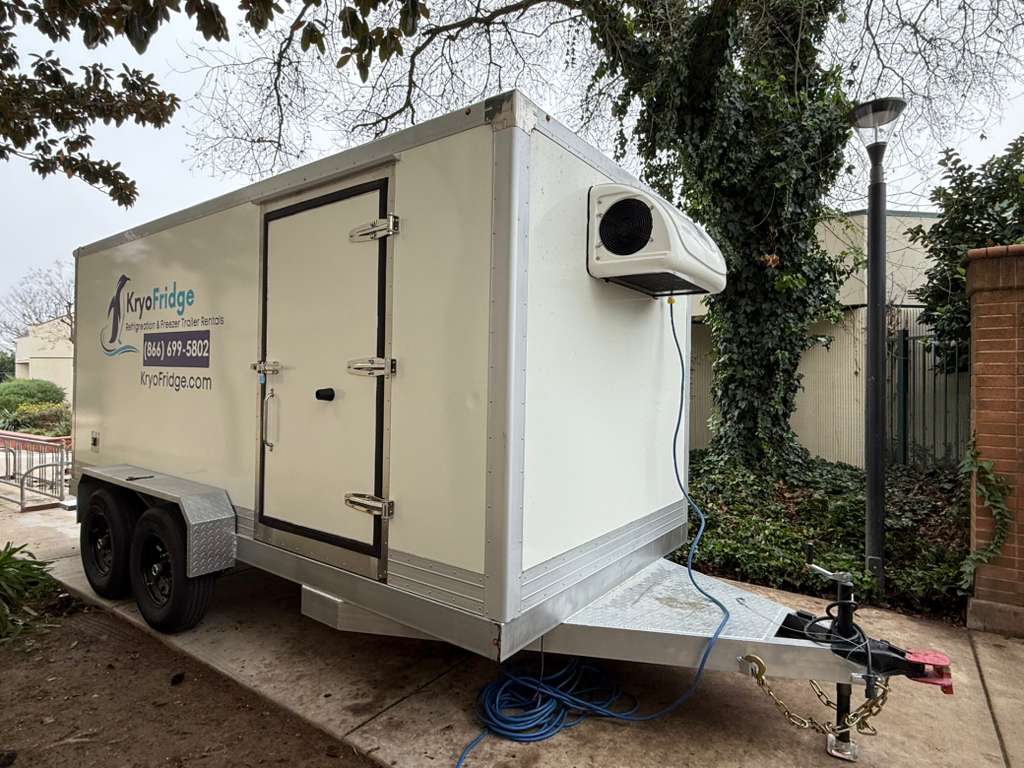
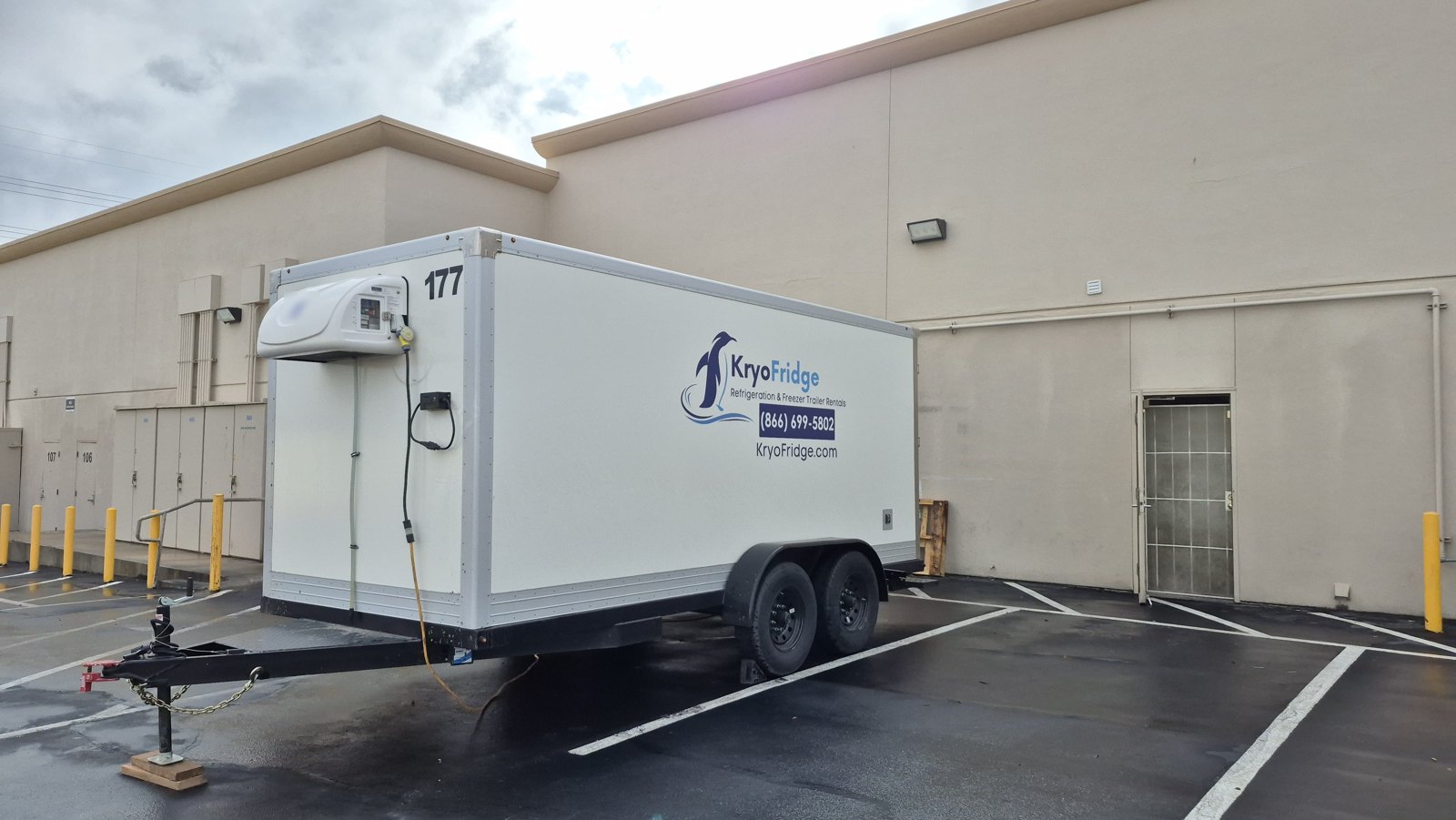
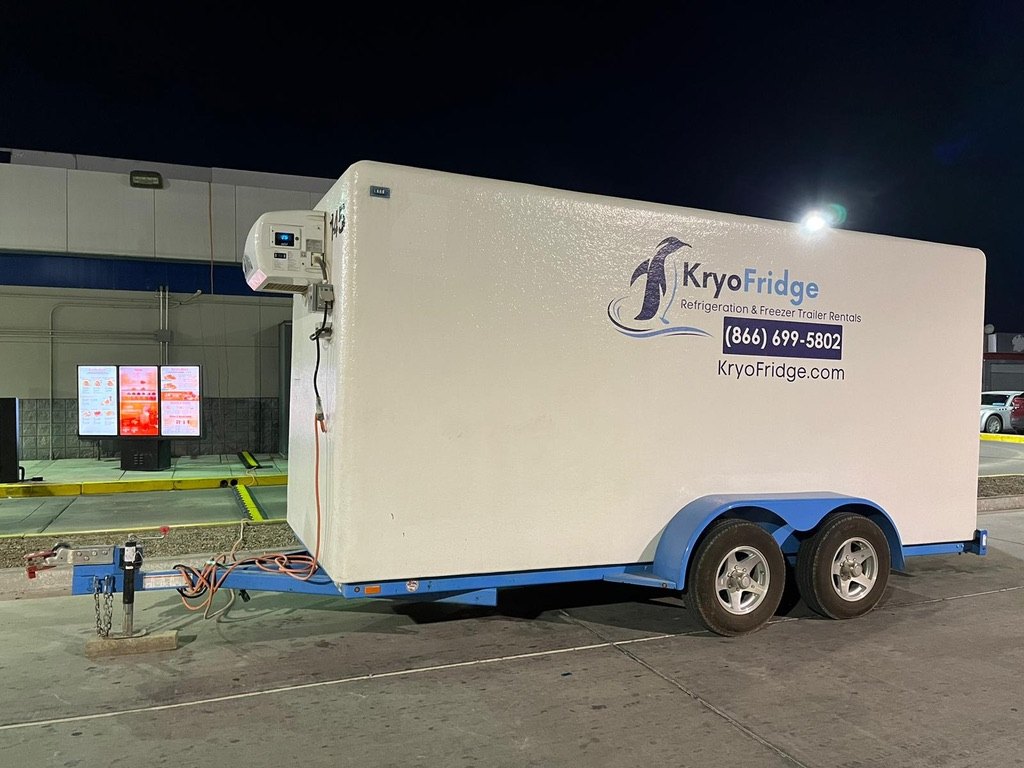
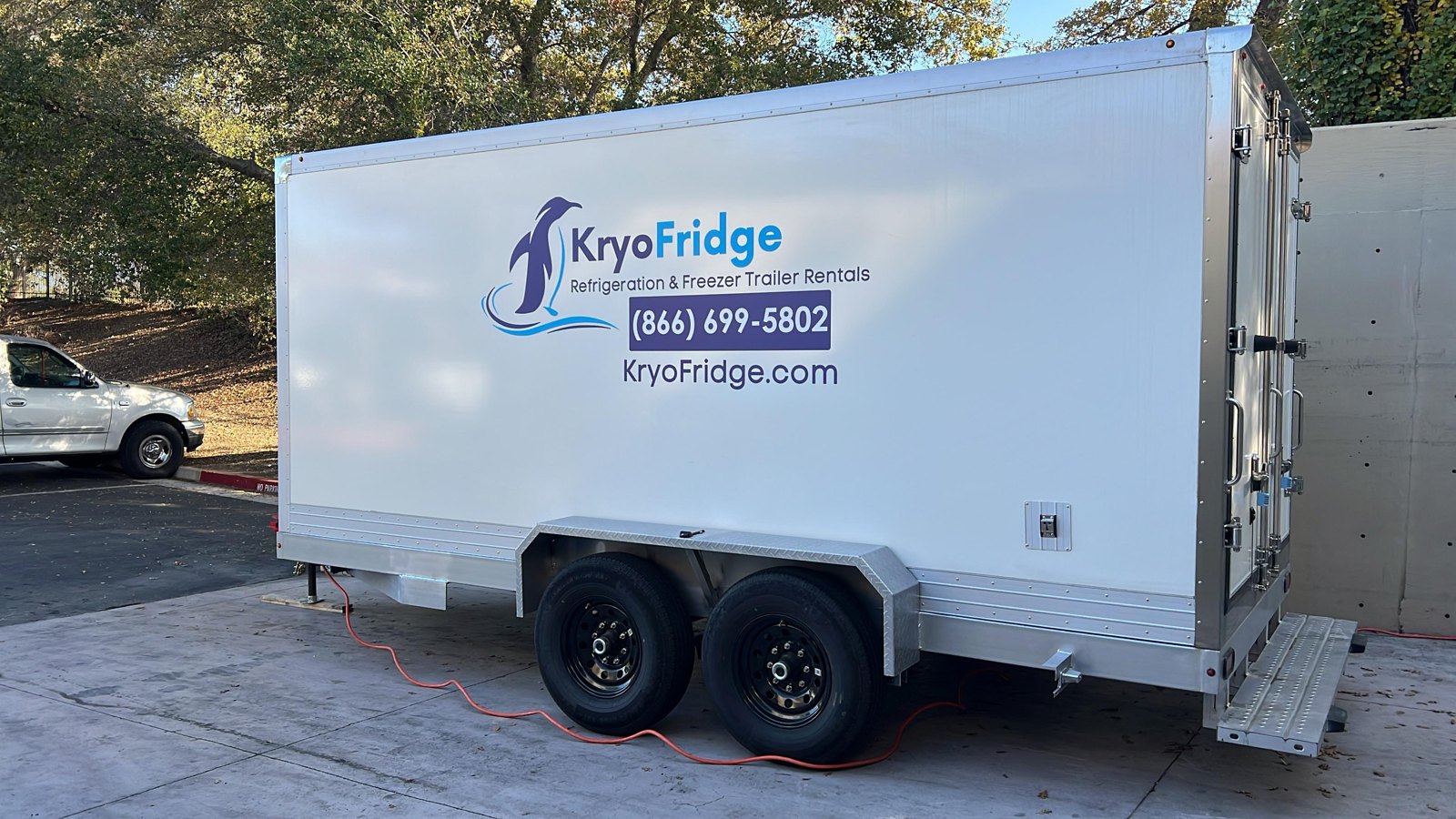
On a food bank lot it looks like a white insulated box on a tandem axle with a cooling unit on the roof and a door at the back. The 16 foot Utility also carries a side utility door, and that matters more here than almost anywhere we deliver, because a volunteer with two cases should not have to walk the length of the box to reach the only way in. It runs at a steady hum, about what a walk in cooler sounds like from ten feet away. On a generator there is engine noise on top, so we stage it away from where families line up.
Getting it to you is one trip. We pull the box down to your temperature at our yard before the truck leaves, so it arrives cold instead of starting to cool on your lot with product waiting on it. The driver sets it level, then we plug into a dedicated 120 volt, 20 amp circuit or run the generator. Food bank yards are rarely built like a stadium dock, so we confirm the drop point with a real person on your end before dispatch.
The 16' Utility is the trailer our crews reach for when the job is serious. A 16-foot insulated box on a tandem axle holds anything from -10°F deep-freeze to 50°F fresh-cold on one precise digital set-point, with NSF-approved surfaces throughout. Rear double doors take pallet loads straight off a dock, and the side utility door lets a cook grab one tray without opening the whole box to the heat.
We own every one of these units, so the trailer that shows up is fueled, pre-cooled, and maintained in-house. It runs on a dedicated 120V, 20-amp circuit or a generator we supply, and it holds its number through triple-digit afternoons. When a walk-in dies or a harvest runs long, this is the box that carries the load.
| Spec | What you get |
|---|---|
| Temperature range | Roughly -10°F deep-freeze up to about 50°F fresh-cold |
| Mode | Dual-purpose: freezer or refrigerator on one precise digital set-point |
| Power | A dedicated 120V, 20-amp circuit within about 100 feet, or a generator we supply |
| Food safety | NSF-approved for direct food contact, food-safe surfaces, proper drainage |
| Footprints | 6x8, 6x12, and 6x16, from a tight retail lot to distribution scale |
| Backing | Owned in-house, fully licensed and insured, with 24/7 emergency dispatch |
Each unit holds a precise digital set-point and runs on a dedicated 120V/20A circuit or a generator. The trailers are not wired for 208 to 240V building service, so we confirm your hookup before the truck rolls.
One call sizes the trailer, sets the delivery window, and locks your quote. Call now, or send the quick quote request and we will call you.
A holiday drive and a rescue route are different problems, and a disaster feeding site is different from both. What they share is cold food arriving at a place that was not built to hold it, on a clock somebody else set.
The one week of the year you can predict almost to the day, and the one most likely to beat your warehouse freezer.
That freezer was sized for year round average flow. A turkey drive is two to three weeks of frozen birds arriving faster than any normal month, then a handful of days when all of it goes back out. Food banks describe being hard pressed to find space to store turkeys at the moment community giving is highest. A second lift follows around Christmas with meal staples instead of birds.
The arithmetic is easy once you count in pallets. A frozen turkey runs twelve to sixteen pounds, and a pallet of cased or shrink wrapped birds carries roughly eight hundred to twelve hundred pounds, so call one pallet fifty to a hundred turkeys. Our 16 foot Utility gives you about twenty pallet spots. The 6x12 runs about fourteen and the 6x8 about eight. A couple thousand birds is twenty to forty pallets of frozen product. Same counting behind our refrigerated trailer rentals for stadiums and concessions.
The failure we see most is not a broken compressor. It is a drive that beat its own goal. Organizers spend their planning on collection, and nobody owns the question of where the food sits between the collection point and the warehouse. Church lots and grocery drop points have a few hours of receiving and no cold storage, so the food bank solves a capacity problem on two days notice.
Here is what we ask about first, and it is not cubic feet. Where the sort line will be, and which way the door should swing, because a box set down backwards costs your volunteers a hundred extra steps per pallet. Whether the lot you are pointing at is the same lot families will stand in on distribution day.
Rescue volume follows the harvest, and it arrives already partway through its shelf life.
A wholesale market with a truckload nobody bought and a grower sitting on a bumper crop both move on the crop schedule, not your receiving plan. Food Forward runs a refrigerated warehouse in Bell, California to catch surplus out of the Los Angeles wholesale produce market, described as putting out tens of thousands of pounds of daily surplus. Fresh Rescue in San Diego runs the same play year round.
Run the numbers. At a conservative twenty thousand pounds a day, a produce recovery operation pushes roughly a hundred and forty thousand pounds a week through cold storage between pickup and pantry. Grocery rescue adds up the same way. One mid size store surplus on an ordinary day runs several hundred pounds of mixed cold and frozen product, so a route across a handful of stores is several thousand pounds before lunch. That is why grocery crews book our refrigerated trailer rentals in Amarillo.
What goes wrong here is a timing collision, not a shortage. The receiving cooler is full at noon from an unrelated donation that landed the same morning, and the afternoon pickup has nowhere cold to go. Now you are choosing between delaying intake, which costs shelf life the produce does not have, or taking it into space that cannot hold it.
Our advice is to treat the rented box as receiving space rather than overflow, set to a cooler temperature instead of a freezer temperature. Most rescue loads want the mid thirties. We ask what the coldest item on the truck is before we dial anything, because a box set for frozen product will freeze the lettuce next to it. When harvest ends and the same group needs frozen holding, it is one dial.
At a staging site the rented unit is not extra capacity. It is the only cold storage on the property.
When the Feeding America network activates for a hurricane or a wildfire, member food banks run mobile distributions into affected communities within days, at sites that were an empty parking lot the week before. The Salvation Army has deployed ninety six mobile feeding units serving more than 2.8 million servings of food and drink in one documented response. Los Angeles area food banks carry standing disaster relief programs as permanent work.
Power is the whole question here. Nothing on a staging lot was a food distribution point before the event, and the grid that would normally run a cooler may be what went down. Some food banks have engineered their warehouses to keep coolers running independent of the grid, which tells you the network already treats power independent cold storage as a requirement. Every unit we send can run off a generator we supply.
There is a gap window at the front of every disaster response, and that is when we get called. A coordinated regional response can eventually stage more than twenty warehouses and over half a million square feet of storage, backed by a national fleet of more than 2,400 trucks. But that is days in. In the first hours a local food bank works with its own fleet and whatever it can rent.
We run dispatch around the clock and a person answers, which is what matters when you are standing in a lot at six in the morning deciding whether the site opens. The questions are short. What is the ground like, and can a truck turn around in there. Then we ask where people will be walking.
A regional warehouse with a real dock is the easy version. A partner pantry in a converted storefront is the one we plan around.
Most of the network is converted retail space and church annexes nobody designed for a delivery truck. The questions there are flat ground and curb clearance, plus somewhere safe to stage a generator in a lot that may double as the distribution line that day. So we confirm placement against the actual site, not the address on the paperwork. Same walkthrough behind our cold storage trailer rentals in Tacoma.
We deliver the day before your first load lands, not the morning of. A box arriving at the same hour as a donation truck means the donation truck waits while we position, and that backs up into the street. Pulling temperature down takes hours, so a unit dropped empty the afternoon before is holding your number by the first pallet.
The most common problem on the day is that the drop spot filled with volunteer parking overnight, so put a cone on it the night before. The next is the circuit. A pantry points at an outlet on the back wall that shares a breaker with the sort room lights, and it trips at the worst hour. We need a dedicated 120 volt, 20 amp circuit within about a hundred feet, and if you do not have one we bring the generator.
Pickup is the easy end. Tell us the last distribution day and we schedule around it, and a drive that runs long gets handled over the phone. Empty the box first, because a unit with product in it either sits another day or gets unloaded onto the asphalt.
Powering one of our trailers is refreshingly simple, and there are precisely two ways to do it. Either you have a dedicated 120-volt, 20-amp circuit reachable within roughly 100 feet of the parking spot, or we bring a generator. What the units will not accept is standard 208 to 240V building service, so a quick question about your outlet before dispatch heads off any surprise on delivery day.
On placement, the unit asks for a reasonably flat patch with enough room for the delivery truck to maneuver it in and set it straight, plus either a power source in reach or space for a generator. We lock down the exact drop point on the distribution site before dispatch, so delivery is one clean trip instead of a guessing game.
On a bad day, booking should be the part that does not add stress. Four steps, an upfront number, and a single person who owns the whole thing.
Tell us whether it is freezer or fridge product, a ballpark volume, and your rough window. That is enough for us to call the right size.
We pair you with a unit, confirm whether you have a dedicated circuit or need a generator, and pin the exact drop point so the truck makes one trip.
We arrive on your schedule, about 45 minutes for a true emergency, set the trailer, energize it, and let it drive down to your number.
It holds the set-point for your entire term while our line stays live the whole way through. Wrap up, and we swing back for the pickup.
Everything here comes back to pallet spots, because that is how food moves through a food bank and how the federal program rules want it stored. Think of each size as a mobile walk in freezer rental built for a different week.
| Scenario | Typical load | Units |
|---|---|---|
| Partner pantry taking one cold donation | A few pallets held up to a week | 1 unit, 6x8 |
| Grocery rescue route across a handful of stores | Several thousand pounds of mixed cold and frozen a day | 1 unit, 6x12 |
| Produce rescue hub in harvest weeks | Daily intake held one to three days at cooler temperature | 6x16 Utility |
| Turkey drive, about 1,000 birds | Roughly 12,000 to 16,000 pounds frozen, two to three weeks | 1 unit, 6x16 Utility |
| Turkey drive, 2,500 birds or more | Twenty to forty pallets of frozen product | 2 units led by the 6x16 |
| Disaster feeding site with no building | Whatever arrives from outside the affected area | 6x16 Utility on a generator |
| Bridge while a grant funded freezer gets built | Baseline frozen stock, several months | 1 to 2 units, 6x16 |
Start with the pallet. A pallet of cased frozen turkeys carries eight hundred to twelve hundred pounds, and a bird runs twelve to sixteen pounds, so one pallet is fifty to a hundred birds. Our footprints run about eight pallet spots in the 6x8 and about fourteen in the 6x12. The 16 foot Utility gives you roughly twenty. A two thousand bird drive is twenty to forty pallets, so one Utility if the birds move out in waves and two if they all sit.
Two things move that number. First is clearance. USDA Foods sit on pallets or shelving with six inches of open air from the floor and walls and two feet under the ceiling, so a pallet spot is not a floor to roof stack and usable capacity is lower than a cubic figure suggests. Second is whether one box holds two kinds of product, because a unit dialed for frozen meat will freeze rescued produce beside it.
The honest default is the 16 foot Utility. One caution about the numbers you find while searching. The figures that come up most often are shipping container specs, a twenty foot reefer container holding eight to twelve standard pallets at around a thousand cubic feet, measured for a box that arrives on a crane. Ours is a road legal trailer we tow into a church lot and plug in that afternoon.
Volumes above are working numbers our dispatchers use on the phone, not a guarantee. Tell us the coldest item on your list and roughly how much of it you are holding, and we will size the unit for you before anything is booked.
"Cold" is not one number. Different product stays safe inside different temperature windows, which is the entire reason a precise digital set-point matters. Use this chart the way our dispatchers do when they size a rental.
| Product | Target holding band | Trailer mode |
|---|---|---|
| Ice cream and frozen desserts | -10°F to 0°F | Deep freeze |
| Frozen proteins, seafood, prepared meals | 0°F or below | Freezer |
| Fresh meat and poultry (short hold) | 28°F to 32°F | Refrigerated |
| Dairy, deli, packaged produce | 34°F to 38°F | Refrigerated |
| Beverages, florals, catering trays | 38°F to 45°F | Refrigerated |
One figure matters more than everything in that chart, and it is not listed there: 40°F. Food-safety guidance treats the band between 40°F and 140°F as the zone where bacteria thrive, and the clock on perishable product starts ticking the moment it crosses 40 on the way up. Roughly four cumulative hours above that line and most refrigerated inventory is no longer safe to serve.
Tell us the single coldest item you are holding when you call, and we dial the trailer to that. One unit carries a straight freezer load with no fuss. When your list mixes deep-freeze product with fresh-cold product on the same job, we will usually point you toward a split setup or a second box so neither side of the load has to settle for the wrong temperature.
Our signature 16 foot Utility series leads the fleet. It is the trailer we send on most jobs, and crews like it for the side utility access door. We build three footprints in all, so a single kitchen holding overflow stock has a fit and so does a distribution floor in a disaster. Every unit is dual purpose by design: one adjustable system swings between freezer and refrigerator on a digital set point. Each trailer runs on a dedicated circuit or on a generator.
| Trailer | Best for | Temp range |
|---|---|---|
| 6x16 Utility ⭐ | Our signature series: distribution, large events, disaster response, side utility door | Heavy-duty reefer |
| 6x12 | Grocers, caterers, mid-size events | Deep-freeze capable |
| 6x8 | Tight lots, small kitchens, short overflow | -10°F to 50°F |
Each unit holds a precise digital set-point and runs on a dedicated 120V/20A circuit or a generator.
Think eight or so pallet spots, and the unit to grab when square footage is the whole problem. It slips into the pinched service yards and cramped back-of-house corners that a larger box cannot even swing into. One cafe or small-market walk-in goes down, and this is almost always enough cold to cover it, plus the simplest unit to set in a small space.
Call it fourteen pallet spots, deep-freeze rated, and far and away the size people ask for most. It lands right in the middle: roomy enough for a multi-day catering job or a restaurant that needs true walk-in-equivalent room while the kitchen is torn up. Roomy enough that nobody is playing Tetris with shelves, yet still small enough to set in most commercial back lots without a site survey.
Roughly twenty pallet spots paired with a heavy-duty reefer plant engineered to keep deep-freeze locked in even when the ambient air is merciless. Reach for it when a warehouse bay drops, when a large festival needs an anchor, or when a relief operation is carrying its own cold chain.
Not sure which size fits? Most customers land on the 16 foot Utility, and we will tell you honestly if a smaller footprint covers your job. Tell us roughly what you are storing and for how long, and we will spec it for you.
Donated food carries the same risk as purchased food, and this sector is already audited on how it holds it.
The Emergency Food Assistance Program, TEFAP, channels USDA commodity foods through state agencies to food banks and their partner agencies, and it carries written storage rules. Recipient agencies have to protect USDA Foods against theft or loss and keep proper temperature and ventilation. Product goes on pallets or shelving with six inches of clearance from the floor and walls and two feet from the ceiling. That wording shapes how a rented box gets loaded as much as what temperature it runs.
Temperature records are the other half. Entities storing USDA Foods are expected to take and record temperatures in every storage area, and dry storage above 85 degrees is flagged as a finding in a state administrative review. This network already runs on a written log with a real audit behind it. Our unit holds a precise digital temperature setting and gives staff one reading to take instead of a dozen scattered household refrigerators. The log stays your own practice on your own form. We do not sell a monitoring service or a high temperature alarm service, and we say so on the phone.
Underneath sits the cold holding standard every food handler works to. The FDA Food Code treats the band between 41 and 135 degrees as the range where bacteria can double about every twenty minutes, and most donated meat and dairy falls under time and temperature control for safety. A family receiving a donated turkey is owed the same cold chain a paying grocery customer gets.
Local authority stays in force the whole time. TEFAP folds in the requirement that recipient agencies comply with the food safety rules that apply to them at every level of government and obtain required health inspections, so a rented unit on your lot is part of your operation for inspection. Local rules on fire lane clearance and on how long temporary equipment can sit vary by county, so call your health department early.
Store USDA Foods on pallets or shelving with six inches of clearance from floor and walls and two feet from the ceiling. Keep air moving and hold the right temperature.
Take and record temperatures in every storage area. Dry storage above 85 degrees is a finding in a state administrative review.
Hold time and temperature control for safety foods at or below 41 degrees, out of the 41 to 135 degree range where bacteria multiply fastest.
The state agency that administers TEFAP where you operate runs the administrative review that checks storage and temperature in practice.
TEFAP requires recipient agencies to meet the food safety rules that apply to them at every level of government and to obtain required inspections.
Equipment grants that fund refrigeration and freezer trailers generally cannot reimburse costs already incurred, so arrange the rental inside the grant window.
A rented unit loaded the way a reviewer wants to see it. Pallets up off the floor, with open space left under the ceiling.
One caveat we always state plainly: we supply the food-safe, temperature-holding hardware itself, but we are not a temperature-logging or alarm-monitoring service. If your program requires continuous written records, line that vendor up on your own.
The most commonly documented outcome is the plainest one. You turn the donation away. Feeding America West Michigan publicly reported declining 250,000 pounds of frozen food in one year and 400,000 pounds the year before, purely for lack of cold space, before it built an 18,810 cubic foot freezer expansion. That is 650,000 pounds of food that was offered and never reached a family. At the 45,000 pound figure Feeding America cited when a carrier donated a fifty three foot refrigerated trailer, that is between five and a half and nine full trailer loads at one organization.
The two habits that fill the gap are not better. One is improvising with household style refrigerators that cannot legitimately hold time and temperature control food at 41 degrees for long. The other is pushing the surplus back out the door with no cold holding, which moves the risk onto the family at the end of the line. Neither produces the defensible temperature record a mechanical unit makes possible. Same reasoning behind our freezer trailer rentals for schools and universities.
Then there is the part nobody puts in a report. A donor told no once tends not to call twice. A grocery chain that hears you have no room routes the next pallet elsewhere, and a rescue route arriving to a full cooler stops being worth the driver time. Capacity decides whether the supply line still points at you next year.
Bars compare the exposure, not the invoice. We never quote a number on a web page, because the right answer depends on the size of the unit and the length of the rental. Call and we will price your job in one conversation.
The warehouse freezer was at working capacity by the first Monday and two corporate collection points had already beaten their goals. The logistics director called Tuesday with a number he trusted, about twenty eight hundred birds. We put a 16 foot Utility on the lot Wednesday morning at zero degrees, then a second one the following Monday when a grocery donation landed early. Both went in beside the dock, doors facing the sort line. Nothing was declined.
A recovery program running four pickup days a week hit a week where a grower cleared a field early and the wholesale market had a load nobody bought. Their cooler was full before lunch on day one. We set a 6x12 at thirty six degrees on the dock apron and it became the receiving space, not the overflow. Afternoon pickups went straight in and sorting happened the next morning. They flipped it to a freezer setting in November.
An emergency services coordinator needed a distribution point standing up in two days, in a neighborhood where the grid was still down. The lot had no building access and no working circuit anywhere on the property. We delivered a 16 foot Utility on a generator, set it at the far end away from the path families would walk, and started it before the first donation truck arrived. It was the only cold storage on that site for eleven days.
TEFAP requires recipient agencies to maintain proper temperature and ventilation for USDA Foods and to store them on pallets or shelving with six inches of clearance from the floor and walls and two feet from the ceiling. Underneath sits the FDA Food Code cold holding standard, at or below 41 degrees. Our units run from about 50 degrees down to ten below, so one box covers either job.
Count pallets rather than birds. A pallet of cased turkeys carries roughly eight hundred to twelve hundred pounds, and a bird runs twelve to sixteen pounds, so one pallet is about fifty to a hundred turkeys. The 16 foot Utility gives you roughly twenty pallet spots, on the order of a thousand to two thousand birds. Leave the clearance the program rules ask for and plan under the theoretical maximum.
Yes. There are exactly two ways to power our units. One is a dedicated 120 volt, 20 amp circuit within about a hundred feet. The other is a generator we supply and set up with the unit. At a staging site with no building and no working grid, the generator is the normal choice, and it is why a rented box can be the only cold storage on that lot.
Most holiday drives land on the 16 foot Utility. A drive expecting around a thousand birds fits one unit comfortably. A drive expecting twenty five hundred or more usually wants a second box, especially if the birds sit until one distribution day. Give us your count and your dates and we will size it with you, and we will say so honestly when a 6x12 covers the week.
Cold chain grant programs are written to fund refrigeration and freezer equipment, including refrigerated or freezer vehicles, and a rental is commonly treated as a legitimate line item. Read your award terms on one point. These programs generally do not reimburse costs already incurred, so arrange the rental inside the grant window. We can provide the documentation your grants staff needs.
No, and we would rather say that plainly than let you plan around it. We do not offer a remote monitoring service or a high temperature alarm service, and we do not keep the log for you. What the unit provides is a precise digital temperature setting that holds where you put it, and one piece of equipment for staff to read instead of a dozen scattered refrigerators. The record keeping stays your own practice, which is how TEFAP expects it.
It can, and that is often the better design. The smallest agencies in a network frequently have one household style refrigerator, so a large cold donation pushed down to them turns into waste rather than meals. Holding the surge centrally and distributing portions each agency can actually store is what gets the food to families. Plan the handoff before the donation lands.
It depends on your city and county, and the answer is worth getting in writing before delivery. Local rules can cover how long temporary equipment may sit on a commercial lot and where a generator can be placed. Call your health department and your fire marshal early and plan as if the strictest applicable rule governs. We will give you the footprint and the power requirement.
Three pieces we wrote because the same questions come back every fall. One walks a turkey drive from the planning meeting to pickup. One maps what the food bank year does to cold storage. The last is for the staffer holding a grant award and a contractor who is running late.
Start at the distribution date and work backward, because it is the only fixed point. Donations arrive early when a grocery partner clears a freezer and late when a corporate drive extends its deadline. Put the distribution days on the wall first, then mark the first day product can arrive. The space between those marks is how many days of frozen holding you need, and it is longer than people guess.
Next, convert your goal into pallets instead of birds. A pallet of cased frozen turkeys carries eight hundred to twelve hundred pounds, which is fifty to a hundred birds depending on how volunteers build it. Take your goal and divide, then add a third, because drives beat their goals more often than they miss. Fifteen hundred birds is fifteen to thirty pallets before the cushion, and your own freezer rarely frees up the whole room.
Now walk the lot. Pick the drop spot before you book anything and photograph it from the street, because whoever quotes your rental needs to see the approach. Look for the turn a truck has to make and the branch over the lane, then decide which way the door should face relative to your sort line. If the only candidate circuit shares a breaker with the sort room lights, plan on a generator.
Further reading: Feeding America on Thanksgiving turkey donations.
Late winter and early spring are the quiet months for frozen holding and the loud months for planning. Grant cycles open and close, and last November is still fresh enough that somebody remembers how short the freezer ran. It is the cheapest time of year to fix a capacity problem, and also when it feels least urgent, which is why it survives into the next holiday season untouched.
Spring into summer belongs to produce. Recovery volume tracks harvest timing rather than the calendar year, so a cold storage need can appear in the middle of June with no holiday anywhere near it. A grower clearing a field early creates a week of intake that has nothing to do with your averages. This is cooler work in the mid thirties, measured in days rather than weeks.
Summer and fall carry the disaster risk. Hurricane season on the Gulf and Atlantic runs roughly June through November, and wildfire season on the West Coast has stretched across spring through fall. Neither is scheduled, but both are seasonal enough to plan for. A feeding site in a parking lot has no walk in, so its only cold storage is whatever arrives on wheels with its own power.
There is a gap almost nobody budgets for: the months between an awarded cold chain grant and a freezer that actually holds temperature. Capital funding moves on application cycles and construction moves on contractor schedules, and neither lines up with the week a donation truck shows up. Organizations get through the award and then discover the easy part has a schedule of its own.
Read the award terms for two things. One is what the funds can pay for. Cold chain grant programs are commonly written to cover refrigeration and freezer equipment, including refrigerated or freezer vehicles. The other is timing. These programs generally do not reimburse costs already incurred, so arrange the rental inside the window and keep the paperwork with the grant file.
Size a bridge unit differently than a surge unit. A holiday rental is sized to a peak. A bridge rental is sized to your baseline, the frozen stock that has to live somewhere every week while the new room is unfinished. That is usually one 16 foot Utility, so the existing walk in stays free to absorb whatever comes through the door. Month to month is the right shape, because construction dates move.
The same trailers, dialed in for a different load. These are the operations we cold-store for most often.
We run the same trailers for cold storage trailer rentals for Schools and universities, refrigerated trailer rentals for Hospitals and healthcare, freezer trailer rentals for Stadiums and concessions, mobile walk in freezer rentals for Restaurant remodels and refrigeration trailer rentals for Meat processing and hunting season.
Summer kitchen projects and meal programs that cannot pause while the walk in is out.
Kitchens on a census clock where meal service is not allowed to stop.
Event day cold storage where a whole weekend of product arrives in one delivery.
Planned kitchen jobs that need the walk in replaced without closing the doors.
Seasonal deep freeze capacity that shows up for a few weeks and then leaves.
We deliver nationwide, and we keep crews and staged trailers in the markets below. If your site is somewhere else, call us anyway. We move units.
Our busiest service area markets include mobile walk in freezer rentals in Salem, mobile walk in freezer rentals in Tacoma, refrigeration trailer rentals in Amarillo, cold storage trailer rentals in Vancouver, refrigerated trailer rentals in Brownsville and freezer trailer rentals in Peoria, each with its own staged trailers and its own drivers.
A farm valley where produce recovery and pantry distribution share one harvest calendar.
Dense pantry networks working out of shared church and community center lots.
Long distances between partner agencies, which makes central cold holding matter more.
Wildfire season staging and a steady grocery rescue route through one warehouse.
Border region produce volume and hurricane season feeding sites in the same year.
Triple digit summers that shrink the safe window on every cold donation.
Coverage runs to all fifty states. Emergency work, disaster response, and long-term holds travel the furthest, and the metro markets above are simply where a trailer is closest to your gate on an ordinary Tuesday.
Tell us what is coming in this week and when it goes back out, then send a photo of the drop spot. We will come back with a size and a delivery window. Dispatch answers twenty four hours a day, and we bring the generator if your lot has no circuit.